

The point.
- A redundancy package is four parts stacked into one number: statutory pay, an enhanced top-up, notice pay, and unused holiday. Notice and holiday sit on top, not inside.
- Your statutory floor is yours by law and never traded away in a negotiation. Everything above it is up for discussion.
- The floor and the tax treatment vary wildly by country. The same six-year worker walks away with a €4,500 floor in France and a €12,000 negotiated norm in Germany.
- Your whole payment is not automatically tax-free, and the tax-free slice changes by country: Ireland and France exempt the statutory amount, the Netherlands taxes the lot, and Britain shields the first £30,000.
- Germany gives no automatic right to a payout, so the severance is usually negotiated, and you never have to sign the first settlement offer.
The point.
- A redundancy package is four parts stacked into one number: statutory pay, an enhanced top-up, notice pay, and unused holiday. Notice and holiday sit on top, not inside.
- Your statutory floor is yours by law and never traded away in a negotiation. Everything above it is up for discussion.
- The floor and the tax treatment vary wildly by country. The same six-year worker walks away with a €4,500 floor in France and a €12,000 negotiated norm in Germany.
- Your whole payment is not automatically tax-free, and the tax-free slice changes by country: Ireland and France exempt the statutory amount, the Netherlands taxes the lot, and Britain shields the first £30,000.
- Germany gives no automatic right to a payout, so the severance is usually negotiated, and you never have to sign the first settlement offer.
Someone hands you a redundancy offer. There’s a number on the page, a few paragraphs of legal wording, and a quiet dread that you’re about to sign something you don’t really understand. You also get a deadline.
So here are redundancy packages explained in one simple idea. A package is a stack, not a single number. Part of that stack is yours by law, whatever anyone offers you. The rest is up for negotiation. Once you can tell those two parts apart, you can read your own offer like a grown-up.
One quick thing first. Redundancy means you lose your job because the role is gone, not because you did anything wrong. That matters. It’s what triggers the payments below.
What goes into a redundancy package?
A package bundles four things into one figure. Employers love to quote a single headline number and let you assume it covers everything. It often doesn’t. A redundancy package includes four parts:
- Statutory payment: the legal minimum, set by law, that the employer must pay.
- Enhanced or ex-gratia top-up: extra they add by goodwill, on top of the legal minimum.
- Notice pay: pay for your notice period, often handed over as a lump sum.
- Unused holiday: any holiday you didn’t take, paid out in cash.
Do notice pay and holiday count inside the figure?
No. Notice pay and unused holiday sit separate from the redundancy figure. You keep them on top. So when someone quotes one number and calls it your “package”, ask straight away: does that include my notice and my holiday, or do those come extra?
How much is mine by law, and how is it worked out?
Meet your floor. It’s the legal minimum nobody can talk you below, your walk-away baseline, the one figure you never trade away in a negotiation. Each country works it out differently, so find your own market below.
In Ireland, the statutory redundancy lump sum (opens in new tab) is two weeks’ pay for every year you worked, plus one bonus week. You need at least two years of service to qualify. The pay used is capped at €600 a week (€31,200 a year), so if you earn more, the extra drops out of the sum. Take six years on €600 a week. That gives (2 × 6 + 1) × €600 = 13 weeks, so €7,800, and it lands tax-free.
Britain bands the statutory payment by age (opens in new tab). You get half a week’s pay per year worked while under 22, one week’s pay per year between 22 and 40, and one and a half weeks’ pay per year from 41 onwards. Service counts up to 20 years. Your weekly pay is capped at £751, so the most statutory pay can reach is £22,530. A 35-year-old with six years of service on £600 a week gets 6 × 1 week × £600 = £3,600. You also get statutory notice on top, which grows with how long you’ve worked there.
In France, the indemnité légale de licenciement (opens in new tab), the statutory dismissal pay, pays a quarter of a month’s salary per year for the first ten years, then a third of a month per year after that. You qualify after eight months with the same employer. Six years on €3,000 a month works out at a quarter × 6 × €3,000 = €4,500.
In Spain, redundancy on business grounds (a despido objetivo, a dismissal for company reasons) pays 20 days’ salary per year worked (opens in new tab), capped at 12 months’ pay. Six years on €2,000 a month gives 120 days, four months’ salary, so €8,000. If a court later rules the dismissal unfair, the rate climbs to 33 days a year.
In the Netherlands, take Bram in Rotterdam, six years at the same firm on €3,000 a month. His transitievergoeding (opens in new tab), the transition payment, pays a third of a month’s salary per year and counts from his very first day of work: a third × 6 × €3,000 = €6,000 before any tax comes off (the “gross” figure). He sees that number and feels relieved, then remembers the Dutch catch. Hold that gross figure in mind. The Dutch tax treatment does something the others don’t.
Why does Germany have no automatic floor?
Germany gives no automatic right to a payout. German law protects hard against the dismissal itself. A severance (an Abfindung) usually shows up through a negotiated deal, a works-council agreement, or a court settlement. There is one exception, and it is narrow. Germany’s dismissal-protection law (the Kündigungsschutzgesetz) lets an employer dismissing you on business grounds write into the dismissal letter itself that you will get half a month’s pay per year of service if you do not challenge the dismissal. The money then falls due when your notice period ends. If that paragraph is not in your letter, the entitlement does not exist, and doing nothing pays you nothing.
The three-week clock is the dangerous part, whichever letter you got. Miss it and the dismissal counts as valid from the outset, so the claim is gone for good. Most German severance is won by filing in time and settling, not by waiting. Read the letter, then take advice inside the three weeks.
That half-a-month-per-year figure is also the usual negotiating benchmark, and it is where most German severance talks start. Take Sophie, six years at a Munich company on €4,000 a month: half a month per year would put her Abfindung at 0.5 × 6 × €4,000 = €12,000. But unless her employer offers the section 1a route, nobody is legally obliged to pay Sophie a cent, so the sum is hers to negotiate.
Rather than do the sums in the margin of the offer letter, put your own country, years and pay into our statutory redundancy calculator. It works out your statutory floor, or in Germany the usual negotiated figure, so you have one number to hold any offer against.
How does redundancy pay differ across Europe?
There’s no single European redundancy payment. The European Union sets only the minimum process for big lay-offs (opens in new tab): who must be consulted, who must be told, and a 30-day waiting period before collective lay-offs take effect. The amounts and the notice stay national. Two people doing the same job in two countries can walk away with wildly different deals.
The chart below runs one worker through all five systems, on €3,000 a month with six years in, so the bars are genuinely comparable. The worked examples further down use each country’s own typical salary instead, which is why the Spanish and German figures there do not match the bars here.
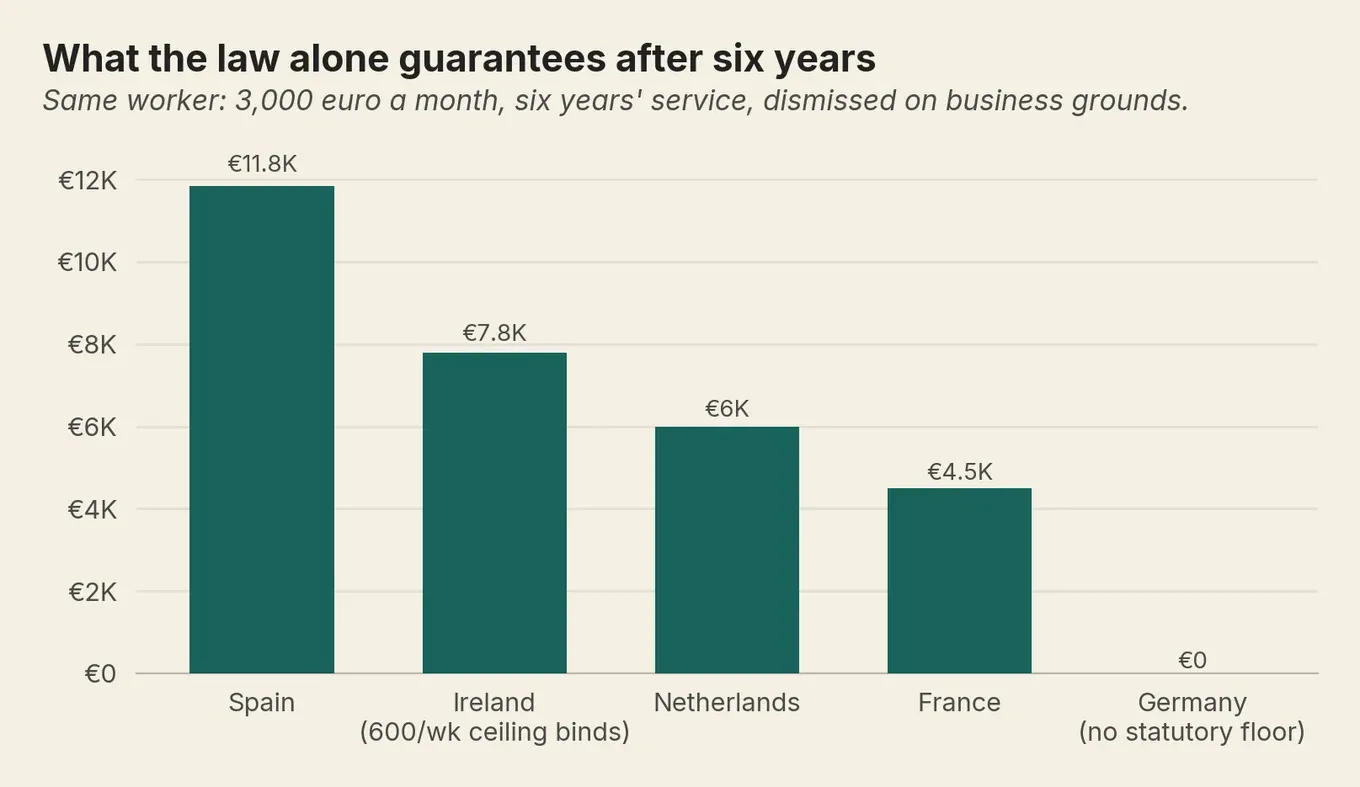
Here is the floor and the tax treatment side by side.
| Country | Statutory floor (how it is worked out) | Tax-free treatment |
|---|---|---|
| Ireland | 2 weeks’ pay per year + 1 bonus week; pay capped at €600/week | Statutory lump sum is tax-free; top-ups partly tax-free, €200,000 lifetime cap |
| Britain | Age-banded weeks per year; pay capped at £751/week, max £22,530 | First £30,000 of the payment is tax-free |
| France | ¼ month’s salary per year (first 10 years), then ⅓ month per year | Statutory amount fully income-tax-free; large top-ups capped, overall €288,360 |
| Spain | 20 days’ pay per year (business-grounds dismissal), capped at 12 months | Tax-free up to €180,000 |
| Netherlands | ⅓ month’s salary per year, from day one; capped at €102,000 (2026) | Fully taxed as income, no tax-free band |
| Germany | No automatic right; severance usually negotiated | Free of social-security charges, but income-taxable |
Comparing your own deal to a friend’s in another country? Hold them both against this table. A Dutch worker and a German worker on the same salary are playing two different games.
Will I be taxed on it?
No, your whole redundancy payment doesn’t arrive tax-free. That’s the most common myth about redundancy, and the most expensive. Believe it, and the tax bill can leave you short by thousands.
How much is tax-free where I live?
It depends entirely on your market. Ireland leaves the statutory lump sum tax-free, with reliefs up to a €200,000 lifetime cap that also touches your pension. Britain shields the first £30,000 (opens in new tab). France exempts the statutory amount in full. Spain exempts it up to €180,000.
Why does my Dutch payment shrink so much?
The Netherlands taxes the transitievergoeding in full, as ordinary income, with no tax-free band at all. So Bram’s whole €6,000 is taxed, and what lands in his account is meaningfully smaller than the headline. Where Britain or Ireland hand a chunk over tax-free, the Dutch system taxes the lot.
Why does my German payslip look worse than expected?
Germany charges no social-security on severance, but it taxes the whole amount as income, and always has. What changed in 2025 is the timing of a tax break called the Fünftelregelung (the “one-fifth rule”). It used to lower the tax taken off your payslip; now Sophie claims it back later, through her tax return. So her payslip looks worse than her real position, and the relief lands when she files her taxes.
What is negotiable before I sign?
Your floor stays fixed. Everything stacked above it is up for discussion: the top-up payment, the wording of your reference, the confidentiality terms, and sometimes even the timing of payment, so it lands in a kinder tax year. And in Germany, unless the employer takes the route above, you negotiate the lot.
Do I have to sign the settlement agreement?
No. A settlement agreement signs you up to take a payment and drop certain tribunal claims, and you never have to accept the first offer. As the UK advice service Acas puts it:
Anyone can suggest making a settlement agreement.
So you can propose your own terms too. In Britain, a settlement agreement is only binding if you have taken advice from a named, insured independent adviser. Ireland has no such statute, but a waiver can be set aside where you were not given a real chance to take advice first. Employers usually offer to cover the cost, but neither country obliges them to.
Should I take voluntary redundancy?
Sometimes. Volunteering can win you a sweeter package. It can also dent your unemployment benefit. In Germany, a mutual termination agreement can trigger a benefit waiting period that quietly eats into a bigger payout.
What to check before you sign
Weigh the extra money against what you stand to lose. Then, before you sign anything, run through five questions:
- Does the offer at least meet my statutory floor? If it falls below the legal minimum, do not sign.
- Have I taken independent legal advice? In Britain it is a condition of a binding settlement agreement; in Ireland it is what makes a waiver stick. Ask whether the employer will cover the cost.
- What exactly am I giving up, which claims am I waiving?
- Do my notice pay and unused holiday stack on top of this number, not buried inside it?
- How does my market tax each part?
You’re allowed to take your time on this, even with a deadline ticking. The floor stays the one thing you never trade below. The rest is a conversation, and you get to be part of it.
Frequently asked questions
What does a redundancy package actually include?
Do my notice pay and unused holiday count inside the redundancy figure?
How much redundancy is mine by law, and how is it calculated?
Will I be taxed on my redundancy payment, and how much is tax-free?
Why does Germany have no automatic redundancy floor?
Do I have to sign the settlement agreement I am offered?
Sources (10)
- GOV.UK: Redundancy pay (your rights)
- GOV.UK: Redundancy tax and National Insurance
- Acas: Settlement agreements
- Department of Enterprise, Trade and Employment (IE): Redundancy payments
- Revenue (IE): Lump sum payments and tax reliefs
- service-public.gouv.fr: Indemnite legale de licenciement
- Agencia Tributaria (ES): Indemnizaciones por despido, cuantia exenta
- Rijksoverheid (NL): Hoe hoog is de transitievergoeding
- Finanztip (DE): Abfindung und Steuer (Fuenftelregelung)
- Your Europe (European Commission): Terminating employment contracts
— That's the lot. It is now night.
Want more of this in your Google results?
Add Money Owl as a preferred source, and Google will show our finance pieces higher when you search for them.
By Jure Jaklič
Founder and editor of Money Owl. Data analyst by trade; personal finance learned first-hand across six European countries.
Recommended

The best savings account in Europe is the one that lets you keep the most
The headline rate on a savings account is rarely what you keep. Post-tax yields in Germany, France, Ireland, Slovenia and beyond tell a very different story.

What insurance do you actually need: subtract before you buy
Most insurance is priced above your expected loss, by design. Subtract your state, employer and savings, and only the real gap is worth a policy.

Sick pay in Europe: who pays you, and from which day
Up to two years of employer-paid sick leave in the Netherlands, none in Portugal. Nine countries, and the percentage everybody quotes rarely decides.