
The point.
- The headline rate is not what you keep. Tax on savings interest varies enormously by country, so the real number is the post-tax yield.
- German, Slovenian and Dutch savers with modest balances often keep the full rate. Germany and Slovenia both have a €1,000 annual allowance, though the Slovenian one covers bank interest while the German one is shared with dividends and other investment income; the Netherlands taxes no wealth under its €59,357 Box 3 threshold.
- Your emergency fund belongs in easy-access only. A higher fixed rate means nothing if you have to break the deal to pay the plumber.
- The EU deposit guarantee scheme protects up to €100,000 per person per licensed bank and must repay you within 7 working days of a bank failure.
- Cash in a money-market fund (common on some neobroker apps) is not a protected deposit. Check whether you hold a bank deposit or a fund before trusting the rate.
The point.
- The headline rate is not what you keep. Tax on savings interest varies enormously by country, so the real number is the post-tax yield.
- German, Slovenian and Dutch savers with modest balances often keep the full rate. Germany and Slovenia both have a €1,000 annual allowance, though the Slovenian one covers bank interest while the German one is shared with dividends and other investment income; the Netherlands taxes no wealth under its €59,357 Box 3 threshold.
- Your emergency fund belongs in easy-access only. A higher fixed rate means nothing if you have to break the deal to pay the plumber.
- The EU deposit guarantee scheme protects up to €100,000 per person per licensed bank and must repay you within 7 working days of a bank failure.
- Cash in a money-market fund (common on some neobroker apps) is not a protected deposit. Check whether you hold a bank deposit or a fund before trusting the rate.
Your bank almost certainly pays you next to nothing. You can do better in about ten minutes. But the big rate in the advert isn’t the number that matters. The number that matters is what lands in your account after tax, and that depends on where you live and how much interest you earn.
That’s the part nobody explains properly. Every guide shows you a fat rate and a tax column. Almost none of them mention that a German or a Slovenian saver, on an ordinary balance, often pays no savings tax at all and keeps the whole rate. This piece does the bit they skip. We find the real rate, work out what you keep after your country takes its cut, and check your money is actually safe where it sits.
What savings rate can you get in Europe right now?
Not as much as a year ago. That’s the honest place to start. The European Central Bank sets the floor for savings rates across the euro area. Its deposit rate (what it pays banks to park money overnight, which drags every savings rate along behind it) sits at 2.25%, effective 17 June 2026. Rates have been sliding from their 2023 highs.
Euro-area inflation ran at 3.2% in the year to May 2026. An easy-access account paying around 2.5% to 3% sits roughly level with inflation before tax, and below it after. Your cash treads water. It doesn’t grow. That’s not a reason to do nothing. It’s a reason to find the best savings account Europe offers you and stop leaking money to a lazy current account.
The widely available easy-access euro rates cluster around 2.5% to 3%, tracking the ECB. Fixed deals run higher. A few platforms advertise the top of that range:
| Provider | Type | Rate (June 2026, variable) |
|---|---|---|
| Trade Republic | Cash on uninvested balance | around 3.0% on up to €50,000 |
| Raisin (marketplace) | Easy-access partner banks | up to around 2.85% |
| Scalable Capital | Cash on uninvested balance | around 2.5% |
| N26 | Standard savings | around 0.25%, more on paid tiers |
| Revolut | Savings paid via a money-market fund, not a protected bank deposit | around 1.5% to 2.5% EUR by plan |
| Trading 212 | Cash interest, partly a money-market fund, not fully deposit-protected | around 2.4%, up to 3.5% for new clients |
| bunq | Bank deposit, protected to €100,000 by the Dutch scheme | around 1.5% to 2.0% EUR |
Look at that Type column before the rate. A headline rate means little if the money sits in a money-market fund rather than a protected bank deposit, because a fund is an investment and can fall, while a deposit is guaranteed up to €100,000. We come back to this further down, but it’s the difference that matters most.
Treat every number there as a moving target. These rates change whenever the bank fancies it, so check the live rate before you open anything. Fixed-term deals reach higher, sometimes around 4% to 5% on a one to three year lock, but you give up access to get there.
What ECB rate drives European savings account interest in 2026?
The ECB deposit rate sits at 2.25% as of 17 June 2026, down from a 2023 peak of 4%. Easy-access euro savings rates from most platforms and banks track just above this floor, clustering around 2.5% to 3% for standard accounts.
Can I open a savings account in another European country?
Yes. EU residents can open savings accounts at banks licensed anywhere in the EEA. You report the interest to your home country’s tax authority, and your money sits under the partner bank’s national deposit guarantee scheme. Platforms like Raisin handle the paperwork.
What is the difference between an easy-access and a fixed-term savings account?
It comes down to one thing: getting at your money versus getting a better rate. You rarely get both.
An easy-access account (a Tagesgeld in Germany, a spaarrekening in the Netherlands, a varčni račun in Slovenia) lets you withdraw any time, normally within a banking day. The rate changes whenever the bank decides. A fixed-term account (a Festgeld, a compte à terme, a depositorekening) locks your money for a set term, say one or two years, and fixes the rate for the whole period in return.
Here are the names to look for on your own bank’s site:
| Market | Easy-access (instant) | Fixed-term (locked) |
|---|---|---|
| Germany | Tagesgeld | Festgeld |
| France | Livret / compte sur livret | Compte à terme |
| Netherlands | Spaarrekening | Depositorekening |
| Italy | Conto deposito libero | Conto deposito vincolato |
| Portugal | Conta poupança | Depósito a prazo |
| Slovenia | Varčni račun | Vezani depozit |
Your emergency fund belongs in easy-access. Full stop. The whole point of an emergency fund is that you reach it the day the boiler dies, and a slightly higher fixed rate is no use if you have to break the deal to pay the plumber.
Which slice is the emergency fund and which is already promised to a tax bill is a separate subtraction, worth doing before you go rate shopping.
Luka had €6,000 set aside as his emergency fund in Ljubljana, sitting at NLB and earning next to nothing, like most domestic Slovenian easy-access accounts. Looking to do better, he found two marketplace options: an easy-access account at 2.85% and a fixed-term deposit at 4.5%. Neither is what NLB pays at home; both are cross-border marketplace rates. The fixed deal on €6,000 would earn €270 a year, the easy-access €171, a difference of €99. Both are tax-free, because Slovenia’s annual savings allowance absorbs the full amount.
He stuck with easy-access. Three months later his car needed a €650 repair. The money was in his account the following morning. The €99 he left on the table was exactly the right price to pay for a fund that works when you actually need it.
For money you won’t touch for a while, fixed-term pays more for your patience. A savings ladder splits the difference: several fixed deals that mature at different times. Say you’ve got €12,000. Lock €4,000 for one year, €4,000 for two, and €4,000 for three. Every year a chunk matures and becomes spendable, while the rest keeps earning the fixed rate.
Because easy-access rates can move any time, banks love a sweetener. They dangle a high introductory rate, then drop it after a few months. Set a reminder, check your rate twice a year, and move if it has slipped. Loyalty earns nothing here.
Does the easy-access rate stay the same after I open an account?
No. Easy-access rates adjust any time the bank decides or the ECB moves. A promotional introductory rate can fall to near zero within months. Set a reminder to check your rate twice a year and switch if the return falls behind the market.
How much tax do you pay on savings interest in Europe?
This is the part that decides your real answer, and the part every competitor gets wrong. They publish a flat “tax by country” table. Real life has allowances, and allowances change the answer completely.
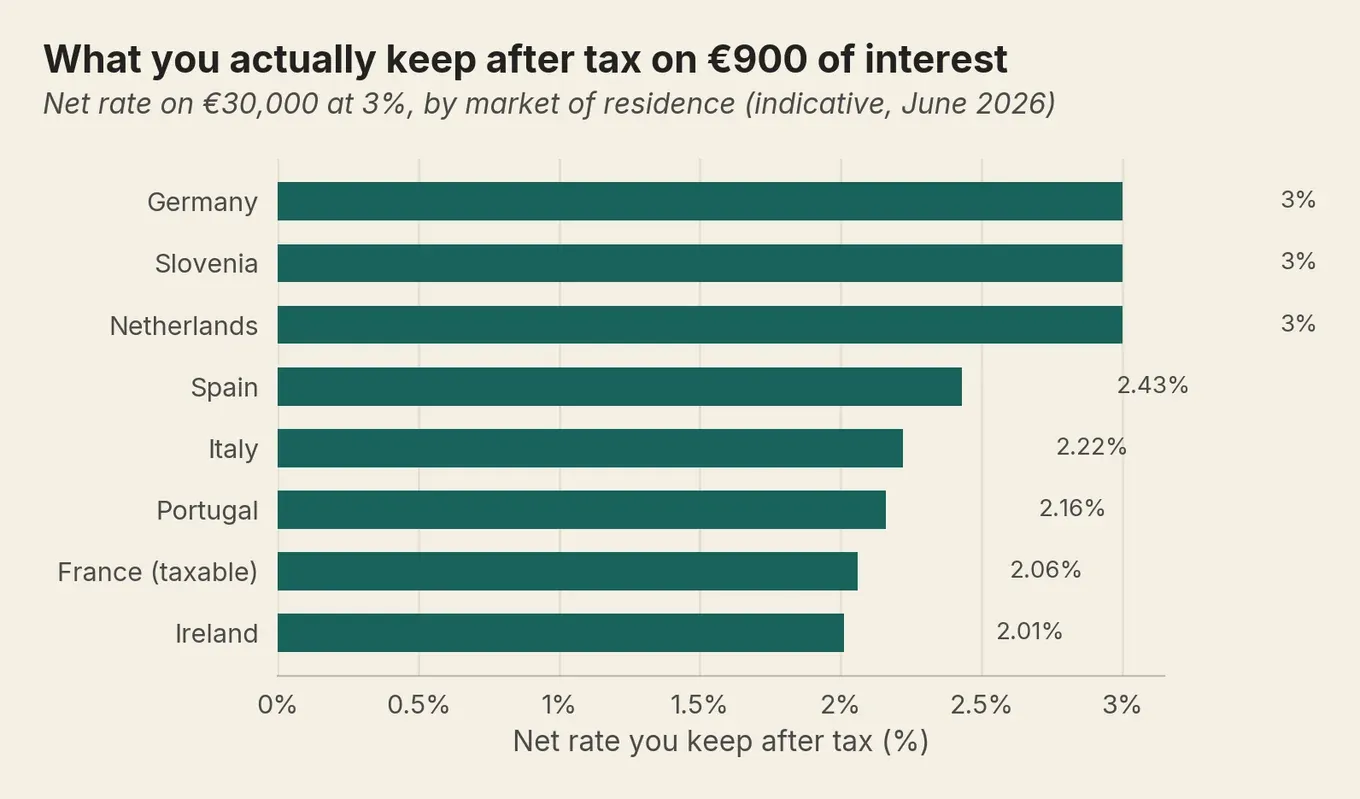
Take a German saver with €30,000 in an easy-access account paying 3%. That earns €900 of interest in a year. Germany gives savers a tax-free savings allowance (the Sparer-Pauschbetrag) of €1,000 per person, though that €1,000 covers all her investment income, dividends included, not interest alone. Her €900 of interest falls under €1,000, so none of it gets taxed. She keeps the full 3%. The Abgeltungsteuer, a flat 26.375% the bank skims straight off the top, never touches her, because her interest never crossed the allowance threshold.
One German catch: that allowance doesn’t apply on its own. You have to tell your bank to use it, with a form called a Freistellungsauftrag. Skip the form and the bank taxes you from the first euro. Fill in the form.
In France, money in a regulated passbook like the Livret A earns interest that’s completely tax-free. No income tax, no social charges. But the Livret A caps at €22,950. Anything above that goes into an ordinary taxable account, where the flat tax (the PFU) takes 31.4% as of 1 January 2026. That rate rose from the old 30% still quoted elsewhere. A French saver’s answer depends entirely on which pot the money sits in.
Here’s what a saver at €30,000 and 3% keeps across our markets:
| Country | Tax on savings interest | Allowance or tax-free wrapper | What the €900 saver keeps |
|---|---|---|---|
| Germany | 26.375% (Abgeltungsteuer) | €1,000 tax-free (Sparer-Pauschbetrag, shared with dividends) | Full 3%, interest under the allowance |
| Slovenia | 25% flat (dohodnina) | €1,000 tax-free, bank interest (not dividends or gains) | Full 3%, interest under the allowance |
| France (Livret A) | 0% inside the regulated passbook | Tax-free up to €22,950 | Full rate, inside the cap |
| France (taxable account) | 31.4% flat (PFU, from 2026) | None | Around 2.06% net |
| Ireland | 33% (DIRT, taken at source) | None, unless you are 65+ on a low income (Form DE1) | Around 2.01% net |
| Spain | 19% to 28% (savings base) | None specific; 19% bites first | Around 2.43% net at 19% |
| Italy | 26% plus 0.20% stamp duty | None | Around 2.22% net, before stamp duty |
| Portugal | 28% (taxa liberatória) | None | Around 2.16% net |
| Netherlands | See below (Box 3) | €59,357 tax-free wealth | Full 3%, wealth under the €59,357 threshold |
Ireland’s savings tax, called Deposit Interest Retention Tax (DIRT), runs at 33% and the bank deducts it for you, so you file nothing. Savers aged 65 or over whose total income stays under the exemption limit can have interest paid gross by filing a Form DE1 with the bank. But An Post State Savings sit outside DIRT entirely and pay tax-free, backed by the Irish State. That gap matters when you weigh a bank rate against an An Post offer.
Italy’s stamp duty (the imposta di bollo) charges against your balance even in years you earn nothing, quietly nibbling a thin return. Spain’s rate climbs: 19% on the first slice, up to 28% on the largest amounts. Most ordinary savers stay at the lower end.
The Netherlands taxes a deemed return on your wealth through Box 3 (the government’s savings and investment tax category), not the actual interest you earned. But the first €59,357 of wealth per person faces no Box 3 tax at all. A saver with €30,000 sits well under that threshold, so they pay nothing and keep the full 3%, exactly like Germany and Slovenia. The tax only starts once your wealth crosses €59,357. Above the threshold, the 2026 deemed return on savings of 1.28%, taxed at 36%, works out at roughly 0.46% of the balance that sits over the line. The Dutch courts ruled against this system, and a new actual-return system arrives around 2028. Treat the Dutch numbers as current and watch this space.
Slovenia adds one chore no other guide covers. Your first €1,000 of interest from any EU bank faces no tax. Interest above that doesn’t get deducted for you. You declare it yourself by 28 February each year. Miss the deadline and you’ve got a problem the bank won’t fix. And whichever country you live in, one rule sits under all of this.
Does savings tax follow where the bank sits or where I live?
Tax follows where you live, not where the bank is. Open a savings account with a foreign EU bank that doesn’t withhold your home tax, and you declare the interest to your own tax authority. Residency decides the tax treatment, full stop.
How does the savings account tax allowance work in Germany and Slovenia?
Both grant €1,000 per person per year, but not on the same terms: Slovenia’s covers bank interest (plus interest on Slovenian government retail bonds issued from 2024 to 2026) and nothing else, while Germany’s single allowance is shared across interest, dividends and investment gains. A saver with €30,000 at 3% earns €900, sits under the allowance, and pays zero tax. A saver at €40,000 earns €1,200 and pays tax on €200.
What savings tax does a French saver pay on interest above the Livret A cap?
The French PFU takes 31.4% on savings interest from taxable accounts, effective 1 January 2026. Interest inside the Livret A passbook faces no tax, up to the €22,950 cap. Interest above the cap, held in an ordinary account, attracts the full 31.4% rate.
How does the EU deposit guarantee scheme protect my savings?
Your money is protected whether the bank sits down your road or in another country. Every bank licensed in the EU carries cover from a deposit guarantee scheme (the EU rule that repays you if your bank fails). It protects up to €100,000 per person, per licensed bank, and the scheme has to repay you within 7 working days without you even having to ask.
The European Commission is blunt about who actually pays for this protection:
“A fundamental principle underlying DGS is that they are funded entirely by banks, and that no taxpayer funds are used.”
A couple with a joint account get €200,000 of cover, because the limit counts per person. Spread more than €100,000 across two separately licensed banks and both halves get full protection. Watch for banks that operate several brands under one banking licence, because those brands share a single limit between them.
Live in Ireland and hold money with a French bank through a marketplace? The French scheme is the one that protects and repays your money, up to €100,000, because that’s where the bank is licensed, not where you live.
A marketplace like Raisin acts as a shop window; it doesn’t hold your money. Your funds move to the actual partner bank, and you become that bank’s customer. So your €100,000 protection sits with the partner bank’s national scheme. Use several partner banks and you get a fresh €100,000 limit at each.
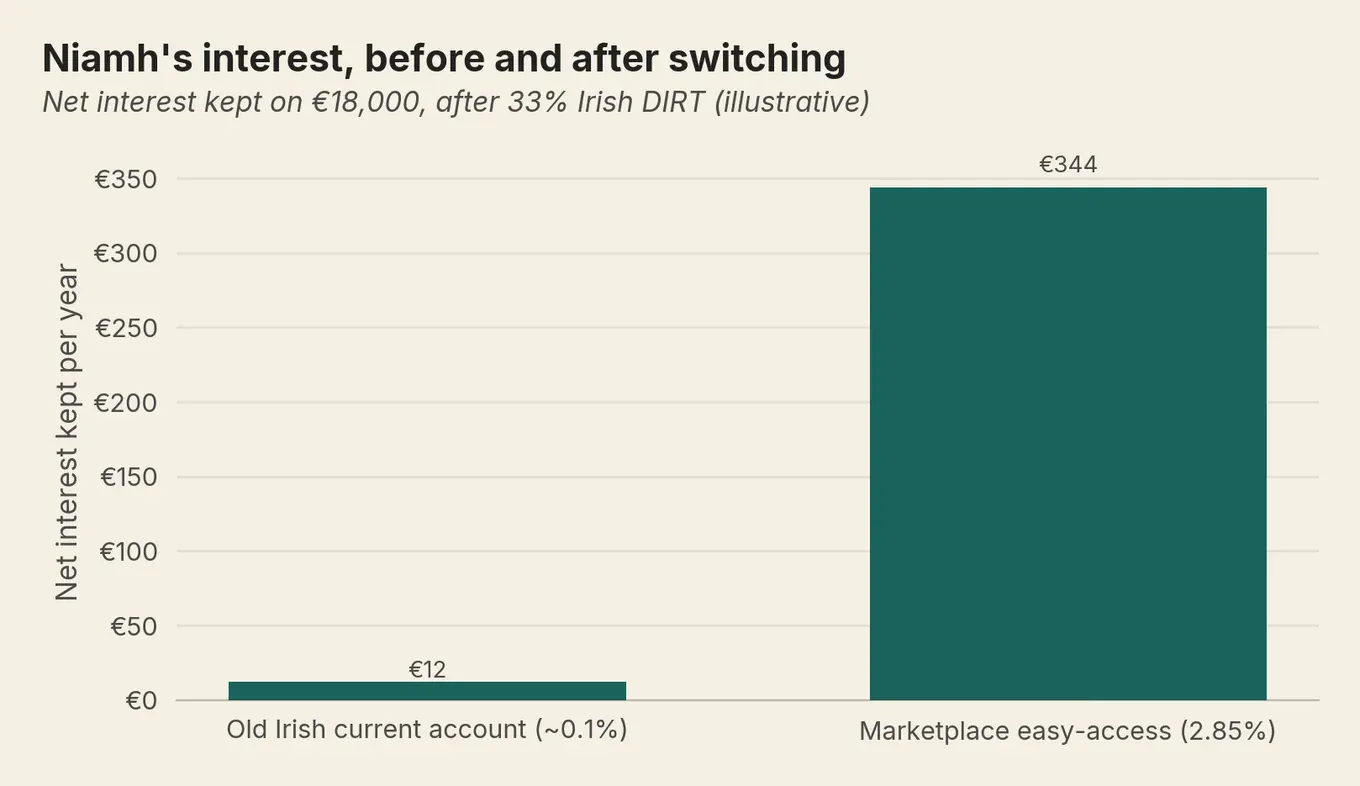
Niamh, 41 and working in Cork, had €18,000 sitting in an AIB current account earning almost nothing (about 0.1%). She kept hearing that she could earn more via Raisin, but two things stopped her. She wasn’t sure it was legal. And she wasn’t sure her money would be safe if the foreign bank went under.
Both fears dissolved when she read the rules properly. EU residents can open savings accounts across the EEA. That’s settled law, not a grey area. She opened an easy-access account with a French partner bank through the Raisin platform, earning 2.85%. On €18,000 that’s €513 in a year.
The tax catch took her by surprise. The French bank doesn’t deduct Irish DIRT for her. She owes 33% of that €513 to Revenue herself, which works out at €169. So her net interest is €344, a net rate of roughly 1.9%. Still about €330 more than her old account paid.
The safety question has a clean answer too. If that French bank failed, the French deposit guarantee scheme would be responsible for repaying Niamh, up to €100,000. Her cover sits with the French scheme rather than the Irish one, which is the part worth checking before you open anything abroad.
One important exception. On some neobroker apps, the cash shown as a “savings” balance isn’t a bank deposit. It can sit in a money-market fund (a pooled investment in short-term bonds, not a bank account), and a deposit guarantee scheme doesn’t cover that.
Take Trade Republic. Where your cash sits with a named partner bank, it gets €100,000 protection. Where the app routes it into a liquidity fund, it becomes an investment, and investment values can fall as well as rise. Before you trust an app’s rate, check one thing: is this a bank deposit, or a fund? If it’s a fund, it isn’t guaranteed cash, however much it looks like it.
So before you chase a rate, run three quick checks:
- Is this a real bank deposit, not a fund?
- Does my balance stay under €100,000 at each licensed bank?
- Does the rate beat what my current account pays, after my country’s tax?
If all three are yes, you’ve found a better home for your money. Set it up this week, then leave it alone. There’s nothing sophisticated about it. That’s exactly why it works.
How quickly does the EU deposit guarantee scheme pay out after a bank fails?
The scheme repays you within 7 working days of a bank failure. You don’t need to file a claim; the scheme contacts you. The €100,000 limit applies per person, per licensed bank, and the payout covers solo and joint accounts alike within that ceiling.
Are savings held with Raisin or Trade Republic covered by the EU deposit guarantee?
Yes, where the money sits with a named partner bank. Raisin routes funds to partner banks and each gives you a fresh €100,000 protection limit. Trade Republic deposits with partner banks carry the same cover. Cash in a money-market fund doesn’t qualify.
Frequently asked questions
Is my money safe in a European online bank or neobank?
Should I keep my emergency fund in easy-access or invest it?
Does inflation outpace savings account interest in Europe right now?
What is the difference between an easy-access and a fixed-term savings account?
Does savings tax follow where the bank sits or where I live?
What savings tax do German and Slovenian savers pay on modest balances?
Sources (14)
- EUR-Lex: Directive 2014/49/EU on deposit guarantee schemes (the operative rule; amended by Directive (EU) 2026/804, which Member States must transpose by 11 May 2028)
- European Central Bank: Key ECB interest rates
- Revenue Ireland: Deposit Interest Retention Tax (DIRT)
- Portal das Finanças: Codigo do IRS - Artigo 71 (taxas liberatórias)
- service-public.gouv.fr: Livret A - taux et plafond
- service-public.gouv.fr: Evolution du taux du PFU (31.4%, 2026)
- Belastingdienst: Berekening box 3-inkomen 2026
- Finančna uprava RS (FURS): Prejel sem obresti
- Banka Slovenije: Deposit Guarantee Scheme
- Bundeszentralamt für Steuern (BZSt): Kirchensteuer auf Abgeltungsteuer
- Bundesministerium der Finanzen (BMF): Abgeltungsteuer
- Agencia Tributaria (AEAT): Intereses de cuentas y depósitos (IRPF 2025)
- European Commission: Deposit guarantee schemes
- Eurostat: Euro area annual inflation up to 3.2% (May 2026)
— That's the lot. It is now night.
Want more of this in your Google results?
Add Money Owl as a preferred source, and Google will show our finance pieces higher when you search for them.
By Jure Jaklič
Founder and editor of Money Owl. Data analyst by trade; personal finance learned first-hand across six European countries.
Recommended

Fix your savings, stay flexible, or build a ladder?
Rates fell, then the ECB hiked. Nobody can call the next move, and a savings ladder is built for exactly that uncertainty.

Liquidity in personal finance: which of your own money can you reach?
Liquidity is which of your own money you can actually reach. Map it onto European wrappers, then size the cash buffer none of the locked stuff can rescue.

Money and mental health: how to calm the worry and the bank balance
Money worry and a worried mind feed each other in two loops. Here's how to ease both at once, with free EU mental-health and debt help near the end.