

The point.
- If you're already behind, or can't keep up, talk to a non-profit debt adviser before you save or borrow anything, and answer any letter from your landlord, bank or court in the meantime. Keep must-pay bills current (rent, power or anything heading for court) and agreed loan and card repayments up to date. Then build a €500 to €1,000 starter pot, then clear credit you can keep dipping into, like a card or an overdraft, before growing the full fund. Keep paying a fixed-instalment loan as agreed throughout.
- Three to six months is only a starting range. Size your own number from four holes: the wait before benefit starts, the drop once it does, any penalty for how the job ended, and how long the search takes. If you can confirm you'd qualify, and for how long, and roughly how much, treat the result as a floor. If you can't, size as if none comes.
- Keep the fund in a separate, easy-access account, at a different bank from any you owe money to (not just a different brand). A deposit at a bank licensed in the EU is covered by the deposit guarantee: €100,000 per person, per bank, with all your deposits at that bank added together.
- Look the provider up in the European Banking Authority's registers, then check whether it holds your money as a deposit. E-money isn't a deposit. Keep your fund as a deposit at a bank, in your own name.
The car packs in on a Thursday, 11 days before payday. It stops with a clunk that sounds expensive. The bonnet’s up, on a country road. In the boot, a tub of raspberry ripple ice cream has started to go soft.
Advice on how to build an emergency fund often starts at three to six months of expenses, which is a lot of breakdowns. American research (opens in new tab) sized the fund to how long people there were out of work. Over here, the number turns on what your safety net pays while you look. And on how the job ended.
Take someone single in Germany, with no children and €1,800 a month of essentials, out of work for four months. If about €1,400 a month of benefit comes as normal, it costs their savings about €1,600, and that’s a floor. Had they agreed to leave without a good reason (notice honoured, no severance), it would be about €5,400. One signature, more than three times the bill.
What’s the first number to aim for?
Aim first for a starter pot of €500 to €1,000. Ireland’s Money Advice and Budgeting Service (MABS (opens in new tab)) suggests that goal. It’s for one bill at a time. The car, say, or the dentist. Keep up any agreed loan and card repayments while the pot builds. And if the rent or a bill is already behind, that comes before the pot. So does a talk to a non-profit debt adviser, if you’re behind or can’t keep up your repayments.
An emergency fund is money kept apart for the bad surprises, in two pots. The small one pays for a bill that turns up. For the months when pay stops, you need the bigger one, an income reserve. To see why you’d split it in two, read the guide to keeping some of your money easy to reach.
If you own a home or a car, aim for the top of the €500 to €1,000 range; the really big repair is a job for the income reserve. Once a repair dips into the reserve, it covers a lost job again only when that money is back.
MABS reckons a first €100 can help too, if only because it’s €100 you don’t have to borrow.
Should you build an emergency fund or pay off debt first?
Keep the must-pay bills and your agreed loan and card repayments current, then build the starter pot, then clear the expensive credit you can keep dipping into, like a card balance or an overdraft. After that, grow the full fund. That’s the order I’d use.
“Must-pay” bills are the ones where falling behind costs you more than money: the roof over your head, the power, anything already heading for court. Germany’s consumer centres put rent, energy and food first (opens in new tab). Elsewhere, which bills count depends on your country.
If you’re behind or can’t keep up your repayments, start with non-profit debt advice, whatever it’s called locally. German consumer centres point people who can’t keep up with loan payments to a recognised non-profit debt-counselling service (opens in new tab), a Schuldnerberatung. In Ireland the adviser is MABS, which says its service is free (opens in new tab).
Ireland’s consumer watchdog, the CCPC, points out that when a loan charges more interest than your savings earn (opens in new tab), clearing the debt first is often the better deal. On the arithmetic alone, they’re right.
I’d still put the pot first, because borrowing room isn’t yours to keep. EU consumer-credit rules (opens in new tab) let a lender stop you drawing on a credit card if the agreement allows it and the lender has an objective reason, such as a sharply higher risk that you can’t repay. From 20 November 2026, the rules replacing them (opens in new tab) keep that power, and it can reach an agreed overdraft too. Card or overdraft, the borrowing can go roughly when you’d want the money most. Considerate.
A loan with fixed instalments is different. Money paid off it can’t be borrowed back, so hold off overpaying until the income reserve reaches its floor, the least you’d want to hold. That isn’t free: the loan keeps charging interest while you wait.
If you’re up to date and a big bill lands before the pot does, check what borrowing for it would cost in total, not only per month, before you agree to it.
Do you really need three to six months of expenses?
Not necessarily. Three to six months is a starting range, and it’s the same for everybody. It doesn’t care how the job ended or what the benefit pays. You aren’t everybody.
Germany’s consumer centres say three to five months’ net income (opens in new tab), MABS three to six months of essential spending (opens in new tab). That’s income against spending, a fairly basic thing to disagree about.
Your number has to cover the four holes in your own safety net if you lose your job:
- the wait before benefit starts;
- the drop in income once it does;
- any penalty for how the job ended;
- how long you spend looking for the next job.
For the fourth, count the months without pay and leave out any looking you did while still in work. Start from how long the gap was last time, or ask someone in your line of work who’s looked recently. If you went straight from one job to the next, your zero is no guide; go by theirs. Allow more if your last search was years ago or the market’s slower now. If the search outlasts the benefit, each month after that costs the whole of your bills.
Before you size anything, check you’d qualify for benefit, and for how long, and roughly how much.
Where does your safety net leave holes?
If you’re let go, a notice period normally comes before any of the holes. In Ireland, Citizens Information says (opens in new tab) you should get your normal pay through it. Loyalty pays slowly: in Germany, from four weeks up to seven months after 20 years (opens in new tab).
The first three holes depend on the country, rather more than you’d hope:
| The hole | Where it’s gentler | Where it bites |
|---|---|---|
| The wait | Ireland: from the Monday after the job ends (opens in new tab) | Italy: from day 8 if you claim within 8 days (opens in new tab); claim within 68 days or lose it (opens in new tab), both later after a just-cause dismissal (see below) |
| The wait, with severance | Ireland: redundancy pay doesn’t affect it (opens in new tab) | France: up to 150 days (opens in new tab) (75 after an economic dismissal), for severance above the legal minimum |
| The drop | Germany: 60% of take-home pay worked out from gross (67% with a child) (opens in new tab), gross capped at €8,450 a month in 2026 (opens in new tab) | Italy: capped at €1,584.70 a month in 2026 (opens in new tab) |
| The penalty | Ireland: up to 9 weeks (opens in new tab), if you left without good cause or were sacked for wilful misconduct | Germany: up to 12 weeks (opens in new tab), if you quit, agreed to leave, or were sacked for your own misconduct, without a good reason |
Rules as of September 2026, from each country’s official sources.
Italy cares who ended the job, and how. Being dismissed for just cause (sacked without notice, after a disciplinary process, for something serious you did) still pays benefit, but later. Benefit starts from day 38 after the dismissal if you claim by then, and the 68 days to claim run from day 30 (opens in new tab). Resigning or agreeing to leave pays unemployment benefit only in the cases INPS lists (opens in new tab).
In Ireland, the misconduct has to be wilful and the direct cause of losing the job. The German penalty applies only if you caused the job loss deliberately or through gross carelessness, and in the 12-week case at least a quarter of your total entitlement goes, the 12 weeks included (opens in new tab). Those weeks are gone for good.
An agreed exit in France, a rupture conventionnelle (opens in new tab), pays benefit, though for a shorter maximum period when the job ends on or after 1 September 2026. Quitting is another matter. A resignation pays only in the cases Unédic lists (opens in new tab). Benefit there also starts after a 7-day wait (opens in new tab), which applies at most once in any 12 months.
Before you sign anything to leave a job, whichever country you work in, look up what its benefit does to someone who signs.
One more hole you can dig yourself. In Germany you have to register as a job-seeker (opens in new tab) no later than three months before the job ends, or within three days if you find out later. Leave it late and it can cost you benefit. It doesn’t count as registering as unemployed. That’s a separate step, naturally, due by your first day out of work, because benefit doesn’t start before you register (opens in new tab).
Look up your own country in the guides to unemployment benefit across Europe and who pays your sick pay. You can also check the first for how long German benefit can be delayed when a job ends with severance before the employer’s notice period has run.
How do the holes turn into a number?
To get your monthly essentials, go through three months of bank statements. Yes, all three. A statement lists every card payment and says nothing about what the ATM cash went on. Add a rough figure for that, plus a twelfth of each yearly bill.
Take the single person in Germany from the start: €3,450 a month before tax, €1,800 a month of essentials. Let go with their notice honoured, on 2026 rules, they’d get about €1,400 a month in benefit, going by the Federal Employment Agency’s own calculator (opens in new tab). That leaves a drop of €400 a month.
Put the search at four months. It’s your number to change. The fund pays that drop for each month out of work, so four months cost it €1,600. If the new job pays its first wage a month later than the old one did, add one more month of essentials.
Each extra month of search adds €400 while the benefit lasts. It lasts 12 months (opens in new tab) for someone under 50 with at least two years of insured work in the last five. A shorter record gets less. After that, each month adds the full €1,800.
Say they’d agreed to leave instead, without a good reason, with their notice honoured and no severance. Germany treats that agreed exit (an Aufhebungsvertrag) like quitting (opens in new tab). No benefit for 12 weeks, starting the day after the job ends. Four months out now cost about €5,400.
Now make it their first job out of university, ten months in, with no insured work before it. That’s short of what benefit needs: at least 12 months of unemployment insurance (opens in new tab) in the last 30 (opens in new tab). No unemployment benefit comes. Four months at €1,800 is €7,200, plus their own health insurance (opens in new tab), which the agency would otherwise cover (opens in new tab).
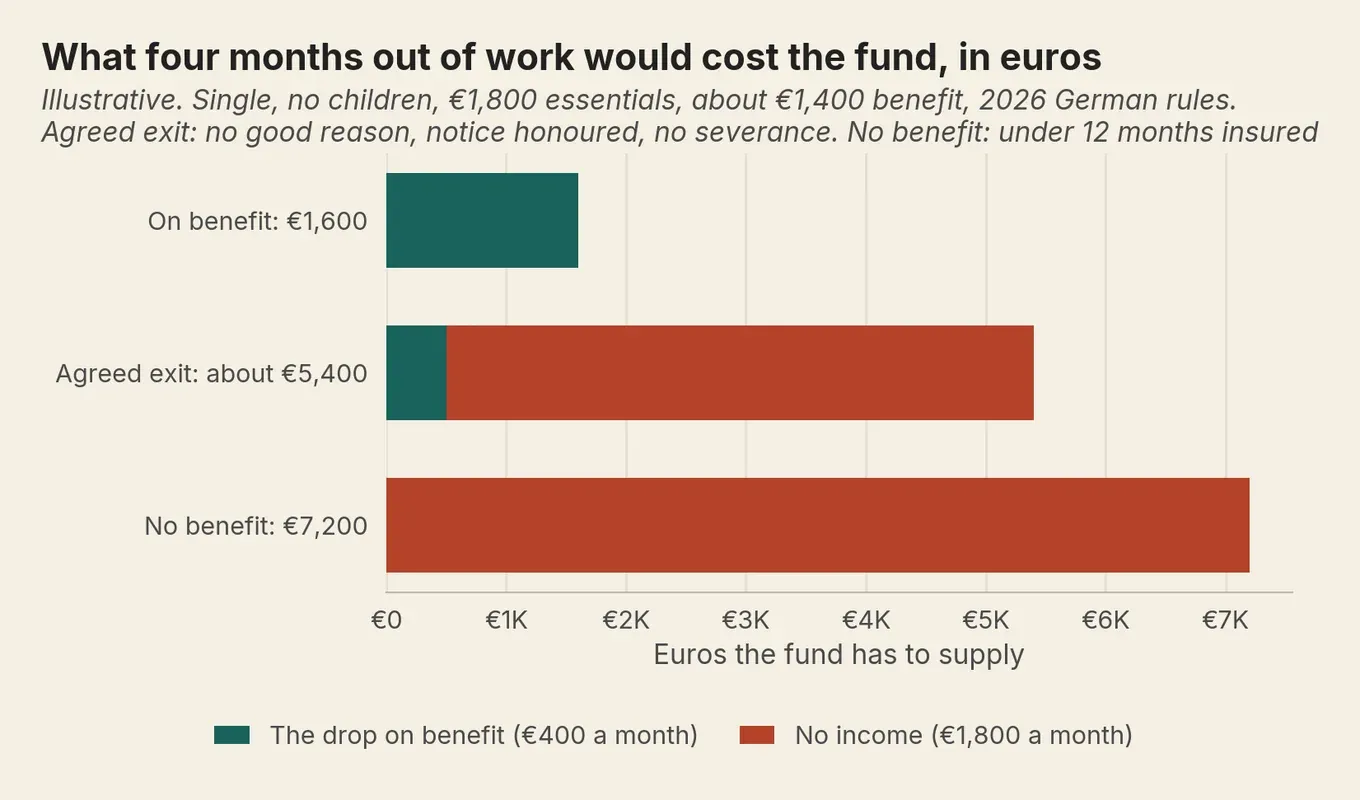
If you’ve confirmed you’d qualify for benefit, and for how long, and roughly how much, hold at least the floor: the on-benefit number, €1,600 here. If you can’t confirm it, hold the larger number: what it costs if no benefit comes.
That €1,600 is counted in essentials, and it holds only if the safety net works as advertised and the first payment arrives on time. The Banque de France’s money-education site calls counting in essentials the less protective way:
“This way of calculating is less protective and isn’t necessarily suited to everyone.” Translated from the French.
Ce mode de calcul est moins protecteur et n’est pas forcement [sic] adapté à toutes les personnes.
Mes questions d’argent, Banque de France (opens in new tab), August 2025.
Money Owl’s emergency fund calculator is quicker and less nosy, but it doesn’t know your notice period or your benefit. If you’ve confirmed you’d get benefit, on time and with no penalty for how the job ended, its main target will usually come out higher than yours, and the gap is cushion. A penalty or a long search shrinks that gap, and can leave you needing more than the calculator says.
If you already hold six months and you’ve checked the net would catch you, your number can come out smaller. That smaller number is a floor, not a refund. Next, decide how much to hold before investing.
What if you’re self-employed, on a fixed-term contract, or new in the job?
The net can catch you later, or not at all.
When you’re self-employed, there’s no employer to give notice or pay you through an illness, so you carry both in full, unless you’re covered. Sick-pay cover is compulsory (opens in new tab) in some countries, opt-in (opens in new tab) in others, and can start weeks late (opens in new tab). If you aren’t covered, or not from day one, size the reserve as if no sick pay comes. Keep your tax money in a separate pot.
On a fixed-term contract you know the end date. Use it. Size the reserve early and build what you can before you get there.
If you’re new in the job, notice, sick pay and benefit usually want to see a stretch of time in work first. In Germany, employer sick pay starts only after four weeks in the job (opens in new tab). Before that, if you’re in the statutory health insurance, the health insurer normally pays sick pay (Krankengeld) (opens in new tab) instead.
Where should you keep an emergency fund?
The correct, unexciting answer is a separate, easy-access bank savings account. In the EU, a deposit at a bank licensed there is covered by the deposit guarantee: €100,000 per person, per bank (opens in new tab), with all your deposits at that bank added together.
If the bank fails, the covered amount is normally paid back within seven working days. The account may pay less interest than a savings app or a money-market fund. In return you get the whole amount, on your bad day, without asking anyone.
Keep it at a different bank from any you owe money to. Another brand of the same bank counts as the same bank. Once a loan or overdraft payment is overdue, the lender’s terms can let it help itself to what it’s owed from any savings you hold with it.
In Germany an account like this is usually called Tagesgeld. In France, the Livret A, LDDS and LEP savings accounts are guaranteed by the French State (opens in new tab), counted apart from your other deposits, and covered together up to their own €100,000 per person, per bank.
The trap is the app. Before you move a euro, look the provider up in the European Banking Authority’s public registers (opens in new tab), then check in its terms which firm holds your money and whether it’s a deposit.
- A bank, holding it as a deposit: the guarantee covers it, and it can pay interest.
- An e-money or payment firm: it isn’t a deposit. EU e-money (opens in new tab) and payments (opens in new tab) law makes an authorised firm safeguard it instead. E-money law also bans interest on e-money, or any other reward for how long you hold it.
- An e-money app that pays interest anyway, or a ‘reward’ for how long you hold it: your money has left e-money. The terms, in the part where things go to not be read, will say where it went: for example, a fund or an account at a partner bank.
At a partner bank, in your own name, it’s an ordinary deposit, covered by the guarantee of the country that licensed that bank. The deposit guarantee doesn’t cover the app itself going bust, only that bank failing.
If it’s a money-market fund, that’s an investment. EU rules make the fund’s marketing papers say it’s not a guaranteed investment (opens in new tab), and its value can fall as well as rise. Under the same rules, some kinds can also limit or pause withdrawals for up to 15 working days when they run short of cash. A fund set up under the EU’s main fund rules (known as UCITS) can suspend them in exceptional cases (opens in new tab).
If the terms don’t say it’s a deposit at a bank, in your own name, I wouldn’t keep your emergency fund there.
What’s the best way to build an emergency fund, step by step?
Start small, and keep it away from the account your card is attached to. Setting it up is quick. Most of it is finding a password.
-
If a must-pay bill is already behind, or you can’t keep up your repayments, talk to a non-profit debt adviser before you save or borrow anything. Answer any letter from your landlord, your bank or a court in the meantime.
-
Open a separate easy-access savings account at a bank you don’t owe money to, not just a different brand of one you do. Give it a dull name you won’t be tempted by.
-
Set a standing order into it for an amount you won’t miss, timed for once the rent and the bills have gone. At least five days after payday is a fair rule of thumb. If your pay varies, a fixed amount can tip you into the overdraft in a thin month. Move whatever’s left at the end of each month instead, after next month’s essentials.
-
Build the starter pot, €500 to €1,000, while the must-pay bills and your agreed loan and card repayments stay current.
-
Next, clear expensive credit you can keep dipping into, like a card balance or an overdraft, and leave the starter pot where it is. A loan with fixed instalments keeps being paid as agreed.
-
Check you’d qualify for benefit, and for how long, and roughly how much, then work out your income reserve from the holes in your safety net. If you can’t confirm you’d qualify, size it as if no benefit comes. Point the standing order at it and leave it alone until you get there.
-
Send a bonus, a tax refund or a lump in your pay to the must-pay bills, then the starter pot, then the card or overdraft, then the reserve, before it becomes a holiday. That changes once the job is ending soon: notice has been given, a leaving date is agreed, or a fixed-term contract is nearing its end with no renewal confirmed. From then on, keep the must-pay bills current, then put it in the fund and leave it there.
In several countries part of your pay arrives as a lump, on a date you know in advance. It would be rude not to plan for it.
In Portugal that’s a Christmas subsidy (opens in new tab) of a month’s pay, due by 15 December. The Dutch holiday allowance (opens in new tab) comes in June, unless a written or collective agreement moves the month. Spanish workers get two extra payments a year (opens in new tab), one at Christmas, unless a collective agreement spreads them across all 12 months.
-
Refill the fund after you use it, once your income covers the must-pay bills again.
What counts as an emergency, and what happens after you use it?
An emergency is a bill you didn’t choose and can’t put off, or the months when pay stops. A badly needed weekend away still isn’t one. Nor is a new phone, most of the time. A broken boiler in January is.
Some costs come with a date attached. Set nothing aside for them and they’ll drain the fund anyway. Moving flat, you pay the new deposit before the old one comes back. German landlords can ask for up to three months’ rent excluding service charges (opens in new tab), though you’re entitled to pay it in three equal monthly instalments. In the Netherlands, on contracts from 1 July 2023, the cap is two months’ rent without service charges (opens in new tab).
When you use the fund, skip the guilt. It was for exactly this. Refill it once your income covers the must-pay bills again. If you borrowed to fill a gap, the same order applies: keep the must-pay bills and agreed repayments current, then refill the starter pot, then clear the card or overdraft.
The car will pack in again, probably on a Thursday. With a starter pot put by, anything short of the really big repair is an annoying afternoon rather than a loan. Open the account this week and set a standing order for whatever you won’t miss.
Sources (44)
- Lee and Hanna, Journal of Financial Counseling and Planning (AFCPE): What, Me Worry? Financial Knowledge Overconfidence and the Perception of Emergency Fund Needs
- MABS (Money Advice and Budgeting Service): starting an emergency fund, a simple guide
- EUR-Lex: Directive 2014/49/EU on deposit guarantee schemes
- Fonds de Garantie des Dépôts et de Résolution (FGDR): explanatory leaflet, the protection of your money
- EUR-Lex: Directive 2009/110/EC on electronic money institutions
- EUR-Lex: Directive (EU) 2015/2366 on payment services
- EUR-Lex: Regulation (EU) 2017/1131 on money market funds
- EUR-Lex: Directive 2009/65/EC on undertakings for collective investment in transferable securities (UCITS)
- European Banking Authority: registers and other list of institutions
- Overheid.nl: Wet minimumloon en minimumvakantiebijslag
- BOE: Estatuto de los Trabajadores
- Diário da República: Código do Trabalho, artigo 263 (Subsídio de Natal)
- Verbraucherzentrale: finanzieller Engpass, was tun, wenn ich nicht rechtzeitig bezahlen kann?
- Banque de France (Mes questions d'argent): une épargne de précaution, pourquoi et comment faire ?
- Unédic: est-ce que j'ai droit aux allocations chômage si j'ai démissionné de mon emploi ?
- Citizens Information: losing your job, entitlements
- Citizens Information: Jobseeker's Pay-Related Benefit
- Unédic: différé d'indemnisation spécifique en cas d'indemnités supra-légales
- Gesetze im Internet: SGB III Section 149, Arbeitslosengeld Grundsatz
- Gesetze im Internet: Sozialversicherungs-Rechengrößenverordnung 2026
- INPS: Circolare numero 4 del 28-01-2026
- Gesetze im Internet: SGB III Section 148, Minderung der Anspruchsdauer
- BOE: Ley General de la Seguridad Social
- Gesetze im Internet: BGB Section 551, Mietsicherheiten
- Rijksoverheid: mag mijn verhuurder een waarborgsom vragen?
- Competition and Consumer Protection Commission (CCPC): savings
- EUR-Lex: Directive 2008/48/EC on credit agreements for consumers
- Gesetze im Internet: SGB III Section 142, Anwartschaftszeit
- Gesetze im Internet: BGB Section 622, Kündigungsfristen
- INPS: domande frequenti sulla NASpI (FAQ)
- INPS: NASpI, indennità mensile di disoccupazione
- Gesetze im Internet: SGB III Section 159, Ruhen bei Sperrzeit
- Bundesagentur für Arbeit: Selbstberechnung Arbeitslosengeld (Kalenderjahr 2026)
- Bundesagentur für Arbeit: Wie Sie sich arbeitsuchend melden
- Bundesagentur für Arbeit: Wie Sie sich arbeitslos melden
- Gesetze im Internet: SGB III Section 147, Anspruchsdauer
- Unédic: est-ce que j'ai droit aux allocations chômage si j'ai effectué une rupture conventionnelle ?
- Gesetze im Internet: SGB V Section 188, freiwillige Mitgliedschaft
- Gesetze im Internet: SGB V Section 251, Tragung der Beiträge durch Dritte
- Gesetze im Internet: EntgFG Section 3, Anspruch auf Entgeltfortzahlung
- Gesetze im Internet: SGB V Section 44, Krankengeld
- Gesetze im Internet: SGB V Section 46, Entstehen des Anspruchs auf Krankengeld
- Gesetze im Internet: SGB III Section 143, Rahmenfrist
- EUR-Lex: Directive (EU) 2023/2225 on credit agreements for consumers
— That's the lot. It is now night.
Want more of this in your Google results?
Add Money Owl as a preferred source, and Google will show our finance pieces higher when you search for them.
By Jure Jaklič
Founder and editor of Money Owl. Data analyst by trade; personal finance learned first-hand across six European countries.
Recommended

The best savings account in Europe is the one that lets you keep the most
The headline rate on a savings account is rarely what you keep. Post-tax yields in Germany, France, Ireland, Slovenia and beyond tell a very different story.

Fix your savings, stay flexible, or build a ladder?
Rates fell, then the ECB hiked. Nobody can call the next move, and a savings ladder is built for exactly that uncertainty.

What insurance do you actually need: subtract before you buy
Most insurance is priced above your expected loss, by design. Subtract your state, employer and savings, and only the real gap is worth a policy.