

The point.
- The euro settlement calendar shuts every Saturday, every Sunday and six named days a year: 1 January, Good Friday, Easter Monday, 1 May, 25 December and 26 December.
- The settlement rules never shift a payment backward. A salary, standing order or direct debit due on a closed day settles on the next open day, which is why a Saturday payday lands on the Monday. Some labour codes push the other way on pay: Portugal requires the salary on the due date or a working day before it, and Slovenia moves a pay day that falls on a work-free day to the next working day.
- The longest closure is four days. Easter delivers one every year without exception, and Christmas matches it in some years. The next Easter run is Friday 26 March to Monday 29 March 2027.
- Move the payments nobody else is waiting for to at least five days after your pay date, on a day of the month at or below the 28th that your own bills have already cleared. Rent, a loan repayment or an insurance premium keeps its contractual date whoever presses the button. Five days clears the longest closure there is, the 29th, 30th and 31st are missing from some months, and the 1st is the wrong answer if that is when your rent leaves.
- "Nothing bounced" is the wrong thing to check. An account with no overdraft agreement, where the bank pays anyway, can land in an unauthorised overdraft with its own fees, so check your balance on the morning of the debit date instead.
- A standing order can be cancelled or changed in your banking app or at a branch, as long as you get there before the payment date. Only a payment that has already left is beyond recall.
The point.
- The euro settlement calendar shuts every Saturday, every Sunday and six named days a year: 1 January, Good Friday, Easter Monday, 1 May, 25 December and 26 December.
- The settlement rules never shift a payment backward. A salary, standing order or direct debit due on a closed day settles on the next open day, which is why a Saturday payday lands on the Monday. Some labour codes push the other way on pay: Portugal requires the salary on the due date or a working day before it, and Slovenia moves a pay day that falls on a work-free day to the next working day.
- The longest closure is four days. Easter delivers one every year without exception, and Christmas matches it in some years. The next Easter run is Friday 26 March to Monday 29 March 2027.
- Move the payments nobody else is waiting for to at least five days after your pay date, on a day of the month at or below the 28th that your own bills have already cleared. Rent, a loan repayment or an insurance premium keeps its contractual date whoever presses the button. Five days clears the longest closure there is, the 29th, 30th and 31st are missing from some months, and the 1st is the wrong answer if that is when your rent leaves.
- "Nothing bounced" is the wrong thing to check. An account with no overdraft agreement, where the bank pays anyway, can land in an unauthorised overdraft with its own fees, so check your balance on the morning of the debit date instead.
- A standing order can be cancelled or changed in your banking app or at a branch, as long as you get there before the payment date. Only a payment that has already left is beyond recall.
Your salary is due on a Saturday. Most people assume that means it turns up on the Friday, a day early, as a small mercy.
It doesn’t, unless your labour code says otherwise. Portugal’s does. The money sits over the weekend and lands on the Monday. So does the rent. And the two direct debits that were due over the weekend. One inflow, a weekend of outflows, all landing in the same morning, in whatever order your bank feels like applying them.
Your gym didn’t choose the date it takes its money, and neither did your bank. That date comes off a calendar the European Central Bank publishes, and the calendar is shut every Saturday, every Sunday, and six named days a year. Euros, that is. Sterling runs on its own system, with a different calendar.
Everyone tells you to automate on payday. Payday is the wrong day: move the payments nobody else is waiting for to at least five days after it, on a date at or below the 28th. Five days, because the calendar behind your account never shuts for longer than four.
The dates underneath a standing order do the damage, and sorting them takes about twenty minutes and one honest look at your payslip.
Which days does the euro settlement system shut?
It shuts every Saturday, every Sunday, and exactly six named days: 1 January, Good Friday, Easter Monday, 1 May, 25 December, and 26 December. Otherwise the euro settlement system (opens in new tab) (T2, if you want to look it up) runs Monday to Friday.
Read the ECB’s own list and it doesn’t say Good Friday. It says “Good Friday (Catholic/Protestant)”. The euro system shuts for that Easter and no other. Cypriot banks took theirs a week later in 2026 (opens in new tab).
We went looking for the version of that list that gets updated each year. There isn’t one. The ECB fixed the euro settlement calendar (opens in new tab) in December 2000, to run “from 2002 until further notice”, and further notice has not arrived, so the calendar that decides when your rent leaves your account was settled before some of the people now paying rent were born.
The press release says why: annual calendars “introduce uncertainties for financial markets”. Not for households, then. Your rent was never the point.
Read the list again. The trap is sitting in the middle of it. Good Friday, Saturday, Sunday, Easter Monday: four days in a row with nothing settling, every year, and it never gets longer. The next one is Friday 26 March to Monday 29 March 2027, and money starts moving again on Tuesday 30 March.
Instant transfers keep running through all four days, while the rails your salary and your bills ride on sit still.
Something is moving, though not this. In May 2026 the Eurosystem said it will open a short weekend settlement window (opens in new tab) for banks shifting liquidity between their own accounts. Salaries and rent stay put.
What should you do when you get paid, in order?
Right. Get your payslip out. Almost all of this is dates.
- Find your actual pay date on your payslip, and check whether it’s a fixed date or the last working day of the month. In Spain and France the law fixes how often you must be paid, not which day, so the date came from your contract and it can land on a closed day. Some countries add a working-day rule on top: Portugal brings the date earlier, Slovenia pushes it later. A fixed date moves when the calendar moves; the last working day already has the shift built in.
- Split what leaves your account by who is waiting for the money. Nobody is waiting for a transfer into your own savings, a pot or an investment, so those are yours to move this afternoon. Rent, a loan repayment, an insurance premium and every direct debit are the other group: someone is expecting that money on a date written into a contract, and setting the standing order up yourself doesn’t make the date yours. Moving one of those starts with a phone call to agree a new date, not with a change in your banking app. Working out what leaves your account each month is the tedious half. The boring bit is the bit.
- Move the payments nobody is waiting for to at least five days after your pay date. The calendar never shuts for more than four days in a row, so the fifth day always falls after the salary has landed. Easter shuts four days, every year, without exception. Christmas does the same in some years, and 1 May and New Year manage three. Four days of margin sounds cautious. It’s exactly one day short.
- Pick a day of the month at or below 28, and one your own bills have already cleared. The 29th, 30th and 31st don’t exist in every month, and the scheme rulebooks say nothing whatsoever about what happens then, so your own bank’s terms decide it and they vary. If your payday is late in the month, five days carries you into the next one. Land past your rent and your month-start direct debits: the 1st and the 2nd are the worst dates on the calendar for anyone whose bills cluster there, and 1 January is a closed day besides. Find the empty stretch in your own month, and put it there.
- Leave a buffer that survives four closed days, sized to the outflows that could stack up inside them. A round number you like the look of is not a size. How much of your pay goes where is a separate question; this is only about what has to be sitting there on the wrong Tuesday.
Steps 3 and 4 take four minutes in a banking app. Step 2 is where people give up.
Do direct debits come out at the weekend?
No. In the euro area, a direct debit due on a Saturday, Sunday or settlement holiday waits. It settles on the next open euro settlement day, then leaves your account on your own bank’s next direct-debit day, which is normally the settlement day itself and occasionally later.
The money moved twice there, on two different calendars. One is euro-wide, identical in Lisbon and Ljubljana and Rotterdam. Your bank runs the other, and it’s published nowhere as a single list. Money that hasn’t left yet still looks like money you have.
Everything shifts forward. Nothing ever shifts back. We read both rulebooks, for euro transfers (opens in new tab) and for direct debits (opens in new tab), and they say so in the same words.
The direct debit rulebook then pins the date itself: between banks, “a given Due Date may never be changed”. Whatever day your gym asked for stays put. The money shuffles around it.
What does the four-day shut look like in a real month?
Marta lives in Madrid, and her contract puts her pay date on the 26th. In March 2027 the 26th is Good Friday, so her salary arrives on Tuesday the 30th.
Her €820 rent standing order, set for the 27th, goes out on the 30th as well. The €260 of direct debits due on the 27th, 28th and 29th all settle on the 30th too.
Four dates, carefully spread across four days, collapsed into one Tuesday morning. The calendar has no view on that. Nothing in the rules says the salary gets applied before the rent.
Say she goes into that Friday with €340 in the account. That figure is illustrative, and the point survives whatever yours is.
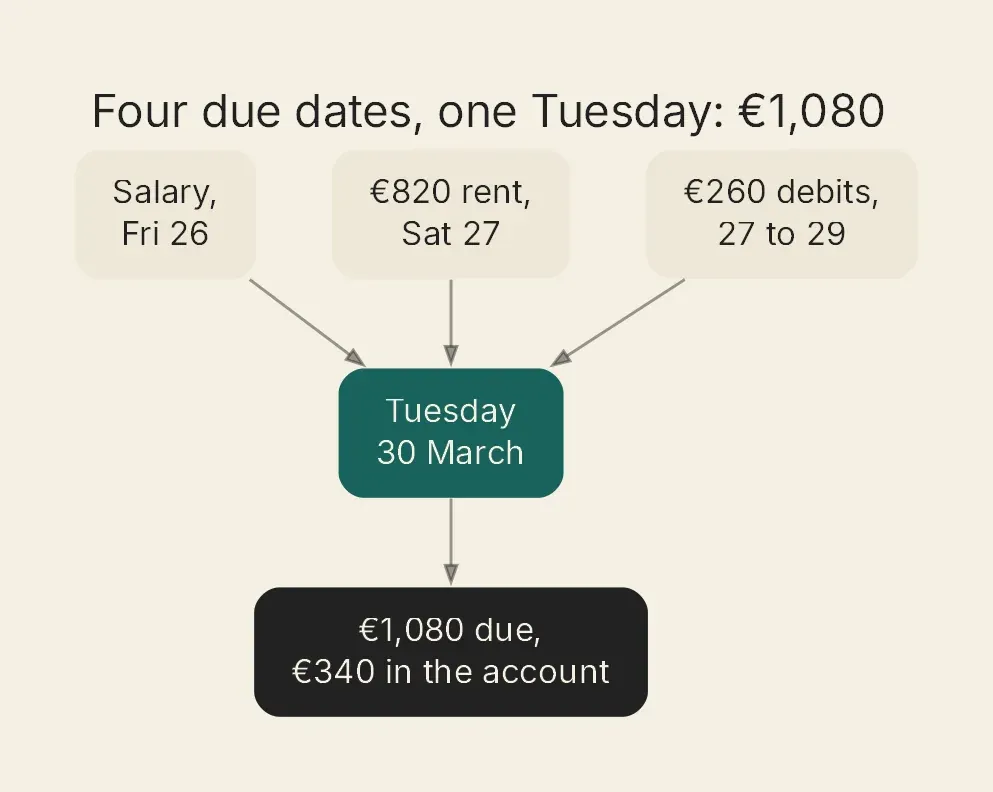
Applied one way round, the day passes and Marta never learns any of this. The other way round, the account is €740 short before the salary has touched it.
So the buffer has to survive four closed days of outflows landing together. Here, €1,080 on one Tuesday.
National law can move your pay date, and your outgoings stay where they are. Portuguese labour law (opens in new tab) pulls Porto’s pay backward: the salary must reach you on the due date or a working day before it. Slovenian labour law (opens in new tab) pushes the other way, moving a pay day that falls on a work-free day to the first working day after it. The rent still waits for the same morning, whichever way your own labour code points.
Standing order vs direct debit: which one can you still stop?
Both, if you get there before the money does. A standing order you can cancel or change in your app, online or at a branch; a direct debit you can refuse. They part company after the money has gone.
A standing order is yours: you set it up once, your bank sends the money, and once it’s fired it’s gone. Wikifin, the Belgian state financial-education body (opens in new tab), uses one word for a payment that has already run: irreversible. Next month’s is a different matter. You can end it online or at your branch, Ireland’s CCPC (opens in new tab) says, and the Irish payment services regulations (opens in new tab) put the cut-off at the end of the business day before the agreed date.
The direct debit is theirs, a request made each time, so you can refuse it. And because they have to ask, the amount can change. You also get at least 14 days’ notice of the amount and the date, unless you agreed to less when you signed up, which plenty of billers write into their terms in the part nobody reads.
Ending a direct debit is fiddlier than starting one. The CCPC says tell both your bank and the company, in writing, though your banking app may do it. Wikifin would rather you sent a registered letter. A state body, in 2026, still pointing you at the post office.
That difference decides the whole running order. The payment with no refund route belongs after the money has landed and before the collections are due. Nothing virtuous about it. You can still stop it if you spot the collision coming. The running order is there so you never have to.
| Payment type | On a closed day | Who starts it | Timing on an open day |
|---|---|---|---|
| Standing order | Does not run. Goes on the next day the system is open. | You, once, in advance | Within one banking business day |
| Direct debit | Does not run. Settlement moves to the next euro settlement day, then the debit moves to your own bank’s next direct-debit day. | The company, every time | Due date, settlement date and debit date are normally the same day |
| Instant transfer | Runs. All hours, all calendar days, bar short announced maintenance. | You, each time | Under 10 seconds |
Closed days are every Saturday, every Sunday and the six named settlement holidays. Behaviour per the SEPA credit transfer (opens in new tab) and direct debit (opens in new tab) scheme rulebooks.
Does a SEPA transfer arrive at the weekend?
SEPA (the Single Euro Payments Area) runs two kinds of transfer, and only one of them works at the weekend. An ordinary transfer waits for the next settlement day; the instant kind lands at any hour, any day of the year.
Since 9 October 2025, every euro-area bank has had to let you send instant payments, not only receive them (opens in new tab). That’s the escape hatch for the shifted month: move the money by hand, in ten seconds, instead of trusting the schedule.
Banks are covered by that rule. Providers licensed as payment or e-money institutions (opens in new tab) have until 9 April 2027, and several of the apps on your phone are licensed that way. The European Banking Authority keeps a register of them (opens in new tab).
N26 and Revolut are both banks, one licensed in Germany (opens in new tab) and one in Lithuania (opens in new tab), so the 2025 deadline already covers them.
Whether a scheduled payment fires at the weekend sits in the terms. N26 lets you choose instant as the transfer type (opens in new tab) when you set one up, and says those go “24 hours a day, 7 days a week”. Left on standard, it keeps the ordinary calendar.
We kept reading. The catch is further down the same page: go over your instant transfer limit on the day and the payment fails, with no automatic retry. That payment ignores the calendar and still answers to a limit in your app. You send that one by hand; the schedule carries on.
Revolut’s personal terms (opens in new tab) answer it in one line: schedule a payment for a non-business day and it goes on the next business day. The ordinary calendar, then. Examples as of August 2026, not endorsements and not advice; check your own provider’s terms.
Why is “nothing bounced” the wrong thing to check?
Because the worst version of this failure succeeds.
What happens when a direct debit bounces?
Ireland’s state consumer body, the CCPC (opens in new tab), states both outcomes in one place:
“If there isn’t enough money in your account, the payment may be returned unpaid and your bank may charge you a penalty. If the bank processes the payment anyway, your account may fall into an unauthorised overdraft, which can lead to additional fees.”
The second sentence is the expensive one.
Which one you get turns on a setting. One you have probably never seen. Certainly never chosen.
An account with no overdraft refuses the payment, says Belgium’s state financial-education body (opens in new tab). One with an agreed credit line pays it, on credit you agreed to. Where there’s no agreement at all and the bank pays anyway, you can land in the CCPC’s unauthorised overdraft, with its own separate fees. A loan you didn’t ask for, on the morning you could least afford one.
Check your balance on the morning of the debit date. If that number was uncomfortable and the payment went through anyway, the running order failed and you paid a fee to find out. Nothing about that is a discipline problem.
The returned version is slow, too. A failed collection can take up to five settlement days to come back. One that fails on the Thursday before Easter can sit there for well over a week. Clawing it back from a company that took it wrongly is a different job, run on the eight-week refund window.
What do you do when extra pay lands outside the monthly rhythm?
Once or twice a year, in most of Europe, money arrives that the monthly routine has no slot for. Legal right, or a company habit? Depends where you work.
In Germany, Austria and the UK there’s no legal right to any of it. None. What you get there comes from your contract, your collective agreement, or a habit the company has kept up long enough to count.
| Market | A legal right? | What arrives | When |
|---|---|---|---|
| Spain | Yes | Two extra payments a year (opens in new tab) | Christmas, and a month set by your collective agreement. Or spread over the year, in which case nothing lands as a lump sum. |
| Portugal | Yes | Christmas pay and holiday pay (opens in new tab) | Christmas pay by 15 December; holiday pay before the holiday starts, unless you agreed otherwise in writing. |
| Netherlands | Yes, capped, with an opt-out | Dutch holiday allowance, at least 8% of gross pay (opens in new tab). Pay above three times the minimum wage does not count toward the 8%, and above that level you and your employer can agree in writing on less, or none. | June by default in the statute, May or June in practice. |
| Slovenia | Yes | Slovenian holiday allowance, at least the minimum wage (opens in new tab), pro-rated if you work part time or are entitled to only part of the year’s leave | As a rule by 1 July. |
| France | Yes, after five unbroken years at 50 staff | A share of the profits (opens in new tab), where there were profits to share. Since 2025, firms of 11 to 49 owe something too, where taxable profit has run at 1% of turnover or better three years running. | Within five months of the company’s year end. Cash only if you ask inside 15 days. |
| Italy | Not statutory | The thirteenth month, from a 1946 collective agreement made binding on the covered categories by decree (opens in new tab) | December, in most collective agreements. |
| Germany, Austria (opens in new tab), UK | No | Christmas pay, holiday allowance, a thirteenth month, a bonus | Only where your contract, a collective agreement or long-standing practice puts it there. |
Most of that table is law. Italy’s comes from a 1946 agreement, made binding by decree in 1960 rather than by statute, and it binds the workers it covers all the same. Only the last row leaves it to your employer.
Not in the table? Your contract or your collective agreement decides it, same as everywhere else.
The running order for a lump sum is easier, for a boring reason: nothing is scheduled against it. No direct debit waits on a June windfall. You pick the whole sequence yourself, which is also why the money disappears: a lump-sum euro spends differently from a wage euro, whatever you meant to do with it.
How do you run a payday routine on an irregular income?
An irregular income rides exactly the same rails. What wobbles is when the money turns up, and how much of it there is.
If the timing wobbles, a transfer you can’t undo has no business sitting on a fixed day of the month; the money it depends on might not have arrived. Move the payments nobody else is waiting for off a date and onto a trigger: when the money lands, you send it, by hand, on the rail with no cut-off. Less tidy than automation. It works in the months automation doesn’t.
The amount is the harder one. Size the fixed payments to your floor rather than your average, because a fixed payment out against a variable payment in produces the overdraft above. It happens in the lean months, the ones you can least afford.
If you invoice for a living, business-to-business direct debits are a separate scheme (opens in new tab), with no refund right on a payment you authorised.
When else does the euro calendar shut for three days or more?
Every run of three or more closed days, 2026 to 2035. Find your pay date in the year you care about. Euro-wide only; your own bank adds its national holidays on top. Dull reading.
| Year | Easter | Other runs of three or more closed days |
|---|---|---|
| 2026 | 3 to 6 April | 1 to 3 May; 25 to 27 December |
| 2027 | 26 to 29 March | 1 to 3 January |
| 2028 | 14 to 17 April | 29 April to 1 May; 23 to 26 December (four days); 30 December to 1 January |
| 2029 | 30 March to 2 April | None |
| 2030 | 19 to 22 April | None |
| 2031 | 11 to 14 April | 25 to 28 December (four days) |
| 2032 | 26 to 29 March | None |
| 2033 | 15 to 18 April | 24 to 26 December |
| 2034 | 7 to 10 April | 29 April to 1 May; 23 to 26 December (four days); 30 December to 1 January |
| 2035 | 23 to 26 March | None |
Every run above comes off the ECB’s closing-day rule (opens in new tab), unchanged since December 2000. The same press release invited member states to “remove any legal impediments” to it. Settlement days went in first, and the law was asked to move.
Set the dates you actually control at least five days after your payday, at or below 28, and the ordinary months look after themselves. The next four-day run is Friday 26 March to Monday 29 March 2027. Nobody should have to know that about Easter. Put it in the calendar anyway.
Frequently asked questions
What date should you set a standing order for after your salary arrives?
How do you budget when you are paid once a month?
Does the law fix the day you get paid?
Sources (25)
- European Central Bank: What is T2?
- European Central Bank: Long-term calendar for TARGET closing days
- Central Bank of Cyprus: Bank holidays 2026
- European Payments Council: SEPA Credit Transfer Scheme Rulebook 2025 (EPC125-05)
- European Payments Council: SEPA Direct Debit Core Scheme Rulebook 2025 (EPC016-06)
- European Commission: New EU rules make instant euro payments faster and safer
- European Central Bank: Instant Payments Regulation
- European Banking Authority: Payment institutions register
- Competition and Consumer Protection Commission (Ireland): Paying your bills
- Wikifin (FSMA, Belgium): Paiements automatiques, domiciliation et ordre permanent
- Boletín Oficial del Estado (Spain): Estatuto de los Trabajadores, art 29 and art 31
- Rijksoverheid (Netherlands): Hoe hoog is mijn vakantiegeld?
- Ministrstvo za delo (Slovenia): Letni dopust in regres, ZDR-1 art 131
- Service-public (France): Participation aux resultats de l'entreprise
- Normattiva (Italy): D.P.R. 28 July 1960 no 1070, extending the 1946 interconfederal agreement
- Arbeiterkammer (Austria): Weihnachts- und Urlaubsgeld
- Procuradoria-Geral Distrital de Lisboa (Portugal): Código do Trabalho, art 263, art 264 and art 278
- Uradni list Republike Slovenije: Zakon o delovnih razmerjih (ZDR-1), art 134
- Irish Statute Book: European Union (Payment Services) Regulations 2018, reg 102 and reg 104
- European Central Bank: Eurosystem moves toward extending T2 operating hours
- ECB Banking Supervision: List of supervised entities (cut-off 1 January 2026)
- Lietuvos bankas (Bank of Lithuania): Revolut Bank UAB
- N26 Support: What are instant scheduled payments?
- Revolut Bank UAB: Personal Terms (Lithuania)
- European Payments Council: SEPA Direct Debit B2B Scheme Rulebook 2025 (EPC222-07)
— That's the lot. It is now night.
Want more of this in your Google results?
Add Money Owl as a preferred source, and Google will show our finance pieces higher when you search for them.
By Jure Jaklič
Founder and editor of Money Owl. Data analyst by trade; personal finance learned first-hand across six European countries.
Recommended

Liquidity in personal finance: which of your own money can you reach?
Liquidity is which of your own money you can actually reach. Map it onto European wrappers, then size the cash buffer none of the locked stuff can rescue.

How to audit your spending and find where it went
A bank statement is a diary you didn't mean to keep. Here's how to read it back and find where the money actually went.

Why you can't save money (it was never willpower)
You keep failing the willpower test because it was never a willpower test. Change the set-up, automate one transfer, and saving happens without you.