

The point.
- The timeline picks the product: the sooner you need the money, the safer and easier to reach it should stay.
- Build a cash emergency fund of roughly three to six months of essential spending first, sitting under every goal.
- One-year money belongs in an easy-access savings account, protected up to 100,000 euro per person, per licensed bank.
- One-to-five-year money (like a house deposit) often suits government bonds you hold to their payback date.
- Ten-year-plus money (like retirement) suits funds that spread your cash across many companies, where time smooths the bumps; values can fall as well as rise.
The point.
- The timeline picks the product: the sooner you need the money, the safer and easier to reach it should stay.
- Build a cash emergency fund of roughly three to six months of essential spending first, sitting under every goal.
- One-year money belongs in an easy-access savings account, protected up to 100,000 euro per person, per licensed bank.
- One-to-five-year money (like a house deposit) often suits government bonds you hold to their payback date.
- Ten-year-plus money (like retirement) suits funds that spread your cash across many companies, where time smooths the bumps; values can fall as well as rise.
You’re saving for a holiday next summer, a house deposit in a few years, and a retirement that sits decades off. Most people keep all three in the same savings account and quietly wonder if they’re doing it wrong.
You’re not, exactly. You just use one tool for three different jobs. Saving for short-term vs long-term goals comes down to one rule: the timeline picks the product. Money you need soon goes one place. Money you need much later belongs somewhere else entirely. Here’s where each pot should live.
Match the product to the timeline: keep one-year money in an easy-access savings account, hold five-year money in government bonds, and grow ten-year-plus money in funds that spread your cash across many companies. The sooner you need the money, the safer and easier to reach it should stay.
What is the difference between saving and investing?
Saving and investing are not the same, even though people swap the words as if they were. They are two separate tools, and one thing decides which you reach for: how long until you need to spend the money.
Saving keeps your money safe and easy to grab. The amount doesn’t bounce around. Put in 1,000 euro, it stays 1,000 euro, and you can take it out tomorrow. The catch? It grows slowly. So saving suits a goal that lands soon.
Investing works the other way. You put money into things that rise and fall in value, like company shares, for a better shot at growth over many years. It can swing hard from one year to the next. That suits a far-off goal, because time gives the swings room to settle down.
So which one should you pick?
Match the tool to the deadline. Money you need within a couple of years belongs in saving, where the amount stays steady. Money you won’t touch for a decade belongs in investing, where time smooths the bumps and the growth builds.
Should you build an emergency fund before you start?
Yes. Before you ladder any goal money, build one buffer first. An emergency fund covers life going sideways: a broken boiler, a sudden bill, a gap between jobs. It is the least exciting money you will ever own, and the only money that quietly turns a disaster into an inconvenience. It sits underneath all your goals, not on the ladder with them.
The reason is the same for everyone. With no buffer, a dead boiler forces you to raid a goal pot at the worst moment, when it’s down. The European Securities and Markets Authority, the EU markets watchdog, warns: do not commit money to a long-term investment if you think you might need it soon. So keep the buffer in cash you can reach instantly, and then start the ladder.
Before the ladder, work out which of today’s balance is already promised elsewhere. The sum that answers it is arithmetic, not a judgement call.
How much should sit in the buffer?
Most advice points to roughly three to six months of essential spending, held in an account you can tap the same day. Build it before the goal tiers. One emergency should never wreck three plans at once. Cash, easy to reach, kept apart from your goals.
Where should you keep money for a short-term goal like a holiday?
Where to put short-term savings stays the easy step. For a goal within about a year, like that summer holiday, you want a savings account you can pull money out of any day (sometimes called instant-access or high-yield): the kind that keeps your money’s value steady and lets you reach the cash fast, in exchange for a small return.
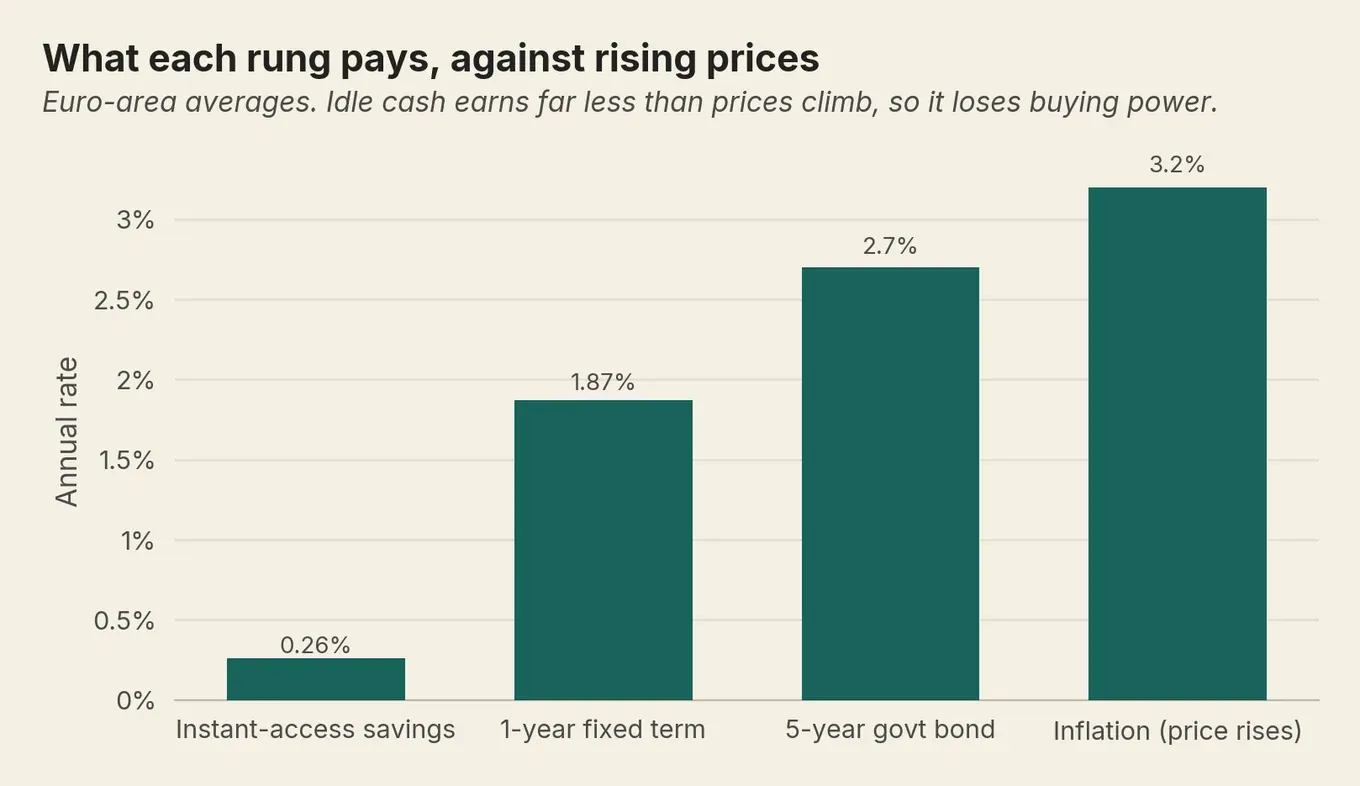
Across the euro area, an ordinary savings account you can dip into any time earns almost nothing right now. That’s around a quarter of one percent a year on average, on European Central Bank (opens in new tab) figures for April 2026. Lock the money away for a fixed year and that nudges up to roughly 2%. Those averages cover all banks, not the rate at any one account, so the best deals sit higher.
The return is small. For short-term money, that’s fine. You’re chasing safety here, not growth. You want the cash to hold its value and sit right there when the goal arrives. One detail trips people up: that EU safety net (set by an EU-wide rule) counts per licensed bank. Split 150,000 euro across two separately licensed banks and all of it is protected. Keep all 150,000 in one bank and 50,000 of it is not. Watch out too for banks that operate several brands under one banking licence, because those brands share a single 100,000 euro limit between them. Check the licence, not the logo. The scheme that pays you sits in the country where the bank holds its licence, not the country you live in. EU rules also protect temporary high balances above 100,000 euro for at least three months, covering things like the proceeds of a house sale, a redundancy payment or an insurance payout, though the amount and the window vary by country, so check your own scheme’s rules.
Take Sanne, 29, in Rotterdam, saving for next summer’s trip. She puts about 170 euro a month into instant-access savings, and after twelve months that is roughly 2,040 euro: enough for her 2,000 euro holiday, and reachable the week she flies. For one-year money, that steadiness is the whole point.
Is your cash protected if the bank fails?
Yes, up to a fixed limit. If your bank collapses, an EU-wide safety net repays up to 100,000 euro of your savings per person, at each licensed bank. An EU rule sets that level, and it holds the same across the EU, the European Commission (opens in new tab) confirms.
How do you save for a medium-term goal like a house deposit?
Where to save for a house deposit lands you with the awkward middle child. It feels too soon to invest, but it’s too far off to leave earning nothing. For a goal roughly one to five years away, the middle tier often means government bonds, sometimes blended with cash.
A government bond is a loan you make to a government for a set time. It pays you interest along the way and hands your money back on an agreed date. Right now, lending to euro-area governments for about five years pays roughly 2.7% to 2.9% a year, on European Central Bank (opens in new tab) bond figures for June 2026. That beats a savings account, and it bounces around less than the stock market, as long as you hold the bond until its agreed payback date.
Mateo, 34, in Valencia, is building a 20,000 euro flat deposit over about four years. He pays roughly 420 euro a month into a government-bond-and-cash mix, matching the bond’s payback date to when he plans to buy. Four years of contributions reach about 20,160 euro, steadier than shares and not at the mercy of one bad month.
What if the goal lands sooner than five years?
Match the bond’s payback date to when you need the cash. Hold it to that date and it acts like a simple loan. Sell early and you might get back more or less than you paid. For a goal under two years, lean cash-heavy. But if part of it can sit locked for a year or two, a savings ladder of staggered fixed-term deposits frees up one chunk each year while the rest keep earning.
Is retirement a long-term goal, and where should that money go?
Retirement sits on the top tier, and it changes the maths completely. For money you won’t touch for ten years or more, the goal shifts from keeping it safe to growing it, which points to funds that spread your money across lots of companies at once.
A fund like this pools lots of people’s money and buys a wide spread of company shares all at once. ETFs (exchange-traded funds, a fund you can buy and sell like a share) are one common kind. Spreading the money this way is what lowers your risk: if one company trips up, it doesn’t drag down the whole pot. Across the EU, most of these funds follow a shared rulebook called UCITS, a Europe-wide set of safety rules for everyday savers.
Here’s the part worth pausing on. Over the last 125 years, a broad spread of company shares grew faster than both cash and bonds, by an illustrative average of around 5% a year above inflation, on Cambridge Judge Business School (opens in new tab) figures. Treat that 5% as a rough, long-run illustration only, not a forecast of your return. Investment values can fall as well as rise, and you could get back less than you put in. Your actual return depends on the specific fund’s performance and the charges you pay, and recent decades ran lower than that long-run average.
Giulia, 41, in Bologna, drip-feeds 200 euro a month into one of those spread-out funds for her sixties. She pays in the same amount whether markets rise or fall, and ignores the dips. The win is the habit, not a magic number: regular money, a long wait, and the nerve to leave it alone.
Why does leaving long-term money in cash become the risky choice?
For a far-off goal, the safe-feeling choice, cash, quietly turns into the riskiest one. Euro-area prices climb about 3.2% a year, on Eurostat (opens in new tab) figures for May 2026, well above the roughly 0.26% a savings account pays. So cash left sitting there buys less and less over time. It looks safe. It isn’t.
Does that make investing a gamble?
No. Gambling flips a coin and hopes. Investing manages a risk you lower two ways: you spread the money across many companies, and you match the timeline to the product. Over a long goal, the bigger danger is doing nothing at all.
The EU’s markets regulator puts the same trade-off in one line:
“Potential greater returns come with greater risk.” ESMA (European Securities and Markets Authority), the EU’s markets regulator, Get ready to invest (investor education)
Do fees matter more on the long-term tier?
Yes, more than anywhere else. Charges nibble a little each year, and over decades those small bites stack up against you. A fund that costs less leaves more of the growth with you. So on the ten-year-plus tier, a small gap in charges adds up to the most.
Which pot goes where?
Here’s the whole ladder for saving for short-term vs long-term goals in one place. Read it this way: the sooner you need the money, the safer and more reachable it should stay; the longer you can wait, the more you let it grow.
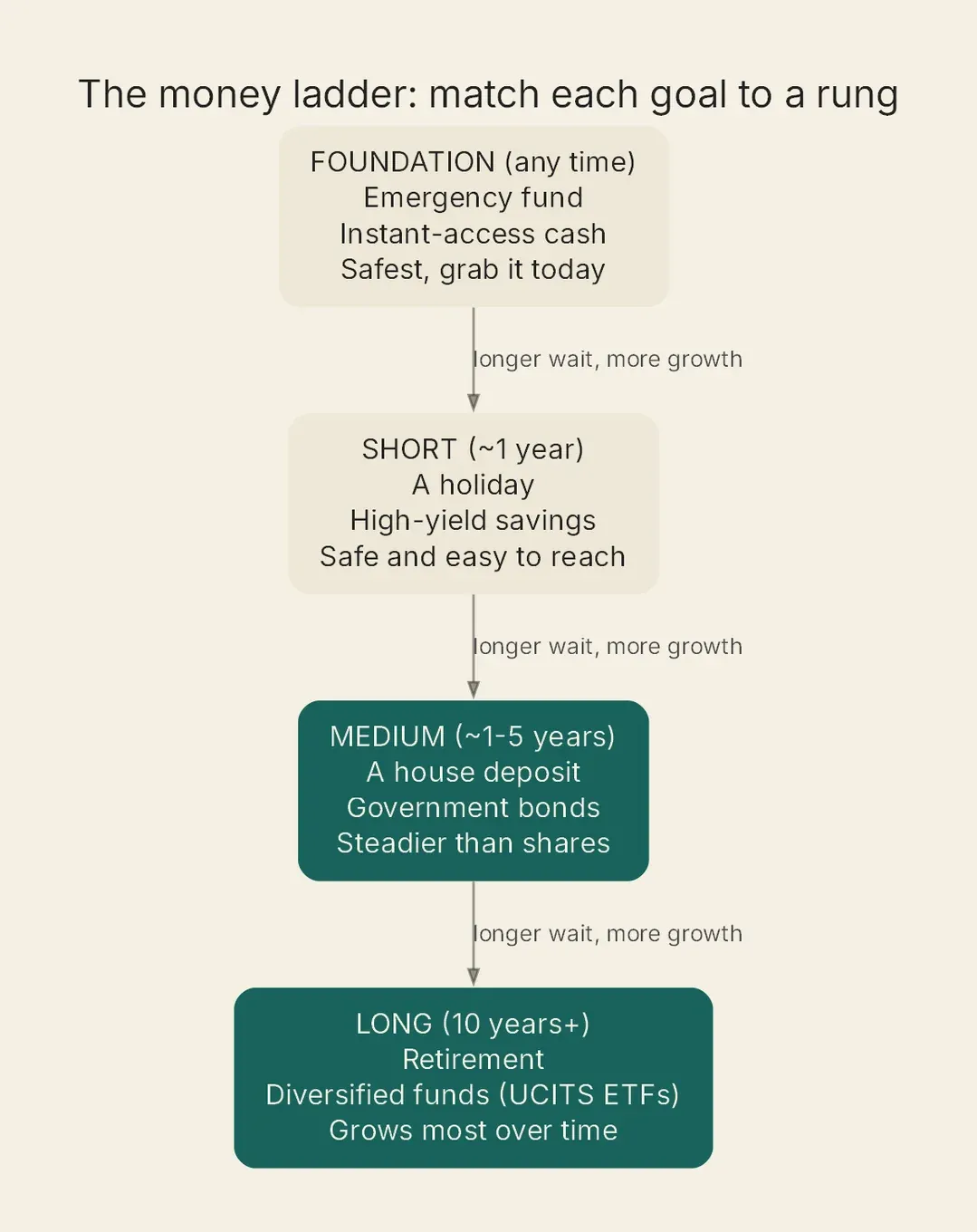
| Goal timeline | Example goal | Where the money goes | How easy to get at | Safety of your money | Growth you might expect |
|---|---|---|---|---|---|
| Foundation (any time) | Emergency fund | Instant-access savings | Instant | Strong (protected up to 100,000 euro per licensed bank) | Tiny |
| Short (about 1 year) | A holiday | High-yield or instant-access savings | Easy | Strong (protected up to 100,000 euro per licensed bank) | Small (around 0.3% to 2%) |
| Medium (about 1 to 5 years) | A house deposit | Government bonds, or a bond and cash mix | Fair (best held to the payback date) | High | Modest (around 2.7% to 2.9% for 5-year euro-area bonds) |
| Long (about 10 years or more) | Retirement | Diversified UCITS ETFs | Sellable any day, but meant to stay put | Lower year to year, higher over decades | Higher over the long run (illustrative only; values can fall as well as rise) |
It’s an unglamorous setup, and that’s the point. You don’t need a perfect portfolio or a finance degree. You need one pot per timeline: a cash buffer underneath, near-term money kept safe and reachable, medium-term money in something steadier than shares, and far-off money left to grow. Pick the tier that matches each goal, set it up once, and get on with your summer. The one-pot-for-everything habit was never a disaster. It just sent one tool to do three jobs. Now you know which tool each job wants.
Frequently asked questions
What is the difference between saving and investing?
Where should I keep money for a short-term goal like a holiday?
How do I save for a house deposit?
Is retirement a long-term goal?
Is my cash protected if the bank fails?
Does saving for a long goal in cash make investing a gamble?
Sources (6)
- European Central Bank: euro area savings and deposit rates (MFI interest rate statistics)
- European Central Bank: euro area government bond yield curves
- European Commission: deposit guarantee schemes (Directive 2014/49/EU)
- Eurostat: euro area annual inflation (HICP, May 2026)
- European Securities and Markets Authority: Get ready to invest (Investor Corner)
- Cambridge Judge Business School: stocks have far outperformed over the past 125 years
— That's the lot. It is now night.
Want more of this in your Google results?
Add Money Owl as a preferred source, and Google will show our finance pieces higher when you search for them.
By Jure Jaklič
Founder and editor of Money Owl. Data analyst by trade; personal finance learned first-hand across six European countries.
Recommended
Mental accounting: why a euro from a refund spends differently
A euro is a euro, but your brain files it into pots and spends each by a different rulebook. Spot the pots quietly costing you, keep the ones that save you.
How much should you have saved by 30, 40 and 50? The European answer
One year's salary by 30, three times by 40. That rule is American, and it assumes you fund half your own retirement yourself. Most of Europe already funds more, and most countries have a free government site where you can look yours up.
How to get back on track after overspending, without starting over
The bad month cost you one month. The nine you didn't go back cost nine times more. Restart at a figure that survives December, and keep the balance.