

The point.
- The euro-area easy-access rate averaged 0.27% in May 2026, against 1.92% for a one-year fix, a gap of roughly 1.6 percentage points (ECB, May 2026).
- Size your liquidity floor first: known outflows for the year ahead, plus a three-to-six-month emergency buffer (larger if your income is irregular or others depend on it), then lock only the surplus.
- A savings ladder splits that surplus across staggered maturities, so only one rung, not the whole balance, faces the reinvestment lottery each year.
- The ECB raised its deposit rate to 2.25% in June 2026 while the Bank of England held at 3.75%; nobody can call the next move with confidence.
- Even the best of these three strategies may still lose to inflation right now: euro-area prices rose 2.8% in the year to June 2026, above the 1.92% average one-year fixed rate.
The point.
- The euro-area easy-access rate averaged 0.27% in May 2026, against 1.92% for a one-year fix, a gap of roughly 1.6 percentage points (ECB, May 2026).
- Size your liquidity floor first: known outflows for the year ahead, plus a three-to-six-month emergency buffer (larger if your income is irregular or others depend on it), then lock only the surplus.
- A savings ladder splits that surplus across staggered maturities, so only one rung, not the whole balance, faces the reinvestment lottery each year.
- The ECB raised its deposit rate to 2.25% in June 2026 while the Bank of England held at 3.75%; nobody can call the next move with confidence.
- Even the best of these three strategies may still lose to inflation right now: euro-area prices rose 2.8% in the year to June 2026, above the 1.92% average one-year fixed rate.
You have money in a savings account and a nagging sense you’re doing the wrong thing with it. Fix it and lock the rate? Leave it where you can reach it any day? Nobody can call the next move, and mid-2026 proves it.
For most of 2025, savers waited for rates to keep falling. Then, in June 2026, the European Central Bank did the opposite and lifted its deposit rate to 2.25%, its own key-rate page shows (opens in new tab), having bottomed at 2.00% only a year earlier. So much for the plan.
A savings ladder is the third option most guides skip, and the one that survives being wrong about rates. What follows compares all three, stay flexible, fix one term, or build a ladder, judged on what each does to your money when the next move is a coin toss.
What is a savings ladder, and how does it work?
A savings ladder splits one lump sum across several fixed-term deposits set to mature in different years, say one, two, and three. One rung frees up each year, so you keep rolling access to some cash while the rest stays locked at fixed-term rates. Over a full cycle the whole balance still reprices; a ladder spreads that, it does not dodge the trend.
Who should weigh this up, and who can skip it?
This piece assumes you already hold a lump sum above your day-to-day spending and you’re deciding what to do with it. If you’re building a first buffer from nothing, the call is simpler: keep saving where you can reach it, and come back when a surplus appears. And clear any expensive debt first, credit cards, overdrafts, buy-now-pay-later; no savings rate here beats the 10% to 20% a year, or more, that clearing it saves you. For matching money to a timeline, our guide to short-term versus long-term goals does the horizon work.
Everyone else faces a genuine trade-off between reaching the money and earning on it. Take Inês in Porto: €8,000 covers her known bills and a buffer, and €12,000 sits idle on top. That kind of idle surplus is what this decision turns on.
How do easy access, a fixed term, and a savings ladder compare?
First, the yardsticks. Five things separate these strategies: how fast you reach the cash, the rate you earn against the cycle, your exposure to reinvesting later at a worse rate, the admin, and the deposit protection behind it. None of the three sweeps the board.
| Strategy | Reaching your cash | Rate against the cycle | Reinvestment risk | Effort |
|---|---|---|---|---|
| Stay easy-access | Any day, no penalty | Variable, reprices quickly | High and constant: the whole balance follows every move | Almost none |
| Fix one term | Locked to maturity; breaking early forfeits interest | Fixed for the term | Concentrated: the full sum reinvests on one date | Low, a single decision |
| Build a ladder | One rung matures each year, rolling access | A blend of fixed rates across several terms | Spread: one rung reprices at a time | Higher: several accounts, tracked dates |
The euro-area figures come from the ECB’s bank interest rate statistics (opens in new tab) for May 2026, and they carry the argument. The ECB’s 2.25% is its policy anchor, the rate it pays banks, not what a saver earns. Easy-access paid 0.27% on average; a one-year fix paid 1.92%, revised up from the 1.91% in that release’s first print. That gap of roughly 1.6 percentage points measures what any-day access costs you.
Both saver figures are gross. Savings interest is taxed differently by market (Irish DIRT, German Abgeltungsteuer, the French flat tax, the Dutch Box 3), so your net return runs lower, more so where tax is high.
A fix does the reverse: it holds the rate steady for the term precisely because you surrendered access. Liquid does not mean protected.
Can you take money out of a fixed term early?
Sometimes, and it costs you: fixed-term access is restricted, the Competition and Consumer Protection Commission explains (opens in new tab), and breaking a term early typically forfeits interest or is refused outright. Treat anything you lock as money you won’t need until it matures, and keep your easy-access floor big enough that you’re never forced to break a rung.
How much of your savings should stay in easy access?
Keep enough in easy access to cover your known outflows for the next year, plus an emergency buffer of three to six months of essential spending. Retirees often hold one to three years. And if your income is irregular, or others lean on it, size the buffer at the top of that range or beyond before you lock anything. Size the floor first. Lock only what sits on top.
The three-month floor comes from StepChange (opens in new tab); the wider retiree range is standard consumer guidance, not a regulator’s rule. This beats the blanket “three to six months” advice, because it adds the bills and planned spending you already know are coming.
Should you split your savings between fixed and easy access?
Yes, and a ladder is the disciplined way to do it. Keep your liquidity floor in easy access for reach, then spread the surplus across staggered fixed terms so one rung always matures soon. That combines rolling access with fixed-tier rates, though the blend usually earns a little less than the best single long fix.
Should you fix now to catch the peak before it goes?
No. The fixed rate on the table today already prices in what markets expect rates to do next, so you’re not grabbing yesterday’s peak, as the ECB has spelled out (opens in new tab). You buy certainty for the term and shed reinvestment risk. Worth having. Hardly a free lunch stolen from the bank.
Staying flexible carries its own cost, mind. An easy-access rate reprices continuously, not once at a maturity date, so a falling cycle nibbles the whole balance every month.
Will savings rates fall further?
Nobody can say for certain, and that’s the point. The ECB raised its rate in June 2026, citing inflation pressure it linked to the war in the Middle East, its decision statement shows (opens in new tab), while the Bank of England has held at 3.75% (opens in new tab). Both banks revisit rates on a set schedule, the ECB’s Governing Council (opens in new tab) and the Bank of England’s rate-setting committee (opens in new tab). That uncertainty argues for a ladder, not against it.
How do you build a savings ladder?
Split the money you can lock into several fixed terms with staggered maturities, say three equal rungs at one, two, and three years. Each year one rung matures and hands you rolling access; you reinvest it into a fresh top rung while the rest stay fixed. No wealth threshold applies beyond each account’s minimum deposit. On a smaller surplus the rungs shrink toward that minimum and the pickup thins, so scale the rungs to the sum, or skip the ladder.
How long should you fix each rung for?
Match the longest rung to the furthest date you can safely commit, then space the rest evenly below it. Longer rungs pay a little more but lock you in longer, so let your liquidity floor, not the headline rate, decide the ceiling.
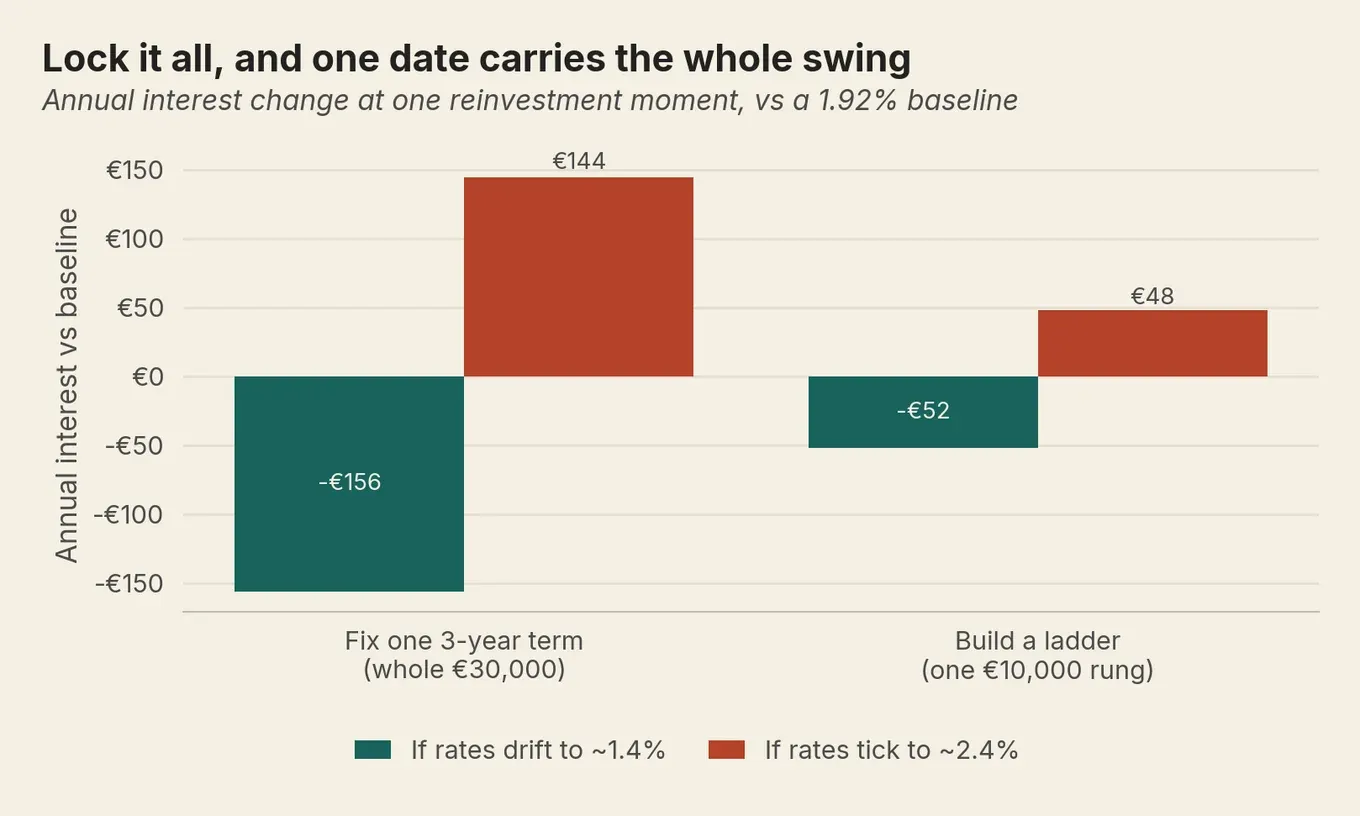
Lena in Leipzig has €30,000 above her floor. She splits it into three €10,000 rungs at one, two, and three years. This is illustrative, not a forecast: savings rates can fall as well as rise, and what each maturing rung earns next depends entirely on the provider and the rate on offer when she reinvests. Spreading the rungs means she never reinvests the whole €30,000 at a single, possibly bad, moment. Diarise each maturity date too, or a provider may quietly roll a maturing rung into a worse term.
Picture the moment her first rung matures. Rates might have drifted down to around 1.4%, or ticked up to around 2.4%; nobody can promise which way. Lock the whole €30,000 in one three-year term instead, and that single reinvestment date decides the fate of every euro at once, for better or worse. Leave it all in easy access, and the whole balance reprices every month regardless of which way the cycle turns. The ladder puts only one rung, €10,000, in the path of that uncertainty each year. You still fret; you just fret over less.
Across the euro area, the core mechanics are the same, early-exit rules aside, though availability, minimum deposits, and tax vary by market. The best rates sometimes sit on cross-border platforms, covered by the deposit-taking bank’s own national scheme, not yours.
| Market | Local term for a fixed-term deposit |
|---|---|
| Germany | Festgeld |
| France | Compte à terme |
| Spain | Depósito a plazo |
| Italy | Conto deposito vincolato |
| Netherlands | Termijndeposito |
| Portugal | Depósito a prazo |
| Slovenia | Vezana vloga |
| Ireland / UK | Fixed-term or fixed-rate account |
So which strategy wins?
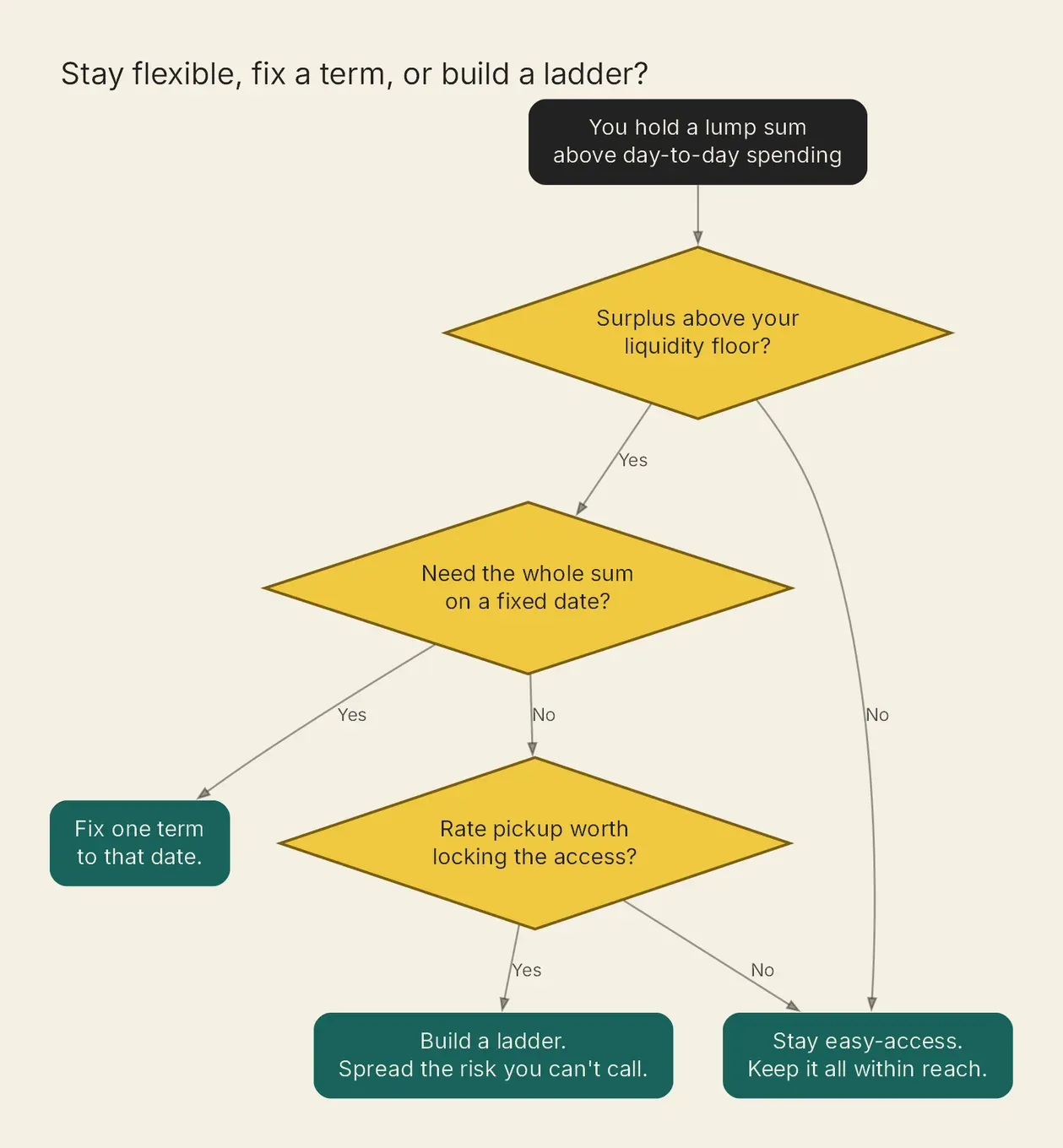
For most people with a genuine surplus above the liquidity floor and no fixed date they need the money, the savings ladder is the lowest-regret choice: not best in every world, but the one that refuses to make you bet on rate direction. The admin runs smaller than it sounds: Maja in Ljubljana keeps three rungs inside one banking app and checks them twice a year. That combines rolling access with fixed-tier rates, which neither pure easy-access nor a single fix gives her together.
One honest caveat. Winning here doesn’t mean beating inflation. Euro-area prices rose 2.8% in the year to June 2026, Eurostat reports (opens in new tab), while the average one-year fix paid 1.92%. Even the best of these three may hand you a small loss in real terms right now. A ladder spreads the reinvestment risk across dates rather than removing it. It can’t touch the risk it cannot spread, inflation. None of that means cash is pointless. Its job here is certainty and quick access, not growth, and money you truly won’t touch for years is a different, riskier call.
When does fixing or staying flexible win instead?
Fix a single term when your horizon sits fixed and known, you want the money whole on a set date, and one clean decision beats juggling several. Stay fully flexible when your liquidity floor already swallows most of the balance, or when the pickup from locking looks too thin to bother with.
Two traps catch savers whichever route they pick. One is rate-chasing: hopping to whichever provider tops the easy-access table this week. Switching takes time, your cash can sit out of the market during it, and the rate you chased can be cut again the week after.
The other trap is the protection ceiling. Cover reaches €100,000 per person per licensed bank, harmonised EU-wide under the EU Deposit Guarantee Schemes Directive (opens in new tab) (2014/49/EU), so several rungs at the same bank share one ceiling rather than one each. The scheme that repays you is the one in the country where the bank holds its licence, not the country you live in. The ceiling is per banking licence, not per brand: two differently-named banks that share a licence share a single limit, so check the licence, not the logo, before you spread money past it. UK savers get different cover, FSCS protection of £120,000 (opens in new tab) since 1 December 2025. Where to find these accounts is a separate job, and our guide to high-yield savings accounts covers the shopping.
The ECB’s jump to 2.25% in June 2026 wrong-footed a market braced for cuts. That is the ladder’s whole case: it never needs you to call the next move right. Set your rungs up on a quiet afternoon, and stop refreshing the rate tables.
Frequently asked questions
Should you fix your savings now, or stay in easy access?
How much of your savings should stay in easy access?
What are the pros and cons of a fixed-rate savings account vs easy access?
How do you build a savings ladder?
Will savings rates fall further?
Sources (12)
- European Central Bank: Key ECB interest rates
- European Central Bank: Euro area bank interest rate statistics, May 2026
- European Central Bank: Monetary policy decisions, 11 June 2026
- European Central Bank: Governing Council monetary policy meeting calendar
- European Central Bank: Rate expectations blog, 16 January 2026
- Eurostat: Euro area annual inflation (HICP)
- Competition and Consumer Protection Commission (Ireland): Compare savings accounts
- StepChange: How to save for an emergency
- European Commission: Deposit guarantee schemes (Directive 2014/49/EU)
- Bank of England: Interest rates and Bank Rate, latest decision
- Bank of England: Upcoming MPC dates
- Financial Services Compensation Scheme: What we cover
— That's the lot. It is now night.
Want more of this in your Google results?
Add Money Owl as a preferred source, and Google will show our finance pieces higher when you search for them.
By Jure Jaklič
Founder and editor of Money Owl. Data analyst by trade; personal finance learned first-hand across six European countries.
Recommended

The best savings account in Europe is the one that lets you keep the most
The headline rate on a savings account is rarely what you keep. Post-tax yields in Germany, France, Ireland, Slovenia and beyond tell a very different story.

How to audit your spending and find where it went
A bank statement is a diary you didn't mean to keep. Here's how to read it back and find where the money actually went.

The subscription audit: how to find and cancel recurring expenses
Run a 30-minute subscription audit: find every recurring charge, cancel it, and use your EU bank and SEPA rights to make it stop.