

The point.
- Liquidity is how fast you can turn an asset into spendable cash without taking a loss, and the test is penalty-free access, not whether the asset can be sold at all.
- Already-locked money never counts as your buffer: a pension balance cannot rescue you in a crisis by design, so the more you lock away, the larger your accessible cash cushion has to be in plain euro terms.
- European wrappers lock differently: a UK pension waits for an access age (currently 55, rising to 57 on 6 April 2028), a French PEA closes the whole plan on any pre-five-year withdrawal, a German Riester claws back its top-ups, a Spanish plan de pensiones frees a decade at a time, while a standard ISA stays fully liquid.
- Build the buffer in two tiers after clearing high-interest debt: a small spending-shock cushion for this week's surprise bill in front of a larger income-shock reserve worth several months of outgoings, scaled to how fragile your income feels.
- Idle cash beyond your buffer loses real value: euro-area inflation runs ahead of easy-access deposit rates, so cash for what is near, growth for what is far.
The point.
- Liquidity is how fast you can turn an asset into spendable cash without taking a loss, and the test is penalty-free access, not whether the asset can be sold at all.
- Already-locked money never counts as your buffer: a pension balance cannot rescue you in a crisis by design, so the more you lock away, the larger your accessible cash cushion has to be in plain euro terms.
- European wrappers lock differently: a UK pension waits for an access age (currently 55, rising to 57 on 6 April 2028), a French PEA closes the whole plan on any pre-five-year withdrawal, a German Riester claws back its top-ups, a Spanish plan de pensiones frees a decade at a time, while a standard ISA stays fully liquid.
- Build the buffer in two tiers after clearing high-interest debt: a small spending-shock cushion for this week's surprise bill in front of a larger income-shock reserve worth several months of outgoings, scaled to how fragile your income feels.
- Idle cash beyond your buffer loses real value: euro-area inflation runs ahead of easy-access deposit rates, so cash for what is near, growth for what is far.
You don’t want to lock money away in case you need it. You also half-suspect that a big pile of idle cash is the lazy, slightly stupid answer. Both instincts are right. The fix is knowing exactly which of your own pots you can reach in a hurry, and which you can’t touch for years.
Liquidity is how fast you can turn an asset into cash you can spend, without taking a loss. For a European household it’s the gap between money you can reach today, your current account and easy-access savings, and money locked in a pension or a French PEA you can’t get at for years. That gap is the whole game.
Search “liquidity personal finance” and most of what comes back was written for someone in Ohio. It explains the idea through a 401(k) and a certificate of deposit, neither of which you own. This guide maps liquidity in personal finance onto the wrappers a European household actually holds and the rules that lock them, then turns “how much should be within reach?” into a rule you can stand behind.
Why does liquidity matter in personal finance for a European household?
Liquidity keeps you from selling the wrong asset at the worst moment. A cash buffer soaks up a sudden shock, so a market dip never forces you to sell investments at a loss. Idle cash, meanwhile, quietly loses real value to inflation.

Take the first half of that. The Financial Conduct Authority (opens in new tab) does not dress it up: investment values can fall as well as rise. Say a boiler dies the same week your fund is down a fifth, and you have no cash. You sell the fund. You lock in the loss for good. A paper dip turns permanent.
This is the bit people miss. An asset you can sell is not the same as an asset that’s liquid when you need it. Shares and the cheap index funds known as ETFs are easy to sell on any normal Tuesday. Forced to sell during a downturn, though, you sell at low prices. Liquidity has a timing side too: the asset is only truly liquid for you if you can sell it when you choose, not when the market chooses for you.
The regulator draws the same line the wrapper table turns on: the test of liquidity is penalty-free access, not whether an asset can be sold at all.
These mainstream products offer access to your money should you need it, without the need to pay significant fees or penalties.
Financial Conduct Authority, “Advantages of mainstream investments” (last updated 17 May 2022).
So a cash buffer you can reach never counts as dead money. It stops you dumping your investments in a panic. It earns its keep by doing nothing, on the one day a year it matters.
Here’s the other side, and it bites. Cash held idle loses real value. The European Central Bank (opens in new tab) aims for inflation of 2% over the medium term, but euro-area prices currently run hotter: Eurostat (opens in new tab) put the all-items rate at 3.2% in May 2026. So €10,000 left in a drawer loses roughly €320 of real spending power a year later. The drawer robs you slowly. And the ECB’s deposit facility rate (opens in new tab), the floor for what banks earn, sits at 2.25%, so even a good easy-access account likely pays less than inflation. Your buffer should stay safe, not grow. Money you won’t need for years, though, has no business shrinking in a savings account.
That tension sits at the heart of this. Too little cash you can reach and a downturn forces your hand. Too much and inflation eats it. The answer isn’t a vibe. It’s a sizing call, settled by how soon you need the money.
What does holding too much cash cost you?
Idle cash loses real value because inflation runs ahead of savings rates. With euro-area prices climbing faster than easy-access accounts pay, any cash you hold beyond your buffer steadily buys less, so playing it too safe carries a quiet cost.
How much of your money should you keep liquid versus locked away?
Keep enough within reach to cover a spending shock, an income shock, and any big payment you know is coming soon. Lock the rest into growth, which can fall as well as rise. Here’s the catch: already-locked pension money never counts as reachable, so the more you lock, the more cash you hold alongside it.
The honest answer is a sum you build up, not a headline percentage. Anyone who tells you to keep a flat “X% of your net worth liquid” is selling a tidy number that doesn’t survive your actual life. The version you can stand behind breaks into three parts.
First, a small spending-shock cushion for the surprise bill that arrives this week. Second, a larger income-shock reserve for the loss of earnings that plays out over months. Third, any big payment you already know is coming, a deposit, a tax bill, a wedding. Add those three, hold them in cash or easy-access savings, and that sum is the money you keep within reach. Anything beyond it can go to the growth or locked end.
Now the part the American guides can’t tell you, because their wrappers work differently. Already-locked money does not count. A pension balance never forms part of the cushion you can reach, because you can’t get at it in a crisis by design. Treating a locked pot as if it were a reserve is the most expensive sizing mistake a European household makes.
How shaky your income feels sizes the reserve too. A two-earner household with two secure public-sector jobs sits at the cautious-but-lower end. A single freelancer with lumpy invoices and no sick pay sits at the upper end, or beyond it. The usual buffer range gives you the anchor; where you sit inside it reflects your own honest read of how steady your income looks.
European households do save. Euro-area households put away around 15% of their gross disposable income in the third quarter of 2025 (opens in new tab), according to Eurostat. The money exists. The open question is never whether you save. It’s which slice stays within reach.
Why does the buffer grow as you lock more away?
Locked money can’t rescue you in a crisis, so the cash you can reach carries any emergency alone. Tie up more in pensions and equity wrappers and your cash cushion has to grow in plain euro terms to make up for it. The two amounts move together. Splitting a statement total into what you can reach and what stays locked is exactly the habit behind tracking your liquid net worth month by month.
Which European wrappers lock your money up, and for how long?
European pension wrappers each lock money on their own terms: a UK pension waits for an access age, a French PEA enforces a five-year rule, a German Riester claws back its top-ups on early exit, and a Spanish plan de pensiones frees up a decade at a time. A standard ISA, by contrast, stays liquid.
This is the map nobody draws for you. Each market locks money differently, and the differences aren’t small. Before you lock away any more, you need to know what each wrapper does when you try to get your money out early. Here’s the lie of the land across five markets.
| Wrapper (market) | How it locks money | Earliest normal access | Cost of getting out early |
|---|---|---|---|
| Workplace or private pension (GB) | Retirement pot, locked by age | Currently 55, rising to 57 from 6 April 2028 | A heavy tax bill on any payout before that age |
| Standard ISA (GB) | Tax-free savings, fully liquid | Any time | None |
| Lifetime ISA (GB) | First-home or retirement saver | Age 60, or buying a first home | 25% government withdrawal charge |
| PEA (FR) | Equity savings plan, soft lock | 5 years from opening | A pre-5-year withdrawal closes the whole plan and taxes the gains |
| Riester-Rente (DE) | Subsidised private pension | Around age 65 | Surrender claws back the state top-ups and the tax relief |
| Plan de pensiones (ES) | Private pension, rolling release | A contingency, or contributions over 10 years old | Locked until the window reaches that vintage |
| PRSA (IE) | Personal pension | 60 to 75 (earlier from 50 on leaving work) | Locked until access age, then flexible |
Two corrections matter before the table makes sense, because GB savers misjudge their wrappers in both directions. They think the pension opens sooner than it does, and the ISA is locked when it isn’t. Plan around a pension age of “57” today and you risk being wrong either way: some savers hold a protected earlier age under their scheme’s own rules, and until April 2028 the age is still 55. Pull money out before your access age and you trigger a heavy tax bill. The ISA runs the opposite way: a standard cash or stocks-and-shares ISA stays reachable at any time (opens in new tab), and a flexible one lets you put the money back in the same tax year. Treat it as untouchable and you hold more cash than you needed.
When can you reach a UK pension or ISA?
A UK pension locks until the minimum pension access age, currently 55 and rising to 57 on 6 April 2028 (opens in new tab). A standard ISA, by contrast, stays fully liquid: take it out any time, tax shelter intact.
Why is a Lifetime ISA not a buffer?
A Lifetime ISA charges a 25% government withdrawal charge on whatever you take out early, other than for a first home, terminal illness, or reaching age 60 (opens in new tab). It borrows the friendly word “ISA” but behaves like a locked wrapper, so keep it out of your cushion.
How does the French PEA five-year rule work?
Per Service-Public.fr (opens in new tab), any ordinary withdrawal from a Plan d’Epargne en Actions before it turns five years old generally closes the whole plan and taxes the gains. A small voluntary dip in year four can cost you the entire wrapper, not just tax on the bit you took.
What does cashing in a German Riester cost?
Cashing in a Riester-Rente early counts as what the Germans call a “harmful use” (schädliche Verwendung). Per the Federal Ministry of Finance (opens in new tab), you hand back the state top-ups (the Zulagen) plus the tax relief you claimed. The statement value flatters what you’d actually keep.
A reformed, more flexible private-pension product is scheduled to arrive from 1 January 2027, but that’s a future date, not today’s rule. For now, the Riester exit penalty stands, and a Riester pot belongs firmly at the locked end of your map.
Does a Spanish plan de pensiones stay illiquid?
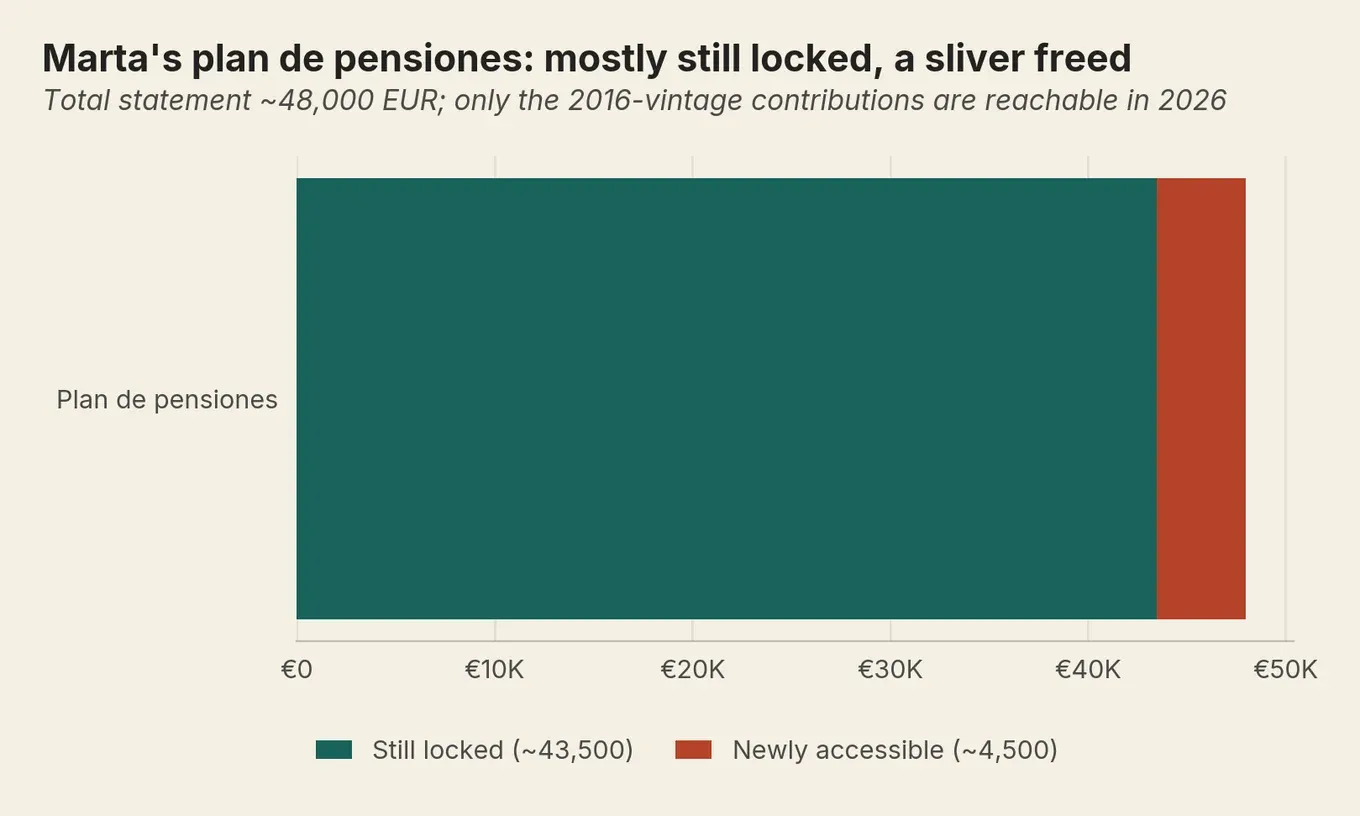
Not flatly, not any more. Since 1 January 2025 a rolling window releases plan de pensiones contributions made over ten years ago without justification, per the Banco de España (opens in new tab). By 2026, 2016 contributions have come free; each January peels back another year.
Marta, 41, runs a small physiotherapy practice near Valencia. Her plan de pensiones statement reads roughly €48,000, and for years she filed it mentally under “untouchable until I’m 65”. So she kept a heavy cash cushion alongside it, more than her steady-ish income really needed, because if the locked pot could never rescue her, the reachable one had to carry every shock alone. The fear made sense; the sizing did not. Checking the rules in early 2026, she found the rolling ten-year liquidity window, live since January 2025, had quietly freed her oldest contributions: the roughly €4,500 she paid in back in 2016 she could now take out, no reason needed. She didn’t touch a euro of it. What changed was the map. Her “locked” pot was less locked than she feared, so her emergency cash never needed to be that big. She trimmed the excess, and slept fine.
When can you access an Irish PRSA?
A Personal Retirement Savings Account normally opens between age 60 and 75 (opens in new tab), per Revenue, earlier from 50 on leaving the related job, and at any age on serious ill-health, per the CCPC (opens in new tab).
What happens to a PRSA after you retire?
At retirement an Irish PRSA holder takes a 25% tax-free lump sum (up to €200,000), then moves the balance into a drawdown pot (an Approved Retirement Fund) and dips into it for life. The wrapper locks late, then opens fully.
How big should your accessible cash buffer be?
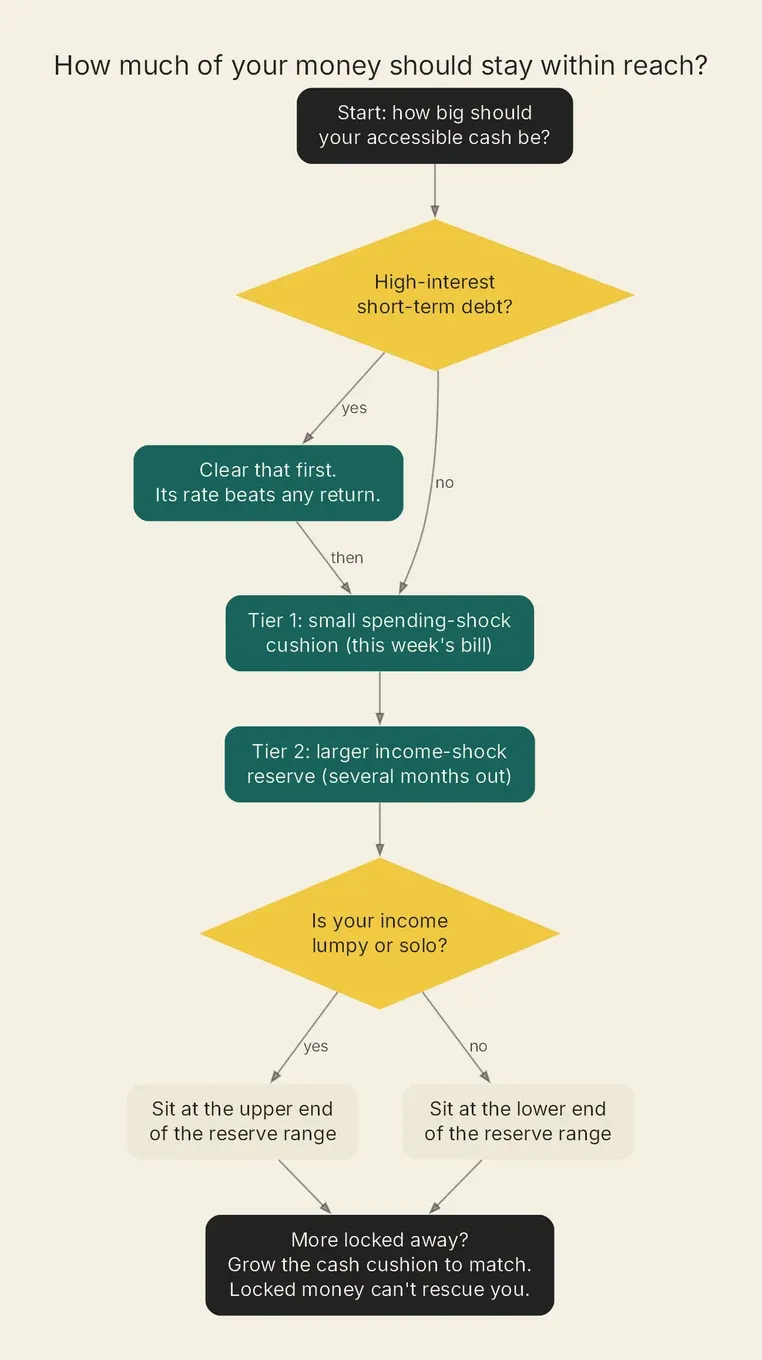
Build the buffer in two tiers: a small spending-shock cushion for this week’s surprise bill, sitting in front of a larger income-shock reserve worth several months of outgoings. Clear high-interest debt first, then size the reserve to how fragile your income feels.
One job comes before the buffer: clear high-interest short-term debt. The FCA (opens in new tab) is blunt about the order. The rate on most short-term debt runs many times higher than the return on any investment, so paying it off beats holding cash and beats investing. There’s no sense earning 2% on savings while a card charges you 23%. Kill that first.
Why two tiers and not one? Because two different things can go wrong. The front tier stays small and soaks up a spending shock: the boiler, the car, a bill that lands this week. The back tier runs larger and soaks up an income shock: redundancy or illness that plays out over months. The usual anchor for that larger reserve spans several months of outgoings, a range the FCA and most consumer guidance settle on. Treating that range as the headline takeaway misses the point, though. The point is the split itself. The small front buffer stops a €600 surprise from forcing you to sell investments or raid the income reserve.
Where you land inside the range is the income-steadiness call from earlier. Steady joint income, lower end. Lumpy solo income, higher end. And remember the flip side: the more you have locked into pensions and equity wrappers, the larger this reachable cushion needs to be in plain euro terms, because none of the locked money can rescue you.
Where should the buffer sit?
Park it in savings you can truly reach, where the balance can’t drop, never in your current account earning nothing and never in anything a downturn could force you to sell at a loss. Easy-access and short fixed-term accounts both fit, depending on when you might need it. The buffer itself stays reachable. For any surplus beyond it that you can safely lock away, a savings ladder staggers fixed terms so a slice still matures each year.
Picking between those two homes, and grasping how deposit protection works, is a topic in its own right, covered in our guide to getting the most from a savings account. And once you’ve split the cash you need soon from the money you can lock away for years, the next question is matching each pot to when you’ll need it, which is the whole point of saving for short-term versus long-term goals.
If you want one illustration of why the timing matters, take €10,000 you won’t touch for a decade. Left in cash losing ground to 3.2% inflation, it buys less in real terms year on year. Invested over the same ten-year-plus stretch it has a chance to grow instead. That’s an illustrative comparison, not a promise: investment values can fall as well as rise, and actual returns depend on the fund’s performance and charges. The point is the rule of thumb, not the figure. Cash for what is near, growth for what is far, and a buffer that means you never have to confuse the two.
There’s no cleverness in it. It’s a list of which pots you can reach and a cushion sized to your own nerves. The real prize isn’t a sharper number. It’s the quiet confidence of logging into your accounts during the next real emergency and finding the money already sitting there, reachable, waiting, so you never have to sell the wrong thing on the worst day.
Frequently asked questions
When can you reach a UK pension or ISA?
Why is a Lifetime ISA not an emergency buffer?
How does the French PEA five-year rule work?
Does a Spanish plan de pensiones stay illiquid?
How big should your accessible cash buffer be?
Sources (15)
- Financial Conduct Authority: Should you invest?
- Financial Conduct Authority: Advantages of mainstream investments
- Service-Public.fr: Plan d'epargne en actions (PEA)
- Bundesministerium der Finanzen: Reform der gefoerderten privaten Altersvorsorge (FAQ)
- Banco de Espana (Cliente Bancario): Que aportaciones al plan de pensiones puedo rescatar
- GOV.UK: Lifetime ISA, withdrawing money from your Lifetime ISA
- GOV.UK: Individual Savings Accounts (ISAs), withdrawing your money
- GOV.UK: Increasing the Normal Minimum Pension Age
- Revenue Commissioners (Ireland): Personal Retirement Savings Accounts (PRSAs)
- Revenue Commissioners (Ireland): Taxation of retirement lump sums
- Competition and Consumer Protection Commission (Ireland): Personal Pensions
- European Central Bank: Price stability, why is it important for you?
- European Central Bank Data Portal: deposit facility rate
- Eurostat: HICP all-items 12-month rate (ei_cphi_m)
- Eurostat: Household saving rate in the euro area (Q3 2025, April 2026 revision)
— That's the lot. It is now night.
Want more of this in your Google results?
Add Money Owl as a preferred source, and Google will show our finance pieces higher when you search for them.
By Jure Jaklič
Founder and editor of Money Owl. Data analyst by trade; personal finance learned first-hand across six European countries.
Recommended

Money and mental health: how to calm the worry and the bank balance
Money worry and a worried mind feed each other in two loops. Here's how to ease both at once, with free EU mental-health and debt help near the end.

The best savings account in Europe is the one that lets you keep the most
The headline rate on a savings account is rarely what you keep. Post-tax yields in Germany, France, Ireland, Slovenia and beyond tell a very different story.

The cost of doing nothing with your money, and what to fix first
Four money lines go stale at once: savings, tariffs, an uninvested surplus, and a pension rate you never set. Here's the ten-year bill, and what to fix first.