

The point.
- A coast FIRE number is what you need invested today so growth alone reaches your target at pension age. The target is 25 times the yearly gap between the income you want, before tax, and your gross state pension.
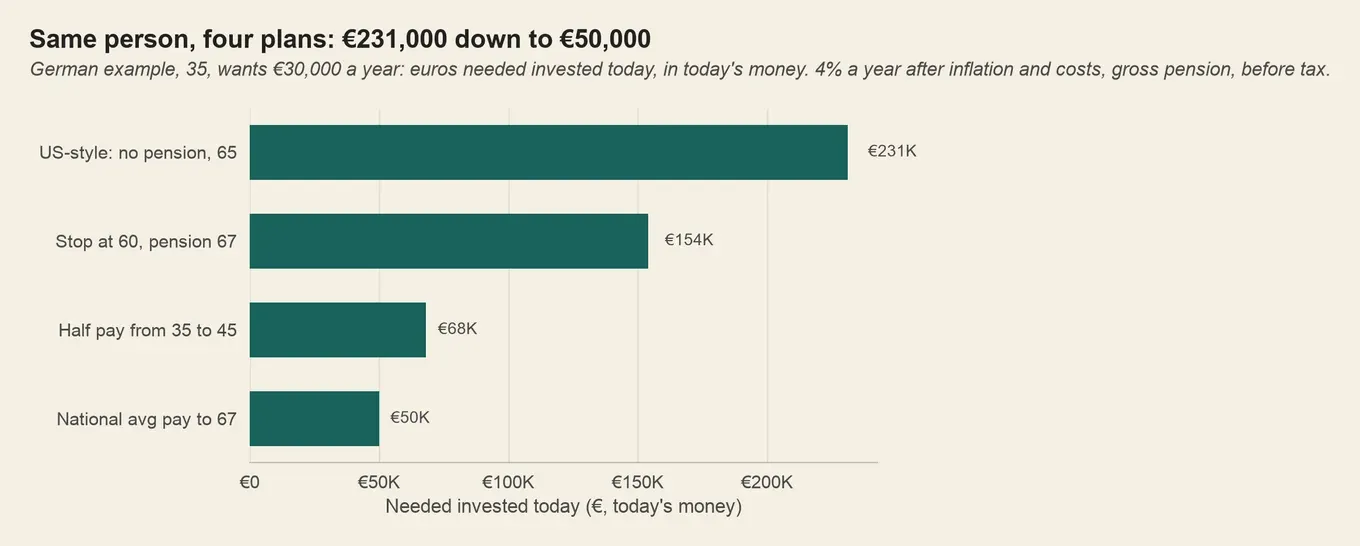
- Illustrative, not a forecast: a German 35-year-old wanting €30,000 a year before tax needs about €231,000 invested today the American way (no pension, retire at 65). Count the gross state pension from 67, on Germany's average pay throughout, and it's about €50,000. Both assume 4% a year after inflation and costs. Income tax and health contributions come out of the €30,000, like out of a salary. Investments can fall as well as rise, and actual returns depend on fund performance and charges.
- Illustrative, not a forecast: a single Dutch 35-year-old, insured all along for the full AOW (the Dutch state pension) and working until it starts, wants €30,000 a year before tax. They need about €57,000 invested today before Box 3, the Dutch tax on the pot. Under the 2026 rules, counted for life, Box 3 more than triples that, to about €180,000, if the pot has the tax-free allowance to itself. A September 2026 proposal to change those rules isn't law as of 30 October 2026. Both figures assume 4% a year after inflation and costs. Investments can fall as well as rise.
- Stop work before your state pension starts and your pot has to pay for the bridge, the years in between. The Dutch AOW can't be claimed early, so it covers none of them.
- In Germany each year's pay buys pension points, so working less shrinks your state pension. In the Netherlands it slows your workplace pension instead, if you have one.
- Your finish line is the state pension age, whatever you type into a calculator. As of 30 October 2026 Germany's is 67 in law for anyone born from 1964, although the German government said in July 2026 that it wants a link to life expectancy in law. The Dutch AOW age for younger people is only expected, because it already follows life expectancy.
Coast FIRE is early retirement for people who don’t especially need to retire early; they’d settle for being told they can stop saving for it. Your coast FIRE number is that permission in euros: what you need invested today so growth alone does the rest while you keep working. Work it out American-style, on your whole spending and retiring at 65, and a 35-year-old who wants €30,000 a year before tax needs about €231,000. Lovely.
Count the state pension and work until it starts, and that’s about €50,000 in Germany, on exactly the national average pay from 22 to 67. In the Netherlands, single and insured all along for the full AOW (the Dutch state pension), it’s about €57,000, until you count Box 3, the Dutch tax on the pot. Under the 2026 rules the tax carries on after you retire, and counted for life it more than triples that, to about €180,000, if the pot has the tax-free allowance to itself. Box 3 pushes the American-style figure up by even more.
Those are illustrative figures at 4% a year after inflation and costs, not forecasts. Investments can fall as well as rise, and actual returns depend on fund performance and charges.
The pension figures are 2026 values from German pension law and the Sociale Verzekeringsbank (SVB), which runs the AOW. Like the €30,000, they’re gross. Coast on less pay and Germany’s state pension shrinks, because every year’s pay buys pension points. The AOW keeps building whatever you earn while you’re insured in the Netherlands (for most people, while you live there), so the cost lands on your workplace pension instead.
Before any of it works, you need to know what you’ll want to live on each year, and what the state will already pay you by then.
How do you calculate your coast FIRE number?
Take the yearly income you’ll want in retirement, before tax, subtract the state pension you expect, and multiply that gap by 25 to get your target. Divide it by the growth you expect between now and the year your state pension starts, and you have your coast FIRE number.
The table does the dividing, because 1.04 to the power of 32 is not a job for a phone. Each cell is what you need invested today for every €100,000 of target, rounded to the nearest €100. Every return is a real return, after inflation and fund costs, so the euros stay in today’s money. The cells are before Box 3. Be wary of the short rows: with five or ten years to go, one bad stretch in the markets can eat the growth built into those cells. On those, use the 2% column or keep saving.
| Years to state pension (€ invested today per €100,000 of target) | 2% after inflation and costs | 3% after inflation and costs | 4% after inflation and costs | 5% after inflation and costs |
|---|---|---|---|---|
| 5 | €90,600 | €86,300 | €82,200 | €78,400 |
| 10 | €82,000 | €74,400 | €67,600 | €61,400 |
| 15 | €74,300 | €64,200 | €55,500 | €48,100 |
| 20 | €67,300 | €55,400 | €45,600 | €37,700 |
| 25 | €61,000 | €47,800 | €37,500 | €29,500 |
| 30 | €55,200 | €41,200 | €30,800 | €23,100 |
| 35 | €50,000 | €35,500 | €25,300 | €18,100 |
| 40 | €45,300 | €30,700 | €20,800 | €14,200 |
| 45 | €41,000 | €26,400 | €17,100 | €11,100 |
-
Work out your gap: the yearly income you’ll want, before tax and in today’s money, minus the gross state pension on your statement. Take a before-tax pension off an after-tax spending figure and you’ve flattered yourself by the size of your tax bill.
-
Multiply the gap by 25. That’s your target.
The 25 comes from the 4% rule of thumb: take 4% of the pot in the first year, then the same amount raised with prices. A 2018 study of maximum withdrawal rates (opens in new tab) questions it, partly because the rule was built on US data and a 30-year horizon. If that makes you nervous, use 30. That 4% is for spending the pot later, and is a different 4% from the growth in the examples.
-
Pick your row (years until your state pension starts) and your column (the return you’re prepared to believe). If your years fall between two rows, use the shorter one; it errs on the high side.
-
Divide the target by 100,000 and multiply by the figure in that cell.
Say your gap is €8,000 a year. Times 25 is €200,000, which is two lots of €100,000. Your pension starts in 30 years and you’d rather assume 3%, so the cell says €41,200 and you need about €82,400 invested today.
For the spreadsheet people: target ÷ (1 + real return) to the power of the years.
How much does the state pension knock off your coast number?
About three-quarters, in both examples, if you work until it starts. That’s before Box 3. The German 35-year-old’s four plans all use the same illustrative 4% and €30,000 a year.
Where do the German and Dutch figures come from?
The Dutch example is a single 35-year-old who has been insured in the Netherlands all along and gets the full AOW. That’s €1,662.16 a month gross from 1 July 2026 (opens in new tab), so about €21,200 a year, holiday allowance included. Their gap is about €8,800 and their target about €220,000. The finish line is an expected AOW age of 69 years and 3 months. That’s 34 and a quarter years away. Couples get €1,139 a month gross each (opens in new tab), so each partner needs about €101,000 instead of €57,000 before Box 3, if each wants €30,000 a year of their own.
The German example is a 35-year-old who has earned exactly the national average every year since 22. Improbably. That buys one pension point (Entgeltpunkt) a year. A point is worth €42.52 a month gross (opens in new tab) from 1 July 2026, so 45 points pay €1,913 a month, about €23,000 a year, from 67. Gap about €7,000, target about €176,000, 32 years to go.
Income tax on the pension and on what you take out comes out of the €30,000, Germany’s flat-rate tax on fund gains (opens in new tab) included. So do the health contributions that come off a pension.
Both pensions are taken at today’s value. By law they follow wages (opens in new tab), and the figures assume that keeps them at least level with prices, which is the hopeful part. If the German one turns out 10% smaller, the coast number rises from about €50,000 to about €67,000 (20% smaller: about €83,000). Leaving the pension out, American-style, does buy a margin against exactly this, and not cheaply. Ignore the pension but still work to 67 and the €50,000 becomes about €214,000. The Dutch figure also leaves out any workplace pension on top.
What does the Dutch tax on the pot do to the number?
Under the 2026 rules, counted for life, Box 3 takes the Dutch 35-year-old from about €57,000 to about €180,000 invested today, on their gap and their years, if the pot has the tax-free allowance to itself. It’s a yearly tax worked out from the value of what you hold above that allowance, €59,357 a person in 2026 (opens in new tab). You pay it whatever you take out, including nothing. Savings held elsewhere share that allowance and push the number up. That €180,000 counts the tax while the pot grows and after you retire.
The government proposed in September 2026 (opens in new tab) to lower the tax-free allowance from 2027 and to tax gains on shares and other financial instruments from 2028. In October, after parliament objected, it said it would rework part of the proposal (opens in new tab) and promised a revised plan for November. None of it is law as of 30 October 2026, and these figures use the 2026 rules.
What if you want to stop working before your state pension starts?
Your pot has to pay for the bridge, the years between your last payslip and your first state pension. Stop at 60 and the Dutch 35-year-old needs about €161,000 invested today instead of €57,000, before Box 3, or about €354,000 with Box 3 counted for life. The German 35-year-old needs about €154,000 if they wait for the pension at 67.
Between 60 and 69 and a quarter, the Dutch example gets no AOW at all (opens in new tab), so nine years and three months of €30,000 a year come out of the pot. Taking the pension off your spending, then aiming at 60, is the expensive mistake: it leaves the bridge out, so your coast number comes out at roughly half the €161,000 you’d actually need. If redundancy or illness picks the date for you, the stop-at-60 figures are roughly what it costs, before any benefits.
As of 30 October 2026, Germany lets you claim early from 63 if you have 35 years in (opens in new tab), at a cut of 0.3% for every month early (opens in new tab): 14.4% at 63. Stopping at 60 also means no more points, so the German example would have 38 rather than 45. And if they’re voluntarily insured in the public health scheme once they stop, they pay health contributions on all their income (opens in new tab), investment income included. The early-claim cut stays for life. Whether that’s worth it depends on how long you live, which nobody tells you in advance.
Stopping early takes two lookups in the same table. Work out your target on the pension you’ll actually get (in Germany, without the points you won’t earn). Shrink it back to the age you’ll stop, on the row for the bridge years, or the shorter row if they fall between two. Add a full year’s income for each bridge year, not grown, which errs on the high side. Then shrink the total back to today on the row for the years until you stop. For the Dutch one, the 5-year row (for nine years and three months) and the 25-year row give about €172,000 before Box 3, a little above the formula’s €161,000.
Why is the finish line the pension age, and can it move?
A calculator lets you type 60 into the retirement box if you like. The state pension age is set by law, and the law can move it. In the Netherlands anyone born from 1 October 1964 can’t yet know exactly what theirs will be.
Dutch law (opens in new tab) ties the AOW age to two-thirds of each gain in life expectancy, so the SVB’s ages for younger people (opens in new tab) are only expected. If you were born between 1 April 1999 and 31 December 2000, it’s expected (the civil-service word for probably) to be 70.
In Germany the age in law, as of 30 October 2026, is 67 for anyone born from 1964. A government pension commission has recommended linking it to life expectancy. In July 2026 the government said (opens in new tab) it wants to carry out the commission’s recommendations in full.
Will working less while you coast shrink your pension?
Germany’s state pension is built from each year’s pay, so a lower-paid year buys fewer points and you feel the pay cut twice. The Dutch AOW builds on the years you’re insured, mostly by living there. So a pay cut there lands on your workplace pension instead, if you have one.
Everywhere else, the OECD’s pension tables (opens in new tab) give the outline and your pension body eventually answers the rest.
| Market | State pension built from | Question for your pension body |
|---|---|---|
| France, Portugal, Slovenia, Spain | Earnings-related | Whether a lower-paid year shrinks it |
| Ireland, UK | A flat basic pension | What counts towards your contribution record |
| Italy | A notional account built from contributions | What a lower-paid year adds |
What does a half-pay year buy in German pension points?
A year on roughly €26,000 buys half a pension point (opens in new tab), since the provisional 2026 average pay (opens in new tab) is €51,944. Halve the German 35-year-old’s pay from 35 to 45 and five points go, about €213 a month of pension for life in today’s money. On the illustrative 4%, the coast number goes from about €50,000 to about €68,000.
The Renteninformation (opens in new tab), the pension statement that arrives every year from age 27, assumes you’ll do no such thing. Its headline projects your pension as if you keep paying in at your average of the last five calendar years, at today’s pension value with no future rises (opens in new tab). So, as long as pensions keep pace with prices, it’s close to today’s money already. Resist the urge to knock inflation off it. If you plan to earn less, start from the pension you’ve already earned, which the statement shows separately. Then add one point, €42.52 a month at today’s value, for every future year at Germany’s average pay, and half that for a year at half of it.
Does working less shrink the Dutch AOW?
The AOW builds by 2% for every year you’re insured (opens in new tab) over the 50 years before your AOW age, however much you earn. Coast somewhere cheaper abroad and it stops building, unless you apply for voluntary insurance within a year of leaving (opens in new tab). That cover usually runs for 10 years at most (opens in new tab). Keeping the AOW building in a country you’ve left costs 17.9% of your income, at least €569 and at most €5,693 a year in 2026 (opens in new tab), for as long as that cover lasts.
The premium on a workplace pension is a percentage of your pensionable pay, so less pay, or stopping work early (opens in new tab), builds less pension. Dutch pension law (opens in new tab) at least lets you keep what you’ve already built if your pay drops or you stop. Under newer pension contracts, though, its value can still go down as well as up.
What return should your coast FIRE number assume?
I’d assume something between 2% and 5% a year after inflation and fund costs, and look across all four columns. Over 32 years, assuming 7% instead of 4% more than halves the coast number, and the German 35-year-old’s €50,000 drops to about €20,000.
Some coast calculators start you on 7% after inflation. American shares returned 6.6% a year after inflation from 1900 to 2025 (opens in new tab), in dollars, before anyone took a fee. So the default asks a European’s fund, after its charges, to beat a century and a quarter of the American stock market before its charges. I wouldn’t plan the next 30 years on it.
Shares worldwide (opens in new tab) did 5.2% a year after inflation over 1900 to 2024, before costs, and past returns are no guide to future ones. ESMA (opens in new tab), the EU markets regulator, puts the EU average over 2020 to 2024 at about 0.5% a year for equity ETFs and about 1.9% for other equity funds. Take those recent costs off the 5.2%, before tax, and it comes to roughly 4.7% a year for an equity ETF. Other equity funds, a little over 3%, so check which kind you hold before you pick a column.
Can you stop saving once you hit your coast number?
Once you have cash you can reach in an emergency and no expensive debt compounding the other way, permission granted. If either is missing, the next euro goes there. Then only money invested for growth counts towards the number. If you believe 4%, keep saving until you’re past what the 3% column says.
The 4% in the examples assumes a pot mostly in shares, the kind behind that 5.2% history. Shares can fall a long way in a bad stretch. Cash in a savings account, the emergency fund included, doesn’t count.
You stop saving into the pot and carry on going to work, because until the state pension starts your pay covers your life and, in Germany, keeps buying pension points. Once it starts, the pot only has to cover the gap, plus Box 3 in the Netherlands.
The number also rests on a return you picked and a pension age the government can move. Re-run it each time a new pension statement turns up.
Where do you find the pension figure the whole sum hangs on?
From whoever will pay the pension: the SVB and mijnpensioenoverzicht.nl in the Netherlands, your Renteninformation in Germany, or your national pension body.
Counting the pension sounds easy if you’ve had one employer in one country. I’ve had workplace pensions in the UK, Ireland and Gibraltar, and I’m self-employed in Spain now. So mine come in pieces. Pulling them together is a bit messy, not least because some of the pension funds got taken over by other companies.
Whatever shape yours are in, get the state pension figure first and count workplace pensions as margin; the financial independence calculator has no pension box and a stricter withdrawal rate than the 4% here, so it shows the whole pot you’d need on the day you retire, with no pension at all.
Sources (29)
- Sociale Verzekeringsbank: AOW amounts
- Sociale Verzekeringsbank: your AOW age
- Sociale Verzekeringsbank: income before your AOW age
- Sociale Verzekeringsbank: how the AOW builds up
- Rijksoverheid: what happens to your pension if you stop working early
- Gesetze im Internet: Rentenwertbestimmungsverordnung 2026
- Gesetze im Internet: SGB VI section 77, early-claim reduction
- Gesetze im Internet: SGB VI section 68, yearly pension adjustment
- Gesetze im Internet: Sozialversicherungs-Rechengrößenverordnung 2026
- Deutsche Rentenversicherung: Entgeltpunkte
- Deutsche Rentenversicherung: Meine Post von der Rente (Renteninformation)
- Bundesregierung: FAQ pension reform
- OECD: Pensions at a Glance 2025, future retirement ages
- ESMA: Costs and performance of EU retail investment products
- UBS: Global Investment Returns Yearbook 2026, summary edition
- Cambridge Judge Business School: stocks have far outperformed over the past 125 years
- IESE (Estrada): the maximum withdrawal rate
- Deutsche Rentenversicherung: Die Renteninformation, mehr wissen
- Gesetze im Internet: SGB VI section 36, early claim at 63
- Belastingdienst: calculating Box 3 income 2026
- Eerste Kamer: cabinet letter on Box 3 proposals, 29 September 2026
- Tweede Kamer: cabinet letter on the 2027 tax package, 9 October 2026
- Sociale Verzekeringsbank: conditions for voluntary insurance
- Sociale Verzekeringsbank: how long you can insure voluntarily
- Overheid.nl: Pensioenwet
- Overheid.nl: Algemene Ouderdomswet (AOW), article 7a
- Gesetze im Internet: SGB V section 240, voluntary members' contribution base
- Gesetze im Internet: EStG section 32d, flat-rate tax on capital income
- Sociale Verzekeringsbank: what voluntary insurance abroad costs
— That's the lot. It is now night.
Want more of this in your Google results?
Add Money Owl as a preferred source, and Google will show our finance pieces higher when you search for them.
By Jure Jaklič
Founder and editor of Money Owl. Data analyst by trade; personal finance learned first-hand across six European countries.
Recommended

What is financial independence? Not a permanent holiday
Financial independence is a coverage test, not a wealth level: non-work income covers your costs, so work turns optional. Europe changes the maths.

What is your 'enough' number? How to define your financial finish line
Your enough number is the pot that replaces a wage. Europe's version beats America's 25x rule, and even hitting it will not feel like enough.

The 4% rule for European retirees: does it still hold up in 2026?
3% to 3.5%, not 4%: that's the realistic safe withdrawal rate for a European retiree living off a portfolio. Here's what moves it, and why.