

The point.
- "Employer pension contributions" is not one rule: only Ireland and Britain set a legal minimum, Germany pays a conditional top-up, the Netherlands leaves it to each sector, and Spain requires nothing.
- The headline percentage usually matters less than the base it is charged on, and sometimes less than whether you opt in (Germany), have a plan at all (Spain), or can bargain for it (the Netherlands): Britain uses a middle earnings band, Ireland gross up to a cap, Germany only the salary you convert, the Netherlands gross minus a state-pension offset.
- To tell a floor from a genuine match, ask one question: does your employer's contribution rise when yours does? If it stays put whatever you add, you are being paid the legal minimum and no more.
- The lever to get more paid in differs by country: opt up and use salary sacrifice in Britain, use the older occupational or PRSA route in Ireland, convert salary to switch on the top-up in Germany, bargain collectively in the Netherlands, and in Spain push your employer to set a plan up.
The point.
- "Employer pension contributions" is not one rule: only Ireland and Britain set a legal minimum, Germany pays a conditional top-up, the Netherlands leaves it to each sector, and Spain requires nothing.
- The headline percentage usually matters less than the base it is charged on, and sometimes less than whether you opt in (Germany), have a plan at all (Spain), or can bargain for it (the Netherlands): Britain uses a middle earnings band, Ireland gross up to a cap, Germany only the salary you convert, the Netherlands gross minus a state-pension offset.
- To tell a floor from a genuine match, ask one question: does your employer's contribution rise when yours does? If it stays put whatever you add, you are being paid the legal minimum and no more.
- The lever to get more paid in differs by country: opt up and use salary sacrifice in Britain, use the older occupational or PRSA route in Ireland, convert salary to switch on the top-up in Germany, bargain collectively in the Netherlands, and in Spain push your employer to set a plan up.
Your employer pays into your pension, so that’s one job you can cross off the list. Except “employer pension contributions” sounds like a single settled fact. Cross a border and it turns into five different things. Five.
In Ireland and Britain, the law makes your employer pay in. Germany only chips in if you first give up some salary. The Netherlands has no national rate, yet almost everyone’s covered. In Spain, an employer can pay nothing into your pension and stay within the rules.
So the honest first question is a plainer one: is there a legal minimum where I work, and what’s it a percentage of? Those two answers change everything, and almost nobody lays them side by side.
One number gets quoted a lot, and it’s worth ignoring first. The OECD (opens in new tab) reckons the combined mandatory contribution across its member countries averages about 18.8% of earnings (2024 figures). People wave that around as “the employer contribution rate”. It is not. It blends state social security with workplace pensions, and tells you nothing about what your own boss must pay.
Here’s what decides the answer.
So how much must your employer pay in?
It depends entirely on which of five systems you’re in. Only Ireland and Britain set an explicit employer percentage. Germany runs a conditional top-up on the salary you convert. The Netherlands leaves the rate to each industry. Spain requires nothing at all.
Picture it as a line. At one end, an explicit legal floor: the employer must pay a set minimum, whatever you do. That’s Ireland and Britain. In the middle, a conditional top-up: the employer pays, but only on money you actively move across into a pension. That’s Germany. Further along, sector rules: no national figure, but a collective agreement can make a pension compulsory for your whole industry. That’s the Netherlands. At the far end, nothing: a pension is a nice-to-have the employer may offer, or may not. That’s Spain.
Reading this from France, Italy, Portugal, or elsewhere? Find your own country on the same line: a legal floor, a conditional top-up, sector rules, or nothing. The shape holds even where the detail shifts, so check yours locally.
The EU itself sets no rate. Brussels coordinates cross-border schemes (opens in new tab) and caps how long you can be made to wait before the money is properly yours, at three years. Beyond that, every country writes its own rules, which is why a single “European answer” doesn’t exist.
What is the minimum employer pension contribution in Ireland, the UK, Germany, the Netherlands and Spain?
There is no single European minimum. Ireland requires 1.5% at launch, rising to 6% by 2035. The UK sets 3% of a middle earnings band. Germany adds 15%, but only on the pay you convert. The Netherlands leaves it to each sector, where the employer pays about two-thirds. Spain requires nothing at all. The base each rate is charged on matters far more than the headline rate.
| Market | Scheme (what it is) | Is there a legal minimum? | What the employer must pay | Which slice of gross it’s charged on | Ceiling / limit |
|---|---|---|---|---|---|
| Ireland | My Future Fund (auto-enrolment), alongside older occupational schemes and PRSAs | Yes, live since January 2026 | 1.5% at launch, rising to 6% by 2035, matched, plus a State top-up | Gross pay up to the €80,000 cap | Older route: up to 100% of salary into a PRSA |
| UK | Workplace pension (auto-enrolment) | Yes, since 2019 | 3% (of an 8% total; you add 5%) | The £6,240 to £50,270 qualifying-earnings band (2026/27) | £60,000 annual allowance (the employer’s share counts) |
| Germany | Betriebliche Altersvorsorge, via Entgeltumwandlung (salary conversion) | No general floor; a conditional subsidy | 15% of the pay you convert, where it cuts the employer’s social security | Only the converted slice of pay | Tax-free up to €8,112 (8% of the 2026 ceiling); only €4,056 of it escapes social security |
| Netherlands | Second-pillar pension fund (a workplace pension), set by sector agreement | Quasi, by sector agreement; no national rate | About two-thirds of a sector-set premium | Gross minus the €19,172 state-pension offset (2026) | Set per sector |
| Spain | Planes de pensiones de empleo (workplace plan) | No; purely voluntary | Nothing required; discretionary via collective bargaining | Whatever the plan defines | €1,500 you, plus €8,500 shared headroom the employer fills or you match, €10,000 combined; 10% employer tax deduction (proportional above €27,000 salary) |
So here’s each country in plain terms.
Ireland: a legal floor that switched on in 2026
Since January 2026, Ireland has had a legal employer contribution for the first time, through the auto-enrolment scheme My Future Fund (opens in new tab). By mid-2026, more than 760,000 workers (opens in new tab) had come within its scope.
The test is simple. If you’re aged 23 to 60, earn over €20,000 a year across all your jobs, and aren’t already in a workplace pension, you’re in. Your employer pays 1.5% of your gross pay to start, matched by you, with the State adding €1 for every €3 you contribute. Those rates climb every three years and reach 6% from the employer, 6% from you and 2% from the State by 2035. Employer and State money stops at €80,000 of pay.
One wrinkle catches higher earners. Your auto-enrolment share comes out of your after-tax pay, and the State’s €1 for every €3 stands in for the usual tax relief. If you pay the 40% higher rate, a traditional PRSA or occupational scheme can hand you more back. Even so, don’t opt out of auto-enrolment just to chase that relief. Leave, and you give up the employer’s matched contribution too.
The older route still runs alongside it: traditional workplace schemes and PRSAs (personal retirement savings accounts). There, an employer contribution is not a benefit-in-kind (opens in new tab) (a taxable perk) for you. Since 1 January 2025, an employer can pay up to 100% of your pay into a PRSA; occupational schemes instead follow Revenue’s maximum-funding limits. There was never a minimum on those. The minimum only arrived with auto-enrolment.
The UK: a legal 3% floor
British workers have had a legal floor since 2019. If you’re aged 22 to State Pension age and earn at least £10,000 a year, your employer must enrol you and pay in. The total minimum is 8% of your “qualifying earnings”. Your employer covers at least 3% of that, and you cover 5%, the government’s tax relief included (gov.uk (opens in new tab), The Pensions Regulator (opens in new tab)).
The catch is that base. “Qualifying earnings” isn’t your whole salary. For 2026/27 it’s the slice between £6,240 and £50,270, and those limits are frozen for 2026/27. So the 3% is 3% of a band in the middle of your pay, not 3% of everything. Take someone earning above the top of the band. The employer’s 3% works out at about £1,321 a year (an illustration, not a promise). Contributions are paid gross, before tax comes out.
Germany: nothing, unless you give up salary first
Germany has no across-the-board employer minimum. What it has is a conditional top-up. Under the country’s workplace-pension law (opens in new tab), you can ask to convert part of your future gross pay into a pension. The Germans call it Entgeltumwandlung, salary conversion. When you do, your employer must add 15% of the converted amount. But only where that swap cuts its own social-security bill (Deutsche Rentenversicherung (opens in new tab)).
Read that twice, because it’s the trap. No conversion, no top-up. The tax side is generous once you do: contributions to these schemes are tax-free up to 8% of the pension ceiling (opens in new tab), which for 2026 means 8% of €101,400, or €8,112 (Bundesregierung (opens in new tab)). Watch the second limit, though, because it is half the first: only 4% of that same ceiling (opens in new tab) escapes social security contributions, so €4,056 in 2026. Convert pay above that and the slice above it still attracts contributions, which is exactly the trade-off the whole arrangement turns on.
Converting isn’t always the right move, though. The pay you convert is the same pay your state pension and other social-security benefits are based on. Convert, and you trim those too (opens in new tab). The company pension isn’t tax-free for good, either. When you draw it, it’s taxed, and health and care charges come off it. For a small sum, the dent in your state pension often isn’t worth it.
Tobias, 29, fixes cars in Cologne on about €3,300 a month. For his first two years, his employer added nothing extra, entirely within the rules. Then he used his conversion right and redirected €100 of monthly gross pay into a company scheme. That one move switched the subsidy on. His employer now adds 15% of whatever he converts, €180 a year, tax-free (though converted pay no longer counts towards his own state pension). The colleague at the next bench who never opted in still gets zero. The German money is real, but it only lands on the pay you actively move across.
The Netherlands: no national rate, but hard to escape
The Dutch answer annoys anyone who wants a single number. There’s no national statutory employer percentage (opens in new tab). The premium is set sector by sector, and the employer typically pays about two-thirds of it, the employee about one-third.
What makes it near-universal is a rule called verplichtstelling. On a request from employers and unions, the government can make a whole industry’s pension fund compulsory. The base is odd too. Your premium comes off your gross pay minus a state-pension offset (opens in new tab), the AOW-franchise, the slice the state pension is meant to cover. That offset is €19,172 for 2026 on the most common basis, a little higher for some schemes. So even a healthy rate comes off a smaller figure, not your whole pay. The line ranks countries by legal force, not generosity: a Dutch sector pension has no national rate, yet often puts in more employer money than the UK’s 3% floor.
Spain: legally, nothing at all
Spain sits at the clean end of the line. Workplace pension plans (planes de pensiones de empleo) are voluntary. There’s no statutory employer minimum; the 2022 law (opens in new tab) that governs them exists to nudge employers into setting plans up, not to force them.
Spain offers a set of limits and carrots instead. You can pay in €1,500 a year yourself, plus up to €8,500 of extra workplace-plan headroom your employer can fill, or that you can match into, for a combined €10,000 ceiling. Employers get a 10% corporate-tax deduction (opens in new tab) on what they pay in for staff earning under €27,000 (a smaller, proportional deduction applies above that). All useful, if a plan exists. Many Spanish workers don’t have one.
In Valencia, Nuria runs a hotel front desk on around €24,000, and for years she assumed her employer was quietly paying into a pension the way her cousin’s firm does in Dublin. She’s 41. It was not, and it was under no obligation to. Spain sets no minimum, so the amount her employer legally owes her pension is exactly nothing. For her, the real question isn’t “how much?” but whether a plan exists at all. That’s her employer’s call, so pushing for one is her only lever.
Gross or net, and how do you read the number properly?
Employer pension contributions are always worked out on gross pay, never net. But “gross” hides the real difference, and it isn’t gross versus net at all. What changes between countries is which slice of gross counts. That slice is the whole game.
Britain uses a middle band. Ireland uses gross up to a cap. Germany counts only the slice you convert, and the Netherlands, gross minus a state-pension offset.
So a bare rate is close to meaningless on its own. A 5% contribution in one country isn’t the same money as 5% in another, because it’s charged on a different base. And sometimes the base isn’t even the point: whether you opt in (Germany), have a plan at all (Spain), or can bargain (the Netherlands) can matter more.
How do you tell a floor-payer from a genuine match?
A match moves and a floor doesn’t, so one question settles it: does the employer’s contribution rise when yours rises? If it climbs as you pay more, you’ve got a match, and paying extra is partly funded by them. If it sits at the legal minimum whatever you add, you’ve got a floor.
This test bites where you can pay more and watch the employer follow: the UK, and older schemes that still match. Ireland’s rates rise by law on both sides at once, not because you asked. In Germany you’re switching a top-up on, not clearing a floor; in Spain there’s often no plan to test at all.
Plenty of employers pay exactly the floor and no more. At the interview they’ll describe it as “we contribute to your pension”, which is true in the way “we provide chairs” is true. Your scheme booklet, or in the Netherlands your collective agreement, tells you which one you’ve got.
The UK floor is a minimum, not a ceiling, and the regulator is blunt about it:
“You, the employer, must pay at least 3% of this, but you can choose to pay more.”
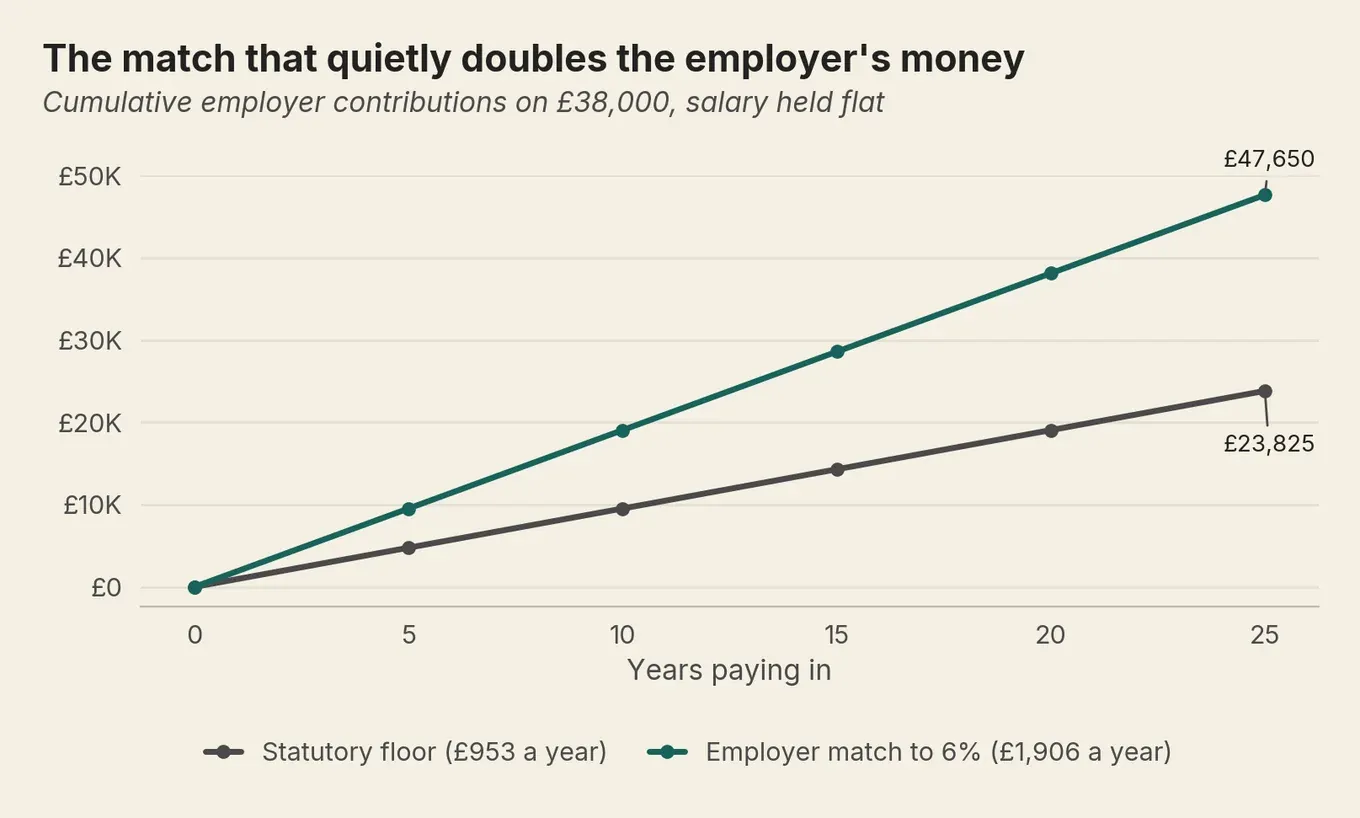
Here’s what that “choose to pay more” is worth. Take two workers on the same £38,000 salary. Yasmin, 34, designs apps in Bristol; Craig, 36, maintains rail signalling near Newcastle. Both pay into a workplace pension, so both feel sorted. The difference is what their employers do next. Yasmin’s pays the statutory floor: 3% of her qualifying earnings, about £953 a year, and it stays £953 whether she adds a penny more or not. Craig’s matches him up to 6% on the same band, so when he pays 6%, his employer pays 6% too, roughly £1,906 a year. Same pay, same pension line on the payslip, but Craig’s employer puts in nearly a thousand a year more.
Held flat over 25 years, that’s £23,825 against £47,650, before any growth. Only one of them is a match.
Are employer contributions taxed, and is there a limit?
Employer contributions count as a business expense the company can deduct. In most systems they’re not taxed as your income when they go in. But they aren’t unlimited, and the cap that bites depends entirely on where you work.
Britain counts them against an annual allowance, Ireland caps them at your salary, and Spain scales its tax breaks to what the employer pays in. Germany and the Netherlands keep them tax-free going in.
Do employer contributions count as taxable income for you?
In most systems they don’t: employer money going in isn’t treated as taxable pay that month. In Ireland it’s not a benefit-in-kind (opens in new tab) on a workplace scheme or PRSA. In Britain it isn’t taxed as income when it lands, because the relief is added, not deducted.
Do the contributions count towards a limit?
In Britain they do, and it’s the ceiling worth watching. Everything paid into your pension in a year, the employer’s share included, counts towards a £60,000 annual allowance (opens in new tab) for 2026/27. Go over it and a tax charge can apply. Most people sit nowhere near it; high earners on the taper (a lower cap for top earners) are the ones who need to check.
What happens to your contributions on parental leave?
In Britain they’re largely protected. If you take paid maternity or family leave, your employer must keep paying in on your normal full salary, not your reduced leave pay (opens in new tab), for at least the first 26 weeks. Your own payments drop to match your reduced pay. It’s one of the few places the rules quietly work in your favour, so it’s worth not signing that away by accident. Other countries handle leave and pensions in their own way, so check your local rules.
A note that applies everywhere: what lands in the pot then gets invested, and like any invested money its value can fall as well as rise. The contribution rules above are fixed. What the pot is eventually worth is not.
How do you get your employer to pay more?
The lever depends on the system. Opt up or sacrifice salary in Britain, convert in Germany, take the older route in Ireland, bargain collectively in the Netherlands, or push your employer for a plan in Spain.
In Britain, two moves are worth your time. If your scheme matches above the floor, opting up is the closest thing to free money most jobs contain. And salary sacrifice (giving up a slice of gross pay so the employer pays it straight into your pension) saves both of you National Insurance. From 6 April 2029, though, only the first £2,000 you sacrifice into a pension each year escapes National Insurance; above that, normal NI applies (set at the Autumn 2025 Budget (opens in new tab)). Both moves stay inside the £60,000 annual allowance, so opting up won’t breach it for most people.
Salary sacrifice carries a catch, mind. Because it cuts your headline pay, it can shrink your mortgage borrowing and trim your statutory maternity pay. It can lower some state benefits too, and it can’t take your pay below the minimum wage. It suits plenty of people, not all. Check how it lands for you (opens in new tab) before you sign up, and ask HR whether yours passes its own saving on.
In Ireland, the auto-enrolment rate is fixed by law, so there’s no personal opt-up. The lever is the older route: a traditional occupational scheme, or a PRSA where an employer can pay up to 100% of your pay.
In Germany, the lever is the conversion right itself. Because the 15% top-up only lands on money you convert, using that right is what switches the employer contribution on in the first place. Do nothing, and the employer adds nothing.
In the Netherlands, there’s no personal opt-up. The rate is set collectively, so the talks that move it happen between the union and the sector, not at your desk.
In Spain, the honest lever is existence, and it isn’t yours to pull alone. Whether a workplace plan exists is your employer’s call, or a collective-bargaining one, not something you set up at your desk. So the move is to push for one, and to point at the tax break on lower salaries when you do. Any plan you’re in beats one that never gets created.
Before you act on any specific pension or provider, one dull but real point: check it’s authorised. Ireland’s registers sit with the Central Bank of Ireland (opens in new tab); Britain’s is the FCA register (opens in new tab); every market has its own. Getting a name wrong in pensions costs real money, and the con often looks tidier than the real thing.
None of this is exciting, which is rather the point. The systems are built to be just complicated enough that most people never check the base, never test whether their 3% moves, and never ask whether a plan exists at all. Find your scheme document this week. Read the one line that says what your employer pays, and on what. That sentence is the job. The brochure round it is wrapping.
Frequently asked questions
How much must my employer actually pay into my pension?
What is the minimum employer contribution in the UK, Ireland, Germany, the Netherlands and Spain?
Are employer contributions based on gross or net salary, and how do I spot a floor-payer versus a genuine matcher?
How can I get my employer to pay more into my pension?
Do employer pension contributions count as taxable income for me?
Do employer contributions continue on parental leave?
Sources (22)
- OECD: Pensions at a Glance 2025, mandatory pension contributions
- European Commission, Your Europe: cross-border pensions
- Citizens Information (Ireland): pension auto-enrolment (My Future Fund)
- Department of Social Protection (Ireland): My Future Fund
- Revenue (Ireland): employer pension contributions and benefit-in-kind
- GOV.UK: what you, your employer and the government pay
- The Pensions Regulator (UK): making contributions to your pension scheme
- MoneyHelper (UK): salary sacrifice and your pension
- GOV.UK: changes to salary sacrifice for pensions from April 2029
- Gesetze im Internet: Betriebsrentengesetz, section 1a (Entgeltumwandlung)
- Deutsche Rentenversicherung: employer subsidy on salary conversion
- Gesetze im Internet: Einkommensteuergesetz, section 3 (tax-free limit)
- Bundesregierung: contribution assessment ceilings 2026
- bpb.de: advantages and disadvantages of company pensions via salary conversion
- Rijksoverheid (Netherlands): structure of the pension system
- Belastingdienst (Netherlands): AOW-franchise figures
- Agencia Tributaria (Spain): Law 12/2022 on employment pension plans
- Agencia Tributaria (Spain): corporate-tax note on Law 12/2022
- GOV.UK: pension annual allowance
- GOV.UK: workplace pensions, changing jobs and taking leave
- Central Bank of Ireland: registers
- Financial Conduct Authority (UK): register
— That's the lot. It is now night.
Want more of this in your Google results?
Add Money Owl as a preferred source, and Google will show our finance pieces higher when you search for them.
By Jure Jaklič
Founder and editor of Money Owl. Data analyst by trade; personal finance learned first-hand across six European countries.
Recommended

The 4% rule for European retirees: does it still hold up in 2026?
3% to 3.5%, not 4%: that's the realistic safe withdrawal rate for a European retiree living off a portfolio. Here's what moves it, and why.

Tax-efficient investing in Europe: the fee you can cut
A 0.5% annual tax drag can cost a European investor tens of thousands over a working life. Cut it with the right wrapper, fund and filling order.

Inflation-proofing retirement: which European pensions keep up
Your pension rose this year; prices rose faster. Which European pensions keep pace with inflation, and how to defend the slices that quietly erode.