

The point.
- Financial independence is a coverage test: income you don't work for covers your living costs, so paid work becomes optional. It is not a wealth level, and what it buys is control over your time.
- Two independences share one name. Independence from your parents arrives at 26.2 on average in the EU (Eurostat, 2024); independence from work is the one nobody measures for you.
- Rich is an amount; independent is a balance between two of your own numbers. The median euro-area household holds €140,100 in net wealth (ECB, 2023 wave), and the test never asks what you earn, only what stops if you stop.
- Europe shrinks the problem: public and compulsory schemes financed 80.5% of EU healthcare spending in 2023, and a mandatory pension (state plus any compulsory workplace pension) replaces part of your pay, but only from legal retirement age.
- The evidence points to autonomy, not idleness: 56% of EU workers want exactly the hours they have, and among workers 45 and over, wanting to stay on beats wanting out early by two to one.
The point.
- Financial independence is a coverage test: income you don't work for covers your living costs, so paid work becomes optional. It is not a wealth level, and what it buys is control over your time.
- Two independences share one name. Independence from your parents arrives at 26.2 on average in the EU (Eurostat, 2024); independence from work is the one nobody measures for you.
- Rich is an amount; independent is a balance between two of your own numbers. The median euro-area household holds €140,100 in net wealth (ECB, 2023 wave), and the test never asks what you earn, only what stops if you stop.
- Europe shrinks the problem: public and compulsory schemes financed 80.5% of EU healthcare spending in 2023, and a mandatory pension (state plus any compulsory workplace pension) replaces part of your pay, but only from legal retirement age.
- The evidence points to autonomy, not idleness: 56% of EU workers want exactly the hours they have, and among workers 45 and over, wanting to stay on beats wanting out early by two to one.
Type “what is financial independence” into a search box and the top results agree on one sentence: it’s the point where work becomes optional. Having agreed, they spend the next three thousand words on US retirement plans. The sentence was the good bit. Almost nobody stays with it.
Financial independence is the state where income you don’t work for (savings, investments, rents, pensions) covers your living costs, so paid work becomes optional. It’s a coverage test against your own expenses, not a wealth level, and what it buys is control over your time.
That sentence deserves better than lip service, because three things hide inside it. There are two independences wearing one name. Rich and independent are different claims. And in Europe the problem itself is a different shape from the one in the imported playbooks, and in most markets smaller.
What does it mean to be financially independent?
Being financially independent means your own resources cover your own costs, with no one else obliged to top you up. One catch: “your own resources” changes meaning once in your life. First it means your salary. Later it means your assets.
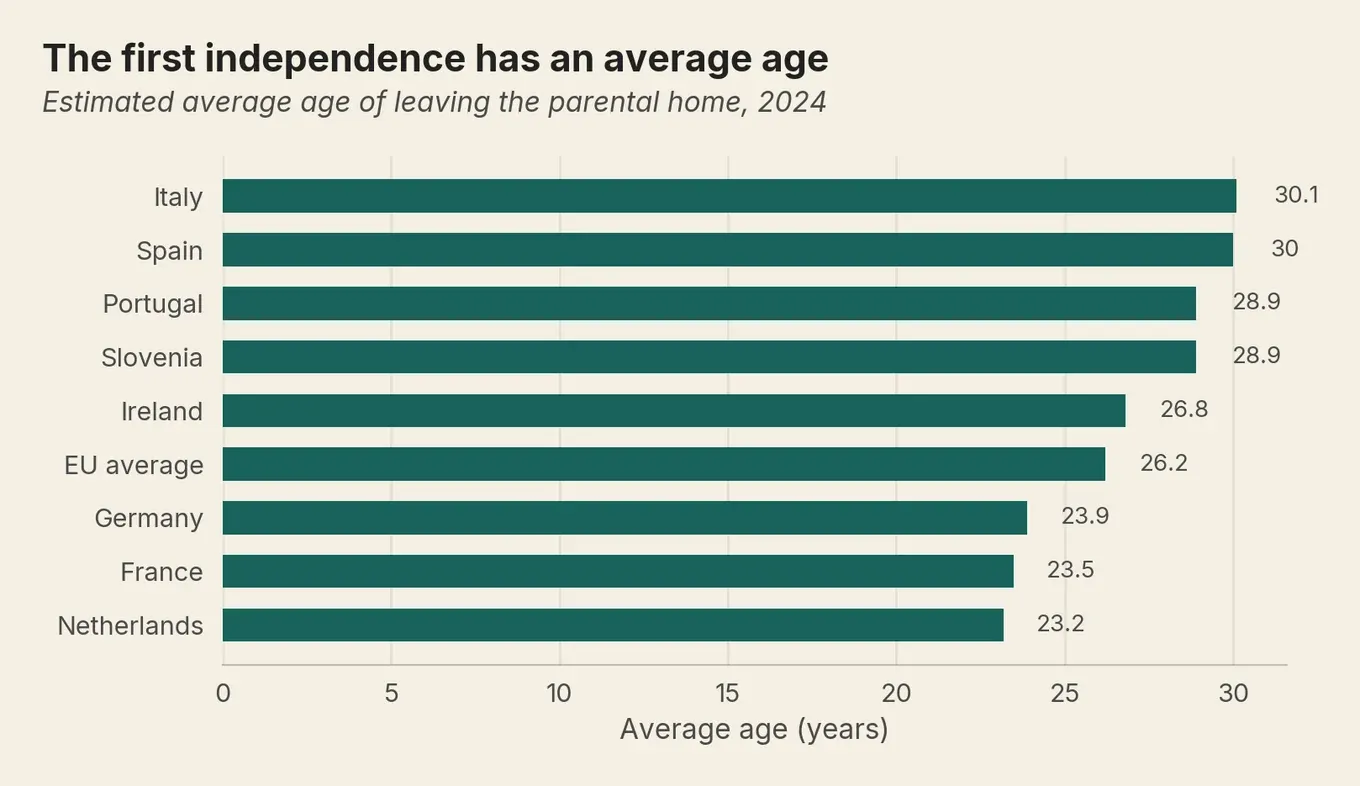
The first independence is from your parents: your income covers your life. This one gets measured. Eurostat (opens in new tab) puts the average age of leaving the parental home at 26.2 across the EU in 2024. The spread behind that: 23.2 in the Netherlands, 23.5 in France, out to 30.0 in Spain and 30.1 in Italy. “Independent by 25” lands as a milestone in Amsterdam and as an oddity in Milan, and neither city needs the lecture.
The second independence is from work: non-work income (dividends, interest, rent, pension rights) covers the same costs with no salary in the picture. No stats office dates this one. The test is private, run against your own spending, and nobody rings a bell when you pass it.
| What we’re comparing | Independence from your parents | Independence from work |
|---|---|---|
| The test | Your income covers your costs | Your non-work income covers your costs |
| Who measures it | Eurostat, to one decimal place | You, against your own spending |
| Typical timing | Age 26.2 on average in the EU (2024) | Whenever coverage arrives, if it does |
| What changes | Who pays for your life | Whether work is a choice |
Either way, coverage is a ratio, and ratios climb by degrees. You’re 40% covered, then 70%, then one quarter’s dividends quietly pay the heating bill. It arrives the way fluency in a language does, no date to put on a card.
A physio in Porto moves out at 28, close to the Portuguese average of 28.9 (Eurostat, 2024). Salary in, rent and groceries out, covered: by the only version of financial independence anyone measures, he has arrived. Then the second test shows up. If the salary stopped next month, what would keep arriving? Nothing, for now. He is 0% covered on the day after passing test one, which is where nearly everyone starts. Same word, different exam, and nobody books the second sitting.
Is financial independence the same as financial freedom?
In most sentences the two swap freely. Where they split, “independence” names the coverage test above. “Financial freedom” gets used for the looser idea of surplus: money beyond coverage, choices beyond safety. Marketing likes “freedom” for the same reason it likes sunsets. Keep the testable term.
Is financial independence the same as being rich?
No. Rich names an amount. Independent names a balance between two of your own numbers: what arrives without work, and what goes out. A modest pot against modest outgoings can pass a test that a big salary with bigger spending fails.
The folk version of this question is “could I live off a million euro?”, and the million is doing a lot of work in that sentence, none of it maths. By the European Central Bank’s own household survey (opens in new tab), the median euro-area household holds €140,100 in net wealth (2023 wave). The mean is €312,000, dragged up by the richest tenth, who hold median assets of roughly €1.1m. Define it as “a million in the bank” and you’ve named the top tenth, not a test.
The quieter worry underneath, “am I independent or merely successful?”, resolves the same way. A high salary proves income, and spending has a talent for keeping up with it. The test never asks what you earn. It asks what stops if you stop.
On paper, €52,600 is a good year: the euro-area mean gross household income (ECB survey, 2023 wave), well clear of the €37,100 median. A couple in Cologne on exactly that, a logistics planner and a dental hygienist in their late thirties, count as doing well. Now run the other test. Stop both salaries, on paper only, and count what still arrives next month. In their case, close to nothing: the income was the engine, and everything bolted to it stops with it. Above the average, covered for nothing.
Why is financial independence a different problem in Europe?
Because part of the bill is covered before you save a cent. Public and compulsory schemes financed 80.5% of EU healthcare spending in 2023, and from retirement age a mandatory pension (state plus any compulsory workplace pension) replaces part of your pay.
US playbooks plan private cover for both. Lifelong. That gap reshapes your target twice.
Who already pays most of the European healthcare bill?
The collective does: government schemes and compulsory insurance financed 80.5% of the EU’s healthcare spending (opens in new tab) in 2023, while households paid 14.9% out of pocket (Eurostat).
That number is why whole chapters of US FIRE guides (financial independence, retire early) read strangely here. They sweat over the “healthcare bridge”, private cover for the years between quitting and Medicare kicking in. For most readers here, that chapter shrinks to a sentence. You’ll stay covered by the same system that covered you last Tuesday.
Covered is not the same as free, and it splits Europe in two. In the contribution-based systems, stopping work before pension age means you keep paying in yourself. A German early retiree stays in the statutory scheme, now charged on their whole income (opens in new tab), savings and rent included. They pay the full amount alone, without the employer half an employee used to get. In the Netherlands the basic premium is owed every month, work or not. In the tax-funded systems, cover follows where you live, not what you pay in. It simply carries on, though charges at the point of care still apply.
Access to care is also written into the EU’s own social-rights pledge (opens in new tab).
The pledge itself is one sentence:
“Everyone has the right to timely access to affordable, preventive and curative health care of good quality.”
European Pillar of Social Rights, principle 16 (opens in new tab), proclaimed by the European Parliament, the Council and the Commission in 2017
Free, though, it is not. The out-of-pocket share ran from 8.8% in Luxembourg to 35.5% in Bulgaria across the EU in 2023; France sat at 9.3%, Portugal at 29.3%. That floor shrinks the health-cost problem everywhere; how far depends on your address.
How much pay does the pension floor replace?
On the OECD’s model (opens in new tab) for a full-career average earner under 2024 rules, the mandatory pension (state plus any compulsory workplace pension) replaces 86.3% of net pre-retirement earnings in Spain and 33.7% in Ireland. France sits at 70.0%, Germany at 53.3%, and the EU27 average at 68.3%. Read those as model projections: full careers, at average pay, under today’s rules, and rules change. The system describing itself, never a promise to you. And the label matters more than it looks.
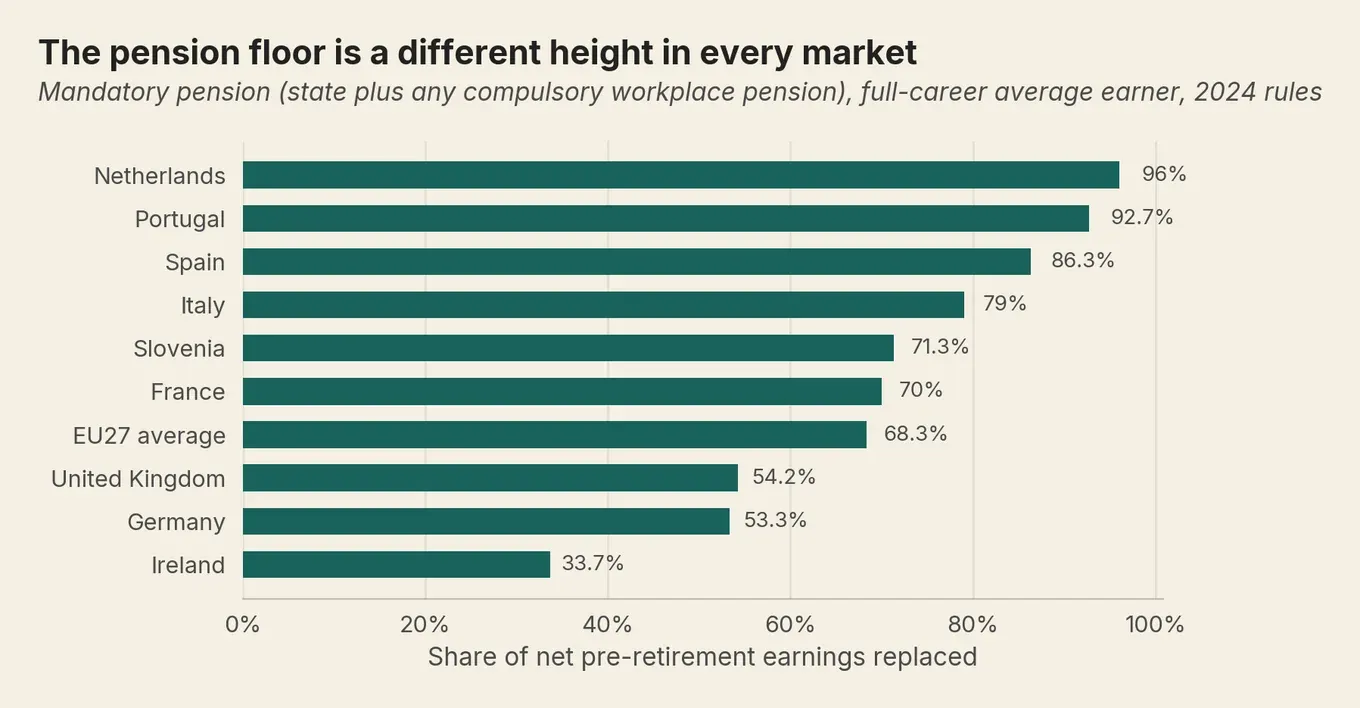
The Netherlands models at 96.0% for the mandatory pension, but that headline is mostly the near-compulsory workplace pillar doing the lifting; the state’s own layer is thinner: around 90% of Dutch employees (opens in new tab) sit in one. What today’s pensioners actually draw is lower: Eurostat’s observed ratio (opens in new tab) of median pensions to late-career earnings is 0.57 (2024). Call either one “the state pension” and you’d mislead a Dutch freelancer, who gets no workplace scheme unless they arrange one.
Ireland is the counterweight. At 33.7%, its mandatory pension is the thinnest floor in this list. Voluntary pensions lift the modelled total to 72.3%, which is another way of saying the lifting is yours to do. Counting the floor can also mean seeing how low it sits.
When does the pension floor arrive, and how solid is it?
Not until legal retirement age: for someone starting work at 22 today, that means a modelled 62 in Slovenia and 70 in Italy and the Netherlands (opens in new tab) (OECD, same edition). Get there at 45 and you’ll bridge 17 to 25 years on your own numbers before the first public cent arrives. Subtract the floor from day one and you under-plan the bridge. Never count it and you’re doing the US sums with the euro symbol swapped in.
The same pledge states what the floor is for:
“Everyone in old age has the right to resources that ensure living in dignity.”
European Pillar of Social Rights, principle 15 (opens in new tab), proclaimed 2017
Then there’s how solid it is. Floors hold you up; they don’t furnish the room. Across the EU, 16.6% of people aged 65 and over (opens in new tab) were at risk of poverty in 2024 (21.1% in Portugal, 22.5% in Slovenia). Europe shrinks the problem only for a full career at average pay: a broken career or below-average pay lowers the floor and grows your own share, which is where that poverty figure lands. The European Commission runs a standing review of whether pensions are enough (opens in new tab), because they aren’t guaranteed to be. One more wrinkle: work across borders and the floor arrives in pieces (opens in new tab), each country paying its share from its own retirement age.
What does financial independence mean to you?
The honest answer moves with age, and there’s evidence on how. A peer-reviewed study of 47 people across three age groups (opens in new tab) (2023, Estonia) found the meaning of financial independence shifting as life does. Its title carries the arc: from security to freedom.
The youngest, 17 to 23, described exit: financial well-being is “when you do not have to work and you earn passive income”. Those in mid-life, 26 to 47, described choice inside a working life: “freedom to choose how to earn and spend money”. One 27-year-old hoped to “only work because you like it”. The oldest, 55 to 64, framed it as not needing anyone else’s support.
If your version is the youngest one, the clean exit, no one here will talk you out of it. Research on the FIRE movement (opens in new tab) finds escape from the workplace is one of its two main motives, next to concern for physical and mental well-being (Khan and Pandey, 2023). That wish is real, and it’s on record. The question is what makes the escape last.
Psychology has an answer: autonomy. Ryan and Deci’s self-determination theory (opens in new tab) names three needs people are born with, competence, autonomy, and relatedness; meet them and motivation and mental health hold up (2000). Independence buys the middle one: the standing power to choose what you do and why. Leisure you can rent by the week; autonomy has to be owned, and standing needs don’t retire when you do.
Ask Europeans what they want and the answers point the same way. Eurofound’s 2024 working-conditions survey (opens in new tab) (36,644 interviews) found 56% of EU workers want exactly the hours they have. Another 33% want fewer, up from 27% in 2015.
Among workers 45 and over, about one in five would like to work “as long as possible”. One in ten wants out “as early as possible”. That’s two to one, among the people nearest the exit, for staying on their own terms.
Which is why “what do you do after you reach financial independence?” has a shorter answer than the forums say. You keep choosing, and many who get there keep working, differently. FIRE, the movement that pairs the independence with early retirement, treats quitting as the point. The evidence treats it as one option.
Jim Dahle (opens in new tab), a US doctor who writes about doctors’ money, got there years ago and kept the day job. His list of uses for it besides retiring runs to eight items.
The European version rarely makes a list. At 51, an upholsterer in Bologna finds the bills are covered whether the workshop opens or not: the flat upstairs is let, and two decades of boring funds pay out either way. She doesn’t close. She drops Mondays, plus the two clients she files under invoices with opinions, and keeps every job she likes. Turnover falls. The test keeps passing, because the other half of it was always her outgoings. Ask when she became financially independent and you get the answer no survey collects: about the time she stopped checking.
How can you achieve financial independence?
You grow the income that doesn’t need you and you shrink the costs it must cover. When the first covers the second, you’re there. Then the European fix: count the healthcare and pension floors at the right points in time, the step imported guides skip.
The maths version is a finish-line number: the pot big enough that steady withdrawals cover your yearly costs through bad markets as well as good, not just in a strong year. You’ve met the 25-times multiple and the 4% rule elsewhere; both try to pin it down. Setting yours properly is its own article. That number follows from the definition: change what your life costs and it moves with you.
Order matters too. Independence from your parents, your income covering your life, comes first. The from-work kind moves the same test from salary to assets. If you’re 27 and two years out of your parents’ place, you haven’t fallen behind anything. On the EU’s own average schedule, you’ve done step one, on time.
And because the test is coverage, the expenses line is one of the few levers fully in your hands. A rich target moves with other people’s money; a coverage target moves with your rent.
The search results weren’t wrong. They stopped too soon. Work income becomes optional. That sentence carries the whole load: who owns your time.
Vicki Robin, whose 1992 book Your Money or Your Life (written with Joe Dominguez) seeded the movement that later got the FIRE name, put the same point in one line:
“Money is something we choose to trade our life energy for.”
Vicki Robin and Joe Dominguez, Your Money or Your Life (opens in new tab)
This week, put two numbers side by side: what your life costs each month, and what would arrive if you stopped working. The gap between them is the actual subject. A permanent holiday needs an end date to stay a holiday. The standing option to choose doesn’t expire, and that option is the thing you’re buying.
Frequently asked questions
What is financial independence?
What does it mean to be financially independent?
Is financial independence the same as being rich?
Is financial independence the same as financial freedom?
How can you achieve financial independence?
What do you do after you reach financial independence?
Sources (20)
- Eurostat: estimated average age of leaving the parental home (yth_demo_030)
- European Central Bank: Household Finance and Consumption Survey, 2023 wave results
- Eurostat: health care expenditure by financing scheme (hlth_sha11_hf)
- EUR-Lex: European Pillar of Social Rights, principles 15 and 16
- Bundesministerium für Gesundheit: contributions to statutory health insurance (GKV Beiträge)
- Rijksoverheid: how health insurance works in the Netherlands (compulsory basisverzekering and nominal premium)
- European Observatory on Health Systems and Policies (WHO): Spain health system summary (residence-based universal coverage funded from general taxation)
- OECD Pensions at a Glance 2025: pension replacement rates (reference year 2024)
- Rijksoverheid: opbouw pensioenstelsel (structure of the Dutch pension system)
- Eurostat: aggregate replacement ratio for pensions (ilc_pnp3)
- OECD Pensions at a Glance 2025: design of pension systems (retirement ages)
- Eurostat: at-risk-of-poverty rate of older people (ilc_pnp1)
- European Commission: 2024 Pension Adequacy Report
- Your Europe: state pensions abroad
- Riitsalu et al.: From Security to Freedom, the meaning of financial well-being changes with age (Journal of Family and Economic Issues, 2023)
- Khan and Pandey: Exploring FIRE, a netnography approach (Journal of Consumer Marketing, 2023)
- Ryan and Deci: Self-Determination Theory (American Psychologist, 2000)
- Eurofound: European Working Conditions Survey 2024 overview report
- The White Coat Investor: 8 things to do with financial independence besides retire early
- Vicki Robin: Your Money or Your Life, summary and key quotes
— That's the lot. It is now night.
Want more of this in your Google results?
Add Money Owl as a preferred source, and Google will show our finance pieces higher when you search for them.
By Jure Jaklič
Founder and editor of Money Owl. Data analyst by trade; personal finance learned first-hand across six European countries.
Recommended

What is your 'enough' number? How to define your financial finish line
Your enough number is the pot that replaces a wage. Europe's version beats America's 25x rule, and even hitting it will not feel like enough.

How to track your net worth: a monthly guide for Europeans
Track net worth across countries and currencies with one home currency, one rate source, and one date each month. A plain, repeatable habit.

Why retirement planning matters: the real cost of waiting
About 41% of Europeans pay into no private or workplace pension, and each year you wait costs more than the payments you skip. Here's that cost, in euros.