

The point.
- The 4% rule was built on 20th-century US market history and does not travel; a European retiree living off a portfolio alone typically needs roughly 3% to 3.5%, on illustrative assumptions, and investment values can fall as well as rise.
- "Safe" never meant your capital stayed intact, only that the pot did not hit zero before you died. You are meant to spend it down.
- Three forces pull the European rate below 4%: lower euro-area bond yields, a harder century for European markets, and local investment taxes on drawdown (from 38% in Ireland to a roughly 18.5% effective rate on German equity funds).
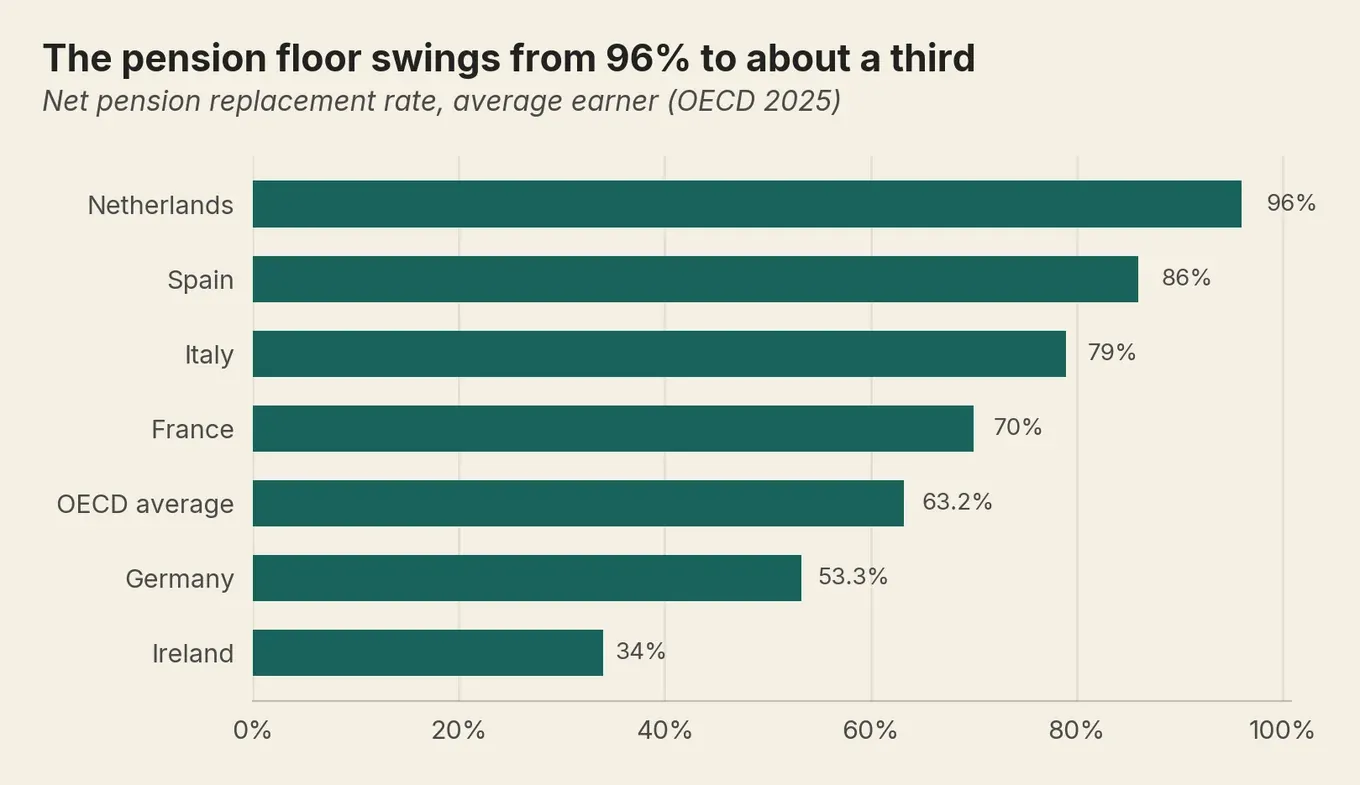
- Your pension floor is the lever most guides ignore. The bigger it is, the harder you can safely draw on the rest. For a full-career average earner the mandatory pension system replaces about 96% of income in the Netherlands (state plus near-mandatory workplace pensions) but about a third in Ireland.
- There is no single number. Set a starting rate at the cautious end, then review it every year against your real horizon, state pension, fund costs and tax.
The point.
- The 4% rule was built on 20th-century US market history and does not travel; a European retiree living off a portfolio alone typically needs roughly 3% to 3.5%, on illustrative assumptions, and investment values can fall as well as rise.
- "Safe" never meant your capital stayed intact, only that the pot did not hit zero before you died. You are meant to spend it down.
- Three forces pull the European rate below 4%: lower euro-area bond yields, a harder century for European markets, and local investment taxes on drawdown (from 38% in Ireland to a roughly 18.5% effective rate on German equity funds).
- Your pension floor is the lever most guides ignore. The bigger it is, the harder you can safely draw on the rest. For a full-career average earner the mandatory pension system replaces about 96% of income in the Netherlands (state plus near-mandatory workplace pensions) but about a third in Ireland.
- There is no single number. Set a starting rate at the cautious end, then review it every year against your real horizon, state pension, fund costs and tax.
You’ve read about the 4% rule. Maybe more than once, late on a Sunday, with a cup of tea going cold beside the laptop. And somewhere in the reading a small worry set in: all of this was written about America, and you don’t live in America.
The worry is correct. Most of what circulates about the 4 percent rule for retirement was built on a century of American market history, and it crosses the Atlantic worse than anyone selling it admits. If you’re in your fifties or early sixties, sitting on savings you’re about to start living off, the gap between the American number and your reality matters. It’s the difference between a plan and a hope.
So here’s the honest version of the 4% rule for retirement in Europe. Not a soothing single figure. An answer that depends, with the sums shown, and the handful of levers you control. The comfort is in knowing which way each lever moves.
How does the 4% rule work in practice?
The 4% rule says you withdraw 4% of your portfolio in the first year of retirement, then raise that euro amount by inflation every year after, ignoring the balance. A financial planner named William Bengen worked it out in 1994 from decades of US market history.
Take Niamh in Galway, retiring at 63 with a €600,000 portfolio. In year one she draws 4%, which is €24,000. The next year she doesn’t recalculate against her balance. She takes the same €24,000, adds inflation, so if prices rose 3% she withdraws €24,720, and she keeps doing that for the rest of her life. Her balance can halve in a bad year and the rule shrugs. What she takes is set by last year’s withdrawal plus inflation, never by what’s left in the pot. These figures are illustrative. Investment values can fall as well as rise, and actual outcomes depend on returns, their order, charges and taxes.
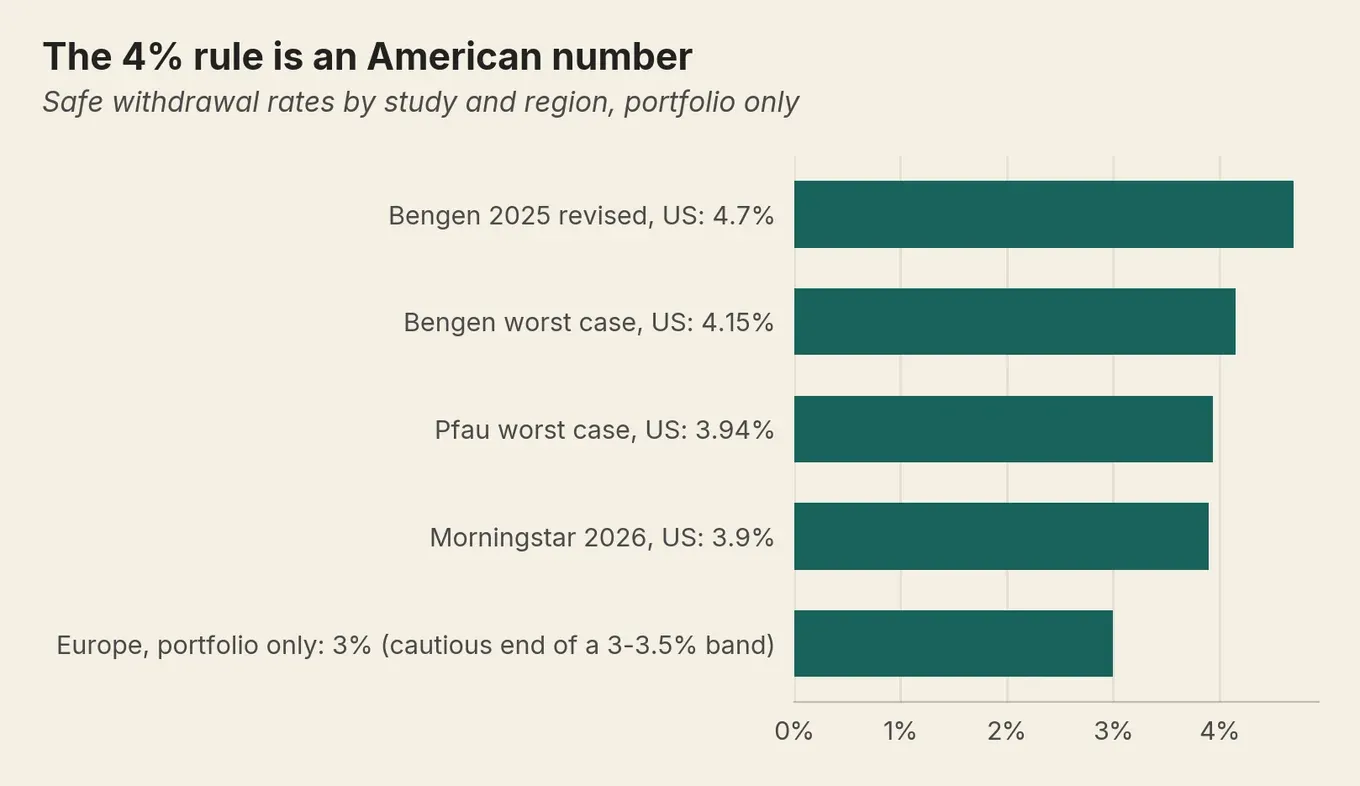
Bengen tested this against every 30-year retirement he could find in the US record, a portfolio split roughly half shares, half bonds. The worst case in the record, a retiree who started in the late 1960s and met the market losses and inflation that followed, still lasted the full 30 years at a starting rate of 4.15% (opens in new tab). He rounded it to 4% and the number stuck. Four years later, three US professors ran the Trinity Study (opens in new tab) and turned it into a probability: at 4% over 30 years with a 50/50 portfolio, the money survived 100% of the historical windows they tested.
Here’s the part the headline hides. “Safe” never meant your money stayed safe. It meant your pot didn’t hit zero before you died. A “successful” run under this rule can end with almost nothing left, because the test is survival, not staying whole. You’re meant to spend the capital down. Deliberately. So if you’ve been picturing the 4% as interest you skim off the top while the pot stays whole, that’s the first thing to unlearn.
Does the 4% rule still work in 2026?
It depends what you mean by work. For a US retiree, the number’s contested from both sides: the rule’s own inventor now argues it’s too cautious, while forward-looking models put it under 4%. A European never had 4% to begin with.
What does the rule’s inventor now say?
Bengen has spent thirty years watching people treat his worst-case floor as a ceiling. In his 2025 book he revised the historical worst case up to 4.7% (opens in new tab), a figure he calls the “Universal Safemax”, for a more mixed portfolio, and reckons retirees who stay flexible could start higher still. Keep it in proportion, though. That’s a claim about US market history, not a European rate.
What do forward-looking 2026 models say?
Morningstar, running models of future returns rather than tests on the past, put the safe starting rate for a US retiree at 3.9% (opens in new tab) in its December 2025 research, up from 3.7% the year before, for a 90% chance of the money lasting 30 years. So the inventor says 4.7%, the modellers say 3.9%, and both are arguing about America. Neither number was ever a measurement of Europe.
Does it still work, then? As a rough guide for a 66-year-old American with a 30-year horizon, it holds up about as well as it ever did: fine as a starting guess, useless as a guarantee. Import it wholesale into a European retirement, though, and it falls apart.
Why do European retirees need a lower withdrawal rate than the US 4%?
European retirees living off a portfolio alone typically need roughly 3% to 3.5% over a 30-year retirement, not the US 4%, on illustrative assumptions. Three forces pull the rate down:
- Euro-area bonds pay far less than 20th-century US bonds did.
- European markets had a harder hundred years than America’s.
- Local taxes on the way out take a bigger slice than America’s ever have.
That range isn’t a hunch. Wade Pfau ran the 4% rule across 20 developed markets over more than a century of global market history (opens in new tab). Held to a perfect record, it survived in none of them. Zero. It came closest in Canada, at 3.96%, and the United States, at 3.94%. In 11 of the 20 countries the safe rate in the past sat below 3%. Italy’s 4% strategy failed in about 76% of the windows tested; Spain, Germany, France and Austria all failed more than half the time. A separate study by Javier Estrada (opens in new tab), different data, different method, pointed the same way: outside America, the 4% rule is riskier and lower almost everywhere. The twentieth-century US market was the exception, not the template. Investment values can fall as well as rise, and the same illustrative caveats apply to any rate you settle on.
Pfau pinned it on American luck rather than skill.
“asset returns enjoyed a particularly favorable climate in the twentieth-century United States”
Wade Pfau, An International Perspective on Safe Withdrawal Rates (opens in new tab), Journal of Financial Planning
Part of the reason is boring and current. The euro-area 10-year government bond yield sits around 3.4% in mid-2026 (opens in new tab), with the ECB’s deposit rate at 2.25% (opens in new tab). After inflation, the 10-year yield gives a real return of well under 1%. The American 4% leaned on decades of fat US bond returns that euro-area bonds haven’t come close to matching.
How does sequence-of-returns risk change the picture?
Sequence-of-returns risk is the polite name for bad timing. The first decade of retirement (opens in new tab) is the most sensitive stretch: the order of your returns, not just their average, decides how the pot holds up. Retire the year before a crash and the rule quietly turns on you, because it keeps telling you to raise your withdrawals for inflation while the pot shrinks.
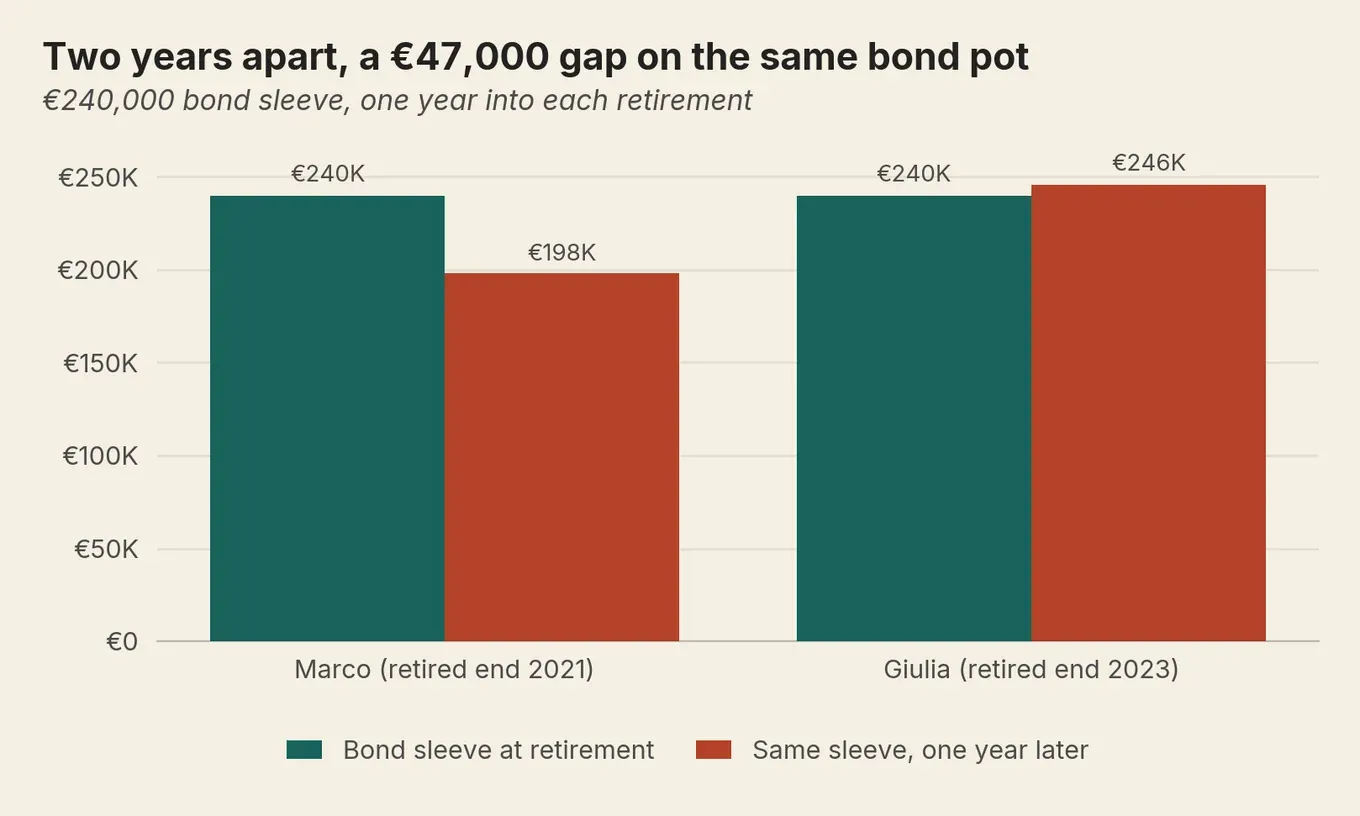
2022 showed this in euros. Euro-area bonds fell 17.34% in 2022 (opens in new tab), the broad euro aggregate index fund’s worst calendar year on record, while European shares fell too. Bonds and shares dropped together, which is the one thing diversification promised wouldn’t happen. At the same time, euro-area inflation peaked at 10.6% in October 2022 (opens in new tab). Picture Marco in Bologna, who retired at the end of 2021 on a fixed 4% plan. The rule told him to raise his spending by double-digit inflation, into a pot that had already fallen by double digits. That’s sequence risk with the mask off.
Now put a second retiree beside him. Giulia stopped working at the end of 2023 with the same €600,000, split the same 60/40. Same rule, same 4% start, same funds. The only difference is two years on the calendar. Marco’s first drawdown year was 2022, so the €240,000 bond sleeve of his pot fell 17.34% to about €198,000, while the rule pushed his €24,000 draw up toward €26,500 to keep pace with 10.6% inflation. He was pulling more units out of a pot that had just shrunk.
Giulia’s first year was 2024. That same bond sleeve rose 2.43%, to roughly €246,000, and her early withdrawals came out of a recovering balance rather than a falling one. One year into each retirement, that is a swing of about €47,000 on the bond side alone, from nothing but timing, on the same illustrative assumptions, and investment values can fall as well as rise. Sequence risk has nothing to do with cleverer funds. It’s the year you happen to stop.
How do local investment taxes affect your safe withdrawal rate?
Local investment taxes lower your real safe withdrawal rate, because the 4% rule is worked out before tax. Bengen and the Trinity Study measured returns gross of tax, and the tax on your gains comes out on top of that. In Europe, the bite ranges from mild to punishing, depending on the country and the wrapper you draw from.
Most people assume the 4% has tax baked in. Wrong. Every euro of gain you realise on the way out can be taxed, and Europe’s rates are all over the shop. All rates assume you are tax-resident in that country in 2026. Illustrative, not tax advice; a tax professional earns their fee here.
| Country | Investment tax on drawdown (2026) | The catch |
|---|---|---|
| Germany | 26.375% headline, about 18.5% effective on equity funds | 30% partial exemption on equity funds; €1,000 annual allowance |
| France | 31.4% flat tax | Up from 30% for 2026; a PEA turns income-tax-free after 5 years |
| Spain | 19% to 30% progressive savings scale | Most retirees sit at 19% to 21%; top band rose to 30% |
| Ireland | 38% fund exit tax (33% CGT on direct shares) | Down from 41%; deemed disposal every 8 years, no loss offset |
| Italy | 26% flat on financial income | Reduced rate on government bonds |
| Netherlands | Box 3: 36% on a deemed return | A tax on holding wealth, not on selling; not comparable to the gains-tax rows; €59,357 tax-free in 2026 |
Which European countries changed their investment tax for 2026?
Two of those numbers would be wrong if you quoted them from memory. Ireland cut its fund exit tax from 41% to 38% on 1 January 2026 (opens in new tab), but left the deemed-disposal rule untouched, so an Irish ETF holder is taxed every eight years even without selling, and can’t offset losses. France went the other way. Its flat tax on investment income rose from 30% to 31.4% for 2026 (opens in new tab) after a new social surcharge.
The gap this opens is real. Say Lena in Leipzig and Niamh in Galway each realise €10,000 of gains from a global equity fund in the same year. Lena pays German investment tax at an effective rate near 18.5% (opens in new tab), because equity funds there get a 30% partial tax break before the 26.375% headline rate applies, so her bill is roughly €1,850. Niamh, drawing from a fund in Ireland, pays 38% exit tax (opens in new tab), or €3,800. Same gain, nearly €2,000 apart, before either of them has bought a coffee with it. The Netherlands does something else entirely: Box 3 (opens in new tab) taxes a deemed return on your wealth at 36%, so it’s a tax on holding money, not on selling it.
Everywhere else runs its own version of the same idea at its own rate, as the table above lays out.
Does your tax wrapper change the net rate?
The wrapper you draw from (the account your funds sit in) matters as much as the country. A French PEA turns income-tax-free after five years; an Irish ARF (the pot an Irish pension rolls into), a German fund with its partial exemption, a Spanish pension plan, each one changes the net rate. The headline 4% is gross. Your spendable rate is whatever survives your tax office.
Why is the rule only calibrated to about 30 years?
Bengen built the rule around a roughly 30-year retirement, the length a 66-year-old might plausibly need. Stretch the horizon and the safe rate falls. Bengen himself put it near 3% for retirements of 50 years or more, before any European haircut applies.
That 30-year assumption does quiet work. A traditional retiree at 66 is roughly on the money. But if you’re chasing early retirement, and plenty of European readers are, your horizon isn’t 30 years. It’s 45 or 50. Camille in Lyon, retiring at 45, needs her pot to survive market cycles her grandparents never saw. For her, the starting rate drifts down toward 3% before the international evidence even gets a look in, and the price you pay for shares on the day you start matters more the longer you hold. The longer the money has to last, the less you can safely take each year. Their state pension is also decades off, so the portfolio carries more on its own for longer. Add the weaker global record and the tax office’s slice on top, and an honest early-retirement starting zone often lands nearer 2.5% to 3%, on illustrative assumptions. That’s the whole of it.
The state-pension bridge tilts the maths back your way
Now the good news. Genuinely. Europe plays this game under different rules than America, and one of those rules works in your favour: a state pension for life (opens in new tab).
Your portfolio doesn’t have to carry the whole retirement. Once your state pension kicks in, the pot only tops up the gap above it. The bigger that floor, the harder you can safely draw on the rest, which lifts the portfolio rate that matters to you. And it’s the lever almost nobody writing about the European 4% rule bothers to mention.
How big that floor is depends entirely on where you live, and the spread is enormous. The OECD’s 2025 figures (opens in new tab) put the net pension replacement rate, the share of an average earner’s working income the mandatory pension system replaces after a full career from age 22, at about 96% in the Netherlands and about a third in Ireland, with Germany near 53%, France at 70%, Italy at 79% and Spain at 86%. Across the OECD, the average is 63.2%. One catch: the Dutch 96% leans on near-mandatory workplace pensions built through your job, not the state scheme alone, and that part is invested, not state-guaranteed, though it still pays a lifelong income, a floor whose height can shift. A second catch, and the one that bites hardest: these figures model someone entering the system at 22 today and working a full career, so they are not what a person retiring next year receives. Earn well above average, take career breaks, or go self-employed, and your own floor sits lower. Check your national pension estimate rather than the average.
Europe’s own pensions regulator reaches the same conclusion, and puts it bluntly.
“In an ageing European society, viable and scalable supplementary pensions are urgently needed to complement statutory pensions and address the pension gaps.”
EIOPA, technical input to the Savings and Investments Union (opens in new tab), 8 September 2025
Two readers, same portfolio, opposite answers. Sanne in Utrecht retires at 62. Her Dutch state pension (AOW) starts at 67 (opens in new tab), so for five years her portfolio funds the lot: that’s the bridge. After that, with her AOW plus the workplace pension she built up over her career replacing most of her old income, the portfolio only tops up a small gap and her withdrawals step down sharply. Niamh in Ireland gets no such luxury. Her state pension replaces about a third of her earnings, so her fund carries roughly two-thirds of her income for the rest of her life, with no meaningful step-down. A flat 4% describes neither of them. With a floor that big, the rate on the remaining pot can sit at or above the top of the 3% to 3.5% band, because it only bridges a gap; with a floor like Niamh’s, the cautious end, or below, is the honest start. Illustrative, not advice.
Ages matter here too, and they keep moving.
| Country | State pension age (2026 direction) |
|---|---|
| Germany | Climbing to 67 |
| Netherlands | 67, rising to 67 years and 3 months in 2028 |
| Ireland | 66, with the option to defer to 70 |
| France | About 63 in 2026; the planned rise to 64 is suspended (opens in new tab) until 2028 |
Plan around a number you half-remember, and you’ll plan around the wrong one.
A realistic European rate is a range, not a single number
So what’s the number? Honestly? There isn’t one. And any piece that hands you a single figure is repeating the exact mistake that sent you searching in the first place.
Here’s the honest shape of it. For a European retiree living off a portfolio alone, over a 30-year horizon, the evidence points to roughly 3% to 3.5% as a sensible starting rate, on illustrative assumptions, before you adjust for your own life. Investment values can fall as well as rise, and your actual outcome depends on returns, their order, charges and taxes. On a €600,000 portfolio, 3% is €18,000 a year and 4% is €24,000. That €6,000 gap is the distance between cautious and hopeful, and it compounds over decades.
Then you move the number with the levers you hold. Some push it up. A large state-pension floor does, at the Dutch end of the scale. So does swapping expensive active funds for cheap passive ones: ESMA’s figures (opens in new tab), from its 2024 market report, put average ongoing costs for active equity funds near 1.3% a year against about 0.4% for passive index funds, and roughly 0.2% for equity ETFs. Every tenth of a percent in fees comes straight off your sustainable rate. A tax-efficient wrapper helps. So does trimming your spending in a bad year rather than raising it on autopilot.
Other levers push it down. A 45-year early-retirement horizon. High-tax country, or a clumsy wrapper. Retiring straight into a market fall. Holding funds in a currency your bills aren’t paid in. None of this is a product you can buy, and none of it is a rate you can look up. It’s a small set of decisions, most of which you make once.
The fear that brought you here was fair. You read an American rule, sensed it didn’t fit, and you were right. What replaces it is sturdier than a number: a range you understand and a few levers you can pull. That is why planning early matters more than the rule itself. Work out your real horizon. Find out what your state pension will cover. Check what your funds cost you, and what your tax office takes on the way out. Set the starting rate at the cautious end, then look at it again every year. Because the one thing the 4% rule got completely right is that retirement income is a number you keep an eye on, across a long and, with any luck, thoroughly boring retirement.
Frequently asked questions
What is the 4% rule for retirement withdrawals?
Why do European retirees use a lower withdrawal rate than the US 4%?
Does the 4% rule still work in 2026?
How do local investment taxes affect your safe withdrawal rate in retirement?
Why is the 4% rule only considered safe for about 30 years?
How does your state pension change your safe withdrawal rate?
Sources (25)
- Retirement Researcher: the 4% rule and the search for a safe withdrawal rate
- Retirement Researcher: Safe Withdrawal Rates and the Trinity Study
- CNBC: Bengen's revised 4.7% safe withdrawal rate
- Morningstar: What's a safe retirement withdrawal rate in 2026?
- Wade Pfau: An International Perspective on Safe Withdrawal Rates (Retirement Researcher)
- Javier Estrada, IESE Business School: Maximum Withdrawal Rates (working paper)
- ECB Data Portal: Euro-area 10-year government bond yield
- ECB Data Portal: Deposit facility rate
- Retirement Researcher: Why sequence-of-returns risk matters for your retirement income
- justETF: SPDR Bloomberg Euro Aggregate Bond UCITS ETF, calendar-year returns
- ECB Data Portal: Euro-area HICP inflation rate
- The Irish Times: ETF investing and deemed disposal after Budget 2026
- The Connexion (France): What is the flat tax (PFU) for 2026?
- PwC Worldwide Tax Summaries: Germany, income determination
- PwC Worldwide Tax Summaries: Ireland, income determination
- PwC Worldwide Tax Summaries: Netherlands, income determination (Box 3)
- PwC Worldwide Tax Summaries: Italy, income determination
- PwC Worldwide Tax Summaries: Spain, income determination
- PwC Worldwide Tax Summaries: France, income determination
- Your Europe (European Commission): State pensions abroad
- OECD Pensions at a Glance 2025: Net pension replacement rates
- EIOPA: Technical input on supplementary pensions for the Savings and Investments Union (8 September 2025)
- OECD Pensions at a Glance 2025: Current retirement ages
- Service-Public.fr: Suspension of the pension age rise (France)
- ESMA: Market Report on the Costs and Performance of EU Retail Investment Products 2024
— That's the lot. It is now night.
Want more of this in your Google results?
Add Money Owl as a preferred source, and Google will show our finance pieces higher when you search for them.
By Jure Jaklič
Founder and editor of Money Owl. Data analyst by trade; personal finance learned first-hand across six European countries.
Recommended

Tax-efficient investing in Europe: the fee you can cut
A 0.5% annual tax drag can cost a European investor tens of thousands over a working life. Cut it with the right wrapper, fund and filling order.

Passive vs active investing: what you trade off
Passive vs active investing in euros: most active funds lose to a cheap tracker after fees, but a few corners still let active win.

Diversification, and why owning one fund isn't where the job ends
You bought a fund and a bad week made you wonder if you were ever safe. You swapped one risk for another, and nobody finished the sentence. Here is the rest.