

The point.
- Europe's realistic safe withdrawal rate sits nearer 3% to 3.5%, so the enough-number multiplier runs about 29 to 33 times annual spending, not the American 25x. These figures are illustrative, and investment values can fall as well as rise; actual returns depend on fund performance, charges, and tax.
- On the same illustrative assumptions, a €40,000 earner needs roughly €260,000 in Germany but about €470,000 in Ireland, because the mandatory state pension floor is lower. These are illustrative figures only, and investment values can fall as well as rise.
- Hitting your number rarely feels like arrival. Hedonic adaptation means the relief fades within weeks, so enough works better as a line you decide on in advance than a feeling you wait for.
- Lean, Fat, Coast, and Barista FIRE change your spending target or your stopping point, not the underlying multiplier-and-pension arithmetic.
The point.
- Europe's realistic safe withdrawal rate sits nearer 3% to 3.5%, so the enough-number multiplier runs about 29 to 33 times annual spending, not the American 25x. These figures are illustrative, and investment values can fall as well as rise; actual returns depend on fund performance, charges, and tax.
- On the same illustrative assumptions, a €40,000 earner needs roughly €260,000 in Germany but about €470,000 in Ireland, because the mandatory state pension floor is lower. These are illustrative figures only, and investment values can fall as well as rise.
- Hitting your number rarely feels like arrival. Hedonic adaptation means the relief fades within weeks, so enough works better as a line you decide on in advance than a feeling you wait for.
- Lean, Fat, Coast, and Barista FIRE change your spending target or your stopping point, not the underlying multiplier-and-pension arithmetic.
Everyone online agrees on how much money is enough. Save 25 times what you spend in a year, and you can stop. Tidy. Also American, and for anyone retiring in Europe, wrong by a decent margin.
So, what is your enough number? It is the size your savings have to reach before they can pay for your life without a salary behind them. The phrase gets used two ways: a target you build towards, and the spending level where extra money stops lifting your mood. We mean the first here. The second is why the first is so hard to feel finished about.
What does ‘enough’ mean in personal finance?
In personal finance, enough marks the point where your assets can fund the life you want on their own. Not rich, not the brochure kind of comfortable. A specific pot that throws off enough income to cover a specific year of spending, indefinitely.
Two camps use the word and mean different things. Wellbeing researchers treat enough as a spending plateau: the income past which another euro barely changes how you feel. The financial-independence crowd treats it as a portfolio target: the figure your savings reach that lets you hand in your notice. Both are real. You need the target to retire, and the plateau to stop that target creeping up as your idea of a normal life inflates. Build the target first, then the plateau. Leave the plateau out and the number runs away from you.
How do you calculate your ‘enough’ number?
Take the annual spending you want to fund. Subtract the income you will get for life, mainly a state pension for most Europeans. Multiply what remains by a number between about 29 and 33. The product, rounded, is your enough number.
Why does a European need a bigger multiple than 25x?
Because a lower safe withdrawal rate forces a larger multiple, and Europe’s realistic rate sits below the American 4%. Where the US saves 25 times spending, a euro-area portfolio should aim nearer 29 to 33 times, a 3.5% to 3% draw.
The 25 comes from a 1990s study by the American planner William Bengen (opens in new tab): a retiree drawing 4% in year one, rising with inflation, rarely ran out over 30 years. One divided by 4% gives you 25. But Bengen used American market history, which ran unusually kind. When the economist Wade Pfau ran the same test across 20 countries (opens in new tab), the 4% rule survived in almost none; in 11 of the 20, the safe rate fell below 3%. Euro-area returns look thin too. The 10-year euro-area government bond (opens in new tab) yields around 3.4% against inflation near 2.8% (opens in new tab), a real return of about 0.6%. These figures stay illustrative; investment values can fall as well as rise, and actual returns depend on fund performance, charges, and tax.
How does a state pension shrink the number?
It drops an income floor under your spending, so only the gap above it needs a portfolio. The higher the floor, the smaller the fund you build. That floor ranges from about a third of your pay to nearly all of it.
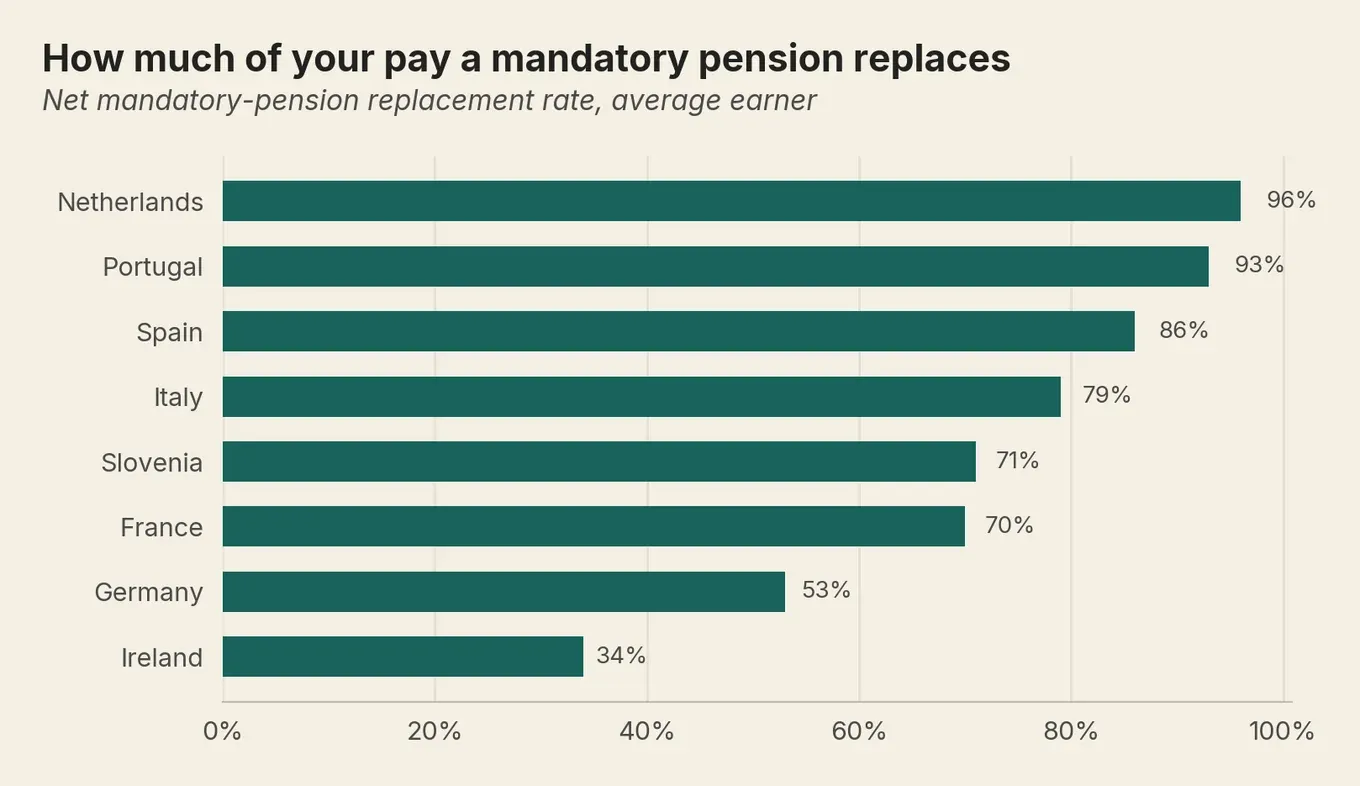
Most Europeans get a state pension (opens in new tab) for life from their country’s retirement age, though only once they have paid in for long enough. The minimum number of contribution years, the years you paid into the system, varies sharply: five in Germany, fifteen in Spain. Spain adds a condition, that two of those fifteen fall in the fifteen years before you claim. The OECD’s headline figure, though, is the whole mandatory pension: the state pension plus any workplace pension you must pay into. Across the OECD’s 2025 pension figures (opens in new tab), the average earner gets 96% in the Netherlands, 53% in Germany, and 34% in Ireland. The Dutch 96% is mostly a near-universal, auto-enrolled workplace pension; the state alone replaces closer to 40%. Germany’s 53% and Ireland’s 34% are the state carrying it almost alone, because their workplace pensions stay voluntary. Same salary, three different-sized holes to fill from savings. Your hole is bigger if you earn above average or are self-employed, so check your own national pension estimate, not the average.
What does the number look like in Germany versus Ireland?
Wildly different, from the same salary and spending. A saver wanting €30,000 a year needs roughly €260,000 saved in Germany, where the state pension runs generous, but about €470,000 in Ireland, where the mandatory floor sits far lower. Nearly double, from a border.
Take someone earning €40,000 after tax who wants that €30,000 a year. For scale, Eurostat (opens in new tab) puts average euro-area spending near €22,300, so €30,000 buys a comfortable life for one. On the same illustrative assumptions and a 3.5% withdrawal rate, that’s a multiple of about 29. Germany’s state pension replaces roughly 53% of that salary, about €21,000, so the portfolio covers only the missing €9,000, about €260,000. Ireland’s mandatory State Pension replaces about 34%, near €13,500, so the gap widens to €16,500 and the target climbs to about €470,000.
Skip the pension step and both chase the naive figure instead: €30,000 with no floor subtracted needs roughly €860,000. The German floor cuts that by about 70%. Two caveats. These are average-earner figures for someone leaning on the state alone, and the pension only starts at state-pension age, so retiring early needs a separate bridge pot. Most Irish workers also hold an occupational pension, which lifts that 34% floor. All illustrative, of course; markets can fall as well as rise.
How do Lean, Fat, Coast, and Barista FIRE change your enough number?
The financial-independence community (opens in new tab) keeps its own labels for the same sum, your FIRE number, or your financial independence number. They are American in origin, worth knowing so the words stop sounding like a club you are not in.
| Label | What it changes | What it does to the number |
|---|---|---|
| Lean FIRE | A deliberately small spending target | Shrinks it; you fund a frugal life |
| Fat FIRE | A comfortable, unrestricted spend | Grows it; you fund the life you already like |
| Coast FIRE | You stop adding to the pot early and let compounding finish | Same end target, reached sooner; you work only to cover today’s bills |
| Barista FIRE | Part-time work covers part of your spending | Shrinks the portfolio; wages fill the gap the fund would |
None of them touch the arithmetic. Lean and Fat change the spending you feed in; Coast and Barista change when you stop. The multiplier and the pension floor stay put. One catch sits under all four: the pension floor pays nothing until state-pension age, so retiring early needs a bridge pot for the gap years the floor cannot reach.
How do you know when you have enough money?
You know on paper long before you know it in your gut. On paper, enough arrives when your reviewed target, spending minus your pension floor, times your multiple, is covered by what you have saved. The real work is deciding, in advance, that this figure counts as the finish line.
Write it down now, while you’re calm and years away, because you won’t trust it when you arrive. A figure set today carries an authority a figure you eyeball at 61 does not. Give it a rule: this number, reviewed once a year, is the line. Cross it, and you can stop, downshift, or keep working because you want to, not because you’re afraid.
One thing quietly wrecks the plan: lifestyle creep (opens in new tab). As your pay rises, spending rises to meet it, and last year’s treat becomes this year’s baseline, dragging the target up faster than you can walk towards it. The fix is dull: cap the spending figure on purpose, and review it rather than letting it drift with your salary.
Why does hitting the number still not feel like enough?
Because feelings adapt. Psychologists call it hedonic adaptation: after any gain, good or bad, satisfaction drifts back towards where it started. Hit your number and the relief fades within weeks. The figure that promised freedom ends up feeling like a Tuesday.
You’ll cross the line on an ordinary afternoon. Nothing will mark it. No horn, no letter, no warm flood of arrival. You’ll refresh the figure twice to be sure, put the kettle on, and go back to whatever you were doing, because that’s what a person does. The plan hasn’t failed. This is what enough feels like from the inside, which is to say, like almost nothing at all.
The research backs the anticlimax. Big windfalls fade back towards the old baseline, the finding that made adaptation theory famous, though the researchers who later revised that theory (opens in new tab) found that adaptation is not complete for every kind of life event. In American data, Kahneman and Deaton put the point where day-to-day mood stops climbing (opens in new tab) at around 100,000 and found the plateau mostly bites people who were already unhappy. Those are US dollars and US samples, not a euro target. More money keeps helping. But the help keeps shrinking, and it never arrives as the sense of “done” you were sold.
This is where careful savers get stuck. They hit the number. The feeling doesn’t come. So they decide it was too low and set a bigger one. The FIRE crowd calls it one-more-year syndrome, and it can run a decade. Even the rule’s inventor keeps nudging his: Bengen has raised his 4% to 4.7% (opens in new tab), which tells you the target was never fixed.
Kurt Vonnegut told the cleanest version of the cure. In a short poem in the New Yorker in 2005, later borrowed by the investor John Bogle for a book called Enough, Vonnegut recalls telling the novelist Joseph Heller that their billionaire host had made more in a single day than Heller earned in all the years since Catch-22. Heller says he has something the host never will: the knowledge that he has enough. Enough, then, isn’t a sum your account reaches; it’s a line you draw and honour. The number tells you when you can draw it. Whether you feel finished is your call, not the market’s.
What should you do with your number this week?
Get the rough version down this week; the precise one can wait for a spreadsheet and a wet Sunday. Write down what you spend in a year now, not what you would like to. Look up your state pension estimate and take it off the top. Multiply what is left by about 29, on the same illustrative assumptions as before. It will be wrong in the third digit and right in the first, which is all a target needs to be.
Then write the number somewhere you’ll find it again, and leave it alone for a year. It won’t feel like a finish line. Finish lines rarely do. Draw it anyway. A line you chose and can defend beats a borrowed American figure you never believed, and it buys the one thing more money kept failing to hand over: the right to stop asking the question.
Frequently asked questions
What does 'enough' mean in personal finance?
How do you calculate your enough number?
How do you know when you have enough money?
Why does hitting the number still not feel like enough?
Sources (13)
- OECD: Pensions at a Glance 2025, net pension replacement rates (Table 4.5)
- European Central Bank: euro area 10-year government bond yield
- Eurostat: euro area HICP inflation rate
- Eurostat: household final consumption expenditure per capita
- European Union, Your Europe: state pensions abroad
- Investopedia: financial independence, retire early (FIRE)
- Retirement Researcher: an international perspective on safe withdrawal rates (Pfau)
- Retirement Researcher: the 4% rule and the search for a safe withdrawal rate (Bengen 1994 background)
- CNBC: William Bengen's revised 4.7% Universal SAFEMAX
- PNAS: high income improves evaluation of life but not emotional well-being (Kahneman and Deaton 2010)
- PNAS: income and emotional well-being, a conflict resolved (Killingsworth, Kahneman and Mellers 2023)
- American Psychologist: beyond the hedonic treadmill (Diener, Lucas and Scollon 2006)
- Fidelity Learning Center: what is lifestyle creep and how does it work
— That's the lot. It is now night.
Want more of this in your Google results?
Add Money Owl as a preferred source, and Google will show our finance pieces higher when you search for them.
By Jure Jaklič
Founder and editor of Money Owl. Data analyst by trade; personal finance learned first-hand across six European countries.
Recommended

When did your bank balance start grading you?
Self worth vs net worth is a real, studied tension, mostly working against you. The named research on why your balance feels like a verdict, and how to stop it.

The science of how to buy happiness (it's not what you think)
Science says you can buy happiness. Four evidence-based rules for spending so it lasts, with real euro examples for European readers.

Scarcity vs abundance: what your money mindset does to your wealth
Your money mindset is real, just not the way Instagram swears. Real scarcity taxes your decisions, and manifestation is a sales funnel with a candle.