

The point.
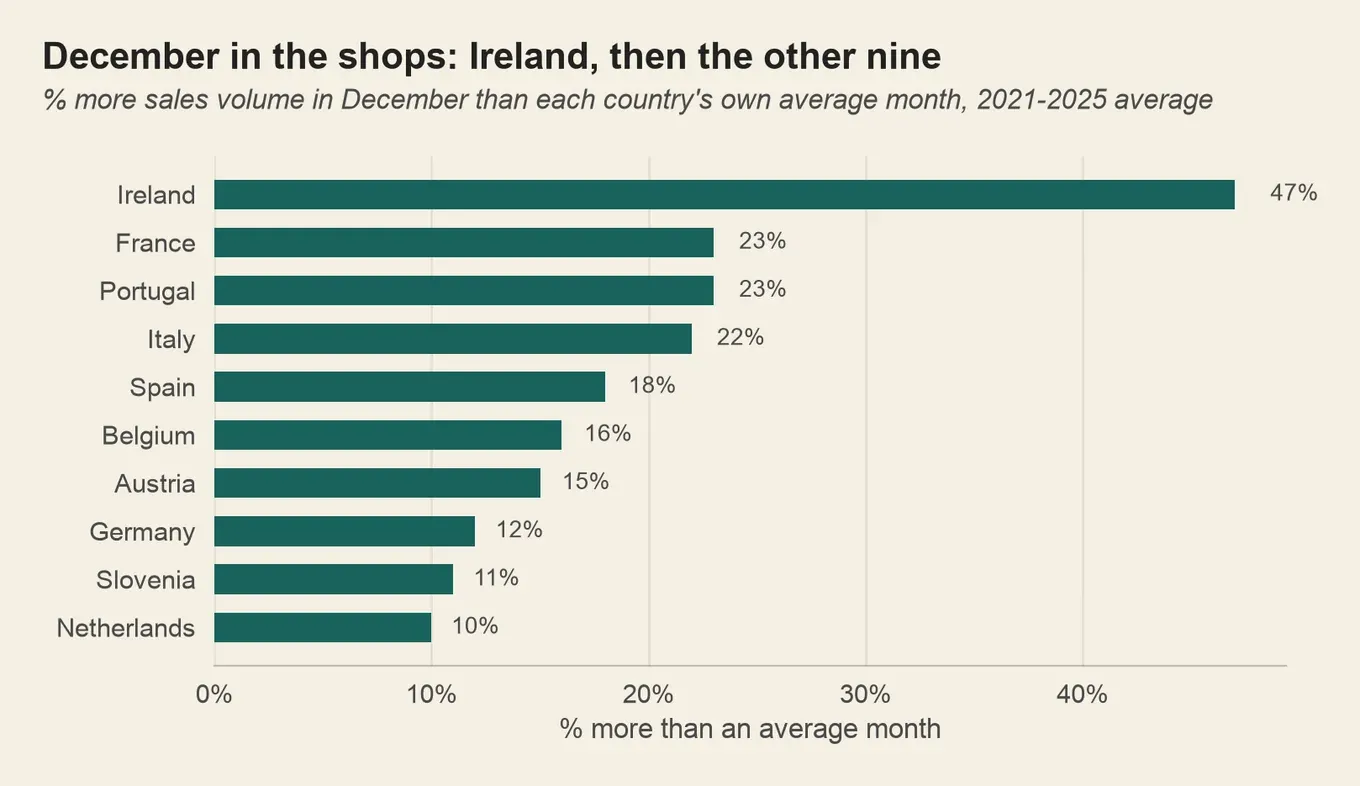
- Irish shops sell about 47% more in December than in an average month (Eurostat, 2021 to 2025), the most of the ten European markets Money Owl counted. That's what shops sell, a different measure from household spending.
- Your own number is last December's spending divided by your average month, with card and buy now, pay later purchases counted at full price in the month you made them. Your ceiling is what you can pay off by the January due date without touching the emergency fund; if last year's extra was more than that, trim the Christmas list until it fits.
- In the worked example, ten adults and four children at €40 each come to €560; a Kris Kindle (a Secret Santa-style draw) for the adults takes that down to €190.
- Spanish employees are owed a Christmas extra payment; if their collective agreement spreads it over twelve monthly payslips, December brings nothing extra.
- Saving from January gives eleven payments if you start buying in December, so the worked example's €900 comes to about €82 a month. Black Friday shoppers get ten, so add November's own extra to the €900 first, then divide by ten.
It’s November, and you have a feeling someone is about to tell you that a Christmas budget should have been started in January. Somebody always does. You’ll come away with your own number for how much bigger your December is than an average month, worked out from bank statements you already have.
Irish shops sell about 47% more in December than in an average month, and that puts Ireland top of the ten European markets I counted in Eurostat’s monthly shop figures (opens in new tab). In all ten, December beat an average month in every year from 2021 to 2025.
One message to the family group chat can take a €560 present list down to €190. Your own December comes first, and it’s sitting in your banking app.
How much should you spend on Christmas?
There’s no normal figure worth copying from anyone else’s Christmas. A ceiling that holds up is the amount you could pay off by the January due date without touching your emergency fund.
Christmas is the most predictable bill of the year (the date has been public for some time), so it gets its own money and leaves the emergency fund alone. Check last year’s Christmas against that ceiling.
How much bigger is your December than an average month?
Divide last December’s spending by your average month over the same year. It takes about as long as the kettle. Longer with a credit card. If an average month sees €2,500 leave your current account and December saw €3,400, your ratio is 1.36. December cost you about 36% more, or €900 extra. That €900 is your Christmas, minus the optimism.
- Find what left your current account in each month of last year. Most banking apps show a monthly total.
- Take out money you moved to yourself, such as transfers to your own savings.
- Count anything bought on a credit card or with buy now, pay later at its full price in the month you bought it. Leave the repayments out of current-account spending, including January’s card bill.
- Divide December by the average of all twelve months for your ratio. December minus that average is your extra in euros.
- If you shop Black Friday, add November minus the average. In Spain, add January’s extra too if it ran above average and the extra went on Christmas. The busy months lift the average, so round the extra up.
If you pay cash a lot, the statement only shows the withdrawal at the cash machine, and what the cash turned into is between you and the shop, so count December’s withdrawals as December spending and leave it there. In Spain, the Banco de España (opens in new tab) found more than half (57%) of payments in shops were made in cash in 2024, by number of payments.
If you share costs with someone, do both accounts. I doubt the two ratios match.
If last year’s extra was cleared by the January due date without touching the emergency fund, that’s your ceiling. Otherwise, trim the Christmas list to what you could have cleared.
Before anyone tells the cousins, don’t compare your ratio with Ireland’s 47%, because shops and households are measured differently.
What can you still change in your Christmas budget?
Each name you drop from the present list saves you the whole present. The trip home and the food are harder to shrink this late, so price those first.
- Write down everyone you’ll buy for, plus the work do and the trip home.
- Put a figure beside each name before you’re standing in a shop.
- Propose a Kris Kindle for the adults, where everyone draws one name and buys for that person only.
- Drop one thing you paid for last year purely to be polite.
Say you buy for ten adults and four children at €40 a head. That’s €560. Put the ten adults into a Kris Kindle with a €30 limit and the adults cost you €30. Keep the children at €40 each and the whole list comes to €190.
Somebody has to propose it, and it may as well be you, in the family group chat, before anyone buys anything.
“Proposal for Christmas: Kris Kindle for the adults. One name each, €30 limit, draw on Sunday. Kids still get presents from everyone. Objections in writing.”
There will be one objection. It’ll come from the relative who likes shopping. They can still buy for the children.
For step four, look at the third work night out in a month. Go to the one you’d miss. In Spain, step four might well be the Christmas lottery, at €20 a décimo, says the state lottery operator (opens in new tab).
Maybe last year’s décimo was bought por compromiso, out of obligation. Because someone from the second floor came round with an envelope, a list of names and the face of a person who’d told everyone you were in.
Is there extra money coming in December?
Portugal and Spain owe employees Christmas pay by law, and Ireland pays a Christmas Bonus with some long-term welfare payments. Portugal’s Christmas allowance, the subsídio de Natal (opens in new tab), is one month’s pay, due by 15 December; exactly when it’s paid can depend on your contract.
There’s a 13th-month table by country in the payday running order. If a January card bill is coming, give it first claim on any extra.
“Only include income that you are absolutely certain you will get before the Christmas holiday. If you can, try to put some money aside for January too, so you have enough to pay your regular bills in the New Year.”
Who gets Ireland’s Christmas Bonus?
People on qualifying long-term social welfare payments get it. You don’t have to apply, which is unusual enough to mention. For 2026, Citizens Information (opens in new tab) says it’s 100% of your normal weekly payment, with a minimum of €20, paid in the week starting 7 December. Jobseeker’s Allowance only counts after 12 months on it, and Child Benefit and Fuel Allowance don’t count at all. The Department of Social Protection’s own example (opens in new tab) is a pensioner on the maximum State Pension (Contributory), who gets €299.30.
What about Spain’s paga extra?
Under Spain’s workers’ statute, the Estatuto de los Trabajadores (opens in new tab), employees are entitled to two extra payments a year, one of them at Christmas. Your collective agreement sets how much they are. It can also spread both across your twelve monthly payslips, and then December brings nothing extra.
Your payslip will tell you which you’ve got. HR will too, eventually. Say Lucía in Valencia takes home about €27,000 a year, roughly the average Spanish wage after tax for a single person in Eurostat’s figures (opens in new tab). If her agreement makes each extra a full month’s pay, December brings her usual pay plus the Christmas extra, and each is about €1,930. Spread over twelve, it’s about €2,250 a month and December is a normal month.
What lands in January, and when?
The card statement arrives first. You’ll recognise most of it. Any buy now, pay later instalments can follow for months. Pay a credit card bill in full before the due date and you aren’t charged interest on purchases, but pay less and you are. The watchdog, the CCPC (opens in new tab), puts that interest-free period on an Irish card at “generally about 56 days”.
That needs last month’s bill cleared in full too, AIB says (opens in new tab) of its own cards. So December’s shopping tends to fall due in January or early February. I’d go by the date printed on the statement. Allow for the bank holidays: the payment must arrive by the due date. The Irish minimum payment, “usually around 2% to 5%” of what you owe, gets you out of a late fee (opens in new tab) and not much else.
In Spain, check how your card is set to pay. Going by a 2020 Banco de España guide (opens in new tab), pago a fin de mes takes the month’s purchases in one go, usually without interest. Pago aplazado (opens in new tab) charges interest on instalments, and a low instalment may not even cover it.
I’ve never used a credit card for credit. I got my first one once I understood money a bit better, and I pay any balance in full every month. When I was younger I was often living on the edge of zero in my bank account, sometimes slipped into the overdraft, and got out of it as soon as I had the money.
Buy now, pay later is a separate loan with its own contract. It arrives as a button. I’d rather a loan looked like a loan. For goods under €500, the CCPC says (opens in new tab) you may be offered interest-free instalments over three to six months.
“BNPL often makes consumers more likely to buy things they don’t need and spend significantly more than they had planned.”
Brian McHugh, Chairperson, Competition and Consumer Protection Commission, opening statement to the Oireachtas finance committee (opens in new tab), 24 June 2026
A €240 coat split into six monthly payments of €40 is still being paid for in spring. How buy now, pay later works gets its own guide.
| Date | What arrives or falls due | Country |
|---|---|---|
| Week starting 7 December 2026 | Christmas Bonus, for those who qualify | Ireland |
| December 2026, on the day your agreement sets | Christmas paga extra, unless your payslips spread it over twelve months | Spain |
| 1 January 2027, usually, says the CCPC | €30 a year government stamp duty (opens in new tab) on each credit card account, taken from the account by your card provider | Ireland |
| January to early February 2027 | December’s card bill falls due; buy now, pay later instalments continue | Ireland |
If you can’t pay, call the lender before the due date. For Christmas already on a card or a loan you can’t clear, there’s a guide to getting back on track after overspending. In Ireland, MABS (opens in new tab), the Money Advice and Budgeting Service, has a helpline on 0818 07 2000. A disputed charge in Spain goes to the bank first, then to the Banco de España’s complaints service (opens in new tab), which is free to use (opens in new tab). Spain has no national debt-advice service in law yet (November 2026), though a January 2026 draft law (opens in new tab) proposes a right to debt advice.
When should you start saving for next Christmas?
In January. Yes, I know. It gives you the most payments before the next December. Divide the extra Christmas cost by the months left before the shopping starts (the same goes for any once-a-year bill).
If you’re behind on a bill, catching up comes first. After that, a small emergency pot you can reach, then whatever’s left of last Christmas on a card or overdraft, and only then the next one.
If you start buying in December, €900 saved from January is eleven payments of about €82. Leave it until September and it’s €300 a month. Black Friday shoppers need it there by November, so add November’s extra to the €900 first, then divide by ten. On an irregular income, it’s allowed to get there unevenly. Use the same total and pay in more in the good months.
Is a credit-union Christmas savings club worth it in Ireland?
Once you have a small emergency pot you can reach and last Christmas is off the card, it’s worth a look if you’d rather not be able to touch the Christmas money. At ANSAC Credit Union (opens in new tab), early access in an emergency may be considered “in exceptional circumstances”. St Canice’s Credit Union (opens in new tab) keeps the money locked, and you can’t take it out unless you ask the credit union to lift the lock.
Your credit union will have its own rules, written down somewhere. Read them before you sign. (These are examples as of November 2026, not endorsements, not advice; verify current terms before acting.)
What you earn is a dividend, and it isn’t promised. ANSAC’s terms tie it to the credit union’s yearly declaration, and it may vary each year. I wouldn’t spend it before it’s declared. Share accounts in credit unions are covered by the Irish Deposit Guarantee Scheme up to €100,000 per person per institution, says the Central Bank of Ireland (opens in new tab). You can look your credit union up on the Central Bank’s registers (opens in new tab).
What do you do with your December number this week?
Work out the ratio tonight, while last December is still in your app’s history. If you’re not sure where next Christmas’s pot should live, the choices are in the guide to saving for short-term and long-term goals. Write your ceiling in euros at the top of your Christmas list.
Sources (23)
- Eurostat: retail trade volume, monthly (sts_trtu_m)
- Eurostat: annual net earnings (earn_nt_net)
- Banco de España: Economic Bulletin 2025/T2, payment habits in Spain
- Citizens Information: Christmas Bonus
- Department of Social Protection: Budget 2027 publications
- BOE: Estatuto de los Trabajadores
- SELAE: Lotería Nacional
- Procuradoria-Geral Distrital de Lisboa: Código do Trabalho, art. 263 (subsídio de Natal)
- CCPC: credit cards
- CCPC: buy now, pay later
- CCPC: opening statement to the Oireachtas finance committee, 24 June 2026
- MABS: Planning for Christmas
- Central Bank of Ireland: Deposit Guarantee Scheme
- Central Bank of Ireland: registers
- St Canice's Credit Union: Christmas Cracker savings club
- ANSAC Credit Union: Christmas savings club terms and conditions
- Banco de España: how credit card payments are charged (2020)
- Banco de España: what revolving cards are and how their instalments work (2020)
- Banco de España: how to make a complaint
- Banco de España: Reclamar donde toca (2025)
- Ministerio de Economía: draft consumer credit law (anteproyecto, January 2026)
- Revenue: stamp duty on credit cards and charge cards
- AIB: credit card questions and answers (accessed November 2026)
— That's the lot. It is now night.
Want more of this in your Google results?
Add Money Owl as a preferred source, and Google will show our finance pieces higher when you search for them.
By Jure Jaklič
Founder and editor of Money Owl. Data analyst by trade; personal finance learned first-hand across six European countries.
Recommended

How much should you have saved by 30, 40 and 50? The European answer
One year's salary by 30, three times by 40. That rule is American, and it assumes you fund half your own retirement yourself. Most of Europe already funds more, and most countries have a free government site where you can look yours up.

How to audit your spending and find where it went
A bank statement is a diary you didn't mean to keep. Here's how to read it back and find where the money actually went.

The 50/30/20 budget rule: a simple plan for European savers, and where it breaks
The 50/30/20 budget rule for European savers, explained plainly: how to split take-home pay, what a need is, and what to do when rent breaks the 50% ceiling.