

The point.
- The 50/30/20 rule splits after-tax income: 50% needs, 30% wants, 20% savings or clearing debt faster.
- Apply it to net take-home pay, not gross, and don't double-count a pension that's already deducted from your payslip.
- In Dublin, Paris and Munich, rent alone can push needs past 50%. That's the rent, not you.
- When housing breaks the ceiling, shift to 60/20/20: protect the savings, trim the wants.
- Past roughly 70% of income on needs, the fix is more income or cheaper housing, not a cleverer percentage.
You did the sums once, at the kitchen table, on a Sunday night. Rent, then the bills, then whatever was left. On its own, the rent came to more than half your take-home pay. The 50/30/20 rule says half is the ceiling for all your needs put together, so you closed the laptop and quietly filed yourself under “bad with money.”
You are not bad with money. One in five European renters paying the market rate is stretched past the affordability line, and not one of them budgeted wrong.
The 50/30/20 budget rule splits your monthly take-home (after-tax) income three ways: 50% to needs, 30% to wants, and 20% to savings or paying off debt faster.
- Needs, 50%. Rent, bills, groceries, insurance, the bus to work, and the minimum you owe each month on any debt.
- Wants, 30%. The things you’d miss but could pause. Dinners out, subscriptions, a weekend away.
- Savings, 20%. An emergency fund, longer-term saving or investing, and clearing debt faster than the minimum.
That’s the whole rule. The interesting part isn’t the split. It’s what happens to the split once you try to live inside it in a European city, which is where most guides go quiet and this one does not.
What is the 50/30/20 budget rule, and where did it come from?
It came from a book. Elizabeth Warren and Amelia Warren Tyagi set out a “balanced money formula” in All Your Worth in 2005, years before Warren became a US senator. They split money into three parts: the must-haves, some fun for now, and whatever’s left for later. Someone later pinned round percentages to the idea, and the 50/30/20 rule was born.
The percentages are the point and also the problem. They make the rule easy to remember, which turns out to matter more than being exactly right. A field study of simple money rules of thumb (opens in new tab) found that a plain rule beat careful, thorough accounting at changing what people did with their money, because you can hold a plain rule in your head at the till. Those in the study were small-business owners in a developing economy, so don’t stretch the finding too far. The direction still holds: a rule you’ll use beats a spreadsheet you won’t open.
So treat 50/30/20 as a starting shape, not a law you pass or fail. Every serious explainer that describes it says the same thing in the small print. The numbers are a guide, not a target you owe anyone. Hold on to that, because in a minute the rule is going to “fail,” and it won’t be your fault.
How do you work out your split from take-home pay?
The arithmetic is easy. It’s the base you apply it to that catches people.
Should you use gross or net pay?
Use net, your take-home pay after tax. Gross is the salary before deductions, and budgeting from it overstates every bucket by your whole tax bill. Net differs by country, so use your own payslip figure, not a percentage of gross.
That country gap is wider than it sounds. What the state removes from a salary is not the same in Dublin, Munich and Porto. On the OECD’s own figures (opens in new tab), a single worker keeps roughly 75% of gross as take-home; the rest goes in income tax and social contributions. The state’s total cut of a job runs heaviest in Germany and France, lightest in Ireland. That headline “tax wedge” figure, though, folds in the part your employer pays that never shows on your payslip, so it is not the deduction you feel.
Then multiply by 0.5, 0.3 and 0.2. Lena in Leipzig, on about €2,300 net, gets roughly €1,150 for needs, €690 for wants, and €460 into savings. Inês in Porto, on a lower Portuguese median, is running the same three splits off a much smaller base, which is the whole reason a percentage rule travels better across Europe than a fixed euro target.
| Monthly take-home | Needs (50%) | Wants (30%) | Savings (20%) |
|---|---|---|---|
| €1,798 (EU-27 median) | €899 | €539 | €360 |
| €2,300 (Germany median) | €1,150 | €690 | €460 |
| €1,609 (Spain median) | €805 | €483 | €322 |
Median monthly take-home, 2024 (Eurostat (opens in new tab)), split three ways. Your own payslip is the number that matters, not the median.
One quiet trap. If your pension is deducted before you ever see “take-home,” it’s money you’ve already saved, so don’t force it into the 20% a second time.
What counts as a need, and what’s just a want?
This is the line people get stuck on, and it’s worth getting right, because miscoding a want as a need breaks the maths.
| Clearly a need (50%) | Clearly a want (30%) | The tricky ones |
|---|---|---|
| Rent, mortgage, utilities | Streaming, takeaways, hobbies | A gym contract: fixed, but a want |
| Groceries, essential transport | A holiday, upgrades | Minimum debt payment: a need; extra paydown: the 20% |
| Insurance you have to hold | The nicer phone plan | A car: a need or a want, depending on whether you can work without it |
Is a gym membership a need or a want?
A want, even though it leaves your account on the same day each month. Fixed and essential differ: a direct debit isn’t a need simply because it recurs. Cancel it for a month and your week stands, so it sits in the 30%.
Debt is the other classic trip. The minimum payment you have to make is a need and belongs in the 50%. Anything extra you throw at the balance to clear it faster isn’t a need; it’s the 20% doing its job. One debt, two buckets. Get that wrong and the plan stops adding up.
When a cost genuinely sits on the fence, use one test: would your week fall apart without it? A phone contract, yes. The premium tier of it, no. That settles most of the tricky column above in about four seconds, which is roughly all the attention a budget deserves.
Is the 50/30/20 rule realistic in high-cost cities like Dublin, Paris or Munich?
Often, no. And that’s about European rents, not about you.
Housing is the obvious need, and Eurostat has a name for housing eating the budget: housing cost overburden (opens in new tab), which means spending more than 40% of your disposable income to keep a roof over your head. Across the EU in 2024 that was 8.2% of people (opens in new tab). Look only at people renting at the market rate, though, and it jumps to 19.2% (opens in new tab), nearly one in five, against roughly one in twenty owners. In the Netherlands it reaches 43.9% of market-rate renters while the national figure sits at a comfortable 6.9%, which tells you how neatly a national average can hide a renter’s problem.
Now the cities.
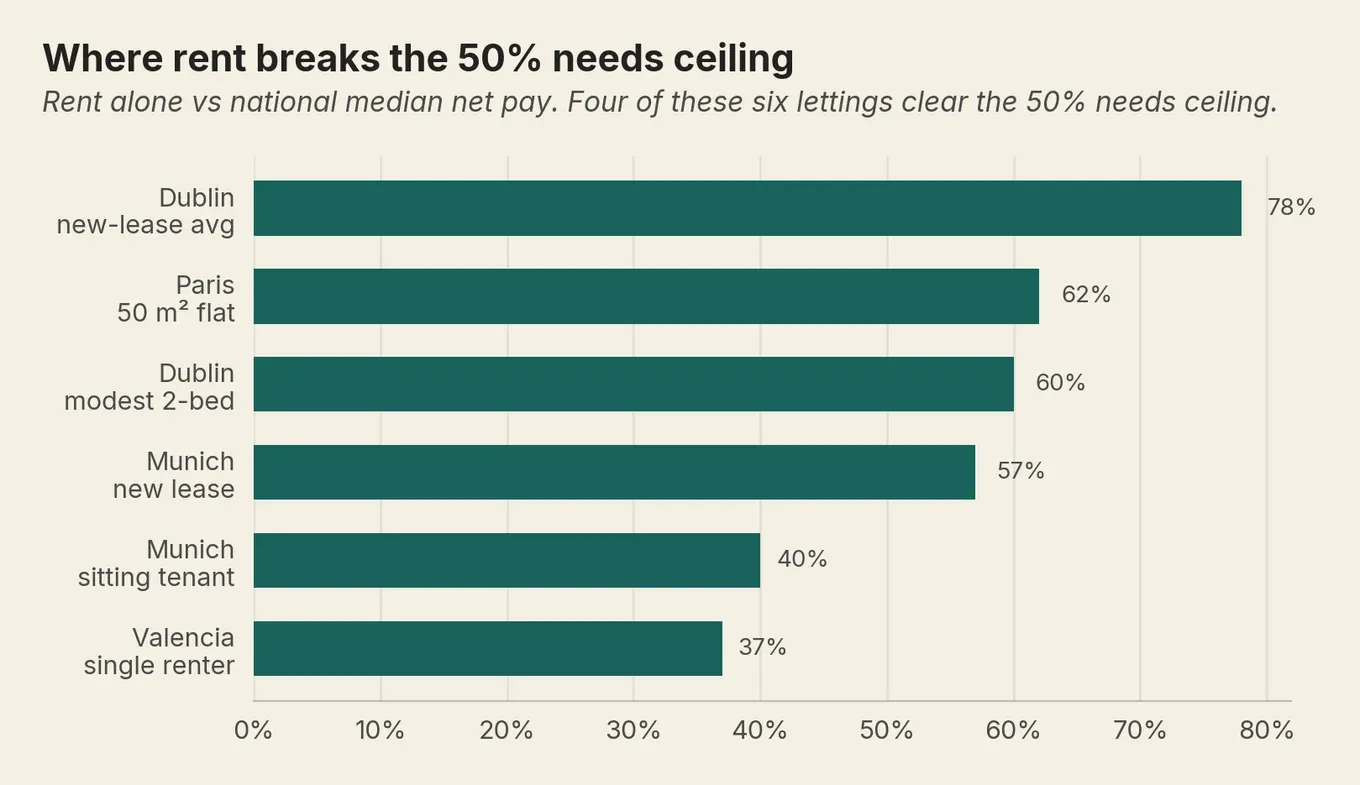
In Dublin the average new tenancy ran to €2,154 a month in late 2025 (opens in new tab), and even a modest two-bed further out was €1,649. Set that against Irish take-home and rent alone is eating around 60% for the two-bed, closer to 78% on the average new lease, before a single grocery. In Paris the city median was €26.6 per square metre in 2024 (opens in new tab), so a 50 m² flat is about €1,330, which lands a single earner near 62%. Munich is the strange one. The official rent index (opens in new tab) puts a 60 m² flat at about €920 a month for a sitting tenant, comfortably fine. But a new arrival signing a fresh lease pays closer to €1,320 for the same four walls, which pushes past 57%. Camille in Paris and a new tenant in Munich can rent the same size flat and land on opposite sides of the line.
Your budget isn’t failing the rule. The rule is failing your postcode. Someone, at some point, chose 50% as the ceiling for needs. It was a tidy number in a 2005 book, not a measurement of what a one-bed costs in Dublin. Nobody in that 19.2% did anything wrong. They signed a lease at the market price, which is the only price on offer.
The OECD’s 2024 affordable-housing data records this as a structural pattern across dozens of countries, not a personal failing:
Tenants are more likely than homeowners to be overburdened by housing costs, with typically the highest overburden rates among low-income households.
OECD, Affordable Housing Database (opens in new tab) (indicator HC1.2, Housing costs over income), 2024
It’s not universal, and that matters too. Maja in Ljubljana lives in a market where only about 3.8% of people are housing-overburdened, and for her the 50% ceiling is genuinely reachable. A cheaper city isn’t automatically a safe one, mind. Valencia has lower rents but lower Spanish wages to match, so a single person in a small flat can sit under the line while a family-size place still tips over it. The ceiling holds or breaks depending on your city, your wages, the size of the flat, and whether you signed last month or ten years ago.
Work it through and the rule holds where the rent is smaller. A single person renting a 40 m² flat in Valencia for about €600, on roughly the Spanish median take-home of €1,600 a month, spends near 37% of pay on rent. Their needs sit just under the half-line, so plain 50/30/20 fits with nothing modified: about €805 for needs, €483 for wants, €322 saved. The rule isn’t broken everywhere, only where housing eats the budget.
What do you change when rent breaks the 50% ceiling?
You move the ceiling, not yourself. Once housing has pushed your needs past half, the useful question is which of the other two buckets takes the hit.
| Plan | Needs | Wants | Savings | When it earns its place |
|---|---|---|---|---|
| 50/30/20 | 50% | 30% | 20% | The starting shape, when housing fits under half |
| 60/20/20 | 60% | 20% | 20% | Housing at 50 to 60%; you protect the savings and trim the fun |
| 60/30/10 (a reasoning move, not a named rule) | 60% | 30% | 10% | Housing near 60%; you keep life livable and let savings dip, briefly |
What is the 60/20/20 budget rule?
A version for higher rents: 60% to needs, 20% to wants, 20% to savings. You lift the needs cap to 60% and take the extra ten points out of wants, so your emergency fund and long-term saving carry on while the fun budget shrinks.
This is the more commonly documented variant (opens in new tab). Take Aoife, a project manager in Dublin on about €3,750 net a month, which is not a small wage. She rents a two-bed out in the commuter belt for €1,649, well under the €2,154 a new city tenancy averages. Yet with bills, groceries, transport and a small loan her needs still land near €2,250, a full 60% of her pay.
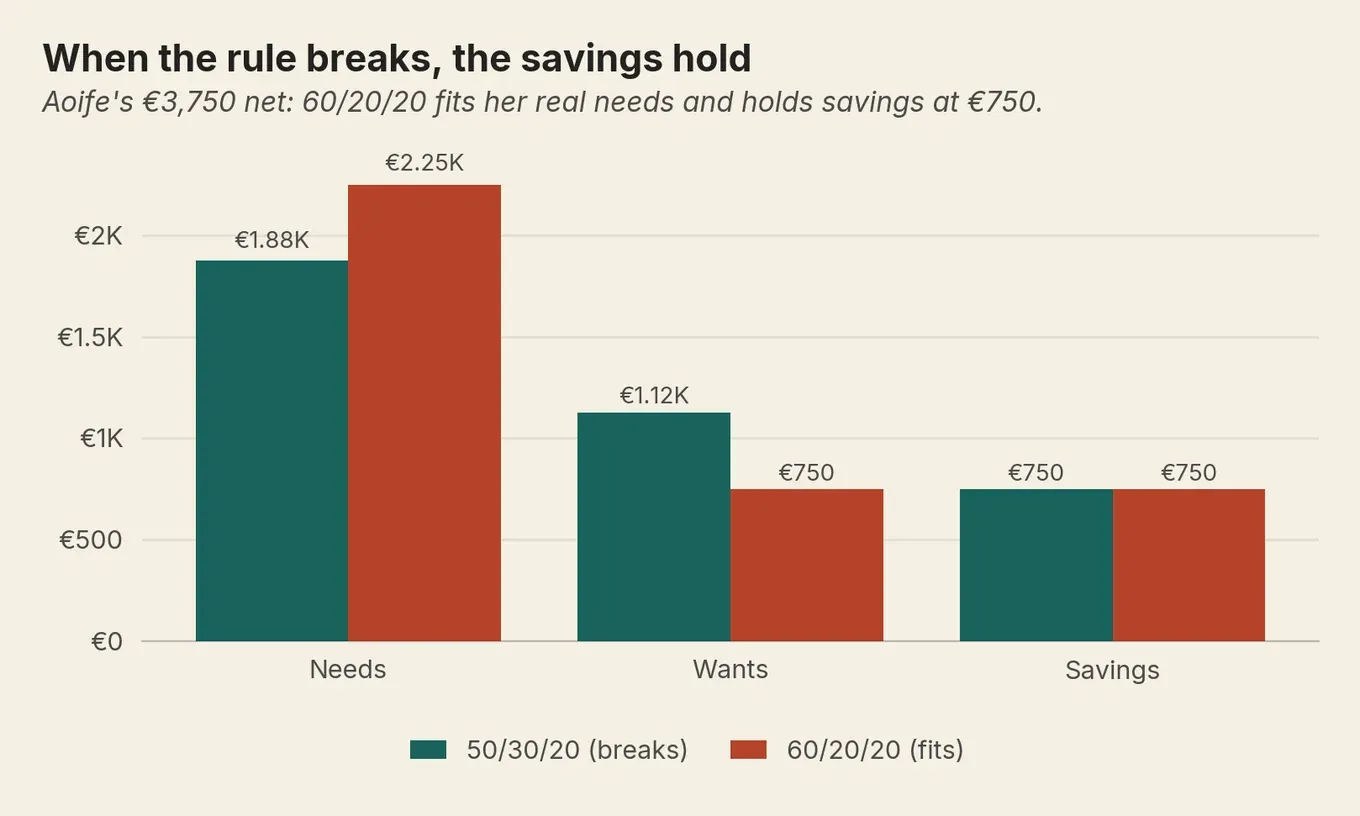
Standard 50/30/20 allows her €1,875 for needs, €375 below what she actually owes each month, so the plan is broken the moment she’s paid. Switch to 60/20/20 and the needs bucket fits, the €375 comes out of the dinners-out budget, and the 20% never flinches: €750 into savings on payday either way. Her rent broke the rule, so she moved the rule, not herself.
What is the 60/30/10 budget rule?
A softer adjustment, and a reasoning tool rather than a named rule with a pedigree: 60% to needs, 30% to wants, 10% to savings. It keeps daily life livable by letting savings dip, which only holds as a short-term posture, since 10% builds slowly.
Keep wants at 30% and let savings take the strain for a while, if that’s what makes the plan one you’ll stick to. You won’t find an authority that blesses 60/30/10 the way 60/20/20 is documented, so treat it as a bridge, not a destination.
Underneath both is one decision. Is the overshoot structural or behavioural? If a high-cost city and a market-rate lease have pushed housing past half, that’s structural, so modify the rule and get on with your life. If “needs” crept over 50% because a want sneaked in wearing a need’s coat, fix the label before you touch the ratios. And past roughly 70% of income going on needs, the split stops being a budgeting tool and becomes a diagnosis: the levers that help are more income or cheaper housing, not a cleverer percentage.
How do you start this without turning it into a hobby?
Do one thing on Tuesday. Open your banking app, look up your net monthly pay, and set a standing order for a small, boring amount into a separate account on payday. That single move does most of the work of the 20%, because money you never see is money you don’t spend.
Order matters after that. Send the first slice toward a thin emergency buffer, a few hundred euro, so the next broken boiler goes on savings rather than a credit card. Then aim it at any expensive debt, the card or the overdraft charging you double digits, because clearing that beats almost anything else you could do with the money. Only then split the rest between longer-term saving and paying debt down faster.
A few footnotes for real life. If you split rent with a partner or flatmates, run the sums on the pooled take-home and the pooled needs, not on your half in isolation. If your income is irregular, freelance months up and lean months down, budget against a low month or a rolling average of the last several, and let the good months spill into savings rather than into a lifestyle you can’t hold in January. And if the whole thing feels like too much admin, that’s rather the point of automating it. It’s meant to save you decisions, not hand you a second job counting beans.
The rule was never the exam. It’s a rough shape for a plan, and a plan you’ll keep beats a perfect one you abandon by February. Open the laptop again on Tuesday. This time, if the needs line runs past half, write it down as a fact about your rent, and leave yourself out of it.
Frequently asked questions
What is the 50/30/20 budget rule?
Do you apply the 50/30/20 rule to gross or net pay?
Is a gym membership a need or a want?
Is the 50/30/20 rule realistic in high-cost cities like Dublin, Paris or Munich?
What is the 60/20/20 budget rule?
Is the 50/30/20 rule still a good budgeting method?
Sources (11)
- Eurostat: Glossary, housing cost overburden rate
- Eurostat: Living conditions in Europe, housing (2024)
- Eurostat: Housing cost overburden rate by tenure status (ilc_lvho07c)
- Eurostat: Mean and median income by age and sex (ilc_di03)
- OECD: Taxing Wages 2026
- OECD: Affordable Housing Database HC1.2, housing costs over income
- Residential Tenancies Board: RTB Rent Index Q4 2025
- OLAP: Rent levels, Paris intra-muros
- City of Munich: Mietspiegel 2025
- American Economic Association: Keeping It Simple, Financial Literacy and Rules of Thumb
- Farmers State Bank: 50/30/20 budgeting rule
— That's the lot. It is now night.
Want more of this in your Google results?
Add Money Owl as a preferred source, and Google will show our finance pieces higher when you search for them.
By Jure Jaklič
Founder and editor of Money Owl. Data analyst by trade; personal finance learned first-hand across six European countries.
Recommended

The best savings account in Europe is the one that lets you keep the most
The headline rate on a savings account is rarely what you keep. Post-tax yields in Germany, France, Ireland, Slovenia and beyond tell a very different story.

The psychology of spending: why we buy things we don't need
A €200 jacket split into four payments reads to your brain as €50. The psychology of spending, and how to put the brake back.

How much should you have saved by 30, 40 and 50? The European answer
One year's salary by 30, three times by 40. That rule is American, and it assumes you fund half your own retirement yourself. Most of Europe already funds more, and most countries have a free government site where you can look yours up.