

The point.
- The month that went wrong cost you one month. The months since, where nothing went in, are where the money actually went.
- Your balance didn't reset when you stopped. It only stopped growing, which is a much smaller thing.
- Two numbers tonight, under ten minutes: whether the transfer is still running, and what the balance is now.
- Restart at a figure you wouldn't have cancelled in the month it broke, at the next payday rather than the first of next month.
- Don't pay back the months you missed, unless the money has a deadline on it. If you dipped into the pot, refill it at the same resumed rate, and clear expensive debt first, whatever shape it takes, unless it is an arranged buffer at no interest.
- Halving the transfer is a way back in. Put a date on raising it again, or the half becomes the plan.
The point.
- The month that went wrong cost you one month. The months since, where nothing went in, are where the money actually went.
- Your balance didn't reset when you stopped. It only stopped growing, which is a much smaller thing.
- Two numbers tonight, under ten minutes: whether the transfer is still running, and what the balance is now.
- Restart at a figure you wouldn't have cancelled in the month it broke, at the next payday rather than the first of next month.
- Don't pay back the months you missed, unless the money has a deadline on it. If you dipped into the pot, refill it at the same resumed rate, and clear expensive debt first, whatever shape it takes, unless it is an arranged buffer at no interest.
- Halving the transfer is a way back in. Put a date on raising it again, or the half becomes the plan.
You had a budget. You kept it for a while, and it worked. Then one month went wrong, and you haven’t been back since. (You know which month. You don’t have to say it out loud.)
We read six guides on how to get back on track after overspending. Most of them run through the same five moves somewhere: don’t panic, look back over the last thirty days, name the cause, cut something for a while, and start again now rather than next month. Four of those are about the month that went wrong. The fifth is a starting gun. Not one of them puts a number on the months in between, which is the part you wanted costed, and it’s why you closed the last four of them.
The month that went wrong cost you one month. The months since, the ones where nothing went in, are where the money went. This is about those.
And about a mechanical fact underneath them: whatever you had already saved is still sitting there. The account never knew there was a streak. It holds a number. That is the entire feature set.
Why does one bad month feel like the whole thing collapsing?
Because the thing you were keeping was a run.
Somewhere in the last decade, budgeting borrowed its shape from language apps and step counters. The green tick. The number that climbs every day you comply. At thirty days, a small congratulation.
It works beautifully right up until the first day you miss, and then the counter goes back to 0 and the six weeks behind it are handed to you as nothing. That is what counters do.
Your savings balance can’t do that. But the counter has already told you what kind of person had that month. Plans usually die right there, ninety seconds after the overspend, in a sentence about yourself.
Right. The it-was-never-willpower argument lives elsewhere, and it puts no money back. The rest of this is arithmetic and plumbing.
Before either, one job for tonight. Open your banking app and look at two things: whether the transfer is still going out, and what the balance is. Going through a month’s spending line by line is its own job, for another evening. Two numbers, under ten minutes, and everything below depends on which answers you get.
What can restarting a transfer fix, and what can’t it?
Two months can look identical from the outside and be nothing like each other underneath.
In the first, the savings stopped and every bill still got paid. The money that used to go into the pot went somewhere else instead. That’s a routing problem. The money existed. It went to the wrong place, which is a thing you can change.
In the second, the savings stopped and something else slipped with them. Rent went late. A bill rolled into the next one. The month got covered by going further into the overdraft, or by splitting a few purchases into instalments that are still turning up.
Restarting a standing order doesn’t reach any of that. Money that isn’t there can’t be re-routed. It’s a different problem, with a different fix and a different urgency.
It isn’t rare, either. Across the EU in 2025, nearly three in ten people said they could not have met an unexpected required expense of their country’s benchmark size out of their own money (Eurostat EU-SILC data (opens in new tab)). Normal is not the same as affordable, though.
If that second month is closer to your last few, the rest of this piece isn’t written for you, and it’s better to say so now than at the bottom. In most European countries there is somebody whose job is to go through it with you, though how developed that is varies a lot by country (opens in new tab). Start there rather than here: this month it is worth more to you than any savings plan, this one included. Before you agree to anything, check that whoever you are talking to is authorised or state-backed rather than whoever came top when you searched, and ask what it costs.
One warning before you go, because it’s the thing most likely to cost you money today: do not restart a €100 transfer into an account that is already overdrawn or nearly empty. A payment that fails can attract a charge and push the account further under. And whatever shape the expensive debt takes, an overdraft, a card balance, instalments still arriving, arrears on rent or utilities or tax, it goes before the savings do. The exception is an arranged buffer at no interest, and only while you’re keeping up with it.
Both of those sort on what the month damaged. Neither asks how many there have been. First month like this, or fourth? If the transfer keeps stopping and you still can’t say where the money went, the fix isn’t in the banking app, and it isn’t debt advice either while the bills are current. That pattern is worth raising with a doctor rather than a bank, before another nine months go by.
Everything after this is about the first case: how to get back on track after overspending when the money existed and only the plumbing broke.
What did that month of overspending cost you, in euros?
If the transfer kept running the whole time and you stopped looking, the answer is zero and you never left. That happens more often than anyone admits. Close the app, feel briefly excellent, carry on.
For everyone else the sum is one line. Take what you were putting aside each month and multiply it by the number of months nothing went in.
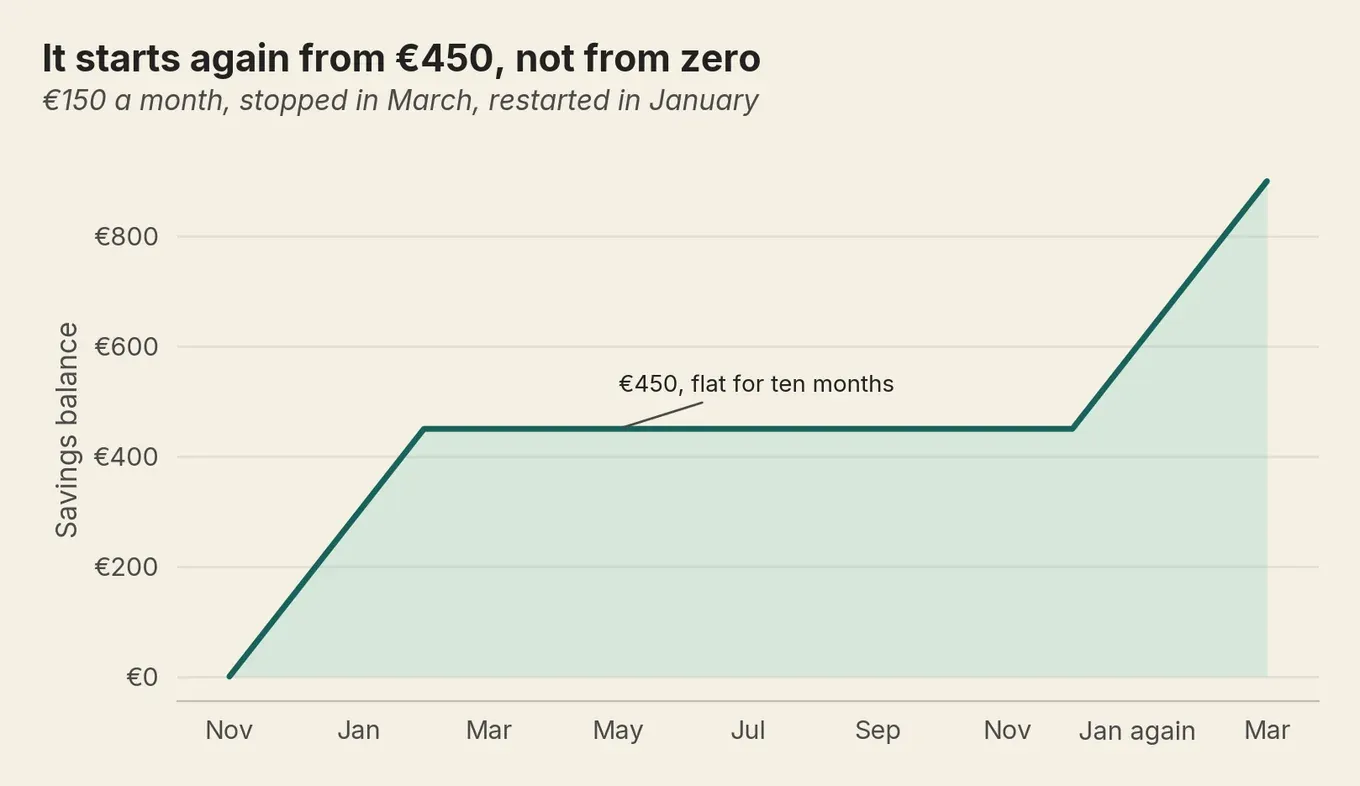
Say it was €150 a month, it stopped in March, and it’s now January. Ten months. One of them is the month that went wrong: €150. The other nine are the months you didn’t go back: €1,350.
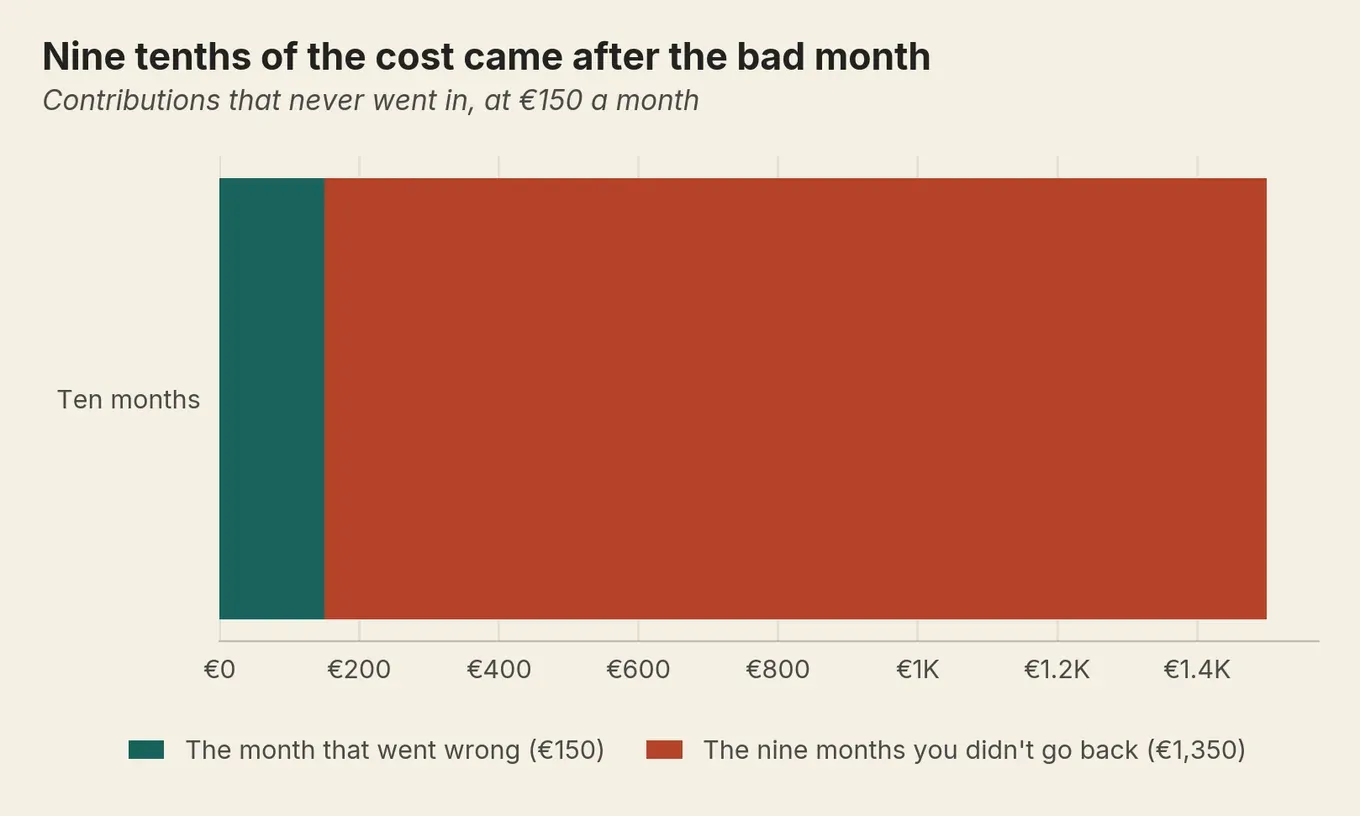
So the bad month is a tenth of it. The nine months after are the other nine tenths. Nobody feels guilty about those, because nothing happened in them. There was no evening. The counter sized the guilt, and the counter was measuring the wrong thing.
Put your own number in. If you were saving €80, ten months is €800. Nothing here is compounded and nothing here is invested; this is money that stayed in the current account and went on ordinary things.
Three €150 payments went in before it stopped, so the restart begins at €450.
Why is every budget built for the version of you who keeps it?
Because that is the only version anyone designs for. Which is strange, given that the other version turns up most years.
Three mechanics do the damage, and none of them is you.
The first is the counter, above. The second is the all-or-nothing rule: a plan with no permitted deviation in it. Deviate once and there’s nothing left to deviate from. The plan is over. Several separate lines of research point the same way, and most of them aren’t about money at all. One that does cover saving money found that having a plan at all can make a small slip feel like the end of it (opens in new tab). Plans with a bad week designed into them survive a bad week.
The third is the restart itself, which everybody writes up as a beginning. Yours carries every payment you made before it stopped, minus anything you’ve taken back out since. Those months are in the balance, and the balance is on your screen.
The standing order is the part that worked: a payment you set up yourself and can stop yourself, which kept running while nobody thought about it. What broke was the scoring system somebody wrapped around it.
Some of what breaks a European month is no surprise at all. It’s something you could have seen coming, and had no slot for. An annual insurance renewal, on a date that never moves. Or a bill arriving late by design. German law gives a landlord twelve months (opens in new tab) after the end of the period to send the operating-costs statement, so last year’s shortfall can legally land almost a year later. Predictable, lawful, and still capable of ruining a Tuesday.
How do you get back on track after overspending, without starting from zero?
Five steps, and none of them is a rebuild. The first takes under ten minutes tonight; most of the rest wait for one payday.
- Open your banking app and read two numbers: whether the transfer is still running, and what the balance is now. A stopped transfer leaves nothing in the transaction list, so scrolling recent payments settles nothing; look for wherever your bank lists scheduled or regular payments.
- Set the transfer to a figure you wouldn’t have cancelled in the month it broke, or set up a new one if it was cancelled outright. If it was €150, try €75. If €75 still assumes a clean month, €40.
- Start it at the next payday, not at the start of next month. If your income lands on no fixed date, set it a few days after money usually arrives rather than on a date it might not.
- Leave the balance alone. You aren’t paying back the months you didn’t pay into.
- Put a date on raising it again. The halved figure is a way back in, and the date is what stops it becoming permanent.
What should you set the transfer to?
A figure you wouldn’t have cancelled in the month it broke. That’s the whole rule, and it lands smaller than most people expect. The job of the restarted transfer isn’t to recover anything. Its job is to make you a person who has a transfer again.
€40 that survives December does that. €150 that gets cancelled in December costs you the next nine months, which we’ve already priced. Recovering missed money is a separate decision and a later one; merging the two is how “restart the transfer” turns back into “rebuild the budget”.
One caveat on the small figure, from the same arithmetic. €150 cut to €40 and left there is €1,320 you don’t put aside over a year, which is roughly the gap this piece opened with. The small figure is how you restart. Step five is the date it stops being small.
Should you pay back the months you missed?
No. You lived that month, the money went where it went, and there’s no version of March left to save in.
One narrowing, and it matters. That holds where the saving is open-ended. If the money has a date on it, a deposit against a mortgage application, a residence permit, a tax bill, the insurance renewal above, then it stops being a habit and becomes an amount due by a deadline, and that runs at what’s left to find divided by the months left to find it in.
(If the balance did shrink, because you took money out, that is a different job, and it has its own section below.)
Which payments can you restart yourself, and which need somebody else?
A standing order belongs to whoever’s name is on the account, both of you if it’s joint. With a direct debit, the company holds the permission slip and starts each collection; what it doesn’t hold is the off switch. You set a standing order up yourself, and you can stop it yourself, in the app, without a phone call or a branch visit. Whether you can suspend one and bring the same instruction back later depends on your bank; where you can’t, you cancel it and set up a new one when you’re ready. Either route is a few taps, and neither needs anybody else to agree to it.
Ireland’s competition and consumer commission spells out both halves (opens in new tab). What happens after that sits in Europe’s shared rules for euro direct debits (opens in new tab): if the company doesn’t put a payment through the mandate for 36 months, it has to cancel it, and a fresh one has to be set up before anything can start again. Those are the euro rules; a sterling direct debit in the UK runs on a different scheme with its own.
Anything you might want to stop for a few months, savings above all, is better run as a standing order. With a direct debit there are two different jobs. Blocking a payment leaves the mandate alive, and some banks let you lift the block yourself; it doesn’t cancel your contract, so the bill carries on existing either way. Left unpaid, it turns into arrears, which is a worse problem than the payment you stopped. Cancelling the mandate is the other job, and then a new one has to be set up before the company can collect again.
What if you spent the savings instead of stopping the transfer?
Different situation, and the rule above doesn’t apply to it. If the balance went down because you dipped into it, rebuilding your savings is the job, and this is the one place where putting money back is the point. You can’t go back and save in a month you already lived. A pot you emptied, though, is a pot with less in it, and pots get refilled.
That assumes you were the one who dipped. Some people reading this weren’t: the balance went down because somebody else moved it, or the spending was somebody else’s on a shared account. Same numbers, different problem, and nothing below reaches it. If money leaves an account you share and you have no real say in it, a savings plan isn’t the thing to fix first.
How fast should you rebuild savings you dipped into?
At the resumed rate. If €75 a month is what survives a bad month, €75 a month is what refills the pot, and it takes as long as it takes. Doubling it to catch up is the same design error as before: a rule that only works in good months.
One ordering point sits in front of all of that. If the money came out to cover a bill and left expensive debt behind it, an overdraft, a card balance, instalments still arriving, arrears, that gets dealt with before anything goes back into savings. An arranged buffer at no interest is the exception, and only while you’re keeping up with it.
Why does the same pot keep emptying?
Because something predictable keeps landing in it: the insurance renewal, the settlement bill, the excess on something. That’s a missing slot, not a missing virtue.
Naming a second pot for exactly that is duller than trying to want it less, and more effective. Many European banks and app banks now let you do it.
What do you do the next time a month goes wrong?
There will be a next time. A wedding in August, and a boiler somewhere with plans of its own.
Build the break in before you need it. Decide now that two months a year are skippable, and decide it while nothing is wrong. A skip you booked in advance is a feature of the plan, and that’s the difference between a plan and a run.
Ten minutes tonight, then a figure that survives a bad month. You’ll break it again, probably in a month with a wedding in it, and you’ll start it again in a few taps.
Somewhere on your laptop there’s a file called Budget_2026_FINAL, last edited in March, with a tab named Sheet2 that nobody will ever open. It’s not evidence of anything. It’s a file.
Frequently asked questions
What do you do when you go over budget?
Does one bad month of overspending undo your progress?
Should you restart your budget from scratch or fix the one you have?
How do you rebuild your savings after using them?
Why do budgets fail?
Sources (6)
- Eurostat: Inability to face unexpected financial expenses, EU-SILC (ilc_mdes04, 2025)
- Gesetze im Internet: German Civil Code (BGB) section 556, operating-costs statement deadline
- European Commission: Report on the 2020-2021 project on debt-advice
- Competition and Consumer Protection Commission (CCPC): Paying your bills
- European Payments Council: SEPA Direct Debit Core Rulebook 2025, version 1.1
- Journal of Consumer Behaviour: Taking a tiny step back: The impact of planning on a bumpy goal pursuit (2024)
— That's the lot. It is now night.
Want more of this in your Google results?
Add Money Owl as a preferred source, and Google will show our finance pieces higher when you search for them.
By Jure Jaklič
Founder and editor of Money Owl. Data analyst by trade; personal finance learned first-hand across six European countries.
Recommended

The cost of doing nothing with your money, and what to fix first
Four money lines go stale at once: savings, tariffs, an uninvested surplus, and a pension rate you never set. Here's the ten-year bill, and what to fix first.

Money and mental health: how to calm the worry and the bank balance
Money worry and a worried mind feed each other in two loops. Here's how to ease both at once, with free EU mental-health and debt help near the end.

Why you can't save money (it was never willpower)
You keep failing the willpower test because it was never a willpower test. Change the set-up, automate one transfer, and saving happens without you.