

The point.
- An audit looks backward at money already spent; a budget plans forward. Run the audit first, so the budget rests on your real numbers.
- Three to six months of statements is enough, with any annual cost divided by twelve so it counts monthly.
- Connect only an authorised open-banking app: it can read your accounts but never move money, and you approve it through your own bank's login.
- The real leaks are forgotten recurring charges, not daily coffees. Filter your feed for anything that repeats.
- Change two or three things, put the freed-up money to work, and repeat lightly once or twice a year.
The point.
- An audit looks backward at money already spent; a budget plans forward. Run the audit first, so the budget rests on your real numbers.
- Three to six months of statements is enough, with any annual cost divided by twelve so it counts monthly.
- Connect only an authorised open-banking app: it can read your accounts but never move money, and you approve it through your own bank's login.
- The real leaks are forgotten recurring charges, not daily coffees. Filter your feed for anything that repeats.
- Change two or three things, put the freed-up money to work, and repeat lightly once or twice a year.
It’s 23:07 on a Sunday. You’ve opened your banking app for the third time this week, scrolled the last month, and thought: where did it all go? The money came in. Most of it left. You couldn’t tell a friend exactly where, and that bothers you more than the amount.
That feeling is not a character flaw. It happens because money now leaves your account quietly, in small automatic amounts, while you get on with your life. A personal spending audit is how you go back and find where it went, a look at what already happened, so the mystery stops being one.
This is how to audit your spending: one short sit-down and a few months of statements you already have. No shame, no spreadsheet you’ll abandon by Thursday, no app that pings you about a coffee. By the end you’ll know where the money goes, whether that’s normal, and the two or three things worth changing.
How do you audit your spending? The short version
The shape of it, in five moves:
- Gather your transactions, from your bank’s app or an authorised open-banking app if they’re scattered.
- Sort them twice: by category to see if you’re normal, and by what you can move.
- Find the leaks, the charges that quietly repeat while you weren’t looking.
- Act on two or three: for each, would you sign up today?
- Repeat once or twice a year.
What is a spending audit, and how is it different from a budget?
A spending audit looks backward at money you’ve already spent: you pull a few months of transactions, sort them, and see where it went. A budget points the other way and plans money forward. Run the audit first; build the budget on what you find.
Most of us skip straight to the budget. We guess our categories, promise to spend less on “eating out”, and wonder why the plan falls apart by the 12th. The audit is the evidence a budget needs. Once you know your real numbers, a forward plan like the 50/30/20 rule finally rests on something true. In that order, the budget stops being fiction.
Ireland’s statutory consumer-protection regulator makes the same case for tracking your money before you plan it, and for leaving room to enjoy it.
Tracking what goes in and out each month can help you prioritise necessities while allowing for treats.
Competition and Consumer Protection Commission (CCPC) (opens in new tab), Building your personal budget plan
A bank statement is a diary you didn’t mean to keep. You read it back anyway, because everything you want to know sits there already.
How do you gather your spending in one place?
Start with the raw material: your transactions. If your spending runs through one bank, you already hold everything you need. Open your bank’s app and use its built-in categories. Most European banks now sort your spending into food, transport, bills and the rest, for free, on your own account. Those categories are a starting point; expect to re-tag a handful (the supermarket run that was half cleaning products, the Amazon line that could be anything). For a lot of people, that finishes the first step. No statement itemises cash. An ATM withdrawal is a single line, so a fat ‘cash’ slice is your cue to track where it goes for two weeks.
It gets harder when the money scatters. A current account here, a credit card there, a Revolut or an N26 for holidays, an old account you keep “just in case”. To see it all in one view, you can connect a budgeting app that reads your accounts through open banking. That’s the EU-wide system for pulling your transactions from several banks into one feed, with your permission. Whether that’s safe comes next; it’s the part everyone worries about, rightly.
How far back should you look?
Three to six months is the practical answer. You want a stretch that looks like your normal life. Leave out the holiday, the house move, the hospital bill. Official statisticians use a whole year to smooth out the odd months; you don’t have to. Begin with three months, then extend if a big annual cost lands outside the window.
That matters more than it sounds. The costs that arrive once a year hide easily: insurance, the car service, a domain renewal, the tax bill. Divide any annual cost by twelve and count it monthly. That’s the difference between an audit and a nice-looking guess.
A few apps that read across EU banks, as of July 2026. These are examples, not endorsements, and not advice. The capabilities below are the providers’ own claims; check current features, coverage, and that the app is authorised before you connect it.
| App | Where it works | What it does |
|---|---|---|
| Wallet by BudgetBakers (opens in new tab) | Many EU markets | Reads across banks, tracks and categorises spending |
| Finanzguru (opens in new tab) | Germany, Austria | Reads across banks, auto-categorises, cancels contracts |
| Bankin’ (opens in new tab) | France | Pulls several accounts into one view |
| Fintonic (opens in new tab) | Spain | Aggregation and alerts (now leans heavily on loan offers) |
| Revolut Linked Accounts (opens in new tab) | Ireland, Netherlands, Portugal and more | Views external bank accounts inside Revolut |
| Your own bank’s app | Everywhere | Categorises your own account, no third party |
No app for your market? Your own bank’s app or a by-hand sort works too.
Is it safe and legal to connect a budgeting app to your bank?
Yes, when the app is authorised. Open banking is a regulated EU system. An app can only read your accounts if it’s registered as an account information provider, a read-only aggregator in plain terms, and only after you approve it through your own bank’s login. Check the register first. For a system with the word ‘open’ in it, it is surprisingly strict about who gets to look.
Here’s what “regulated” buys you. That read-only connection can look but not move money: it reads your transactions and cannot make a payment. It reaches your data through your bank’s normal two-factor login, so you never hand the app your banking password. A real connection always sends you out to your own bank’s app or website to approve it; you never type your banking password, PIN or full card number into the budgeting app itself. So if an app asks for those directly, that’s the scam. Walk away. And under EU data-protection rules it can only use that data to run the service you asked for, not to sell you things or build a profile, unless you separately agree. The European Data Protection Board (opens in new tab) is the body that spells this out.
Before you connect anything, run three checks. First, is the provider authorised? Start with your national regulator’s public register, which is built for consumers, and fall back to the European Banking Authority’s EU-wide register of payment institutions (opens in new tab), which lists authorised account information providers. The brand on an app can differ from the authorised company (Wallet is run by BudgetBakers), so check the company, not just the brand. Second, does the consent screen tell you what it will read, why, and for how long? The rule is simple: it should ask for the accounts it needs and no more. Third, can you turn it off? A legitimate app lets you withdraw consent and disconnect without a fight.
Connecting is not “set and forget”. Since 25 July 2023, EU rules (opens in new tab) have let a connection run up to 180 days before you re-approve it at your bank; the old limit was 90 days, which was a nuisance. Between check-ins, the app can refresh the feed (opens in new tab) four times a day at most, so it stays near-live. In practice: connect once, glance when you like, re-approve about twice a year.
Joint accounts come with a wrinkle. Pooling one pulls in your partner’s spending and the details of everyone you paid, and EU regulators flag that “silent party” data as something to handle with care. If the account is shared, treat the audit as shared too.
When all your money already sits in one bank, skip this whole section. Your bank’s own app does the categorising, no third party, nothing to check. (UK readers: post-Brexit you sit outside this EU regime; British open banking runs under the FCA, so the same idea holds, different timings.)
How should you sort what you find?
Two questions, two different sorts, so run both. The first asks whether your spending is normal. The second asks what you can change.
Is your spending normal?
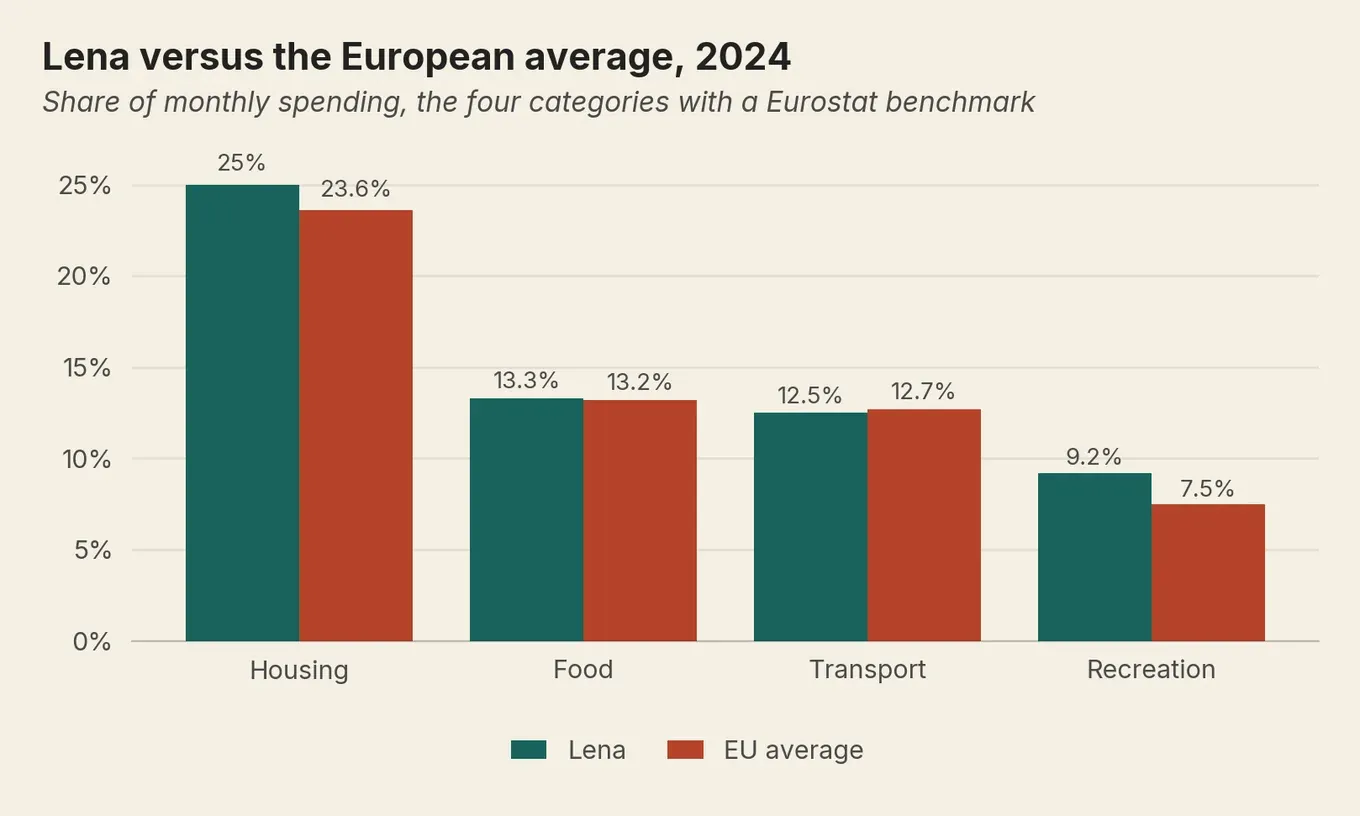
Group your spending by purpose, the way official statistics do: housing, food, transport, and the rest. Europe’s statisticians use thirteen such categories and publish what a typical household spends on each, so you can measure yourself against a real benchmark rather than a feeling. These are whole-household averages, so if you live alone your housing share usually sits higher than the figure, and that’s still normal.
Here’s the benchmark, drawn from Eurostat’s 2024 figures (opens in new tab).
| Category | Typical EU share, 2024 | Range across the EU |
|---|---|---|
| Housing, energy and water | 23.6% | 14.4% (Croatia) to 32.1% (Czechia) |
| Food and non-alcoholic drinks | 13.2% | 9.3% (Luxembourg) to 23.1% (Romania) |
| Transport | 12.7% | 5.8% (Slovakia) to 17.0% (Slovenia) |
| Recreation and culture | 7.5% | Varies by country |
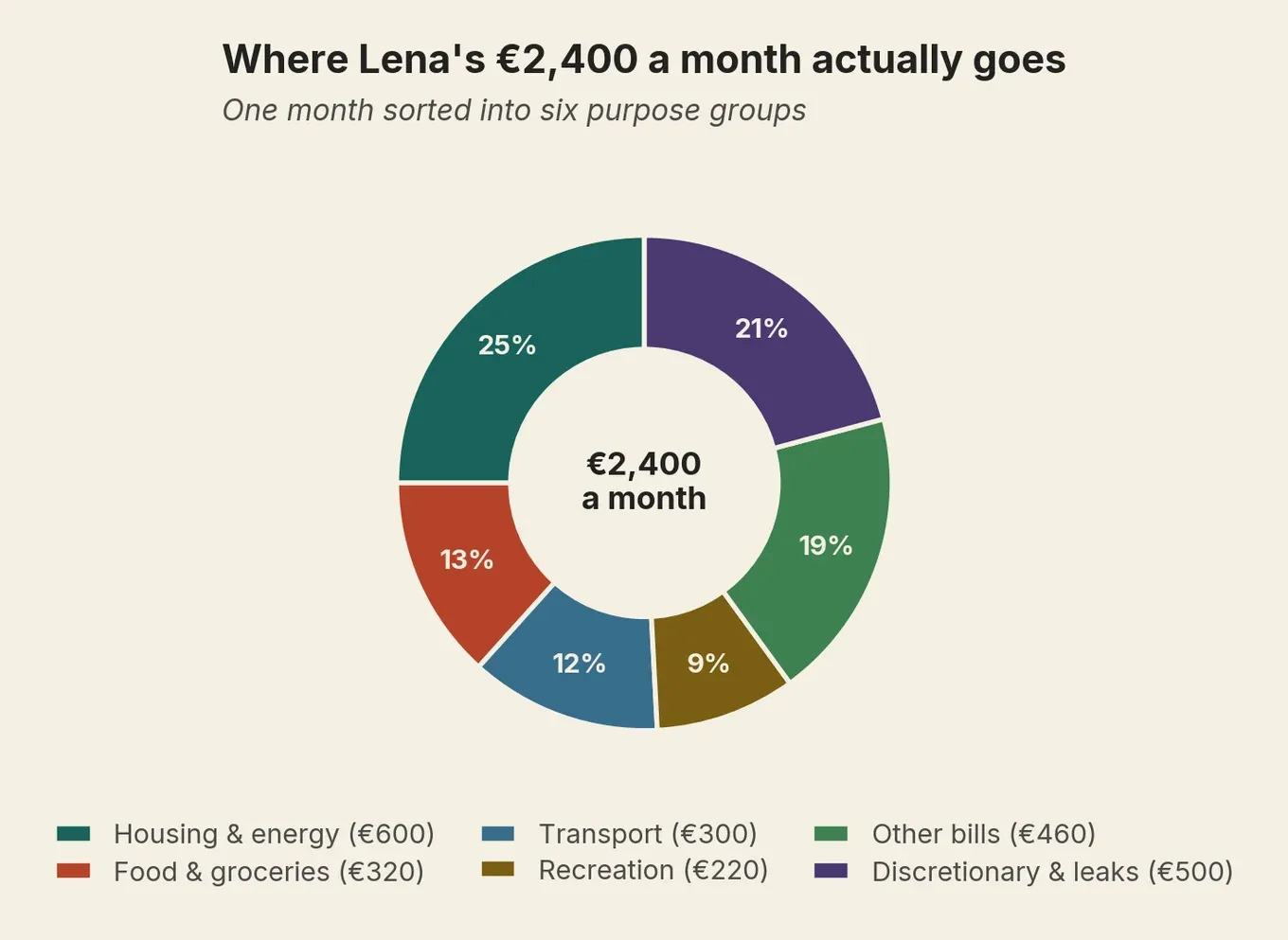
If housing swallows a quarter or more of your spending, you’re in ordinary company. Take Lena in Leipzig, an illustrative case: she brings home about €2,400 a month, a round number for the maths. If roughly €600 goes on rent and bills, that’s a quarter, right on the European norm. The number was never the problem. Not knowing it was.
When Lena sorts the whole €2,400, the shape is almost dull. Food takes €320 and getting around €300, both a rounding error from the European average. Fun is €220. Another €460 covers the other bills: phone, insurance, the odd new kettle. And €500 is loose, unlabelled drift she could never quite account for. The numbers are dull, and dull is the good news.
What can you change?
Tag each cost as fixed, variable or discretionary. Fixed is rent or insurance, hard to move this month. Variable is groceries and energy, which flex with how you live. Discretionary is everything you chose and could unchoose.
Discretionary spending, from streaming to takeaways to the third music app, is where the audit earns its keep. It won’t tell you to stop enjoying things. Only which of them you’d still choose.
How many categories do you need?
As few as do the job. Five to ten purpose groups cover the benchmark, and the fixed, variable and discretionary tags add three buckets on top. Go finer than that and you’ll spend longer sorting than deciding.
How do you find hidden expenses and spending leaks you’ve forgotten about?
This is the payoff, and it’s rarely the coffee. The real leaks are the recurring charges your brain filed under “bills” and stopped looking at: the subscription you used twice, the “free trial” that started charging in March, the app you forgot you owned, the gym you joined with real conviction in January.
Paying by card or direct debit stings less than handing over cash, so an automatic charge slips past the part of you that notices. Autopay was built to go unwatched, which is why a yearly look catches what daily attention never will.
And you’re in good company. Across seventeen markets, YouGov found (opens in new tab) that only about 38% of subscribers had used all their subscriptions in the past six months, which leaves roughly 62% paying for at least one they hadn’t used in six months. So turning up one or two you forgot is just what most subscribers do. Nika in Ljubljana finds three streaming services and a language app she last opened in spring, and she’s statistically normal.
To surface them, filter your feed for anything that repeats: same merchant, same amount, every month or every year. Most bank apps and aggregators track your spending and show recurring payments directly. Cancelling the ones you don’t want is a job of its own, and worth doing carefully, so we’ve covered the how in a separate guide to auditing and cancelling your subscriptions.
What should you do once you’ve found the leaks?
Resist the urge to cancel everything. A crash diet on your spending fails the way a crash diet on food does: you rebound. Harder. Pick two or three things and stop there.
Sort what you found into two piles. Structural costs have little give this month: rent, essential travel, required insurance. Behavioural leaks are the discretionary bits that grew quietly because nobody was watching. Go after the leaks first: fast wins that cost nothing you’ll miss.
For each recurring charge, use one test. If you weren’t already signed up, would you pay today’s price to start? When the honest answer is no, that’s your cancel; it sidesteps the guilt of money already spent. Before you cancel, check for a minimum term, notice period or exit fee; gyms, phone and insurance contracts hide those.
That test is what Lena runs down her own list, and three charges fail it. €30 for a gym she last swiped into in January. €12 for a music subscription that duplicates one already bundled with her phone. €8 for a cloud-storage plan that began billing the month a free trial quietly ended. Cancelled, they hand her back €50 a month, €600 a year, from money she was not enjoying anyway. Her other €450 of that €500 stays put: real choices she’d make again. The point was to find the leaks, then move on.
Then give the freed-up money a job, or it evaporates back into the account by the end of the month. A sensible order for most people. First, top up a small emergency buffer, a cushion you could reach in a hurry. Next, clear any expensive debt, because a credit card at 20% costs you more than almost any savings account will pay. Expensive usually means the highest rate, but if you’re behind on rent, mortgage, utilities or tax, clear those first whatever the rate; falling behind on the essentials hurts more than any interest bill. Then set a standing order, so the rest moves itself.
And a normal amount can still be more than you can afford. If the basics are eating your income and you’re borrowing to cover them, that’s a signal to get free, confidential debt advice from your country’s free debt-advice service. For context, the national accounts put euro-area household saving near 14.4% (opens in new tab) of income in late 2025, so keeping some of it, automatically, is well within normal.
How often should you do this?
Once properly, then lightly. A full audit once or twice a year catches the drift, and a five-minute glance at your recurring payments each quarter stops new leaks settling in. Tie it to something you’ll remember, a birthday, or the week the clocks change, so it doesn’t become one more thing to forget.
You already have the statements. The app came with your bank. All that’s new is one honest hour: read it back, find your two or three leaks, change those, and stop. That was always the point. Not to fret over every euro, but to know where they went, so you can stop wondering at 23:07 on a Sunday.
Frequently asked questions
What is a spending audit, and how is it different from a budget?
How many months of bank statements should you review?
What if your bank is not supported by the app?
Is it safe and legal to connect a budgeting app to your bank?
Does connecting an open banking app affect your credit score?
What if most of your spending is cash?
Can you do a spending audit without connecting any app?
How often should you do a spending audit?
Sources (8)
- Competition and Consumer Protection Commission (CCPC): Building your personal budget plan
- EUR-Lex: Commission Delegated Regulation (EU) 2022/2360 (open banking re-authorisation window)
- EUR-Lex: Commission Delegated Regulation (EU) 2018/389 (strong customer authentication RTS)
- European Data Protection Board: Guidelines 06/2020 on the interplay of PSD2 and the GDPR
- European Banking Authority: Registers and other lists of institutions
- Eurostat: Household consumption by purpose (COICOP, 2024)
- Eurostat: Households saving rate, euro area (late 2025)
- YouGov: Subscription graveyard, how many unused subscriptions consumers pay for
— That's the lot. It is now night.
Want more of this in your Google results?
Add Money Owl as a preferred source, and Google will show our finance pieces higher when you search for them.
By Jure Jaklič
Founder and editor of Money Owl. Data analyst by trade; personal finance learned first-hand across six European countries.
Recommended

The subscription audit: how to find and cancel recurring expenses
Run a 30-minute subscription audit: find every recurring charge, cancel it, and use your EU bank and SEPA rights to make it stop.

The envelope system and cash stuffing: does it still work in a cashless Europe?
The cash envelope budgeting system still works in a cashless Europe, but only if the empty bucket can actually stop your card. Cash, pots, and sub-accounts compared.

The payday running order: what to do when you get paid
The euro payment system shuts four days straight every Easter. Move the payments nobody else is waiting for to at least five days after payday, on a date at or below the 28th that your own bills have already cleared.