

The point.
- The decades do the heavy lifting, not clever timing: an invested pension earns returns on its own returns, so over the years compounding becomes most of the pot.
- Your country's default pension replaces only part of your old pay, not all of it, and how much ranges from about 34% in Ireland to 96% in the Netherlands, where a compulsory workplace pension does most of that work.
- Waiting is expensive: on an illustrative €200 a month at a 5% real return (values can fall as well as rise), starting at 35 rather than 25 costs roughly €153,000 by 67, most of it compounding you never collected.
- It's never too late: starting later leans harder on what you contribute than on time, and any start beats meaning to.
You keep meaning to sort your pension. It’s been on the list a while now. Then the month happens, the rent goes out, something breaks, and future-you can wait one more payday, because future-you always can.
This isn’t a character flaw. Your brain is built to value the payday in front of you over the one forty years out. Economists call it present bias (opens in new tab), and everyone has it. It’s the most normal reason in the world that people who fully intend to save never get started.
Every retirement article on earth then tells you the same thing: start early. Fine. True. Useless on its own, because almost none of them show you what starting early is worth, in money, in your currency. So that’s the job here: why retirement planning matters in real money, not slogans. We’ll put a number on the cost of waiting, explain why the state pension was never going to cover the whole thing, and do it in euros, for people living in Europe rather than reading American advice by accident.
Two things before we start. You’re not unusually behind: about 41% of Europeans aren’t paying into any private or workplace pension either, according to Insurance Europe’s 2025 survey (opens in new tab). And if you’re reading this at 42 rather than 22, this is still for you. Starting later changes the plan a little. It doesn’t make it pointless, and we’ll come back to that near the end.
Why does retirement planning matter, even if retirement feels decades away?
Retirement planning matters because the state pension was built to replace only part of your old pay, never all of it, and the earlier you start your own pot, the more of the work compounding does for free. Because the thing doing the heavy lifting is time, not timing. A pension you build for yourself grows by investing your contributions, so the returns start earning returns of their own. Over decades, that compounds into most of the money. The decades are the asset.
That’s why retirement planning matters, and why it matters most when the finish line feels furthest away. The state will hand you something at the end, but it was designed to replace part of your old pay, not all of it. What’s left is yours to build. And the one advantage a 30-year-old has over a 50-year-old is twenty extra years of compounding, which you can’t buy back later at any price.
Why is the state pension unlikely to be enough on its own?
Because it’s only one of three pillars, and it was built to replace a slice of your working pay, not the lot. How big that slice is depends entirely on where you live.
Europe’s pensions regulator is blunt about the same point.
We know that the state alone will not be able to provide a liveable income at retirement.
Petra Hielkema, Chairperson of EIOPA (opens in new tab), the EU pensions regulator (Navigating Challenges in Pension Sustainability, October 2024)
What are the three pension pillars?
Three sources are meant to fund your retirement. The state pension, paid from today’s workers’ taxes. A workplace pension, invested for you. And a personal pension you set up yourself. The last two are invested, and the part that is yours to build.
Those personal pillars go by different names in different places, an Irish PRSA, a French PER, a German Riester plan (now closing to new savers from 2027, with a simpler invested pot taking over), but the idea is the same everywhere.
How much pension does your country set up for you by default?
Far less than a full salary, and it swings wildly by country, from about a third of prior pay in Ireland to nearly all of it in the Netherlands. One catch: near the top of that range, most of the money is a required workplace pension, not the state on its own. Here’s the spread across Money Owl’s markets:
| Where you live | The default pension system replaces roughly |
|---|---|
| Ireland | 34% |
| Germany | 53% |
| United Kingdom | 54% |
| France | 70% |
| Slovenia | 71% |
| Italy | 79% |
| Spain | 86% |
| Portugal | 93% |
| Netherlands | 96% |
| EU27 average | 68% |
Those are OECD figures (opens in new tab) for a man on an average wage, working a full career, starting his working life today. They add in any pension you’re forced to join, so much of the Dutch and UK figure is a required workplace pension, not the state alone. They also picture someone starting work now, not what today’s pensioners really get. Women, part-timers and anyone with a broken career land lower. Treat the numbers as the optimistic base case, not a promise.
Two readers can draw opposite lessons from that table, and both can be right. If you’re in Ireland, the state replaces about a third of prior pay, so most of your retirement is on you from the first payslip. Over in the Netherlands, a near-universal workplace pension does most of the work, and it’s a funded, invested pillar you own. But a high number isn’t the same as a safe one. Spain, Portugal and Italy reach their generous figures through pay-as-you-go state pensions, paid from today’s workers’ taxes, and those systems as a whole are the ones most exposed to the maths in the next section. Comfort now, strain later.
What happens if you never plan for retirement?
You fall back entirely on that state pillar, at whatever level your country sets, and hope it stretches. For a lot of people it doesn’t. Across the EU, around one in five people over 65, roughly 18.5 million of them, are already at risk of poverty or social exclusion, EIOPA reports (opens in new tab). It isn’t evenly shared, either: women over 65 receive about a quarter less pension than men across the EU, largely because career breaks and part-time years mean fewer years paying in (Eurostat (opens in new tab)). And the money has to last: on Eurostat’s latest figures (opens in new tab) a 65-year-old in the EU can expect around twenty more years of life, so the pension you lean on has to stretch two decades, not a few years.
That’s the picture today, before the demographics get harder. Europe currently has roughly three working-age people for every pensioner. By the end of the century that drops toward fewer than two (Eurostat again (opens in new tab)). Fewer workers paying in, more pensioners drawing out; that’s what puts a pay-as-you-go pillar under strain, and it’s why leaning on the state is a shakier plan for a 30-year-old than it was for their grandparents.
It shows up in how people feel, too. Fewer than half of Europeans, about 42%, are confident they’ll have enough money to live comfortably once they stop working (EIOPA Eurobarometer (opens in new tab)). None of which means you’re doomed. It means the funded part, the bit you control, is shouldering more of the work than it used to.
How much does each year of delay cost you?
More than you would guess, and far more than the contributions you skip. Take a plain example. Put €200 a month into an invested pension, assume a 5% return a year after inflation, and retire at 67. That return is illustrative, not a promise: it’s deliberately rounded down from the 5.2% a year that global shares returned, after inflation, over the 125 years to 2024 (Dimson, Marsh and Staunton, via the University of Cambridge (opens in new tab)).
One honest health warning first, because this is the number the whole piece turns on. This is an illustrative example, not a forecast or a personal recommendation. Investments can fall as well as rise, and you could get back less than you put in; a 5% return is not guaranteed. Actual outcomes depend on the funds you pick, the charges you pay, tax and inflation, and past performance is not a reliable guide to future results. One more assumption worth naming: the €200 a month keeps pace with inflation, so picture the standing order edging up a little each year, which is what lets the pots below be read in today’s money.
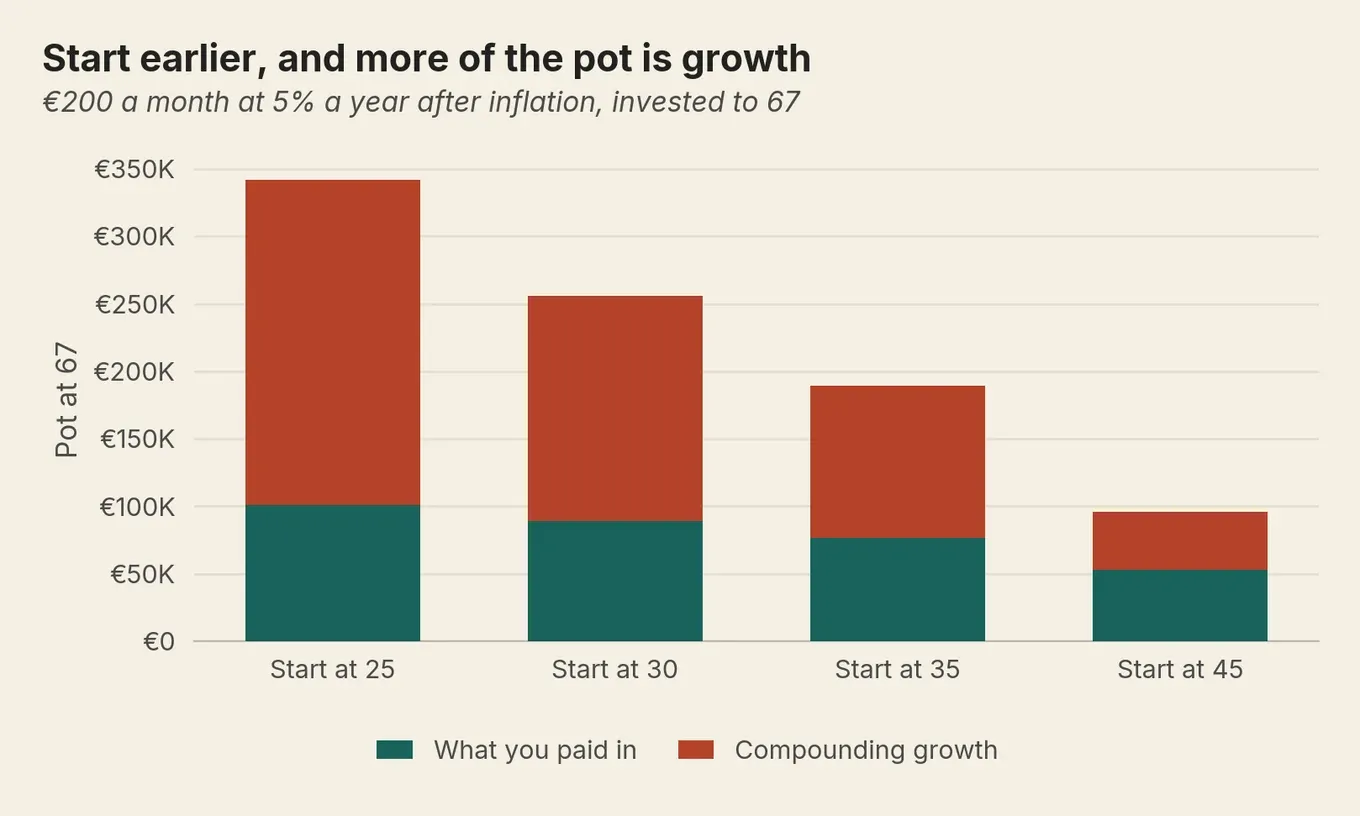
With that said, here’s what the same €200 a month does, depending on when you start:
| Start age | Total paid in by 67 (today’s money) | Pot at 67 (today’s money) |
|---|---|---|
| 25 | ~€100,800 | ~€342,000 |
| 30 | ~€88,800 | ~€256,000 |
| 35 | ~€76,800 | ~€189,000 |
Look at the gap between starting at 25 and starting at 35. The same €200 a month, ten years apart, and the pot at the end differs by about €153,000. Only around €24,000 of that is the extra contributions. The other €129,000 is compounding you never collected. Wait five years instead of ten and the gap is about €86,000. Delay a single year, 26 instead of 25, and you’re roughly €19,000 lighter at the finish, for the sake of €2,400 you didn’t pay in. Those pot sizes are before charges: take off a typical 1% a year and the age-25 pot slips from about €342,000 to roughly €261,000, so low fees matter almost as much as starting early.
Why does one skipped year cost so much?
A year’s delay doesn’t shave off a cheap year at the start. It removes the most expensive year at the end, when the pot is biggest and a single year of growth is worth the most. That’s the whole trick. Pick a more cautious return and the numbers shrink, but the shape holds. At 3.5% a year, roughly the pace global shares have kept so far this century, the age-25 pot lands nearer €229,000 and the ten-year gap around €88,000. Smaller numbers, same lesson.
It’s also why “start early” is genuine advice rather than a slogan. This isn’t a bill for the years behind you. It’s a price list for the years ahead. That €19,000 is what starting a year sooner still buys, from wherever you’re standing, at whatever age you’re reading this.
One more thing, because it trips people up: cash in an ordinary savings account won’t do any of this. It isn’t invested, it isn’t a pension, and inflation quietly eats it over a horizon this long. A pension is an investment rather than a bank deposit, so no deposit-guarantee scheme covers it. The protection is different, not missing: a firm authorised under EU investment rules (opens in new tab) must keep your money apart from its own. If the firm goes under, that pot is not theirs to spend.
What do you gain by starting early?
Mostly time, converted into money you never had to earn. The same €200 buys a bigger pot the earlier it goes in, on the same illustrative assumptions as above. Turn that around and a younger starter can put away less each month and still land in the same place, because the compounding makes up the difference.
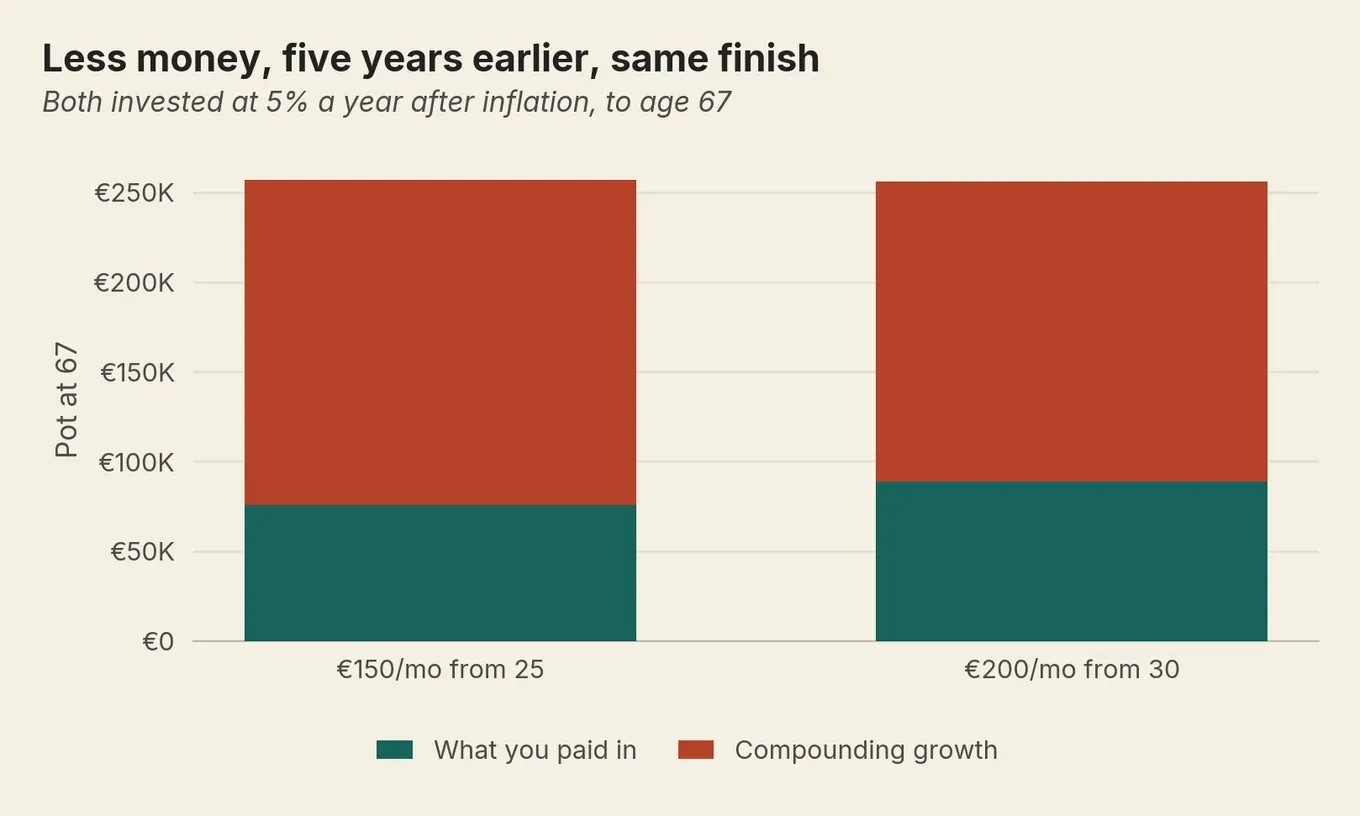
Here’s that same trade in euros. Say you’re 25, in a market like Portugal, where the state pension looks generous, near 93% of prior pay, but rests on a strained pay-as-you-go system, so the funded pillar you control still earns its keep. You spare €150 a month; picture the same you waiting to 30 and paying the fuller €200. On the same illustrative assumptions, your €150 reaches about €257,000 by 67, just past the €256,000 the later €200 gets to. You paid in €75,600 against their €88,800: about €13,200 less of your own money, and still a hair ahead, purely because you started five years sooner.
There’s a quieter gain, as well: start early and you can hand the whole thing to a standing order, then stop thinking about it. The people who do best with pensions are rarely the cleverest in the room. They’re the ones who set it up once and left it alone.
Why do so many Europeans keep putting it off?
The barrier was never information; it’s behaviour. That present bias from the top of the piece is doing its job. Retirement feels abstract and far away, so it loses, every single month, to the things that feel real now. Willpower makes a bad plan, and a standing order makes a good one.
Does making it automatic work?
Yes, and the evidence is almost rude in how clear it is. When one large employer switched from asking staff to opt in to a pension to enrolling them automatically, participation jumped from 37% to 86% (Madrian and Shea (opens in new tab)). Comparable new hires, same money, one changed default. Most stayed in, and most never touched the settings again.
The authors of that study pinned down why the change sticks.
This “default” behavior appears to result from participant inertia and from employee perceptions of the default as investment advice.
Brigitte Madrian and Dennis Shea, Quarterly Journal of Economics, 2001 (opens in new tab)
That last part cuts both ways. If your workplace has auto-enrolled you, brilliant, but being enrolled at the default rate isn’t the same as being on track, and almost nobody checks what their rate is. Worth checking. It’s one of the higher-return ten minutes you’ll spend this year. And if no workplace scheme covers you, which is common outside the countries that mandate it, you can be your own auto-enrolment: point one standing order at a personal pension, set it once, and let inertia work for you, not against you.
When should you start, and why is “now” almost always the answer?
Now, for a boring reason: the years you lose by waiting are the expensive ones at the end, and you can’t get them back. Holding out for a pay rise, or for a cheaper year that never quite arrives, costs more in forgone compounding than it saves in contributions.
There’s a tailwind, too. Normal retirement ages across Europe are drifting up, clustering around 66 to 67 and, in several countries, heading past 70 (OECD (opens in new tab)). That sounds like bad news, and for the finish line it is. But it also means most people reading this have a longer runway than they assume, and a long runway is exactly what rewards starting sooner. The best day to start was years ago. The second best is a Tuesday this month.
Is it ever too late to start a pension?
No. Later only changes the mix. With a short runway, compounding does less of the work and your own contribution does more, so a late starter leans harder on the amount they put in and a bit less on time. That’s a different plan. It still works.
If you’re 45 and starting from nothing, you’re not the exception this piece forgot; you’re half the reason it exists. You won’t get the full forty-year table above, and pretending otherwise would be a lie. What you will get is a pot that’s bigger than nothing, tax rules that tend to be kinder to pension money than to ordinary savings, and the same freedom from having to think about it once it’s running.
Put a number on that. Say you’re 45, in Ireland, where the state pension replaces only about a third of your working pay, so the funded part is squarely down to you. Start the same €200 a month now, on the same illustrative 5% assumptions as before, and you reach roughly €96,000 by 67. Around €52,800 of that is your own contributions. The other €43,000 or so is growth you never earned, on a runway less than half the length a 25-year-old gets. That’s what starting this month still buys you at 45, even from a standing start.
A shorter compounding period still beats no compounding period. Every version of starting beats the version where you keep meaning to.
Pick the pillar you control and put something into it this month. If you have a workplace pension, raising your contribution is one email to whoever runs payroll. If you don’t, opening a personal one is an afternoon, not a life event. You’ve got three sorts of provider: a bank, an insurer, or a low-cost investment platform, whichever is authorised in your country and charges least. Begin with an amount so small it’s almost embarrassing: €50, €100, whatever survives the rent. The figure matters far less than the date you begin.
Your pension will outlast several governments and at least one of your phones, and the version of you that finally set it up will have done nothing clever, just something early. That’s the point.
Frequently asked questions
How much does waiting to save for retirement cost you?
Will pensions cover my retirement across Europe?
What happens if you never plan for retirement?
What happens if you run out of money in retirement?
Why is retirement planning important even if you're young?
Is it ever too late to start a pension at 45?
How many Europeans aren't saving into a pension?
Sources (12)
- EIOPA: Navigating Challenges in Pension Sustainability (October 2024)
- EIOPA: Eurobarometer 2025, consumer trends in insurance and pension services
- OECD: Net pension replacement rates (Pensions at a Glance 2025)
- OECD: Future retirement ages (Pensions at a Glance 2025)
- Eurostat: Gender pension gap, women's pension 25% lower than men's in 2024
- Eurostat: Population structure and ageing
- University of Cambridge Judge Business School: Stocks have far outperformed over the past 125 years (Dimson, Marsh & Staunton)
- Insurance Europe: 2025 Pension Survey, Europe's pension gap persists
- ESMA: MiFID II Article 24, general principles and information to clients
- Madrian & Shea: The Power of Suggestion (Quarterly Journal of Economics, 2001)
- Madrian & Shea: The Power of Suggestion, inertia in 401(k) participation (NBER working paper 7682)
- Department for Work and Pensions: Applying Behavioural Insights to Green Pensions
— That's the lot. It is now night.
Want more of this in your Google results?
Add Money Owl as a preferred source, and Google will show our finance pieces higher when you search for them.
By Jure Jaklič
Founder and editor of Money Owl. Data analyst by trade; personal finance learned first-hand across six European countries.
Recommended

How to teach your brain to delay gratification
Delayed gratification is a skill, not a flaw you were born with. Four small levers turn it into a saving habit instead of a daily willpower fight.

Tax-efficient investing in Europe: the fee you can cut
A 0.5% annual tax drag can cost a European investor tens of thousands over a working life. Cut it with the right wrapper, fund and filling order.

What is the stock market? A plain guide for first-time investors
The stock market explained for first-time European investors: what shares and exchanges actually are, and the rules that protect you.