

The point.
- Inflation-proofing retirement is two jobs in order: work out which slice of your income already rises on its own, then defend only the flat remainder.
- European state pensions protect real value unevenly. Wage-linked systems (Germany, the Netherlands) and capped ones can trail prices in a fast year, while price-linked pensions (Spain, France, Italy, Portugal) track prices roughly a year behind.
- Level annuities, fixed drawdown, cash, and capped final-salary pensions keep their cash figure while quietly shedding real value. Guaranteed against default is not the same as protected against inflation.
- A fixed €2,000 a month keeps only about 55% of its purchasing power after 20 years at 3% inflation. These figures are illustrative; values can fall as well as rise.
- Size the defence to the eroding slice you actually have. Inflation-linked government bonds hedge prices most directly; equities beat inflation over long stretches but not in any single year.
The point.
- Inflation-proofing retirement is two jobs in order: work out which slice of your income already rises on its own, then defend only the flat remainder.
- European state pensions protect real value unevenly. Wage-linked systems (Germany, the Netherlands) and capped ones can trail prices in a fast year, while price-linked pensions (Spain, France, Italy, Portugal) track prices roughly a year behind.
- Level annuities, fixed drawdown, cash, and capped final-salary pensions keep their cash figure while quietly shedding real value. Guaranteed against default is not the same as protected against inflation.
- A fixed €2,000 a month keeps only about 55% of its purchasing power after 20 years at 3% inflation. These figures are illustrative; values can fall as well as rise.
- Size the defence to the eroding slice you actually have. Inflation-linked government bonds hedge prices most directly; equities beat inflation over long stretches but not in any single year.
Your pension went up this year. On paper, in most of Europe, it did. Then the weekly shop went up too, and the energy standing charge, and the insurance renewal, and somewhere in the gap between those two facts you got a little poorer without anyone sending you a letter about it.
You’re not imagining it. When euro-area prices peaked at 10.6% in October 2022 (opens in new tab), hardly any pension kept pace. The headlines said pensioners were protected. The bank balance said something quieter and less comforting.
Inflation-proofing retirement sounds like one job. It splits into two. First, work out which parts of your income already rise on their own. Then protect the ones that stay flat. Sort the first and the second shrinks to something you can actually plan around.
Why does a pension that rose still leave you poorer?
A pension can grow in cash and shrink in value at the same time. Nominal income is the figure printed on your statement. Real income is what that figure buys once prices have moved. When prices rise faster than the payment, your real income drops while the cash amount sits perfectly still.
The European Central Bank (opens in new tab) spells it out: a fixed sum buys less each year that prices rise, and the losses stack up. Euro-area inflation sat at 2.8% in June 2026 (opens in new tab), well down from that 2022 peak. Gentle. Stacked across a retirement that runs 25 or 30 years, gentle still does real damage.
Here’s the shape of it. Take a fixed €2,000 a month, the sort of payment a level annuity or a flat drawdown hands you, and hold it steady while prices climb. These figures are illustrative. They assume one steady rate of inflation, and in the real world pension and investment values can fall as well as rise. Actual returns depend on fund performance and charges, and the true path of prices is never a smooth line.
| Yearly inflation | After 10 years | After 20 years | After 30 years | Prices double in |
|---|---|---|---|---|
| 2% | €1,640 | €1,346 | €1,104 | about 35 years |
| 3% | €1,488 | €1,107 | €824 | about 24 years |
| 5% | €1,228 | €754 | €463 | about 14 years |
Real value of a fixed €2,000 monthly income, on the same illustrative footing. Read the middle row. At 3% a year, that €2,000 keeps only about 55% of its buying power after 20 years. The number on the statement hasn’t budged. What it buys has nearly halved. That’s what the 2022-to-2024 cohort watched happen in real time, and they were right to be rattled.
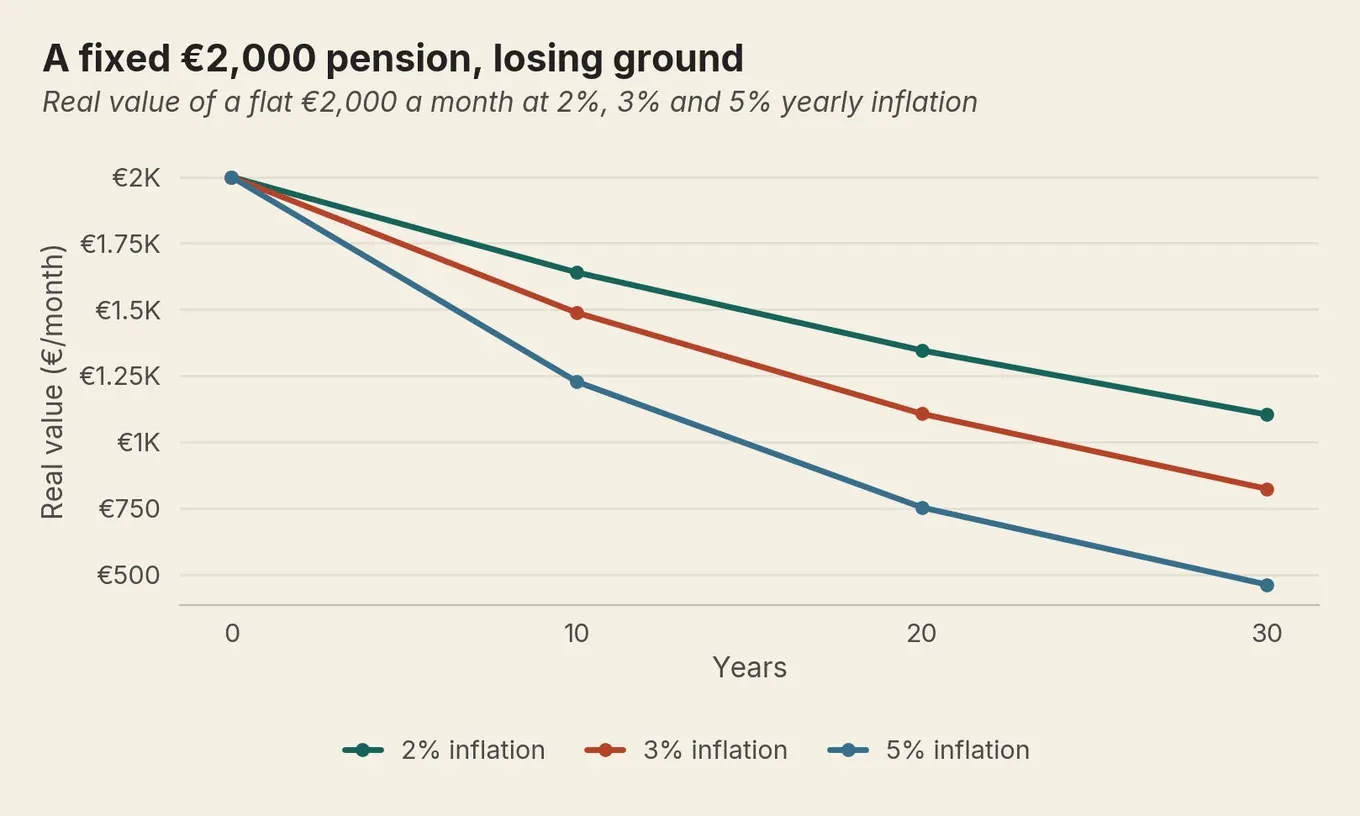
Before that erosion frightens anyone off, hold the plan in view: part of this income already rises on its own, so the real task is to find that part and defend only the flat gap it leaves.
Does your state pension keep up with inflation?
Sometimes, partly, and it depends on where you live. Every European state pension carries a yearly increase rule. The rules differ market by market, and several of them can trail real inflation in a fast year. How well they keep up runs across a spectrum, from near-full protection to almost none.
This is the part most guides skip. It means holding nine rulebooks in your head at once. Nine. The table below maps which European state pensions rise with prices and which trail.
| Market | 2026 rise | How it is set | How well it holds real value |
|---|---|---|---|
| Germany | +4.24% | Wage-linked (earnings-point value €40.79 to €42.52) | Can trail prices in a spike |
| France, basic pension | +0.9% | Price-linked, consumer prices excluding tobacco | Tracks prices, a year behind |
| France, Agirc-Arrco top-up | 0%, frozen | Set by the scheme board, can freeze | Frozen for 2026 |
| Spain | +2.7% | Price-linked, previous year’s average inflation | Tracks prices, a year behind |
| Italy | +1.4% | Price-linked, tapered by pension size | Smaller pensions fully, larger less |
| Portugal | +2.8% (lower pensions) | Growth-and-prices mix, tapered by the IAS (€537.13) | Bigger pensions get less, or nothing |
| Netherlands, AOW | Twice a year | Pinned to the net minimum wage (70% single, 50% partner) | Tracks wages, not prices |
| Ireland | +€10/week to €299.30 | Discretionary Budget decision, no statutory rule | Weakest automatic guarantee |
| Slovenia | +4.2% | Blend of wage growth and inflation | Between wage and price linkage |
| United Kingdom | +4.8% | Triple lock: highest of earnings, inflation, or 2.5% | Strongest rule, fiscally contested |
Wage-linked pensions can trail prices (Germany, the Netherlands)
Germany ties its state pension to wages. That pension, the gesetzliche Rente, rises 4.24% on 1 July 2026 (opens in new tab), lifting the value of one earnings point from €40.79 to €42.52. In a normal year that tracks the economy nicely. Then a spike comes, prices sprint ahead of wages, and a wage-linked pension rises by less than the cost of living. That’s exactly what German pensioners lived through in 2022 and 2023. The Netherlands runs the same risk by a different route. Its state pension is pinned to the net minimum wage: a single person gets 70% of it, each partner in a couple 50%. The rate re-sets twice a year as that minimum wage climbs from €14.71 to €14.99 an hour across 2026. It follows wages. Your shopping basket goes its own way.
Thomas, 53 and two years out from finishing work near Cologne, has less to worry about than he thinks. His state pension is set to rise 4.24% next July, and this year that easily clears the 2.8% inflation recorded for June 2026. On paper, healthy. What nags at him is the memory: when euro-area prices touched 10.6% in October 2022, his wage-linked pension rose too, only far slower than the tills, so each week the rise bought a little less.
Beside that pension sits a private annuity he bought for certainty, paying the same fixed euro figure for life. A flat payment like that erodes exactly like the €2,000 line in the table above: around €510 of monthly buying power gone over the first decade at 3%. His state slice largely defends itself through the wage link; the annuity is already locked. So his real lever is the rest of his savings. He can size it to that one eroding pension and leave the wage-linked one alone. These figures are illustrative, at one steady inflation rate; prices never move in a straight line, values can fall as well as rise, and any return depends on fund charges and performance.
Price-linked pensions track prices, on a delay (France, Spain)
France and Spain link to prices instead. That’s closer to what a pensioner wants, with one catch: the increase looks backwards. The French basic pension rose 0.9% on 1 January 2026 (opens in new tab), set to consumer prices without tobacco. Spain added 2.7% (opens in new tab), tied to the previous year’s average inflation. Both hold their buying power over time. But a hot year of prices is only caught up the following January, so you carry the loss for twelve months first.
France then hides a sharper problem inside the same pay packet. The Agirc-Arrco top-up that most French private-sector retirees lean on was frozen for 2026 (opens in new tab). Its point value was held flat after the scheme’s board couldn’t agree a rise. A French retiree can watch the state slice climb 0.9% while a large chunk of the rest sits at zero, in the same year. Even the unions called the freeze baffling. That tells you something about how it landed.
Tapered pensions protect the smaller pension more (Italy, Portugal)
Italy and Portugal track prices too, but they taper: the smaller your pension, the larger your rise. Italian pensions went up 1.4% for 2026 (opens in new tab), with the full rise reserved for smaller pensions, up to roughly four times the minimum, and less above that. Portugal lifted its lower pensions by 2.8% (opens in new tab), using a mix of economic growth and inflation without housing. That’s scaled against its support index, the IAS, set at €537.13 for 2026. So the largest pensions get the least, and the biggest can be frozen outright. Fair enough: protect the people closest to the line. The sting lands on the comfortable retiree, the one who assumed the yearly rise had the whole thing covered.
Slovenia blends the two; Ireland promises nothing automatic
Slovenia sits in the middle, lifting pensions by a blend of wage growth and inflation; the 2026 rise came in at 4.2% (opens in new tab). Ireland sits at the far end, with no fixed rule at all. Its State Pension rose €10 a week to €299.30 for 2026 (opens in new tab), but that increase is a Budget decision taken fresh each October. In a tight year the government can simply decide to give less.
The triple lock is the strongest rule, and the most argued-over (United Kingdom)
Britain sits here as the comparison point, because its rule is the generous exception. The triple lock lifts the State Pension by the highest of three numbers: average earnings growth, inflation, or 2.5%. For 2026 the earnings measure won and the pension rose 4.8% from April (opens in new tab). No euro-area pensioner gets a rule that kind. The catch here is political: economists broadly accept the lock protects pensioners, and argue endlessly over whether the country can keep affording it (opens in new tab). A rule that works beautifully and might not survive carries its own kind of uncertainty.
Which parts of your income quietly lose value?
The parts you chose for safety. Level annuities, fixed drawdown, cash, and capped workplace pensions all hold their cash value while shedding real value. Guaranteed against default is not the same as protected against inflation, and that gap between the two words is where retirements quietly shrink.
The gap between “guaranteed” and “protected” reaches well beyond a single retiree’s private worry. When the EU’s insurance and pensions watchdog looked at packaged insurance-based investment products (the industry calls them IBIPs), it reached the same conclusion this section makes.
the performance of IBIPs did not outperform inflation levels, and it varies greatly depending on the risk profile of products as well as on consumers’ investment objectives
EIOPA, performance of retail insurance and pension products fails to outperform inflation (opens in new tab), 15 April 2025.
Is a level annuity the safe option?
Not over a 25-year retirement. A level annuity pays the same cash amount for life. That protects you if the insurer fails, but it does nothing about prices, so it buys a little less each year that inflation runs. An inflation-linked or escalating annuity fixes that. You pay for the protection with a lower starting income, and a break-even that runs years before the rising payment overtakes the level one. Neither version is right or wrong. A level annuity still buys the one thing drawdown can’t, an income you can’t outlive, and its only real gamble is on inflation. The mistake is treating the level one as the safe default, when it’s really a slow bet that prices will behave.
| Annuity type | Starting income | Inflation protection | The trade-off |
|---|---|---|---|
| Level (flat) annuity | Highest at the outset | None: the cash amount never changes | Protected if the insurer fails, but fully exposed to prices; it buys a little less every year |
| Escalating annuity | Lower at the outset | Partial: rises by a set percentage each year | Only keeps pace if inflation stays near that fixed percentage |
| Inflation-linked annuity | Lowest at the outset | Tracks a price index directly | Cheapest real income early; the rising payment takes years to overtake the level one |
Illustrative comparison of annuity types, not advice. Starting income and break-even behaviour vary by provider, age and prevailing rates.
Is a final-salary pension fully inflation-proof?
Not fully. Across Europe, plenty of occupational and defined-benefit schemes raise your pension each year, then cap how big that yearly rise can be. In a fast year the rise lags real inflation. The shortfall is banked for good, and never clawed back later. Germany’s Betriebsrente, the workplace pension that tops up the state one, works like this, with many schemes capping or limiting the annual increase. Dutch second-pillar schemes carry a related risk from the other side. These are the workplace pots most employees pay into, and several only raise payments when the fund can afford it. The UK is the market with published numbers, so take it as the worked example. British schemes cap the increases at 5% a year for pension built up between 1997 and 2005, and 2.5% for anything built up after 2005, measured by inflation to the previous September (opens in new tab). When inflation runs above the cap, as it did in 2022 and 2023, the pension rises by the cap and the rest is simply lost. The real value steps down for good, inside the very schemes people call gold-plated.
Is cash safe in retirement?
Only in cash terms. Cash keeps its number and loses its value, because an ordinary deposit rate sitting below inflation gives a slightly negative real return, year after year. Moving to cash when prices are frightening is a very human thing to do. It’s also the move that locks the loss in. None of this means ditching the cash you need soon: a rainy-day buffer and the next year or two of spending belong in cash, where a small, known loss beats being forced to sell in a bad year. With the ECB deposit rate at 2.25% (opens in new tab) against June 2026 inflation of 2.8%, an ordinary easy-access account earns slightly less than prices rise. One warning worth keeping, if you go looking for something better: a money-market fund is an investment, not a deposit, so it sits outside the deposit-guarantee scheme that protects ordinary savings. Reaching for a little more yield can hand back the protection you moved to cash to keep.
Two years from her planned retirement near Lyon, Sylvie has a harder hand to play. At 55, her income lands in three slices that behave nothing alike. Her French state pension rose 0.9% for 2026, price-linked, so it shadows prices a year behind, and even that “protected” slice trails the 2.8% inflation of June 2026 by nearly two points. Her Agirc-Arrco top-up, the slice most French private-sector retirees lean on, was frozen flat at 0%. In the fright of 2022, when prices hit 10.6%, she moved a cushion of savings into an account “for safety,” where it now earns less than prices rise.
One part half-defends itself while two stand still, stacking up the losses in the table above across a retirement that could run thirty years. Her next move is arithmetic. She adds up the part that already rises, subtracts it from what she spends, and protects only the flat gap that remains, sized to how hot her own bills run. The same illustrative footing applies: prices never move in a straight line, values can fall as well as rise, and any return depends on fund charges and performance.
How much of your income do you actually need to defend?
Only the flat part. Some of your income already climbs with prices or wages and looks after itself. The rest stays put while the cost of living rises, and that stuck slice is what you protect. It’s usually smaller than the whole.
Put as a checklist:
- Add up the income that already rises with prices or wages.
- Subtract it from what you spend.
- Defend only that flat remainder.
- Size the hedge to that gap, and to your own energy, healthcare, and housing costs.
One catch: price-linked income catches up about a year late, so it defends itself mostly, not fully; in a fast year, keep a little of it inside the gap you defend.
Illustratively, say you spend around €2,400 a month, and €1,300 of that is covered by a price-linked state pension that rises each year. The flat gap is roughly €1,100. That €1,100 is what needs defending; the whole €2,400 was never the target. These are round, made-up figures rather than anyone’s real budget, but the shape holds: you defend the gap and leave the covered part alone.
A retiree living mostly on a price-linked state pension needs a small hedge, because the big slice defends itself. A retiree living on a level annuity plus fixed drawdown needs a large one, because almost nothing does. Work out which you are before you touch anything.
Then size it to your own basket. The ECB’s headline measure (opens in new tab) tracks a European shopping trolley, and yours may look nothing like it. It may lean hard on energy, on housing, on staying healthy, each one hotter than the average through this spike. If your own inflation beats the headline, your gap is wider than the erosion table suggests, and your defence bigger to match.
What can you do about the money that isn’t protected?
Match each tool to the gap you actually have. Inflation-linked government bonds hedge prices most directly. Equities beat inflation over long stretches but not reliably in any single year. Real assets help a little. The right mix shifts as you move from saving into spending.
None of what follows recommends a product, or names one to buy. These are categories with their trade-offs laid out, so you can ask sharper questions of whoever manages your money.
| Inflation tool | What it hedges | Best matched to | The catch |
|---|---|---|---|
| Inflation-linked government bonds | Prices, most directly: principal and coupon rise with the index | Spending you can see coming over the next few years | Low real yield, and the price still swings with interest rates |
| Equities | Inflation over long stretches, not any single year | The later years of a long retirement | Volatile; a bad year can arrive when your income needs it least |
| Real assets (property, infrastructure, commodities, gold) | Some inflations, unreliably and with no guarantee | A supporting, diversifying role | Dangerous as the whole plan; useful only alongside the rest |
Educational categories, not product recommendations. Inflation-linked bond mechanics: European Central Bank; Deutsche Finanzagentur.
What hedges inflation most directly?
Inflation-linked government bonds do. The payout itself rises with prices, both the principal and the coupon climbing with the index, so they track inflation more closely than anything else a retiree can hold, at the cost of a low real yield. French OATi, other euro-area government linkers, index-linked gilts, and the euro inflation-linked government-bond funds that hold a basket of them all work this way. Their real yields sit close to zero: German inflation-linked federal bonds (Bundeswertpapiere (opens in new tab)) have paid barely anything above inflation, and their market price still swings with interest rates. A fund is the awkward one: it never matures, so a jump in real yields hands it a capital loss with no maturity date to pull the price back, the way many inflation-linked bond funds fell in 2022. Match a fund’s duration to when you will actually spend, or hold individual linkers to maturity.
Equities: the long-run inflation-beater, unreliable in any single year
Over long stretches, shares have been the strongest thing there is at outrunning inflation, because companies raise their own prices as costs climb. Over a single year? Volatile. A bad year can turn up at the exact moment your income needs it least. Past performance is no guide to the future, values can fall as well as rise, and actual returns depend on fund charges and performance. For someone near retirement, equities are the growth engine for the later years. They won’t pay next winter’s heating bill.
Real assets: partial and imperfect
Property, listed property funds, infrastructure, commodities, and gold all get called inflation hedges. Sometimes. Not reliably, though, and not one of them comes with a guarantee. Each earns its place as a diversifier, catching some inflations and missing others. Useful in a supporting role. Dangerous as the whole plan.
How should your mix change as you near retirement?
Lean the protection heavier and the growth lighter, because your salary is no longer there to ride out a bad market. Then aim each tool at the slice that is genuinely eroding. If the eroding slice is a level annuity, that choice was locked in at purchase, and the lever now is the rest of your portfolio. If it’s fixed drawdown, the lever is an inflation-aware withdrawal rule plus a sleeve of real assets. If it’s a capped final-salary pension, the lever is hedging the part of your money that isn’t capped. Same illustrative footing as before: values can fall as well as rise, and none of this is advice about your own case.
What trips people up near retirement?
The cruellest trap is timing. A burst of inflation in the first years of retirement does lasting damage, which is why the years just before you retire reward a little planning. The reason: a capped or frozen rise is not recovered afterwards, so the income steps down permanently, and every year after builds from the smaller base. It’s the inflation version of sequence-of-returns risk, the mirror image of a stock-market crash early in retirement, and the 2022 cohort caught it square on.
The tapered systems catch a different group. In Italy and Portugal the better-off retiree gets the smallest rise, or none. Comfort and protection point in opposite directions.
Anyone drawing a pension from two countries inherits two different increase rules, one on each half. A German-then-Spanish working life leaves a wage-linked slice next to a price-linked slice, the two drifting out of step for the rest of your life.
The headline you read is rarely the number that moves your pension. The ECB targets one euro-area inflation figure. Your pension is raised by a national index, sometimes stripped of tobacco or housing. So “inflation came down” and “my pension kept up” are two separate claims. People often blur them into one comforting sentence that was never true.
A gross rise can also be partly taxed away where income-tax bands are frozen, the quiet work of fiscal drag, so judge it by the net rise that reaches your account, not the headline figure.
None of this needs a guru or a product. Protecting your retirement savings from inflation comes down to those same two jobs: find the slice that already rises on its own, then decide how much of the flat remainder really needs defending, given how long you expect to draw it and how hot your own costs run. That’s a talk worth having with an adviser paid by you, not by a product. You lived through the worst inflation in a generation, and you’re still here asking the right question. That already puts you ahead of most. The gap in that opening paragraph is real. It’s also, once you can see it plainly, a good deal smaller than the fear of it.
Frequently asked questions
Does your state pension keep up with inflation?
Which retirement income keeps pace with inflation, and which erodes?
Is a level annuity the safe choice, or are inflation-linked annuities worth it?
Is cash safe in retirement?
What are the best inflation hedges for retirees?
How much of my retirement income do I actually need to inflation-proof?
Sources (15)
- Eurostat: euro-area annual inflation peaked at 10.6% in October 2022
- European Central Bank: how the HICP measures inflation, and the ECB deposit rate
- Deutsche Rentenversicherung: Rentenanpassung 2026 (state pension uprating)
- Service-Public (DILA): revalorisation of the French basic pension, January 2026
- Service-Public (DILA): Agirc-Arrco point value frozen for 2026
- Boletín Oficial del Estado: Spanish pension revaluation for 2026
- INPS: pensioni 2026, i nuovi importi (Italian pension uprating)
- Governo de Portugal: o que muda em 2026 (pension uprating and the IAS)
- gov.ie: Budget 2026, State Pension increase (Department of Social Protection)
- ZPIZ: redna uskladitev pokojnin 2026 (Slovenian pension adjustment)
- GOV.UK (DWP): State Pension to rise 4.8% from April 2026
- House of Commons Library: increases to occupational pensions in payment (caps)
- Economics Observatory: can the UK afford the triple lock on state pensions?
- Deutsche Finanzagentur: inflationsindexierte Bundeswertpapiere (inflation-linked bonds)
- EIOPA: performance of retail insurance and pension products fails to outperform inflation, 15 April 2025
— That's the lot. It is now night.
Want more of this in your Google results?
Add Money Owl as a preferred source, and Google will show our finance pieces higher when you search for them.
By Jure Jaklič
Founder and editor of Money Owl. Data analyst by trade; personal finance learned first-hand across six European countries.
Recommended

The 4% rule for European retirees: does it still hold up in 2026?
3% to 3.5%, not 4%: that's the realistic safe withdrawal rate for a European retiree living off a portfolio. Here's what moves it, and why.

Why retirement planning matters: the real cost of waiting
About 41% of Europeans pay into no private or workplace pension, and each year you wait costs more than the payments you skip. Here's that cost, in euros.

Dividend investing in Europe: is it really passive income?
Pooled across 2018, 2019, 2021 and 2022, 70.6% of European once-a-year dividend payments arrived in April, May and June. What that does to a monthly budget, and what living off it really costs.