

The point.
- Tax behaves like a fund fee: a small annual drag compounds against you, so an illustrative 0.5% a year can cost tens of thousands over decades.
- Fill your accounts by trade-off type, not allowance size: employer match or up-front relief first, then use-it-or-lose-it allowances, then gross roll-up or tax-free-growth wrappers for long-horizon money, with a cash buffer outside the lock-in.
- Pick the account, then the fund: an Irish-domiciled UCITS fund cuts US dividend withholding from 30% to 15% under the Ireland-US treaty, and any EU-registered fund removes the US estate-tax exposure a US-listed fund carries.
- Three markets tax you without a sale: Germany's Vorabpauschale, Ireland's eight-year deemed disposal, and the Dutch Box 3 deemed return.
- Rates and accounts differ by market and drift each tax year; the mechanism does not, and the mechanism is what keeps more of your return compounding.
The point.
- Tax behaves like a fund fee: a small annual drag compounds against you, so an illustrative 0.5% a year can cost tens of thousands over decades.
- Fill your accounts by trade-off type, not allowance size: employer match or up-front relief first, then use-it-or-lose-it allowances, then gross roll-up or tax-free-growth wrappers for long-horizon money, with a cash buffer outside the lock-in.
- Pick the account, then the fund: an Irish-domiciled UCITS fund cuts US dividend withholding from 30% to 15% under the Ireland-US treaty, and any EU-registered fund removes the US estate-tax exposure a US-listed fund carries.
- Three markets tax you without a sale: Germany's Vorabpauschale, Ireland's eight-year deemed disposal, and the Dutch Box 3 deemed return.
- Rates and accounts differ by market and drift each tax year; the mechanism does not, and the mechanism is what keeps more of your return compounding.
A 0.5% slice of your return, taken in tax every year, costs an ordinary European investor several thousand euros over a working life. Not because the market did anything. Tax, like a fund fee, compounds against you quietly while you look the other way. Tax-efficient investing is the boring craft of making that slice smaller.
That slice has a name. Tax drag is the part of your investment return lost to tax each year, and like a fund’s annual charge it compounds: the money taken in tax this year is money that won’t grow next year, or the year after. A small annual drag over decades quietly costs a European investor thousands. Most guides hand you a country table and stop there.
This is the bit they skip. Even the EU has noticed. In September 2025 the European Commission proposed standard, simpler tax-advantaged “Savings and Investment Accounts” across member states, on the grounds that the way Europeans save and invest across borders is too fragmented. The owl would put it less politely: it’s a mess. So here’s how that fragmented reality works today. Why the tax taken from your returns behaves like a fee, the order to fill your accounts in and why, and the three places where “you don’t pay tax until you sell” is false.
The figures change and differ by market. That’s the point of the table near the end. The mechanism doesn’t change, and the mechanism is what saves you money.
What is tax-efficient investing, and why does it matter so much?
Tax-efficient investing means arranging the same investments so that less of their return is lost to tax each year. You’re not picking different shares. You’re picking the account they sit in, the country the fund is registered in, and the order you act, so the tax bill is smaller and more of your return stays invested. If the basics of how shares and funds even work are still fuzzy, start there first, then come back. In Europe that mostly means three levers: a tax wrapper, an EU-registered fund, and the order you fill them.
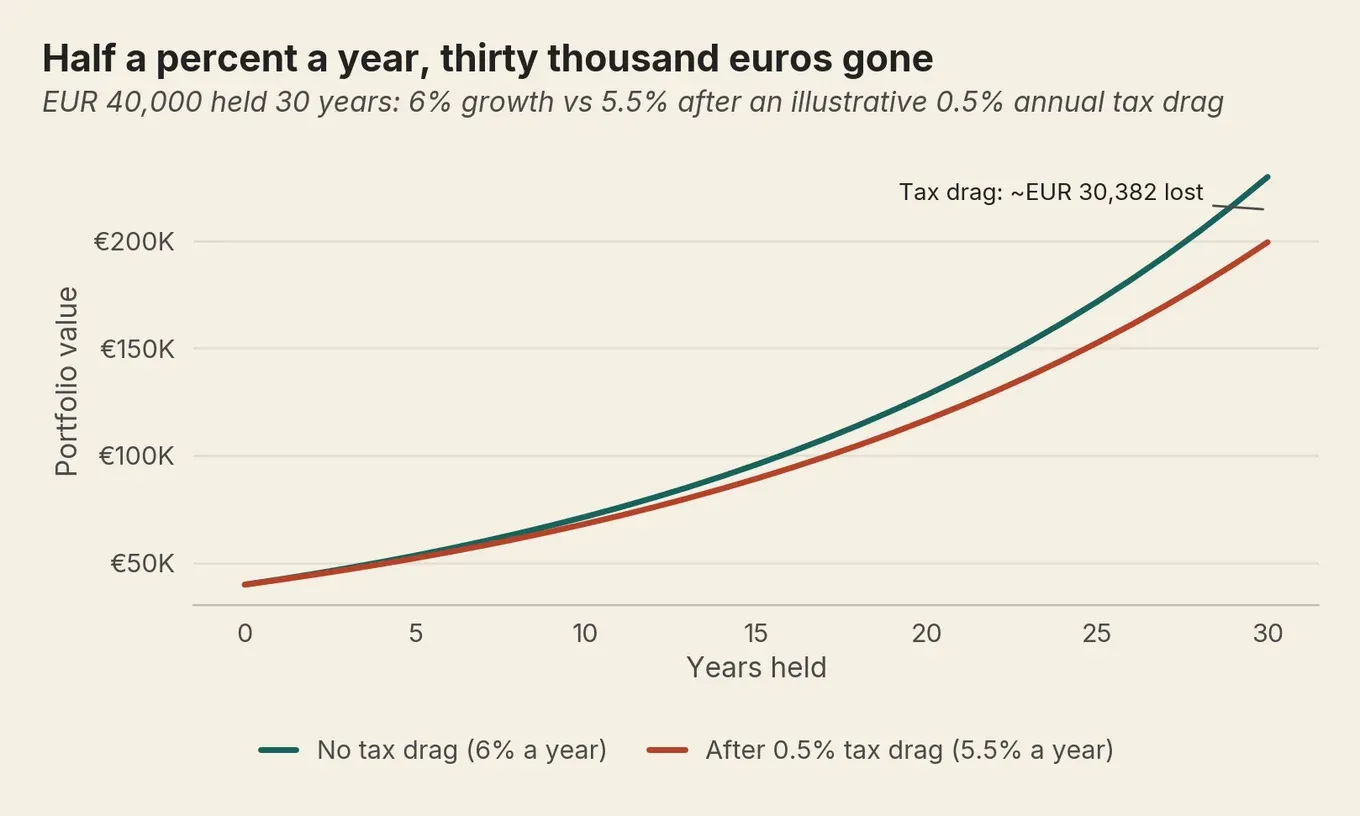
Money shows it more clearly than percentages. Meet Lena, 34, in Leipzig, with €40,000 in a global equity fund she plans to hold for 30 years.
Take an illustrative annual tax drag of 0.5% on her return. That’s roughly what a typical mix of dividend tax and an annual fund charge can cost a buy-and-hold investor. It’s an illustration, not a statutory rate, and her real figure depends on her fund, her country, and her own tax position. Investment values can fall as well as rise.
Now the maths, which you can check. Say her fund grows at 6% a year before tax. Lose 0.5% to tax annually and she compounds at 5.5% instead. Over 30 years, €40,000 at 6% grows to about €230,000. At 5.5% it grows to about €199,000.
The drag costs her roughly €30,000. Half a percent. Thirty thousand euros. The number’s illustrative and the real one will differ. The shape of it isn’t a trick; it’s geometric compounding working against her.
The regulator says the same about ongoing costs, with its own figures. The European Securities and Markets Authority calculates fund performance using the geometric mean “which fully reflects the compounding nature of an investment,” and its cost reports show the net outcome after charges sitting well below the gross, with the gap widening over time. Tax drag rides the same mechanism. A euro lost to tax and a euro lost to charges leave at the same door and never come back.
That’s the whole argument, and it’s what separates real tax-efficient investing strategies from a list of account names. Tax isn’t a one-off bill you pay when you sell. It’s a recurring cost, and recurring costs compound. Once you see it as a fee, you start trying to reduce it, which is the rest of this guide.
Tax-efficient investing in Europe carries one extra wrinkle. Where your fund is registered changes the bill too, so an EU-registered UCITS fund and a US-listed one can hold the same shares and tax you differently.
What is tax drag, in one line?
Tax drag is the slice of your return lost to tax each year. It behaves like a fund charge: the money taken this year stops compounding, so a small annual drag quietly costs thousands over decades. You cut it by choosing the right account and fund.
What is a tax wrapper, and how does it work?
A tax wrapper wraps ordinary shares, bonds, and funds in a kinder tax treatment. The Commission calls it a Savings and Investment Account. It changes when and whether your returns are taxed. It doesn’t change what you invest in.
The lever it pulls separates two regimes.
In a gross roll-up regime, income and gains build up inside the fund with no annual tax, so the full untaxed amount keeps compounding; tax is charged later, at a set event. Irish Revenue is explicit: the general thrust is that “there is no annual tax on income or gains arising to a fund.” The opposite is taxed-as-you-go, where dividends, interest, and gains are taxed in the year they arise, so only the after-tax amount compounds.
The gap between those two bases, compounded over decades, is the prize. A wrapper with gross roll-up or tax-free growth lets the untaxed amount work for you year after year. So a wrapper earns more the longer you hold and the more your money grows inside it. That also explains why “I’ll sort the tax later” costs you. Later. The damage is now.
Does gross roll-up beat taxed-as-you-go?
Over a long horizon, yes, because the untaxed amount compounds for longer. Gross roll-up defers tax to a set event; taxed-as-you-go takes its cut yearly. The longer you hold, the wider that gap opens, which is why the wrapper matters most for patient money, and why matching each pot to its time horizon decides which wrapper is even worth using.
In what order should you fill your wrappers, and why?
Here’s the question almost nobody answers. You have money to invest and more than one account available. Which do you fill first, and why? Tables list the options. Endlessly. They rarely explain the order, and the order is where the money is.
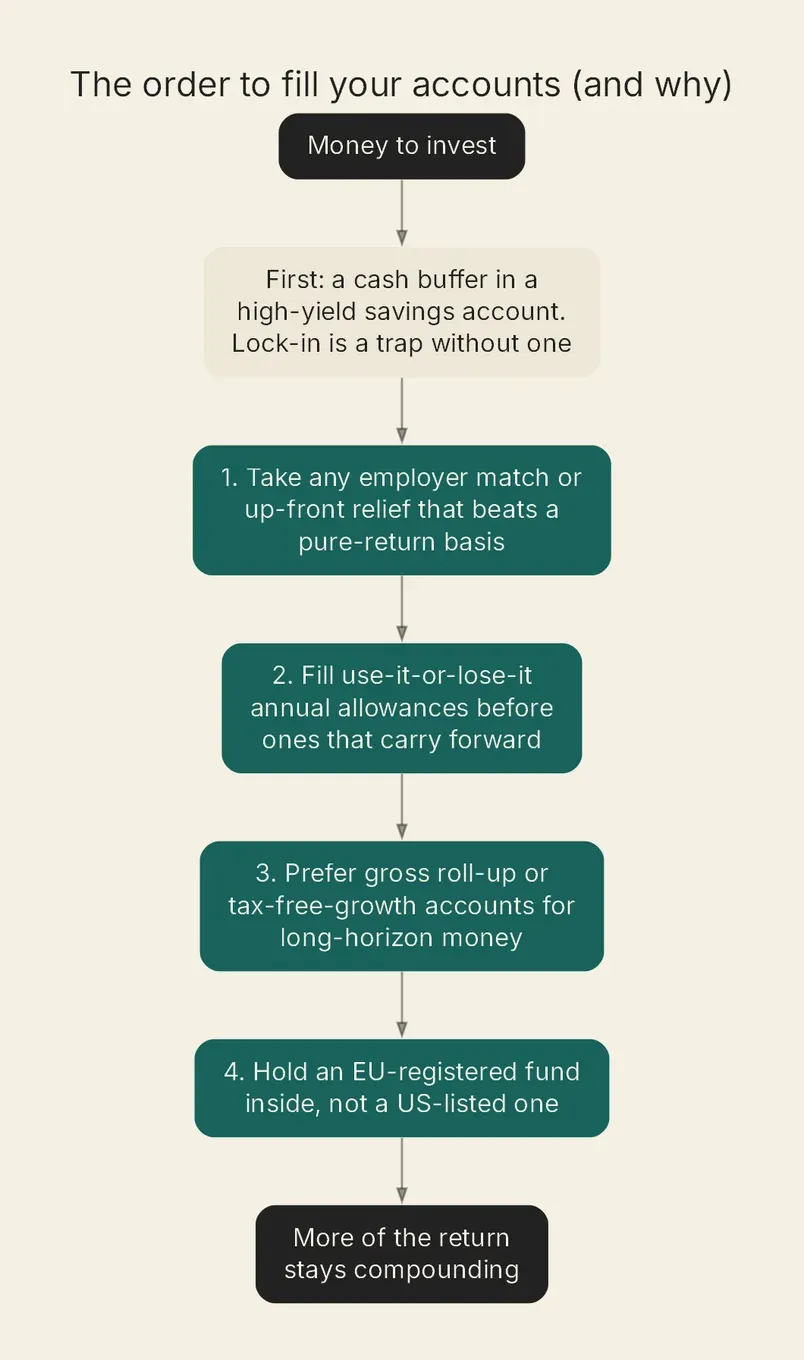
The wrong rule is “fill whichever account has the biggest allowance first.” Size isn’t the right filter. The kind of trade-off each account makes is the right filter. Four questions sort it out, in order. None of this is personal advice; the right order depends on your own tax rates and your market.
Does the account give relief now, or tax-free growth later?
Pension-type wrappers cut your taxable income now and tax you on the way out. Others give no relief now but tax-free growth later. Which wins turns on your tax rate today against your expected rate in retirement. Taxed heavily now, lightly later? Relief-now wins.
Can you afford to lock the money away?
Pensions lock your money until a set age. France’s PEA gives its full tax break only after a five-year hold. So the prior question is whether you hold an accessible cash buffer first, because the freedom to reach your money quickly is worth more than a tax break you can’t use in an emergency. Lock-in is fine behind a buffer. It’s a trap without one.
Will the allowance still be there next year?
Some markets attach an annual allowance that doesn’t roll forward. Use it this year or lose it. So you fill a forfeitable allowance before one that carries forward. A use-it-or-lose-it band beats a bigger cap you can fill any time.
Should you pick the account or the fund first?
Both, in that order, because they’re two separate decisions. Pick the account using the three questions above. Then pick the fund inside it: an EU-registered one, not US-registered, for the reasons the next section explains. People who only think about the account leave money on the table.
So the rough default, a heuristic rather than a rule. Take any employer pension match or up-front relief that beats everything on a pure-return basis. Fill forfeitable annual allowances next. Prefer gross roll-up or tax-free-growth accounts for long-horizon money. Hold an EU-registered fund inside, and keep that cash buffer parked in a high-yield savings account outside all of it. Your market decides which named account fills each slot, and the table near the end names them.
Why are you taxed on funds you never sold?
Now the gotcha that catches careful people. “You don’t pay tax until you sell” feels true. In several Money Owl markets it’s false, and the bill arrives in a year you did precisely nothing. Nothing.
In Germany, an accumulating fund (one that reinvests your income rather than paying it out) gets an annual advance charge called the Vorabpauschale. It prepays tax, calculated from a yearly base rate the finance ministry publishes each January, under the Investment Tax Act. So a German investor can owe tax on a fund in a year with no sale and no payout. The fund went up on paper. The Finanzamt would like its slice now.
In Ireland, the rule is the deemed disposal. Every eight years from when you bought a fund, Revenue treats you as if you’d sold it, taxes the gain, and lets you keep holding. The Tax and Duty Manual is explicit: a chargeable event is deemed to occur at the end of each eight-year period, and fund exit tax falls due on the gain, with no actual sale. A patient buy-and-hold Irish investor pays tax mid-hold, on a sale that never happened.
In the Netherlands, Box 3 taxes a deemed return. Dutch wealth above a tax-free threshold is taxed on an assumed yield, the fictief rendement, not on what you made. You can be taxed in a year you sold nothing and gained nothing, on a return the government assumes you earned. The Dutch are mid-reform towards taxing actual returns, but not before 2028 at the earliest. The deemed-return system bites today.
The point under all three is the same. Tax isn’t always triggered by a sale. Some systems tax the holding itself, on a yearly or periodic schedule, whether or not you did anything. In one of these markets, “I haven’t sold, so there’s nothing to declare” is the sentence that gets you a letter.
This is also why “accumulating funds are always more tax-efficient” is a confident half-truth. An accumulating fund changes the timing and the cash flow. It doesn’t, by itself, change the lifetime tax you owe, and in Germany and Ireland it’s taxed on a schedule anyway. Whether accumulating beats distributing depends on your market’s timing rules. It isn’t a universal winner, whatever the forums tell you.
Which countries tax funds you have not sold?
Three Money Owl markets tax fund holdings without a sale. Germany charges the Vorabpauschale on accumulating funds. Ireland deems a disposal every eight years. The Netherlands taxes a deemed return under Box 3. A buy-and-hold investor in any of them owes tax in quiet years.
Does the fund’s home address change your tax bill?
It does, and this is the most expensive thing most people get wrong without noticing. Two funds can hold the exact same shares and tax you differently, because the country the fund is registered in sets part of the bill. Two mechanisms cause the damage.
Withholding tax on US dividends comes first, and the US example matters because most global funds run heavy in US shares. The United States withholds 30% on dividends paid to foreign investors as standard. An Irish-domiciled fund, under the Ireland-US tax treaty, brings that down to 15% on the US dividends inside it. A US-listed fund holding the identical shares loses the full 30%. On a global fund yielding roughly 1.8% with about 60% in US shares, the Irish-domiciled version saves around 16 basis points a year of leakage. That compounds too.
US estate tax comes second, and it reaches US assets, including shares of US companies and US-registered funds, once they pass a low filing threshold. An EU-registered fund holding the same shares doesn’t count as US property for you, so it removes the exposure. Don’t panic. It’s a reason to prefer the EU-registered version, which sits one search away.
So the plain rule sits underneath the wrapper question: pick your account, then put an EU-registered fund inside it. Choosing a UCITS ETF domiciled in Europe is the practical version of this, and gets the fund’s home address right so you fix a leak you’d otherwise never have seen on a statement.
What is withholding tax on dividends, and how do you cut it?
It’s tax taken from dividends before they reach you, at two layers: the company’s country first, the fund’s country second. The fund’s home country sets the treaty rate at that first layer. An Irish-domiciled fund cuts the US rate from 30% to 15%; many Luxembourg structures do not.
Could a US-listed fund leave a tax bill on your estate?
Yes, and most Europeans holding one have no idea. A US-registered fund counts as US property for US estate tax, on assets above $60,000 at death, with tax rising to as much as 40%. An EU-registered fund avoids it.
How does tax-efficient investing differ market by market?
This is the reference table, and it’s genuinely a reference: scan for your market, then go back and act on the mechanism above, which moves the needle. Each market brings its own accounts, its own headline rate, and its own answer to “can I be taxed without selling.” The figures hold for the 2026 tax year (2026-27 for the UK, which runs its tax year from 6 April).
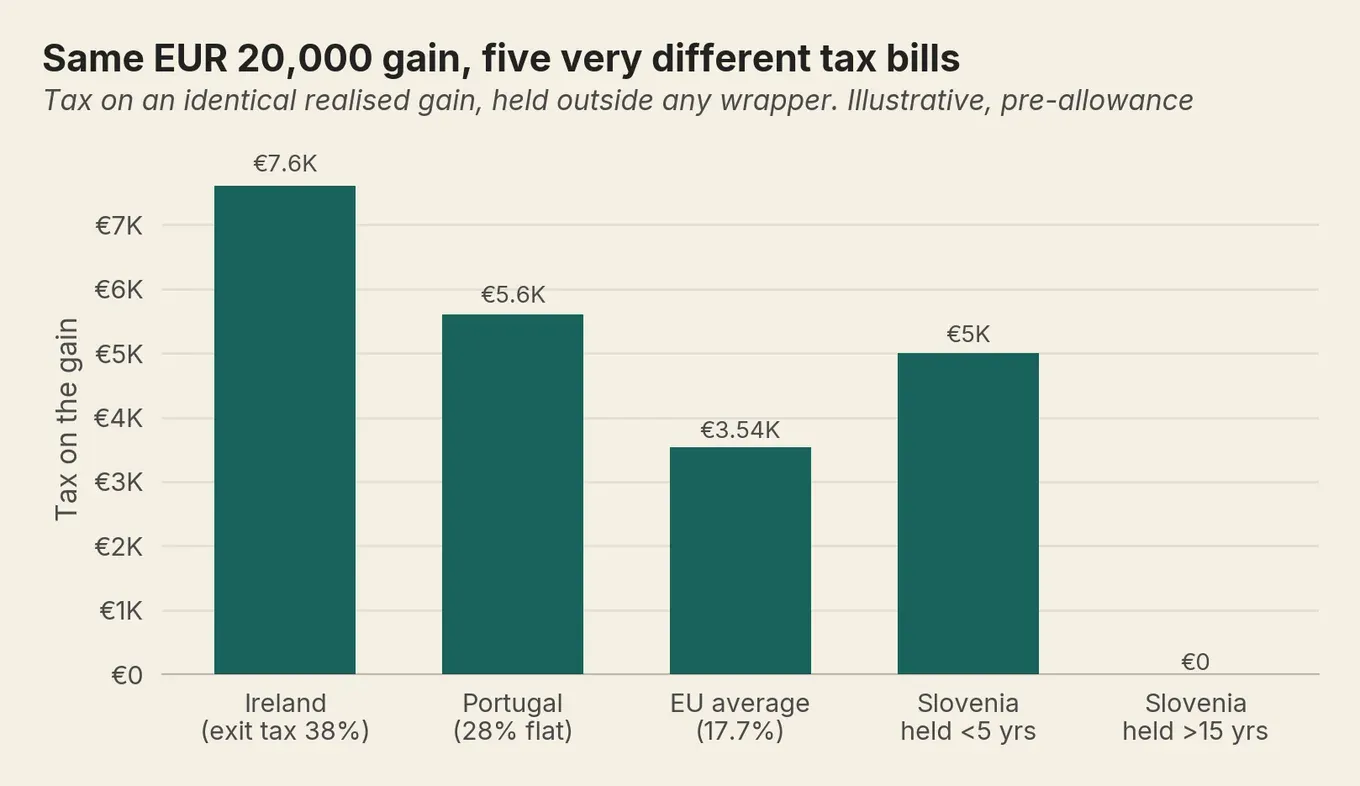
A note on two of them. France’s tax on investment gains is a flat tax of around 30% (12.8% income tax plus social levies). The exact total has drifted with the social-levy part, so treat 30% as a working figure, not a precise one. Portugal taxes share sales at a flat 28%, with holding-period exemptions that can lower the effective rate, so one clean number overstates the certainty.
| Market | Main tax-advantaged account(s) and cap | Headline tax on shares/funds | Taxed without selling? |
|---|---|---|---|
| Germany (DE) | Saver’s allowance (Sparerpauschbetrag) €1,000 single, €2,000 joint; Basisrente/Riester pensions | 26.375% (25% plus solidarity surcharge); equity funds 30% exempt under Teilfreistellung | Yes, the Vorabpauschale advance charge on accumulating funds |
| Spain (ES) | Plan de Pensiones €1,500 a year deductible (plus up to €8,500 from employer contributions) | Savings income 19% to 30%, in bands | No, taxed on disposal |
| France (FR) | PEA €150,000 cap (PEA-PME €225,000); Assurance-Vie; five-year hold for the PEA break | Flat tax of around 30% (12.8% income tax plus social levies) | No, taxed on disposal |
| United Kingdom (GB) | ISA £20,000 a year tax-free; SIPP (pension); CGT allowance £3,000; dividend allowance £500 | CGT on shares 18% (basic rate) or 24% (higher rate) | No, taxed on disposal |
| Ireland (IE) | PRSA (pension); no ISA equivalent; CGT exemption €1,270 | Fund/ETF exit tax 38% (cut from 41% on 1 January 2026); direct shares CGT 33% | Yes, the eight-year deemed disposal on funds |
| Italy (IT) | PIR savings plan; fondo pensione (pension) | 26% substitute tax on dividends and gains | No, taxed on disposal |
| Netherlands (NL) | Box 3 wealth tax; tax-free threshold €59,357 per person; lijfrente (annuity) | Box 3 36% on a deemed return above the threshold | Yes, Box 3 taxes a deemed return |
| Portugal (PT) | PPR retirement savings plan | 28% flat on share sales, with holding-period exemptions | No, taxed on disposal |
| Slovenia (SI) | Pension insurance (pokojninsko zavarovanje) | Capital-gains taper: 25% under five years, 20% (5 to 10), 15% (10 to 15), 0% after 15 years | No, taxed on disposal |
Two patterns stand out from the grid. Germany, Ireland, and the Netherlands all tax you without a sale, by three different routes, so a buy-and-hold investor in any of them should budget for a bill in a quiet year. Slovenia rewards patience hardest. Hold for more than 15 years and the capital-gains rate falls to zero. For context, the EU average capital-gains rate sits around 17.7%, so several of these headline numbers are above the European norm, and a good account is how you bring your own rate back down.
The accounts and rates above will drift. Tax-year figures always do. The reason to pick the right account and the right fund doesn’t drift, and it’s the same in each column: keep more of the return that’s already yours, and let the part you keep carry on compounding.
You don’t need to optimise all nine markets, or memorise a rate. You need to do the boring thing in your own market. Find your main tax-advantaged account this week, check whether it has an annual allowance you’re about to waste, and put an EU-registered fund inside it rather than a US-listed one. None of it is clever. The tax taken from your returns has been compounding against you this whole time. Set it compounding a little less, starting now.
Frequently asked questions
What is tax-efficient investing, and why does it matter?
What is a tax wrapper, and how does it work?
What is tax drag, and how much does it cost a long-term investor?
How are ETFs taxed across Europe, and how does it differ from the US?
What is withholding tax on dividends, and how do I reduce it?
Accumulating vs distributing ETFs: which is more tax-efficient?
How do I reduce capital gains tax on my investments?
In what order should I fill my tax wrappers?
How does tax-efficient investing differ by country?
Sources (12)
- DGFiP (impots.gouv.fr): how securities are taxed (PFU / flat tax)
- ESMA: Costs and Performance of EU Retail Investment Products 2025
- Belastingdienst: Berekening box 3-inkomen 2026 (deemed return, EUR 59,357 threshold)
- Revenue (Ireland): Tax and Duty Manual Part 27-01A-03, ETFs (38% exit tax, eight-year deemed disposal)
- Revenue (Ireland): tax treaty rates (Ireland-US dividend withholding)
- Bundesministerium der Finanzen: Basiszins for the Vorabpauschale, 2026
- Service-Public.gouv.fr: Plan d'epargne en actions (PEA), EUR 150,000 cap, five-year hold
- GOV.UK: Individual Savings Accounts (ISA, 2026 to 2027)
- PwC Worldwide Tax Summaries: Slovenia, capital-gains holding-period taper
- Tax Foundation Europe: 2026 capital gains tax rates in Europe (EU average, Portugal)
- IRS: taxation of nonresident aliens (30% FDAP dividend withholding)
- IRS: estate tax for nonresidents not citizens of the United States (USD 60,000 threshold)
— That's the lot. It is now night.
Want more of this in your Google results?
Add Money Owl as a preferred source, and Google will show our finance pieces higher when you search for them.
By Jure Jaklič
Founder and editor of Money Owl. Data analyst by trade; personal finance learned first-hand across six European countries.
Recommended

How to pick an ETF in Europe without losing the plot
Pick a UCITS ETF in Europe with a weighted six-point checklist: the UCITS gate, what it tracks, true cost, size, acc or dist, domicile.

The cost of doing nothing with your money, and what to fix first
Four money lines go stale at once: savings, tariffs, an uninvested surplus, and a pension rate you never set. Here's the ten-year bill, and what to fix first.

The 4% rule for European retirees: does it still hold up in 2026?
3% to 3.5%, not 4%: that's the realistic safe withdrawal rate for a European retiree living off a portfolio. Here's what moves it, and why.