

The point.
- €8,000 sitting at the euro-area average overnight rate of 0.27%, instead of a new one-year fixed deposit at 1.92% (ECB, May 2026), costs about €130 in year one and about €1,300 over ten years, and only if you repeat the move annually.
- Three unreviewed tariffs (energy, internet and TV, insurance) run to about €900 a year for a couple and €1,160 for a family of four (Consumentenbond, Netherlands, March 2025), against a measured median of about two hours per switch (CCPC Ireland, 2021). That is roughly €150 an hour.
- One extra percentage point of a €40,000 salary is €400 a year, but only in a scheme that lets you set your own rate. Ireland's MyFutureFund fixes the rate in statute, so the Irish lever is staying enrolled rather than paying more. Those euros are also your own money moving into a pot you cannot reach for decades, not a gain.
- ESMA's stylised €10,000 retail fund portfolio finished at €9,956 over the five years to end-2024, and at €11,927 over the ten years, both after ongoing costs and after inflation. These are illustrative figures and not a forecast. Investment values can fall as well as rise, and actual returns depend on fund performance and charges.
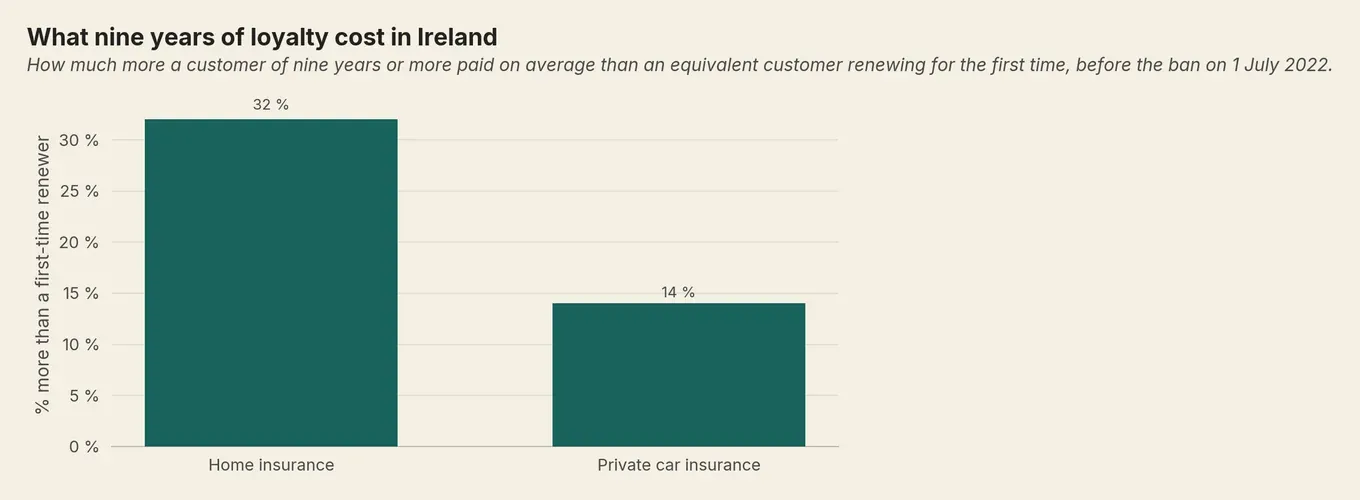
- Price walking is banned in the EU only in Ireland, only on private car and home cover, from 1 July 2022. Before the ban, customers of nine years or more paid 14% more on car cover and 32% more on home cover than a first-time renewer. There is no EU-wide ban.
The point.
- €8,000 sitting at the euro-area average overnight rate of 0.27%, instead of a new one-year fixed deposit at 1.92% (ECB, May 2026), costs about €130 in year one and about €1,300 over ten years, and only if you repeat the move annually.
- Three unreviewed tariffs (energy, internet and TV, insurance) run to about €900 a year for a couple and €1,160 for a family of four (Consumentenbond, Netherlands, March 2025), against a measured median of about two hours per switch (CCPC Ireland, 2021). That is roughly €150 an hour.
- One extra percentage point of a €40,000 salary is €400 a year, but only in a scheme that lets you set your own rate. Ireland's MyFutureFund fixes the rate in statute, so the Irish lever is staying enrolled rather than paying more. Those euros are also your own money moving into a pot you cannot reach for decades, not a gain.
- ESMA's stylised €10,000 retail fund portfolio finished at €9,956 over the five years to end-2024, and at €11,927 over the ten years, both after ongoing costs and after inflation. These are illustrative figures and not a forecast. Investment values can fall as well as rise, and actual returns depend on fund performance and charges.
- Price walking is banned in the EU only in Ireland, only on private car and home cover, from 1 July 2022. Before the ban, customers of nine years or more paid 14% more on car cover and 32% more on home cover than a first-time renewer. There is no EU-wide ban.
What is the cost of doing nothing with your money?
You weren’t lazy. Someone priced you.
Take your own number first. Leave €8,000 in an everyday account paying the euro-area average of 0.27%, while a new one-year fixed deposit pays 1.92%, and the gap costs you about €130 in the first year (ECB, May 2026). That is one transfer. The account you left it in did nothing dramatic to you. It simply stopped having to win you.
Four lines go stale at the same time. A savings rate nobody resets. Tariffs that renew themselves. A surplus that never gets invested. And a pension contribution rate someone else picked for you.
Only one of the four ever writes to you. The other three go quiet for years, and quiet isn’t the same as accidental. Sandra Molenaar, who runs the Dutch consumer body Consumentenbond, put a number on it (opens in new tab) in March 2025. Translated from the Dutch: providers, insurers and energy firms “lure new customers with big discounts”, but “those discounts disappear as soon as you stay with such a provider for longer”.
If you switched something two years ago, this is still about you. The reason turns up later.
Why do these four lines go quiet for years?
Because almost nothing in the system is obliged to disturb you.
An ECB working paper from July 2026 (opens in new tab) says it from behind the counter. When rate-sensitive savers moved their money out, banks gained pricing power over the ones who stayed. The paper calls them “a core group of inertial depositors”.
You probably do look, mind. Ireland’s consumer authority (opens in new tab) found 78% of people shop around each year or when a contract renews. Looking isn’t the rare part. Moving is. The same report names what stops them.
“As shown in this research, reasons for consumer inertia include a belief the consumer had the best deal available, or a belief it would be too much hassle to switch.”
Competition and Consumer Protection Commission, Compare and Switch (opens in new tab), November 2023
Which of the four ever sends you a letter?
Only the phone contract, by law. Under the EU’s telecoms rules (opens in new tab), your provider must warn you before a fixed-term contract rolls over, say how to leave, and hand you its best tariff advice while it’s at it. At least once a year, on phone and broadband. Nothing else on this list.
Energy and insurance at least send a renewal, which most people then file. The same consumer authority quotes the CRU, Ireland’s energy regulator: in 2022, 41% of electricity users and 29% of gas users rolled over with the same supplier, whatever the price. Auto-renewal, in the authority’s words, “removes the ‘trigger points’ at which consumers are motivated to review what they are paying”.
Why does a savings rate slide without telling you?
Because a deposit account never sends you an event at all. When the central bank moves its policy rate, roughly 15% of the move reaches an everyday account in the short run, against about 63% into a fixed-term deposit. Yours falls fast and climbs slowly.
The UK’s Financial Conduct Authority (opens in new tab) has a name for where you end up. The back book: products closed to new customers, which no longer have to win anyone over. In an app they look exactly like the open ones. Same logo, same balance, paying less.
Moving it doesn’t make it less safe, which is the real question. Every bank licensed in the EU sits in a guarantee scheme covering €100,000 (opens in new tab) per person, per bank.
Has anyone actually banned the loyalty penalty?
Ireland has, and nowhere else in the EU so far. Price walking means charging you more each year because you keep renewing, not because your risk changed. The Central Bank of Ireland banned it on private car and home cover from 1 July 2022.
Before the ban, the Bank (opens in new tab) measured it: customers of nine years or more paid 14% more on private car cover and 32% more on home cover than a first-time renewer.
Its follow-up review (opens in new tab) put the home gap down from 33% to 9%.
Now the part worth being annoyed about. There’s no EU-wide version. EIOPA (opens in new tab), the EU insurance supervisor, sent national regulators a supervisory statement. That sets expectations for supervisors, not rights for you. Live in Germany, Spain, France, Italy, the Netherlands, Portugal or Slovenia and you have the expectation. Ireland got the ban.
What does a decade of doing nothing look like in one table?
Here’s the cost of doing nothing with your money for one made-up euro-area household. An example, not an average: the figures underneath come from other countries and other years, and each row says which, in today’s euros with no inflation forecast added.
| Neglected line | The illustration | Year one | Ten years, today’s euros |
|---|---|---|---|
| Savings rate | €8,000 left at the euro-area average overnight rate instead of the average new one-year fixed deposit, 1.65 points apart in May 2026 (ECB) | about €130 | about €1,300, but only if you repeat the move every year |
| Recurring tariffs | energy, internet and TV, and insurance all left to renew (Consumentenbond, Netherlands, March 2025) | up to about €900 for a couple, €1,160 for a family of four | up to about €9,000, on the same annual condition |
| Surplus never invested | €10,000 in cash instead of the stylised fund portfolio from ESMA, the EU markets regulator, after ongoing costs and inflation, which stood at €9,956 five years in | no meaningful one-year figure | €11,927 after ten years (ESMA) |
| Pension rate | one extra percentage point of a €40,000 salary, in a scheme that lets you set your own rate | €400 of your own money going in | €4,000 of your own contributions in |
No bottom line, because two of those rows are money you lose and two are money you move, and adding them would mean nothing.
The savings row uses ECB averages across all reporting euro-area banks (opens in new tab). Households earned 0.27% on overnight deposits in May 2026, and a new fixed-term deposit of up to a year (opens in new tab) paid 1.92%. That’s an average, not an offer, and your bank may sit either side of it.
The tariff row is Dutch. Consumentenbond publishes no method, and it sells the comparison services its own figure measures. Read it as the shape of a household total, not a European one.
Read the third row twice, worse half first. ESMA’s stylised fund portfolio (opens in new tab) starts at €10,000. After costs and inflation it finished the five years to end-2024 at €9,956, €44 below where it began. The ten years finished at €11,927, roughly €1,900 ahead. Same regulator, same table, opposite signs. Both are illustrative figures and not a forecast. Investment values can fall as well as rise, and actual returns depend on fund performance and charges.
If you put a lump sum in during 2020 and feel behind, you aren’t being gloomy. You’re inside the EU markets regulator’s own figures. The horizon separates an expectation from a promise.
Why do defaults beat reminders?
Be sceptical of prompts, ours included. DellaVigna and Linos (opens in new tab) pooled 126 trials from two government nudge units, covering 23.5 million people. The average nudge lifted take-up by 1.4 percentage points, against 8.7 across published academic studies. About one sixth of the promised effect. That’s US work on US programmes, and the lesson travels anyway. Reminders are weak. Defaults are strong.
Which is awkward, because three of these four lines only respond to reminders. A tariff switch and a savings move both decay: the opening rate ends, the fixed term rolls over, the account shuts to new customers. This is the bit we promised earlier. That switch you made two years ago has quietly expired. Each one is an hour you repeat, forever, or it stops working.
A contribution rate is the exception, in a scheme that lets you set it. Change it once and it applies to every payslip after. No anniversary, no one to chase, nothing in your calendar. That is the one line here where you move a default instead of setting yourself a reminder.
Ireland is the live example, and it cuts against us. MyFutureFund (opens in new tab), its auto-enrolment scheme, fixes the contribution rate in statute, and Citizens Information (opens in new tab) doesn’t hedge about it: “You cannot pay more or less than the set rate.” So there the move is staying enrolled rather than paying more.
Nor does the maths travel by itself. Plenty of workplace schemes on the continent are set by collective agreement, with no individual match, in which case an extra point is €400 of your own money changing pockets rather than €400 gained.
Where do you start after years of leaving it alone?
Two things come before anything on this list. If you have no cash buffer at all, or a card balance sitting at card rates, deal with those first. And pension euros aren’t spendable: they go into a pot you can’t reach for decades, so a percentage point you can’t afford is no kind of win.
After that, work from events rather than intervals, because no European rule tells you how often to review and we went looking. Find out what contribution rate your pension runs at and what the maximum matched rate is, then ask payroll for the higher one where the scheme allows it. Where the law fixes the rate instead, staying enrolled is the same move. Then look up what your everyday account pays today and write the number down somewhere you’ll trip over it.
The tariffs don’t need a diary. The renewal letter is the review, and the price printed on it is the thing you’re being asked to accept without looking.
The law helps a little with the rest. Under the EU’s electricity rules (opens in new tab) you can change supplier within three weeks of asking, and households cannot be charged a switching fee. Three weeks is the floor, and national law beats it: Germany wrote 24 hours into its own energy act (opens in new tab) from 1 January 2026, and Spain caps a switch at ten working days (opens in new tab). Leave a fixed-term, fixed-price electricity contract early and an exit fee is still allowed, though it has to be proportionate. Read the contract before you count the saving.
Energy and insurance will keep sending you a renewal. Your savings rate, your uninvested cash and your contribution rate will send you nothing, ever, and they are the three that were quietly costing you while you waited to be asked. Go and look at one of them tonight. In a year you’ll have a number instead of a hunch.
Frequently asked questions
Why do people keep paying, even when switching clearly pays?
Is this only about savings accounts, or does it hit everything?
How do you work out your own ten-year inertia bill?
Which of your bills carries a loyalty penalty, and is it banned across the EU?
Does leaving a cash surplus uninvested always cost you money?
Where do you start after years of leaving it alone?
Sources (21)
- European Central Bank: MFI interest rate statistics (MIR), euro-area household overnight deposits (series L21)
- European Central Bank: MFI interest rate statistics (MIR), euro-area household deposits with an agreed maturity of up to one year, new business (series L22)
- European Central Bank: Bank deposit pricing in the euro area (Working Paper Series No 3255)
- ESMA: Costs and Performance of EU Retail Investment Products 2025
- EIOPA: Supervisory statement on differential pricing practices in non-life insurance (EIOPA-BoS-23-076)
- EUR-Lex: Directive (EU) 2018/1972, European Electronic Communications Code, Article 105
- EUR-Lex: Directive (EU) 2019/944 on the internal market for electricity, Articles 10 and 12
- EUR-Lex: Directive 2014/49/EU on deposit guarantee schemes, Articles 6 and 7
- Gesetze im Internet (Germany): Energiewirtschaftsgesetz, § 20a (Lieferantenwechsel)
- BOE (Spain): Real Decreto 88/2026, de 11 de febrero, Article 18 (cambio de comercializador)
- Central Bank of Ireland: Review of Differential Pricing in the Private Car and Home Insurance Markets, final report
- Central Bank of Ireland: Review of Differential Pricing Regulations in the Private Car and Home Insurance Market
- Competition and Consumer Protection Commission (Ireland): Compare and Switch, understanding consumer behaviour in regulated markets
- MyFutureFund (NAERSA, Ireland): about the scheme, eligibility and contributions
- Automatic Enrolment Retirement Savings System Act 2024 (No. 20), sections 50, 51, 53, 54 and 61 (revised text, Law Reform Commission)
- Department of Social Protection (Ireland): Update on MyFutureFund, press release, 9 February 2026
- Department of Social Protection (Ireland): MyFutureFund Contributions
- Citizens Information (Ireland): Auto-enrolment pension, MyFutureFund
- Consumentenbond (Netherlands): Consumenten kunnen tot wel duizend euro per jaar besparen met vergelijkers
- Financial Conduct Authority (GB): Cash Savings Market Review 2023
- NBER: RCTs to Scale, Comprehensive Evidence from Two Nudge Units (Working Paper 27594)
— That's the lot. It is now night.
Want more of this in your Google results?
Add Money Owl as a preferred source, and Google will show our finance pieces higher when you search for them.
By Jure Jaklič
Founder and editor of Money Owl. Data analyst by trade; personal finance learned first-hand across six European countries.
Recommended

Employer pension contributions mean five different things across Europe
Cross a border and employer pension contributions become five different things. Ireland and Britain force a minimum in; Spain requires nothing at all.

The subscription audit: how to find and cancel recurring expenses
Run a 30-minute subscription audit: find every recurring charge, cancel it, and use your EU bank and SEPA rights to make it stop.

The best savings account in Europe is the one that lets you keep the most
The headline rate on a savings account is rarely what you keep. Post-tax yields in Germany, France, Ireland, Slovenia and beyond tell a very different story.