

The point.
- Net worth is everything you own minus everything you owe, and it can be negative without anything being wrong.
- Count assets at their value today; a future state pension stays out because there is no pot to value.
- To handle multiple currencies, pick one home currency, one rate source, and one date each month, then convert every foreign line on that date.
- The free ECB euro reference rates cover around 30 currencies and are published for information only, which makes them a fair public yardstick.
- Track once a month on a fixed date and compare this month with last month, never against an age benchmark.
You keep meaning to sort this out. Somewhere along the way you heard the phrase “net worth” and assumed it was a rich-person thing. It isn’t. Net worth is just one number that shows how you’re doing with money, and you can work yours out in about twenty minutes.
Here’s the part nobody tells you. Net worth doesn’t demand a spreadsheet built for investors. Learning how to track net worth means building one small habit you repeat once a month, the same way each time. If your money is spread across two or three countries, you’ve probably decided it’s too messy to bother with. It isn’t. This guide walks you through the plain version.
What is net worth, and how do you work it out?
Net worth is everything you own minus everything you owe. Total up your assets, the things you own. Then your liabilities: the money you owe. Subtract that second number from the first. The figure that remains becomes your net worth. That single sum captures the whole method.
The people who count this for a living agree on the formula. The Central Statistics Office in Ireland (opens in new tab) defines net wealth as the value of what you own minus the value of what you owe. The European Central Bank (opens in new tab) measures household wealth across the euro area the same way. So you’re using the exact method the economists use. It fits on the back of an envelope.
Can my net worth be negative?
Yes, and that’s fine. A negative number turns up often when you’re young, or when you’ve recently bought a home with a big mortgage. The point is never the number today. It’s which way that number moves over the months ahead.
What should you include, and what should you leave out?
One simple rule handles the tricky calls. If a thing carries a value you could look up or guess today, count it. If it only promises money later, leave it out.
What goes on the “own” side?
The own side holds anything with a value today. Count your cash and savings, your investments, your home if you own one, your car at resale value, and any pension pot that shows a balance. You could sell or cash in each one.
What goes on the “owe” side?
The owe side holds your debts. Count your mortgage, any car or personal loans, your overdraft, and the balance sitting on your credit cards. Add these up, then take the total off your own side. The figure left over becomes your net worth.
Does my pension count?
Sometimes. A workplace or personal pension pot that shows a balance counts, even if you can’t touch the money yet, because it holds a value today. A future state pension stays out. It carries no pot and no balance to add up.
Do I count money someone owes me?
Yes, if you genuinely expect it back. A real loan to a friend or relative belongs on your own side, because the money still counts as yours. Leave out anything vague that you’d never chase, since it carries no value you could rely on.
How do I value my home and my car?
Use what a thing would sell for today, not what you paid, exactly as the Dutch tax authority (opens in new tab) values wealth. Your car goes in at resale value, your home at what it would fetch now, and a property abroad at an honest, consistent estimate.
How do you track net worth across different countries and currencies?
People dread this part, and it runs far easier than it looks. To track net worth across borders you don’t need a banking app, a live feed, or anything an investor would use. Three small decisions, made once, carry the whole method.
Pick one home currency. Pick one rate source. Pick one date each month. Then convert each foreign line into your home currency using that one rate, on that one date. That covers the entire method.
For the free rate source, reach for the European Central Bank’s euro reference rates (opens in new tab). The ECB publishes rates for around 30 currencies, updated at about 4pm Brussels time each working day. The ECB calls these rates “published for information purposes only”, so treat them as a fair public yardstick, not a dealing price you could trade at.
Where do I write it all down?
A plain spreadsheet handles the whole job. One column lists what you own, one lists what you owe, and a third holds the running total. A notebook works too. You need no app, no bank login, and no subscription to track your own number.
What does this look like for a real reader?
Meet a reader whose money is scattered. She works in Ireland and counts in euros. She owns a flat in Spain. She left a pension pot in a third country. And she holds £1,000 in a UK savings account.
She picks the 22nd of the month as her snapshot date. On 22 June 2026, the ECB rate was 1 euro to £0.86468. So her £1,000 was worth about €1,156 that day (rounded). She writes €1,156 in her own-currency column, not the pounds.
She repeats the same for each line. The Spanish flat at its estimated sale value. The pension pot at its statement balance. Her euro savings as they are. Then she adds up the “own” side, subtracts what she owes, and is left with one single number in euros that pulls a flat in Spain, a pension she half-forgot, and a thousand pounds in Britain into the same honest total. Next month she repeats it on the 22nd, with the ECB rate from that day. Same currency, same source, same date. The two numbers now compare cleanly.
Here’s the whole idea on one line each, with three accounts pulled into euros on a single date:
| Account | What you have | ECB rate (22 June 2026) | Worth in euros |
|---|---|---|---|
| Euro current account | €12,000 | Already euros | €12,000 |
| UK savings account | £1,000 | €1 = £0.86468 | €1,156 |
| Swiss savings account | CHF 5,000 | €1 = CHF 0.9257 | €5,401 |
Source: European Central Bank euro foreign exchange reference rates, fixing dated 22 June 2026. The ECB publishes these “for information purposes only”, so use them as a fair yardstick, not a dealing price. Foreign figures rounded to the nearest euro.
What if I live in the Netherlands?
Then the habit will already feel familiar. Dutch wealth tax values your assets and debts on one fixed date, the 1st of January, which the Dutch call the peildatum, “the one date you value things on”. Your monthly snapshot is just that yearly move, done more often.
For 2026, the Belastingdienst (opens in new tab) leaves the first €59,357 of your savings and investments free of that tax, or €118,714 for a couple. Track your own number all year and nothing nasty is waiting for you on 1 January.
What if I live in Spain?
Then tracking your foreign assets monthly carries a real bonus. Spain asks residents to report foreign assets once any one category tops €50,000, on a form called Modelo 720 (opens in new tab). It’s a report, not a tax.
If you already track your foreign accounts, investments, and property each month, you’re holding the figures the report needs. This is a touchpoint, not tax advice. Check your own duty with the tax office.
How often should you track your net worth?
Track your net worth once a month, on a fixed date, using the same rate source. That hits the sweet spot. It lands often enough to build a habit and draw a real trend line, and rarely enough that the daily noise of exchange rates doesn’t swamp the picture.
Ireland’s consumer watchdog, the Competition and Consumer Protection Commission, makes the case for the monthly rhythm:
“Tracking what goes in and out each month can help you prioritise necessities while allowing for treats.”
The same once-a-month discipline that keeps a budget honest keeps a net-worth number honest.
Checking daily backfires. A net-worth number is a photograph taken on one day, not a live score. Look daily and you’re mostly watching the exchange market’s mood, not your own saving. Pick a date, set a reminder, and leave it alone the rest of the month.
Why bother tracking it at all?
Because the difference between this month and last month carries the real signal. It tells you whether your wealth grew or shrank, in a way your bank balance alone never will. One number, once a month, and you watch the line of your whole financial life bending the right way or the wrong way. A rising line most often traces back to the money you’re putting aside toward short and long-term goals, so the trend rewards the saving you were already doing.
There’s a quieter benefit too. As the CCPC, Ireland’s consumer-protection body, puts it (opens in new tab):
“Taking control of your spending can help you feel more confident about your finances and better prepared for whatever lies ahead.”
Watching your own line bend the right way is what turns a chore into a habit you keep.
What counts as a good net worth for my age?
The only honest answer compares you this month against you last month. There’s no single “good” figure for your age that you must hit. Charts of age-band averages mostly breed worry, so measure your own trend instead and ignore the league table.
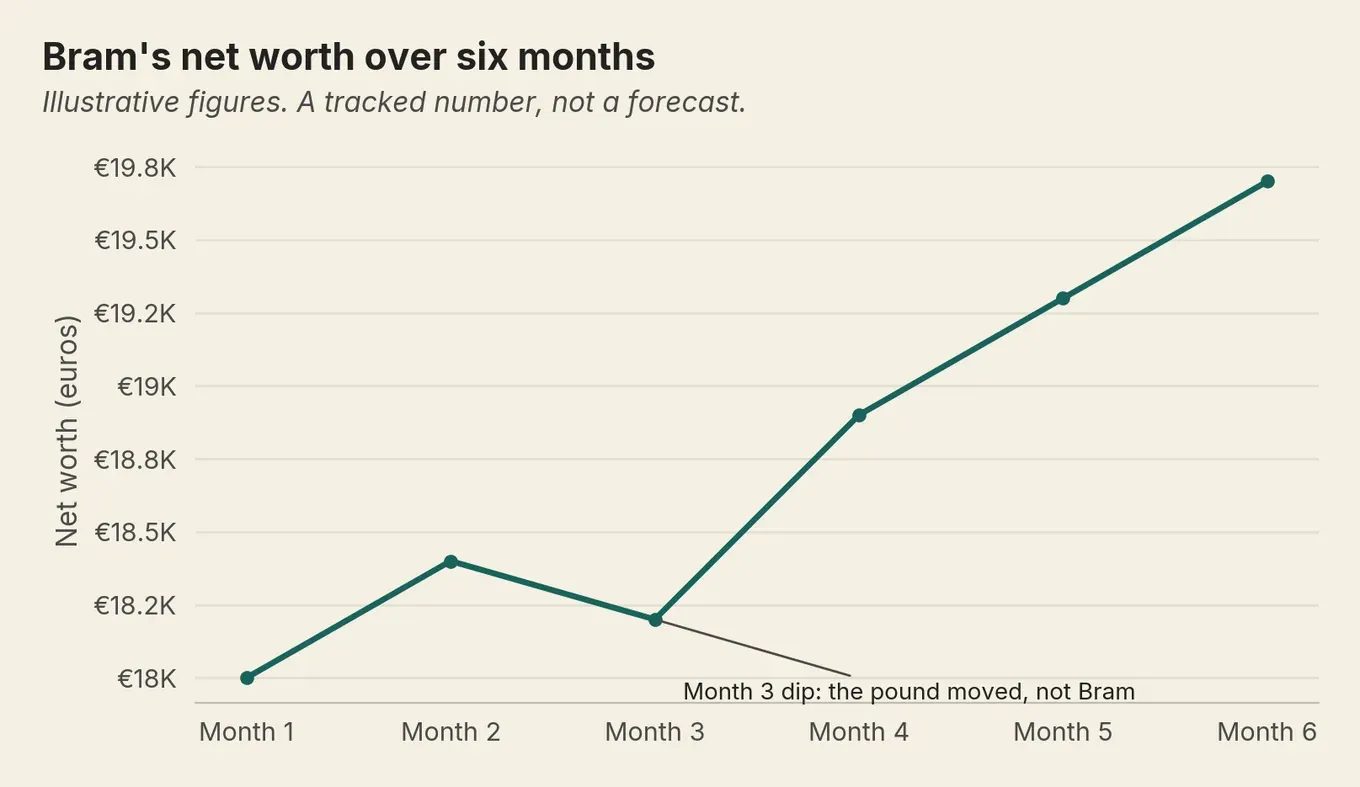
Here’s how that looks over time. Bram, 34, lives in the Netherlands and started tracking on the 1st of each month. (These figures are illustrative, and any tracked number can fall as well as rise.)
In month one his net worth was about €18,000. Month two it rose to about €18,400, because he’d saved a little. Then month three it slipped to about €18,200, and he nearly gave up. But he hadn’t overspent. The pound had simply moved against the euro that day, so his foreign savings were worth a touch less. Nothing he did was wrong.
He kept going. Same date, same rate source. Month four was about €18,900, month five about €19,300, month six about €19,700. Six months, six dots, one rising line.
Notice what Bram never did. He never looked up the “right” number for a 34-year-old. He just watched his own line bend the right way. That dip in month three would have scared him off if he’d checked it against a chart instead of against himself.
A few mistakes catch nearly all of us the first time. Here’s how to dodge them.
| The mistake | What to do instead |
|---|---|
| Counting your car at the price you paid | Count it at today’s resale value, which falls each year |
| Deciding multi-currency is too hard | Use one home currency, one rate source, one date |
| Panicking when the number drops | A currency-only dip isn’t overspending; the rate moved, nothing more |
| Adding your future state pension | Leave it out; there’s no pot to value |
| Comparing yourself to an age benchmark | Compare yourself to you last month, not to a chart |
That last mistake matters most. A month where only the exchange rate moved is neither a win nor a loss. It’s the rate doing rate things, which is exactly why the fixed date and the monthly rhythm keep your number fair.
It’s a dull routine, and the dullness is the point. Pick your home currency. Pick the 22nd, or the 1st, or whatever date you’ll reliably remember. Do the sum once. Come back in a month and do it again. In a year you’ll have a line worth looking at, and one less thing nagging at the back of your mind.
Frequently asked questions
Can my net worth be negative?
Does my pension count towards net worth?
How do you track net worth across different countries and currencies?
How often should you track your net worth?
What counts as a good net worth for my age?
Sources (10)
- CCPC (Ireland): Building your personal budget plan
- European Central Bank: Euro foreign exchange reference rates
- European Central Bank: Household Finance and Consumption Survey (HFCS)
- European Central Bank: HFCS research publications (2023 wave)
- Belastingdienst: Heffingsvrij vermogen (box 3 tax-free allowance)
- Belastingdienst: Berekening box 3-inkomen 2026
- Belastingdienst: Waarde en peildatum (box 3 vermogen)
- Agencia Tributaria: Modelo 720 procedure page
- Agencia Tributaria: Modelo 720 FAQ (50,000 EUR threshold)
- Central Statistics Office Ireland: Household Finance and Consumption Survey 2023, key findings
— That's the lot. It is now night.
Want more of this in your Google results?
Add Money Owl as a preferred source, and Google will show our finance pieces higher when you search for them.
By Jure Jaklič
Founder and editor of Money Owl. Data analyst by trade; personal finance learned first-hand across six European countries.
Recommended

How much should you have saved by 30, 40 and 50? The European answer
One year's salary by 30, three times by 40. That rule is American, and it assumes you fund half your own retirement yourself. Most of Europe already funds more, and most countries have a free government site where you can look yours up.

How to audit your spending and find where it went
A bank statement is a diary you didn't mean to keep. Here's how to read it back and find where the money actually went.

The 50/30/20 budget rule: a simple plan for European savers, and where it breaks
The 50/30/20 budget rule for European savers, explained plainly: how to split take-home pay, what a need is, and what to do when rent breaks the 50% ceiling.