

The point.
- Money and mental health run in two loops: worry harms sleep and clear thinking, and a tired mind handles money worse.
- You do not have to fix both at once. Ease either loop and the other one loosens too.
- For the body loop, hold a worry window earlier in the day, write tomorrow's one money job, and keep your balance off-limits in bed.
- For the money loop, automate steady bills off payday, build a small starter buffer, and hand scary creditor calls to a free debt service.
- Free help exists in your own country and costs nothing: call 112 in an emergency, 116 123 for a listening line, and your national free debt-advice service.
The point.
- Money and mental health run in two loops: worry harms sleep and clear thinking, and a tired mind handles money worse.
- You do not have to fix both at once. Ease either loop and the other one loosens too.
- For the body loop, hold a worry window earlier in the day, write tomorrow's one money job, and keep your balance off-limits in bed.
- For the money loop, automate steady bills off payday, build a small starter buffer, and hand scary creditor calls to a free debt service.
- Free help exists in your own country and costs nothing: call 112 in an emergency, 116 123 for a listening line, and your national free debt-advice service.
It’s 2am. You’re awake, doing sums in the dark, and the sums never come out right.
If that’s you, you’re not alone, and you’re not bad with money. Across the EU, almost 3 in 10 people could not pay a surprise bill from their own pocket in 2025, according to Eurostat (opens in new tab). A broken washing machine. A car that fails its test. One unlucky week. For anyone in that group, one bill tips the whole month over.
Money and mental health tie together. A money worry weighs on your mind, and a worried mind handles money worse. This guide shows you how they feed each other, and how to ease both at once. We keep it plain. The free help, in your own country, sits near the end, clearly marked. If things feel dark right now, skip ahead to that part first.
What is the link between money and mental health?
Money and mental health pull on each other in two loops. Money trouble sparks worry, bad sleep, and that 2am spiral. The tired, worried mind then handles money worse, which drags the money down further. Each loop feeds the other. The good news hides in that same fact: ease one loop, and the other one eases too.
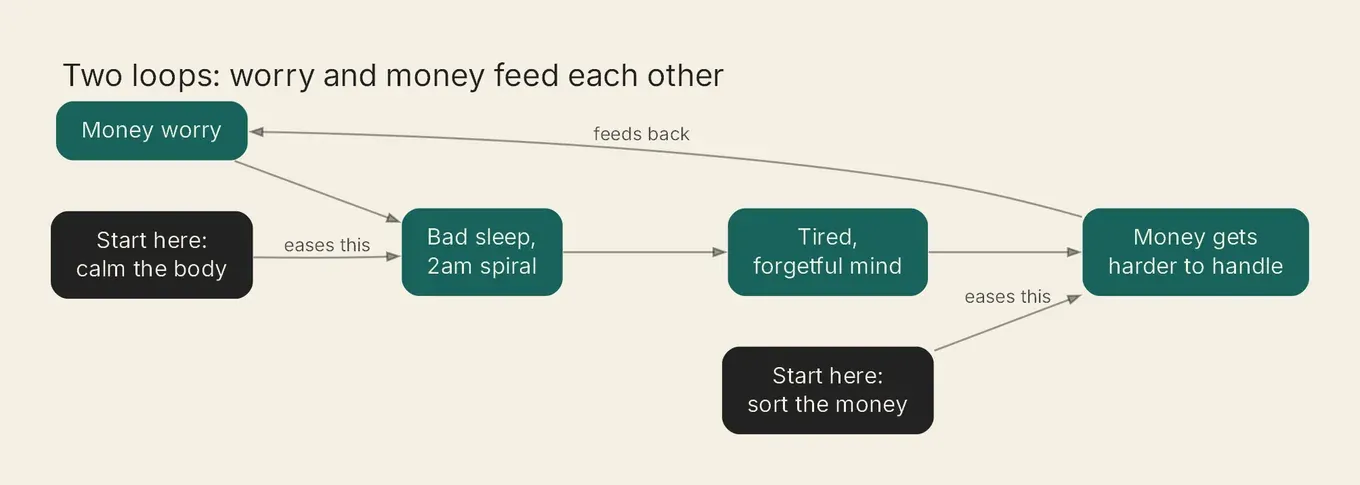
The people who study this for a living describe it the same way you feel it at 2am, as a loop you get stuck in.
“Poverty and poor mental health often create a vicious cycle that is hard to escape.”
Mark Rowland, Chief Executive, Mental Health Foundation (a UK mental-health charity)
So you don’t have to fix it all at once. You don’t have to clear all your debt before you deserve to feel better. You can start at the calm-your-body end, or at the sort-the-money end, and either one lifts pressure off the other.
Here are the signs the loop is running:
- You lie awake doing money sums.
- You leave bills unopened, or let calls ring out.
- Even small money decisions feel hard.
- You spend a bit to feel better, then feel worse.
- You feel tired, on edge, or forgetful most days.
None of that means you’re weak or lazy. It means the loop is turning. Below, we take each loop apart and pair it with one thing you can try.
How does financial stress affect your mind, sleep and body?
Start with the first loop, the one in your body.
When money runs tight, your body treats it like any other threat. Your heart speeds up. Your breathing goes shallow. Your alarm system, the same one that fires if a dog runs at you, switches on and stays on. Ireland’s health service, the HSE (opens in new tab), links money worry to anxiety, low mood, and trouble sleeping.
Then the worry goes round in a circle. The HSE (opens in new tab) describes anxiety as the same thoughts repeating, checking and rechecking, never landing. Call it the 2am money spiral. The same five worries, looping, getting you nowhere.
Lost sleep makes the next day harder. Sleep tidies your brain and readies it to think clearly. Lose it to worry, and tomorrow’s thinking starts weak. So tomorrow’s money decisions slip, which feeds you more to worry about tonight. Round it goes.
Can money worries harm your mental health?
Research links money strain to poor sleep and low mood, working through how you feel rather than as a one-button cause. The loop is real, not a sentence. It shapes the fixes below but never dooms you to a fixed outcome.
How do you stop worrying about money at night?
You can’t order a worried brain to stop. But you can give it somewhere else to put the worry, so it stops dumping it on you at bedtime. Here’s a sequence that works on the body loop:
- Hold a worry window earlier in the day. Pick 15 minutes after work, not at night. That’s when you let yourself think about money. The HSE (opens in new tab) suggests setting aside a fixed “worry time”. When the worry shows up at 11pm, you can tell it: not now, we did this at six.
- Write down tomorrow’s one money job, then close the app. Not ten jobs. One. “Ring the energy company.” The worry loops because it holds an open question. Write the answer down and the loop finds somewhere to rest.
- Set up a small starter buffer so “what if” gets an answer. Even a little money set aside changes the night-time question. Keep it somewhere you can reach in a hurry, like an easy-access savings pot. “What if the boiler dies and I have nothing” becomes “what if the boiler dies, well, I keep a bit put by”. Research from Nest Insight (opens in new tab) links a savings buffer to better sleep and less worry. You need the question answered, not thousands in the bank.
- Stop checking your balance in bed. Looking at your account at midnight feeds the spiral and changes nothing. The money stays there until morning, when you can act on it.
Here’s how that looks for one person.
Marta, 34, works in a hotel in Valencia. Her pay covers the month, just. But at 2am her brain runs the same loop: what if the car fails its test, what if there’s a bill she forgot. She dreads opening the banking app, so she stops looking, which makes the dread worse.
Her fix wasn’t more willpower. She picked one worry, the “what if something breaks”, and gave it an answer. She set aside €20 a week into a separate pot, automatically, the day after payday. After 50 weeks she had €1,000 sitting there. She also started writing tomorrow’s one money job on a sticky note, then closing the app.
The car still might fail. But now the 2am question has an address: “well, I keep a bit put by.” She sleeps more nights than she used to.
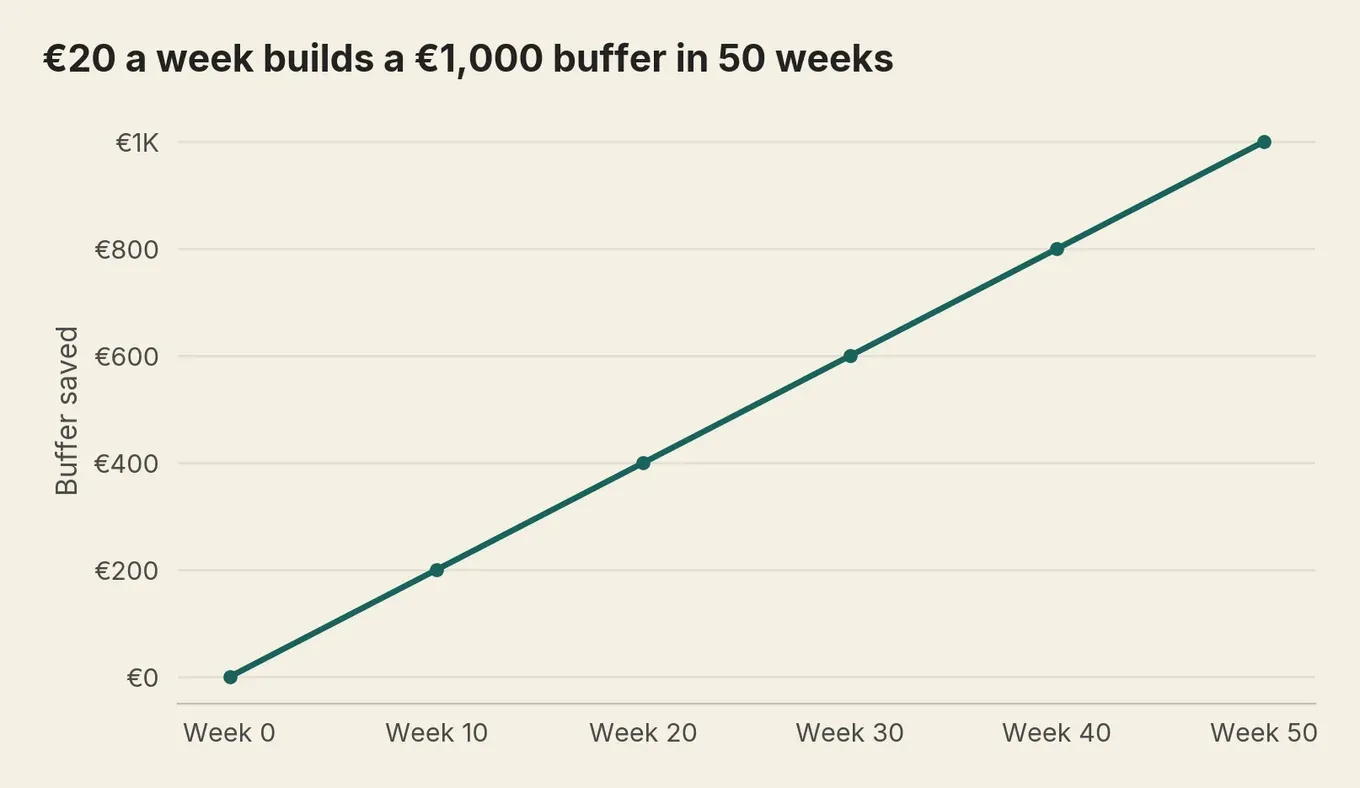
These don’t switch the worry off like a light. They give it a smaller, quieter place to live, so it stops running the whole night.
What if the worry still wins at night?
Some nights it wins anyway, and that breaks nobody’s rules. Try the slow-breath count, four in and six out, to settle the alarm system. If the dark thoughts turn heavy, ring a free listening line. The numbers sit further down this page.
How do you fix the money side so the worry has nothing to feed on?
Now the second loop, the money one. This part trips up most money advice.
When money runs tight, the worry doesn’t just sit in your chest. It eats room in your head. Researchers Sendhil Mullainathan and Eldar Shafir call this a tax on your mental bandwidth, the brainpower you need to think clearly. Their work, reported by Princeton (opens in new tab), found that money pressure saps attention and effort. Not because you try less. Because the worry already fills the seat where good decisions get made.
So “just budget harder” reaches for the wrong tool. You don’t need more willpower. You need fewer decisions. The four fixes below all work the same way: each one removes a decision or answers a “what if”, so your tired brain carries less.
The evidence backs this. A UK study cited by Nest Insight (opens in new tab) found that about £1,000 in easy-reach savings cut the chance of falling into problem debt by about 44%, so even a small pot earns its keep. Separate UK research, from the Money and Mental Health Policy Institute (opens in new tab), found about 4 in 10 people find phone calls distressing when they feel unwell, which explains why “just ring them” backfires.
That same UK study found people with mental-health problems are about three and a half times more likely to fall into serious debt, and nearly half of people in serious debt also carry a mental-health problem. Those are UK figures, not Europe-wide ones. But they show the loop is common, and it is no character flaw. You’re not the only one in it.
Should you automate the bills you can count on?
Yes. Set steady bills (rent or mortgage, energy, the rest) to leave your account the day after payday by direct debit. The money gets handled while you sleep, and one less daily decision means one less thing to dread. If your income jumps around, or a sudden income drop like redundancy is the worry gnawing at you, automate only what you know you can cover.
What goes in a one-page money plan?
One page holds three things: what comes in, what must go out (rent, food, energy first), and the one next job to do. That single sheet swaps a hundred small live decisions for one quick glance, so your tired brain carries less.
Why build a small buffer before clearing debt?
A buffer answers the “what if” that fuels the spiral. It turns “what if the boiler dies” into “well, I keep a bit put by”. Start with €20 a week, and keep it in an easy-access savings account you can reach the same day. The buffer stops one surprise bill becoming a crisis.
If you ever want to put a number on it, our emergency-fund calculator sizes one gently, no pressure.
How do you handle the scary creditor calls?
You hand them to a free debt-advice service. It builds a plan with you and makes the hard calls on your behalf, so the phone stops being a thing you dread. Asking for that help is the sensible move, not the white flag, and it costs nothing.
Which fix matches which worry?
Pair each worry with the fix that eases the loop it sits in. The table below maps the common night-time worries to the concrete money move that gives each one somewhere to go.
| What keeps you up | What eases it |
|---|---|
| Dreading opening the bills | Automate them off payday, so they happen without you looking |
| The 2am “what if” spiral | A small starter buffer that answers the “what if”, plus tomorrow’s one job written down |
| Avoiding the banking app | A 10-minute money check-in once a week, at a set time, low effort |
| Spending to feel better, then guilt | A tiny planned treat amount, so the urge has a sanctioned outlet |
| ”It is all a mess, where do I start” | One-page plan: in, out, one next step |
Here’s one of those fixes in action.
Bram, 41, drives a delivery van near Rotterdam. He takes home about €2,200 a month. The bills weren’t unaffordable, but deciding which to pay, and when, ate at him. Some he paid late out of dread. Then he’d spend a bit to feel better and feel worse after.
So he stopped deciding. He set his steady bills to leave the day after payday: rent €1,000, energy and water €250, phone and transport €200. That’s €1,450, handled while he sleeps. He also named a guilt-free amount, €50 a month, for whatever he likes. That left €700 for food and the rest.
Nothing got cheaper. But the bills stopped being a daily decision, and the treat stopped carrying guilt. The dread had less to feed on.
Where can you get free mental-health and money support in Europe?
If money worry has turned into thoughts of harming yourself, please talk to someone now, before reading on.
- In an emergency, anywhere in the EU, call 112. It’s free, works from any phone, across all EU countries.
- For emotional support, 116 123 reaches a listening line in many European countries. Free and confidential. In Ireland and the UK it reaches Samaritans (opens in new tab); in Germany it reaches TelefonSeelsorge (opens in new tab). Some countries run their own line too: Spain offers 024, France offers 3114.
Using a helpline is a normal, sensible move. It serves more than the worst cases.
For the money side, free and confidential debt advice exists in each Money Owl market. It’s not a loan and it never costs you a fee. A few examples:
- Ireland: MABS (opens in new tab), the free, State-funded Money Advice and Budgeting Service.
- Germany: Caritas Schuldnerberatung (opens in new tab), free and anonymous.
- France: Points conseil budget (opens in new tab), free and state-certified, with the Banque de France running the over-indebtedness route.
- Italy: the free over-indebtedness service via an OCC, explained by Banca d’Italia (opens in new tab).
- Netherlands: your local council’s free debt help (opens in new tab) (gemeente schuldhulpverlening), which must step in within three days in a threatening situation.
- Portugal: the free, state-recognised support network for over-indebted bank customers, RACE (opens in new tab), backed by the Banco de Portugal.
- Slovenia: free consumer advice via the Ministry of the Economy and the consumers’ association (opens in new tab).
- UK: StepChange (opens in new tab), free, confidential, and regulated.
Living somewhere not on this list? Start with 116 123 for the worry, and search your own government’s site for “free debt advice”. The point stays simple: help exists in your country, and it costs nothing.
So where should you start?
Two loops, one system. The worry feeds the money trouble, and the money trouble feeds the worry. You don’t have to break both at once.
If sleep wrecks you most, start at the body end: a worry window earlier in the day, tomorrow’s one job written down, balance off-limits in bed. If unopened bills weigh heaviest, start at the money end: automate what you count on, set aside a little, and let a free service make the scary call. Either way, the other loop loosens.
Nothing here is ambitious. That’s the whole point. Pick one small thing from this guide and do it this week. Come back for the next one when you feel ready. You’re doing better than you think.
Frequently asked questions
What is the link between money and mental health?
How does financial stress affect your mind, sleep and body?
How do you stop worrying about money at night?
Why does a small savings buffer help more than budgeting harder?
Where can you get free mental-health and money support in Europe?
Sources (17)
- HSE: Money worries and mental health
- HSE: Anxiety, signs, causes, tips and self-help
- Nest Insight: Financial resilience research programme
- Nest Insight: Workplace emergency savings research
- Money and Mental Health Policy Institute: The facts
- Eurostat: share unable to face unexpected financial expenses (ilc_mdes04, 2025)
- Princeton: Poor concentration, poverty reduces brainpower
- Samaritans: Contact us (116 123)
- TelefonSeelsorge Deutschland
- Citizens Information: MABS, the Money Advice and Budgeting Service
- Caritas: Schuldnerberatung (free debt advice)
- Solidarites.gouv.fr: Points conseil budget
- Banca d'Italia: Sovraindebitamento (over-indebtedness)
- Rijksoverheid: Schuldhulpverlening aanvragen
- RACE: free state support for over-indebted bank customers (Banco de Portugal)
- Government of Slovenia: Consumer protection
- StepChange: Free debt advice
— That's the lot. It is now night.
Want more of this in your Google results?
Add Money Owl as a preferred source, and Google will show our finance pieces higher when you search for them.
By Jure Jaklič
Founder and editor of Money Owl. Data analyst by trade; personal finance learned first-hand across six European countries.
Recommended

Loud budgeting: how to turn down plans you can't afford without shame
Someone's booked a hen weekend that costs a week's groceries. Loud budgeting is how you say no to it without sounding cheap, broke, or mean.
Mental accounting: why a euro from a refund spends differently
A euro is a euro, but your brain files it into pots and spends each by a different rulebook. Spot the pots quietly costing you, keep the ones that save you.

Scarcity vs abundance: what your money mindset does to your wealth
Your money mindset is real, just not the way Instagram swears. Real scarcity taxes your decisions, and manifestation is a sales funnel with a candle.