

The point.
- The magic of cash stuffing was never the envelopes, it was the friction; a tap feels like nothing, so it is the worst at making you stop.
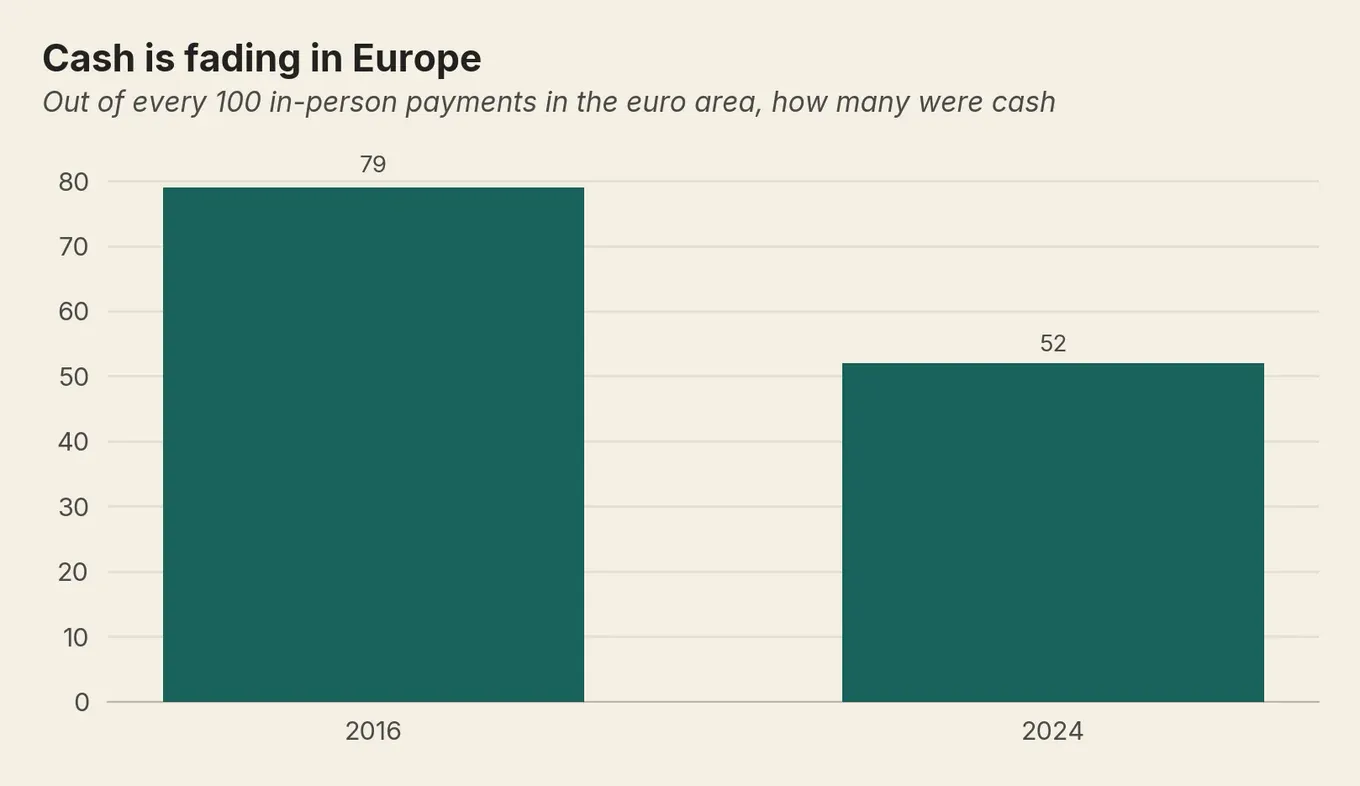
- Cash is fading fast: the ECB found cash was used for 52 of every 100 in-person euro-area payments in 2024, down from 79 in 2016.
- A digital bucket only acts as a real envelope when it has its own account number; a shared-balance pot shows zero but the card still works.
- Keep only this month's spending in physical cash; cash at home earns nothing and has no protection, while bank deposits are covered up to €100,000 per person per licensed bank under EU rules.
You tap your card. The thing is bought. And somehow it never feels like money left your account.
That feeling isn’t a flaw in you. It’s the whole point of a tap. The faster and smoother paying gets, the less it hurts. And the less it hurts, the more you spend.
So if you keep meaning to rein in your card spending and you keep not managing it, the card’s doing its job. You’re not failing at yours.
The envelope system is the old fix for exactly this. It roared back, mostly on TikTok, under the name cash stuffing. RTE reports the trend has racked up over 3 billion views on the app. So here’s the question for anyone living in Europe right now, the one in the title: does a method built on physical cash survive when cash is fading fast from everyday spending?
Short answer: yes. But only if you keep the one thing that made it work. And that thing was never the envelopes.
What is the cash envelope (cash stuffing) system, in plain terms?
The cash envelope budgeting system splits your monthly money into spending categories, gives each one a labelled envelope, and stops you spending in a category once its envelope is empty. In a mostly cashless Europe you can run it with real envelopes or with digital “pots” in a banking app. “Cash stuffing” is just the newer name for the same old method.
That’s the entire idea. You decide in advance how much each part of your life gets. You separate the money physically. When a pile’s gone, the shop’s closed for that thing until next month.
One quick thing to clear up first. Cash stuffing is a way to control spending, not a way to earn money. There’s a separate, much shadier “stuff envelopes for cash from home” gig that turns up in the same searches, and it’s almost always a scam. The method in this guide only moves your own money around. Nobody pays you to do it.
How does cash stuffing work, step by step?
The classic version runs in six small steps, and a 12-year-old could follow every one.
- Work out your monthly budget. Write down what comes in. Write down what has to go out.
- Split your spending into a few categories and give each a limit. Think groceries, transport, fun, eating out.
- Make one envelope per category and write its name on the front.
- Take out cash and put each category’s amount into its envelope. This is the “stuffing”.
- Spend only from the matching envelope. Buying food comes out of Groceries and nothing else.
- When an envelope is empty, you stop. Anything left at month end gets saved.
Here’s a real-money version. Say you give Groceries €300 for the month. Two weeks in, you’ve spent €220, so the envelope holds €80. That €80 is your grocery budget for the rest of the month, no matter how the big shop looks on Saturday. The envelope does the saying-no for you.
Step 6 is the secret. The empty envelope is a hard stop. The moment the cash runs out, you physically can’t spend more on that thing. You’re not leaning on willpower at the till. The money’s simply not in your hand.
Keep it simple. Start with four to six categories, not twenty. The strength of the method is that you can hold the whole thing in your head. Twenty tiny envelopes turns a clear plan into admin you’ll quietly abandon by week two.
Can you do the envelope system without cash (debit card or app)?
Yes. You don’t have to carry or hide cash to run this. Running the envelope system with a debit card works fine, because most banking apps now let you build the same structure on screen, by creating little labelled buckets of money. The catch is that not all of those buckets behave the same way, and that difference is the whole game.
A “pot”, “space”, “pocket”, or “sub-account” is the app version of an envelope: a labelled bucket of money inside your banking app. Some of these buckets are a truly separate pile of money, with their own account number. Others are just a label sitting on top of one big shared balance. The first kind can stop your card. The second kind can’t. Here are the four ways people go digital, weakest brake to strongest.
Do in-app pots like Revolut Pockets actually stop you?
Not really. Revolut calls its buckets Pockets (you may still see the older name, Vaults). They’re easy and they look exactly like envelopes: a row of named categories, each showing a balance. The problem is underneath. Revolut’s own help pages confirm that money in a Pocket sits inside your main account, and a Pocket doesn’t have its own account number. So when a Pocket reads zero, your card still works, because the card draws on the whole account, not the empty bucket.
That means a shared-balance pot gives you a clear view of your categories but no actual wall. The pot showing zero is a label, not a locked door. It’s great for seeing where your money goes. It’s weak at making you stop, because nothing physically stops you. You’ve got to stop yourself.
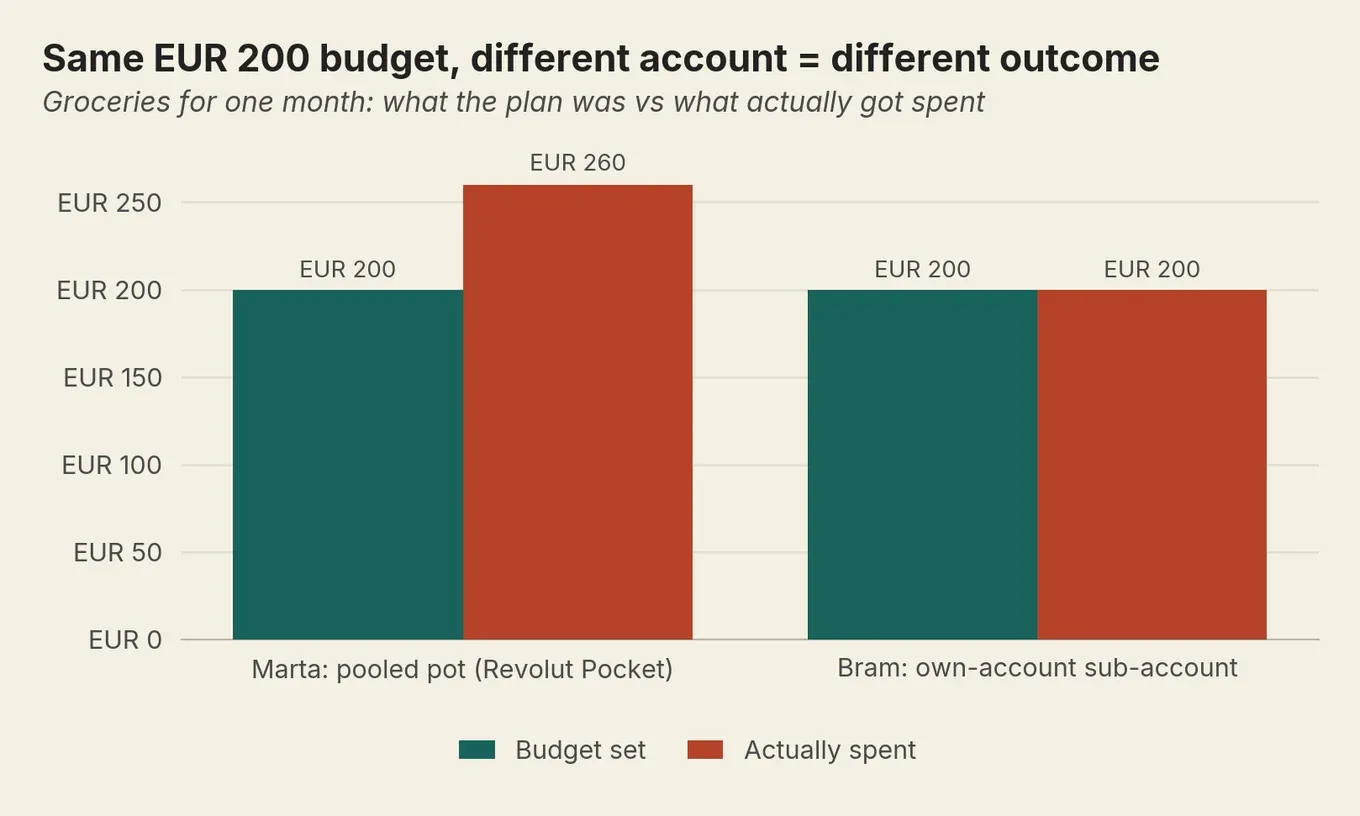
Take Marta in Valencia. She made a Groceries Pocket and moved €200 into it for the month. It looked exactly like an envelope. But the Pocket sat on top of her one big balance with no account number of its own, so when it hit €0 her card kept working, drawing on the whole account. She tapped through to €260 and finished €60 over. The pot gave her a view of her spending, not a wall.
Do bank sub-accounts (N26 Spaces, bunq) stop your card?
Yes. This is the version that behaves like a real envelope. A sub-account with its own account number (called an IBAN) is a genuinely separate pile of money. Tie a card to that pile and the card spends only that pile. Empty means empty.
N26 calls these Spaces. You can give a Space its own account number and link a card to it. bunq goes furthest: every sub-account comes with its own account number, and you can have a lot of them (bunq allows up to 25). With one of these, an empty bucket can decline the card outright, which is the closest a phone gets to the old empty-envelope hard stop.
Bram in Utrecht had the same plan as Marta and the same €200, but he put it in a sub-account with its own account number and linked a card to that pile only. On the 24th the sub-account hit €0 and his next €30 shop was simply declined at the till. No overdraft, no drama, just a card that wouldn’t go through. He finished the month exactly on €200. Same idea as Marta, same budget, opposite result. The only thing that changed was whether the money was truly walled off.
Can a virtual card work as an envelope?
Barely. A virtual card is a card number you create for a single category, often to keep online spending in its lane. It’s the most convenient option, and the most dangerous one for this particular job. Convenience is the enemy here. A tap is exactly the frictionless thing the method was built to slow down. And on a shared-balance pot, that virtual card still reaches the whole account anyway. Use it for tidiness, not for restraint.
Is a dedicated app like Goodbudget any better?
Sometimes. If you’d rather not switch banks, a dedicated digital cash stuffing app sits on top of the accounts you already have. Goodbudget is built directly on the envelope method and works in euros (it has no fixed currency, so euro amounts are fine). It syncs across your phone and the web, so a couple can share one budget. The free tier covers 10 everyday envelopes plus 10 savings ones. Worth one honest note: the paid plan is priced in US dollars, even though you do all your budgeting in euros. An app like this enforces categories more strictly than a normal bank app. But the same truth applies. Unless something genuinely declines the card, the final stop is still a decision you make.
Setting any of these up takes about four steps:
- Open the app and pick your envelope tool (a pot, space, sub-account, or dedicated app).
- Create one bucket per category and name it. In N26 you tap Spaces and add one called Groceries.
- Move this month’s money into each bucket. On payday, most apps can split it automatically.
- Spend each category from its own bucket, then check in once a month so the auto-splits don’t quietly drift out of date.
Does cash or digital envelope budgeting work better in a cashless Europe?
Time for the honest verdict, because no one else seems to give one. Cash works better at the one job most people come for, which is making themselves stop. Digital works better at almost everything else. Which matters more depends entirely on you.
Start with the backdrop, because it’s the reason the question even exists. Europe is going cashless, fast. The European Central Bank’s 2024 payments study (opens in new tab) found cash was used for 52 out of every 100 in-person payments in the euro area, down from 79 out of 100 back in 2016. Same survey, telling detail: people who like cash say one of its main advantages is that it makes them more aware of what they’re spending. The ECB’s own readers are telling it that cash hurts in a useful way.
That’s the friction insight, and it’s the spine of this whole article. The magic of cash stuffing was never the envelopes. It was the friction. Handing over real notes feels like something. A tap feels like nothing.
The research backs this up. A study from the Dutch central bank and the University of Groningen (Broekhoff and van der Cruijsen, 2024 (opens in new tab)) found that paying by card hurts less than paying by cash, and a contactless tap hurts the least of all. And the less a payment hurts, the worse it is at stopping you overspending. Two older studies, Raghubir and Srivastava in 2008 and Prelec and Simester in 2001, found the same shape: the less real the money feels, the more freely you spend it. The jury’s still out on whether any app can fully rebuild the sting of cash, so treat that as an open question, not a solved one.
Lay it out and the trade-off is plain. The easier a method makes paying, the worse it is at the only thing you wanted from it. That’s the whole decision in one line.
| Friction (does it stop you?) | Fees | Protection if lost | Ease in daily life | |
|---|---|---|---|---|
| Physical cash envelopes | Strongest: empty means stop | None | None if lost or stolen | Hardest: you carry cash |
| Shared-balance pot (Revolut Pockets) | Weak: pot says zero, card still works | None on the pot itself | Covered as a bank deposit, same as the rest of your balance there | Easiest |
| Own-account sub-account (N26 Space, bunq) | Strong: empty can decline the card | None on the sub-account itself | Covered as a bank deposit, same as the rest of your balance there | Easy |
| Dedicated app (Goodbudget) | Medium: enforces, rarely declines | Free tier, then paid | Money stays in your bank | Easy, but a second app |
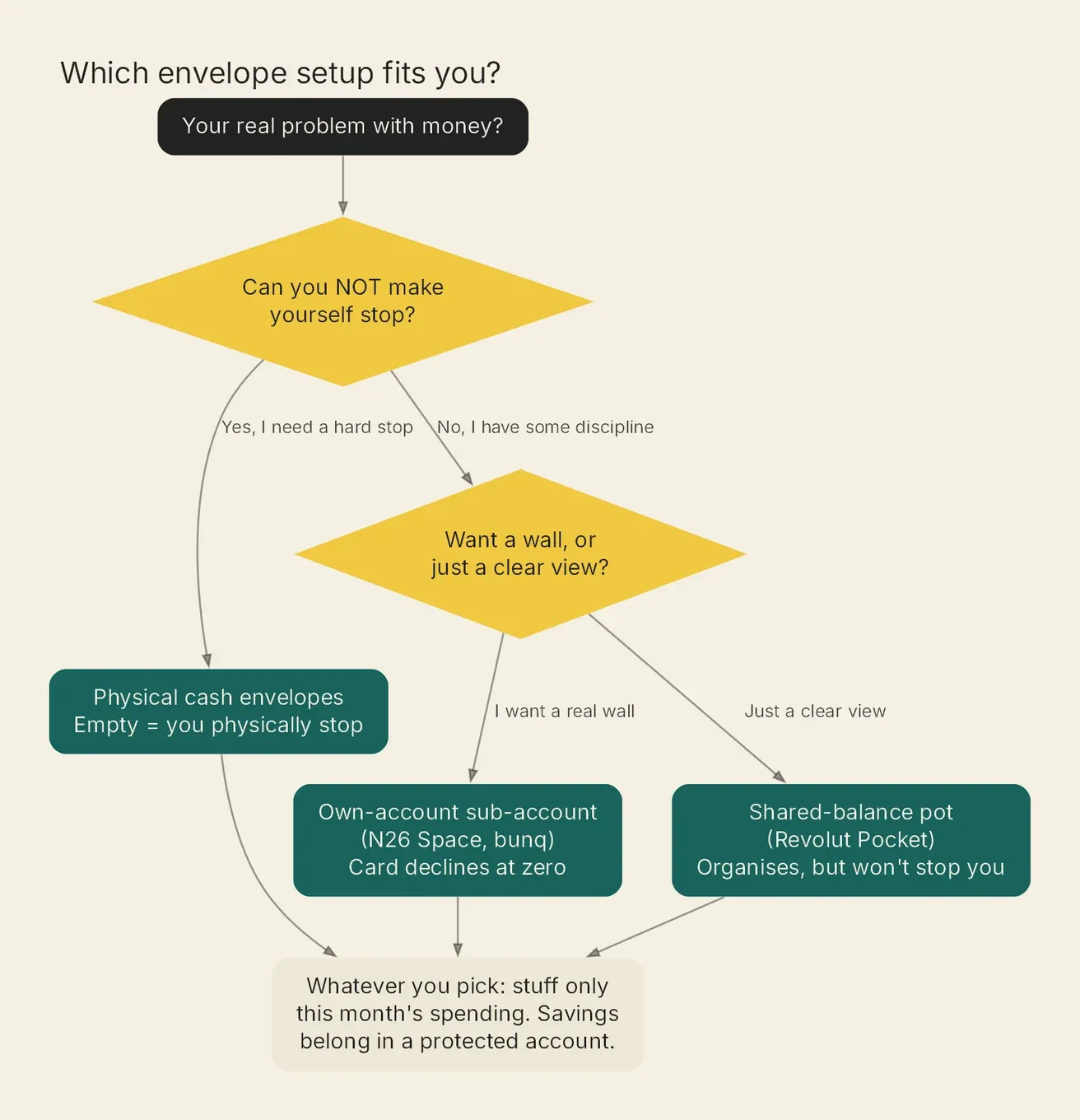
So: if your real problem is that you can’t make yourself stop, physical cash is still the strongest brake there is. If you mainly want structure and a clear view without carrying notes, an own-account sub-account gives you most of the brake with none of the cash. A shared-balance pot organises you but won’t stop you. A virtual card is the convenient option that quietly defeats the purpose.
One more real example, because the answer really is “it depends on you”. Sofia in Lisbon runs most of her budget in a euro-friendly envelope app, which handles her fixed bills fine. But her weekly market-and-coffee habit was where she always leaked money, so for that one category she went fully physical: €80 in a real envelope, €20 a week. By the middle of week three she was down to a single €5 note. A €12 lunch was out of reach, and there was no card to fall back on. So she waited for the next week’s €20. Digital structure everywhere, a physical brake on the one habit that needed it.
Is cash stuffing a good idea, and who does it suit?
For the right person, yes. The cash envelope budgeting system is one of the simplest budgeting methods going. For the wrong person, or done the wrong way, it can be fiddly or even risky. Here’s the clear-eyed version.
The good parts. Cash stuffing budgeting forces you to plan before you spend, it makes overspending visibly impossible in the cash version, and it needs no spreadsheet and no jargon. It suits people who overspend on cards and want a hard wall rather than another gentle nudge they’ll ignore.
The catches, and they’re real. A purely physical system can’t pay your online shopping, your subscriptions, or your direct debits, so almost everyone ends up with a hybrid: cash for in-person spending, the bank account for fixed bills. Decide in advance what happens when a category runs short, because a rigid system breaks the first time the car needs a tyre. The simplest fix is a small buffer envelope or pot you agree on up front.
One safety point matters more than the rest, and it’s non-negotiable. Cash kept at home earns nothing, and it’s got no protection if it goes missing or gets stolen. Money in a proper savings account is different: across the EU, deposits are protected up to €100,000 per person per licensed bank under EU deposit guarantee rules (opens in new tab). The same €100,000 figure applies in every euro-area country; only the scheme’s name changes. Cash in an envelope has none of that. So if you do the physical version, stuff only this month’s spending. Your savings belong somewhere they can grow and stay protected, which is a separate decision about where to put money for each goal, not in a kitchen drawer.
That’s the honest shape of it. Cash stuffing works in a cashless Europe, and you can absolutely run it from your phone. Just be clear about what you’re buying. Pots and sub-accounts give you the structure. Whether the brake comes too depends on whether the money’s genuinely walled off, or whether the wall is still just you. Pick the version that matches the job you truly need doing, set it up on a quiet Sunday, and check back in a month.
Frequently asked questions
What is the cash envelope (cash stuffing) system?
Can you do the envelope system without cash?
Does cash or digital envelope budgeting work better in a cashless Europe?
Why does a Revolut Pocket not stop your card at zero?
What protects cash kept at home versus money in a bank?
Does an N26 Space or bunq sub-account behave like a real envelope?
Sources (12)
- European Central Bank: Study on the payment attitudes of consumers in the euro area (SPACE) 2024
- European Commission: Deposit guarantee schemes
- Deposit Guarantee Scheme (Ireland): What We Cover
- Competition and Consumer Protection Commission: Budgeting resources
- RTE: Cash stuffing, the old-school budget trend returns
- Revolut: Meet Pockets, the next evolution of Vaults
- N26: Spaces, organize your money with sub-accounts
- bunq: Bank accounts (sub-accounts with own IBANs)
- Goodbudget: How It Works
- Broekhoff & van der Cruijsen (2024), De Nederlandsche Bank and University of Groningen: Paying in a blink of an eye, it hurts less but you spend more
- Raghubir & Srivastava (2008), Journal of Experimental Psychology Applied: Monopoly money, the effect of payment coupling and form on spending behavior
- Prelec & Simester (2001), Marketing Letters: Always leave home without it, a further investigation of the credit-card effect on willingness to pay
— That's the lot. It is now night.
Want more of this in your Google results?
Add Money Owl as a preferred source, and Google will show our finance pieces higher when you search for them.
By Jure Jaklič
Founder and editor of Money Owl. Data analyst by trade; personal finance learned first-hand across six European countries.
Recommended

How to audit your spending and find where it went
A bank statement is a diary you didn't mean to keep. Here's how to read it back and find where the money actually went.

Loud budgeting: how to turn down plans you can't afford without shame
Someone's booked a hen weekend that costs a week's groceries. Loud budgeting is how you say no to it without sounding cheap, broke, or mean.
Why you can't save money (it was never willpower)
You keep failing the willpower test because it was never a willpower test. Change the set-up, automate one transfer, and saving happens without you.