

The point.
- Loud budgeting works when you name a specific limit, not a grand new identity like "I'm a saver now".
- Saying the money reason plainly loosens the shame that secrecy feeds on.
- Voicing your limit tells the room they're probably not the only one who can't.
- Rehearse one line, repeat it under pressure, and offer a cheaper plan instead of a defence.
- With a boss or a landlord, a quiet no beats a loud one.
Someone in the group chat has booked a hen weekend in Lisbon. Flights, an apartment, a boat trip, three dinners. The total lands somewhere near €600 before you’ve bought a single coffee, and your bank balance is already shaking its head. So you do what most of us do. You go quiet for a bit, then you find a reason: a work thing, a family thing, a vague thing that’s technically true. Anything except the real reason, which is that you can’t afford it and would rather not say so out loud.
That silence is what loud budgeting is trying to fix. Not the €600. The going-quiet part.
Loud budgeting means naming your spending limit out loud instead of hiding behind a vague excuse: telling friends in Dublin or Berlin “that’s out of my budget this month, so I’ll skip the trip” rather than inventing a reason you’re busy.
Below are the words that work, sorted by the situation you’re dreading, plus the plain reason each one lands. First, the bit everyone skips: why saying it beats hiding it, and the one way of doing it that quietly backfires.
What is loud budgeting, and why is everyone doing it out loud?
Loud budgeting is refusing to spend money you’ve decided not to spend, and saying the money part out loud instead of dressing it up. The name is new; the behaviour is old. The term itself came from the TikTok comedian Lukas Battle (opens in new tab), who dropped it into an “ins and outs” list for 2024 in late 2023, half as a joke. It stuck. Gen Z turned it into a trend. If quiet luxury was the art of spending so discreetly nobody clocked the price tag, loud budgeting is the opposite instinct: name the price out loud, then walk past it. The pressure underneath it is real, and it doesn’t stop at any one border.
Across 20 European countries, 31% of Gen Z say chasing influencer lifestyles has tipped them into debt, and more than half say their mental health has got worse, according to the credit-management firm Intrum (opens in new tab). It’s the same pull that has you buying things you don’t need whenever the feed is full of people who seem to afford everything.
The easy yes has never been easier, either. In Germany, nearly half of all new instalment loans are now for under €1,000, a shift SCHUFA (opens in new tab), the country’s credit bureau, puts down to buy-now-pay-later at the checkout. It isn’t only the young reaching for it. But a one-tap “pay in 3” is built to remove exactly the friction that saying “no thanks” puts back.
There’s an upside the gloomy version misses. Euro-area households still tuck away roughly 14 cents of every euro they take home, according to Eurostat (opens in new tab). Skip a €50 round, and that money quietly slips into the buffer doing its job.
Why does saying your limit out loud beat hiding it?
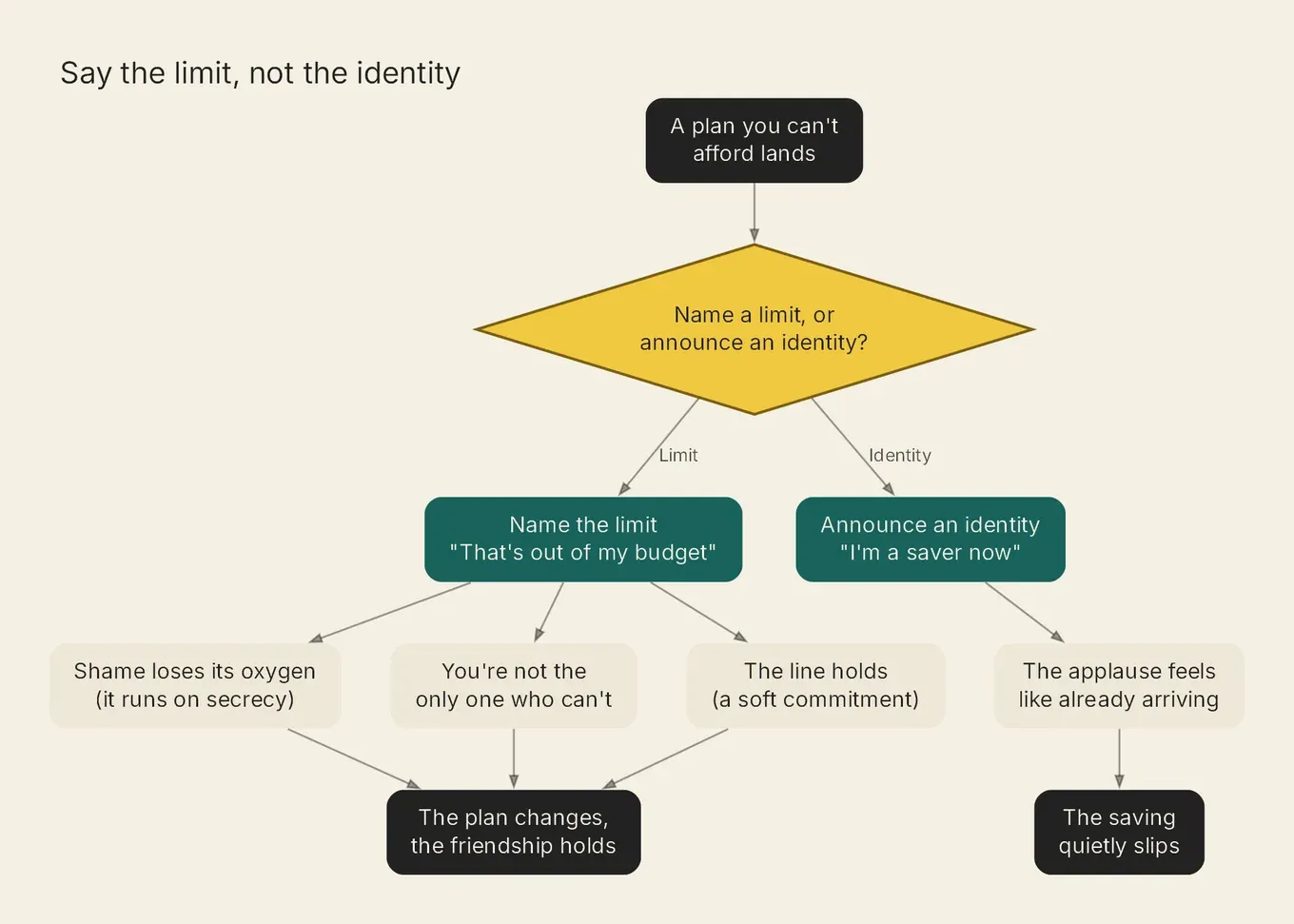
Because the shame that makes you hide runs on secrecy, and a stated limit does three jobs a silent one can’t. It takes the shame’s power away. The room learns you’re not the only one who can’t. And the decision locks in before anyone can talk you round. Part of the payoff isn’t even the euros: feeling in control of your money (opens in new tab) tracks how positively people rate their whole life, roughly whatever they earn.
The UK debt charity StepChange makes the same case for saying the quiet part out loud:
Money remains one of society’s most closed-off topics, yet open conversations can make a huge difference for anyone struggling.
Vikki Brownridge, Chief Executive, StepChange Debt Charity (StepChange, 16 March 2026 (opens in new tab))
Why does saying it kill the shame?
Because shame runs on secrecy. It convinces you that you’re the only one, and that people will think less of you if they knew. Said out loud, it has nothing to work with.
Money trouble is one of the most hidden things there is. People stay quiet about it mostly out of embarrassment, and that silence grinds them down and strains the people close to them, as the Money and Mental Health Policy Institute (opens in new tab) has spelled out. One line worth drawing, though: turning down a pricey weekend is one thing, and debt you genuinely can’t manage is another. If it’s the second, loud budgeting isn’t a substitute for real help; a free, confidential debt-advice service in your country, often run by a charity or consumer body, is where to start. “That’s out of my budget this month” is a boring sentence, and boring is the one thing shame can’t feed on.
Are you the only one who can’t?
Almost never. Most of us carry a private limit we assume nobody else shares. At a table working out how much to spend, half the room may be hoping someone else calls the plan too dear before they have to.
In the study that named this gap (opens in new tab), students each thought they were far more uncomfortable with the group’s drinking than the people around them, a misread that held even among close friends. Say the true thing, and you’re not the killjoy. You’re the one who let everyone else off the hook. The pressure is more about perception than reality, too: a recent working paper (opens in new tab) reports that what your friends spend nudges your own spending only a little, while what you believe about how you compare drives how you feel.
Why does a stated number stick?
Because a voiced refusal behaves like a small promise to yourself, weighted by a bit of social pressure. Decide the line before the moment arrives and it holds far better than one you improvise on the spot.
Behavioural economists call a stated, in-the-moment refusal a soft commitment device (opens in new tab). Deciding your line in advance helps even more: people who pre-plan a specific “if this comes up, I’ll say that” response (opens in new tab) follow through far more reliably, across 94 separate tests. The line works because you set it before the pressure showed up.
But don’t announce a whole new identity
This is where the trend gets it wrong, and it matters more than any script. Saying a specific limit works. Announcing a grand new identity doesn’t. When people go public with an aspirational goal that feels like who they want to be, the applause does something sneaky: it hands them a premature sense of already being that person, and the effort slips. Psychologists showed this with public goals (opens in new tab), and later work found the same backfire in related settings (opens in new tab). “I’m keeping this month to €50 on nights out” is a limit. “I’m a saver now” is an identity. Post the second one, and the likes can quietly stand in for the saving itself. Say the number, not the label.
Try this version of the same moment. Four friends in Berlin are planning a long weekend in the mountains. The link lands in the chat: a four-day package at, say, €240 each, flights included. Checkout offers to break that into three payments of €80, one now and one each of the next two months, so today it barely touches your account.
You could tap it and dodge the conversation. Or you could put the number in the chat before anyone books anything: “I can do €150 for this, not the flights-included version, count me in for whatever gets us there for that.” Not a lecture. Not “I’m being careful with money now.” Just the number.
Within the hour, two other people in the chat say the same figure. The organiser finds a self-catered version for €150 instead. Nobody signs up for three months of instalments on a long weekend, and nobody drops out either.
That is the difference between naming a limit and announcing an identity. The limit changed the plan. An identity would only have changed how you felt about not going.
It doesn’t always land that neatly. Sometimes the group books the pricier version regardless, and you’re the one sitting it out. That’s a real cost, and pretending otherwise would be its own small dishonesty. But saying your line still beats going quiet and resenting the whole thing later. Miss the trip if you have to. Missing it in silence, then stewing for a fortnight, is the worse of the two.
Which words work, scenario by scenario?
Enough theory. Here’s the part you came for: loud budgeting examples for the invitations you dread. Every line below is short on purpose, a way to say no to plans you can’t afford. It names a limit and skips the lecture. The door stays open. Find the one that fits and say it once. Then fight the urge to explain the maths behind it.
| Scenario | What you can say | Why it works |
|---|---|---|
| A destination wedding or hen or stag abroad | ”I can’t stretch to the trip this year, but I’d love to take you out when you’re back.” | Names the limit and protects the friendship with a cheaper yes, no figures shared. |
| A group dinner split evenly down the middle | ”I’m going to order light and pay for my own tonight, if that’s alright.” | Sets the boundary before the bill lands, when it’s easy to say and hard to argue with. |
| Buying rounds at the bar | ”I’m out after this one, so I’ll get my own from here.” | Steps out of the round economy without moralising; a clear limit, stated early. |
| A workplace leaving-collection or group gift | ”I’ll put €5 in this time, money’s a bit tight this month.” | Honest, small and specific; ends the awkward “how much is everyone giving” spiral. |
| A pricey group holiday | ”That’s over my budget for this year. Count me in for the local weekend instead.” | Declines the big spend, keeps you in the group with a smaller plan. |
| Family gift expectations | ”Can we set a limit this year? I’d rather a €10 gift and a good coffee than a pile of stuff.” | Reframes the whole group’s spending down, so no single person looks cheap. |
| Dating on a tight month | ”I’m doing cheap dates this month, fancy the park-and-coffee version?” | States the constraint as a plan, not an apology, and invites rather than cancels. |
The words change by country, the limit doesn’t
The psychology travels; the exact words don’t. A flat “nee” or “nein” reads as honest in the Netherlands or Germany, where a plain no is taken as a plain no. In Spain, Italy or Portugal the same refusal often needs a warmer wrap, so it lands as “I’d love to, but not this month” rather than a bare no. France leans more formal again. It’s the same boundary each time, just wearing a different scarf.
What if they push back?
Some people will push. Not out of malice, mostly out of habit, because a refusal breaks the easy rhythm of everyone saying yes. The trick is to not reopen the negotiation. You’ve said your line. Say it again, nearly word for word, and add nothing new. The second you start justifying the number, you’ve handed over things to argue with. A boundary is a sentence, not a debate.
If it helps, pair the no with a smaller yes. “I can’t do the dinner, but I’m in for the walk after” keeps the friendship and drops the cost. That’s the whole move: hold on to the person, let go of the expense.
When is a quiet no the smarter move?
With a boss, a client, or a landlord, spelling out your budget carries a real risk. That’s when the quiet no wins: a plain “I can’t make that one,” with no money reason attached, is the safer play. The same can hold closer to home: if a partner controls the money or watches it closely, being open about a private limit, or a bit of quiet saving, may not be safe, so the quiet no belongs in that room too.
Loud budgeting is for the rooms where honesty is free. Keep the quiet version for the rooms where it isn’t.
So is loud budgeting real, or just a TikTok thing?
It’s real, with one condition: it works when you name the limit, and it does much less when you turn it into a personality. The pressure it answers is documented right across Europe, as the Intrum numbers above show. For the cleanest counts of people refusing plans, though, you have to look outside the euro area, so treat them as a signal rather than a European average. In the UK, 68% of Gen Z adults have turned down a social plan for money reasons, half of them to save, according to research cited by the consumer group Which? (opens in new tab). In the US, 42% of Gen Z now say they’re comfortable admitting they can’t afford something, up from 38% two years earlier, in Bank of America’s own research (opens in new tab). Every one of those figures points the same way.
A few worries stop most people trying it. One is that loud budgeting is just being cheap, or worse, preachy about how other people spend. It isn’t, as long as you keep it to your own limit. You’re not auditing anyone’s choices; you’re stating yours, which quietly gives everyone else permission to state theirs.
Another is that you have to overshare, and announce your salary, your debts, your exact budget. You don’t. The limit you say out loud, “I can do €150 for this”, is a ceiling for one plan, not a readout of your salary, your debts, or what sits in your account. You share the line, not your finances. “That’s out of my budget this month” is already a complete sentence. The numbers behind it stay yours.
And the last worry: it’s a Gen Z fad that won’t suit anyone a bit older. The label is young, but the psychology behind it is decades old. If you’ve ever quietly dreaded a bill, this is for you too.
None of this replaces a real budget. The limit you say out loud has to come from somewhere real: a rough plan for where your money goes and which pots it sits in, so the number isn’t plucked from the air.
Get that roughly right, and the next Lisbon hen weekend in the group chat stops being a small crisis. You’ll already know your line. You say it, and you’re still there for the coffee afterwards.
Frequently asked questions
What is loud budgeting?
Why does saying your limit out loud beat hiding it?
What if they push back?
Is loud budgeting real, or just a TikTok thing?
Sources (15)
- Intrum: European Consumer Payment Report, Gen Z debt and social pressure
- SCHUFA: Risiko- und Kredit-Kompass 2024, buy now pay later growth
- Eurostat: Euro area household saving rate, Q4 2025
- Frontiers in Psychology: Financial control and subjective wellbeing, 2025
- StepChange Debt Charity: Problem debt is still a well-kept secret, 16 March 2026
- Money and Mental Health Policy Institute: Breaking the debt taboo
- Prentice and Miller (1993), pluralistic ignorance and drinking norms, PubMed
- NBER Working Paper 32107, peer spending and social comparison
- Bryan, Karlan and Nelson (2010), commitment devices, Annual Review of Economics
- Gollwitzer and Sheeran, implementation intentions meta-analysis, University of Konstanz
- Gollwitzer and colleagues (2009), public goal announcements, Psychological Science
- Susewind and Walkowitz (2020), corroboration of public-goal effects in a related setting, PMC
- Which?: Should you try loud budgeting
- Bank of America research on Gen Z spending habits, via Fox Business
- CNBC on the origin of the loud budgeting trend (Lukas Battle, late 2023)
— That's the lot. It is now night.
Want more of this in your Google results?
Add Money Owl as a preferred source, and Google will show our finance pieces higher when you search for them.
By Jure Jaklič
Founder and editor of Money Owl. Data analyst by trade; personal finance learned first-hand across six European countries.
Recommended

The psychology of spending: why we buy things we don't need
A €200 jacket split into four payments reads to your brain as €50. The psychology of spending, and how to put the brake back.

Mental accounting: why a euro from a refund spends differently
A euro is a euro, but your brain files it into pots and spends each by a different rulebook. Spot the pots quietly costing you, keep the ones that save you.

Financial therapy: what it is, and who it's for
Financial therapy treats your relationship with money, not the money. Who it helps, what it costs in Europe, whether it works, and how to find a real one.