

The point.
- Saving fails because of your set-up, not your character: spending is one tap away while saving needs a fresh decision every single month.
- Present bias is only the impulse half of the problem; the structural half is the environment built around the decision.
- Same brains, different systems: in 2024 German households saved 20.0% of income and the EU averaged 14.5%, while Greece ran a negative saving rate (Eurostat).
- Defaults beat willpower: auto-enrolment made most new hires savers by default, and Save More Tomorrow lifted the average saving rate from 3.5% to 13.6% across four pay rises.
- Pay yourself first: open a separate savings account and set a standing order for the day after payday, so saving happens before the rest of life reaches the money.
- Identity follows the plumbing: once the transfer runs on its own, you are simply a person who saves. Change one setting, not your personality.
The point.
- Saving fails because of your set-up, not your character: spending is one tap away while saving needs a fresh decision every single month.
- Present bias is only the impulse half of the problem; the structural half is the environment built around the decision.
- Same brains, different systems: in 2024 German households saved 20.0% of income and the EU averaged 14.5%, while Greece ran a negative saving rate (Eurostat).
- Defaults beat willpower: auto-enrolment made most new hires savers by default, and Save More Tomorrow lifted the average saving rate from 3.5% to 13.6% across four pay rises.
- Pay yourself first: open a separate savings account and set a standing order for the day after payday, so saving happens before the rest of life reaches the money.
- Identity follows the plumbing: once the transfer runs on its own, you are simply a person who saves. Change one setting, not your personality.
You keep meaning to save. You’ve meant to for years.
Every pay rise, every January, every time the balance creeps back towards zero, the same small voice turns up: what is wrong with me? Other people manage it. You’ve read the tips. You’ve tried the budget, the app, the heroic no-spend month. It holds for six weeks, then it doesn’t, and the money leaves again.
Here’s the part nobody prints on the front of the leaflet. The problem was never you. It was the set-up. You’ve been told for years that saving is a test of character, you keep failing the test, so you’ve decided you must be the kind of person who can’t save. You’re not. You’re a normal person standing inside a system built to move money in one direction, and it isn’t towards the savings account.
The psychology of saving money, boiled right down, is mostly about how your money is set up to move by default. Change the set-up and the character question quietly evaporates. That part is fixable. Plumbing normally is.
Why can’t you save money?
You can’t save because saving asks for a fresh decision every time, while everything around you makes spending the default. Contactless, one tap, subscriptions that renew whether you meant them to or not. Spending happens by itself. Saving is the thing you keep having to choose.
That gap is the whole problem. Spending is now nearly frictionless; saving still takes a deliberate act, and then another one next month. When one side of the scale is effortless and the other needs a decision every single time, the effortless side wins. Weakness has nothing to do with it. That’s what happens to anyone standing on that scale.
Take Marta, 31, renting in Valencia. Her rent has climbed €190 a month over two years; her pay has gone up once, and not by much. She isn’t reckless. She lives inside a current account where the money is always one tap from gone, and saving is the bit she has to remember to do, on top of everything else. Millions of people are Marta right now. That is not a personality flaw held by millions at once.
Some of this comes down to present bias, your brain giving far more weight to money now than money later. That’s real, and it’s the impulse-control half of the story. We’ve written that playbook separately, so if the pull to spend right now is your main enemy, learn to delay gratification first.
This piece covers the other half: the structure around the decision. You can hold iron willpower and still lose if the set-up is against you. And if you want to see where the money escapes, the quiet monthly leaks are often subscriptions you forgot you signed up to.
If you want the short, structural version of why saving fails, it’s this:
- Your default is to spend, and nothing automatic pulls money the other way.
- There’s no separate pot, so “savings” is just money you haven’t spent yet.
- The transfer, if it exists at all, depends on you remembering, every month.
- Your whole environment is built for spending, from the one-tap checkout to the auto-renewing subscription.
- You’ve been handed willpower as the only tool, when the real fix is changing the set-up.
None of those is a flaw in you. They’re settings, and settings can be changed. This is a plumbing problem, not a willpower problem.
Same brains, different systems
Here’s the evidence. Change the system around people, and the same people save completely differently.
Why do saving rates differ so much across Europe?
Because the systems differ. The people are much the same. In 2024 German households saved 20.0% of their income, the highest rate in the EU. Spanish households saved 12.7%, Portuguese households 12.5%, Italian households 11.2%, and the EU average sat at 14.5% (Eurostat (opens in new tab)). In Greece the rate was negative: households spent more than they took in.
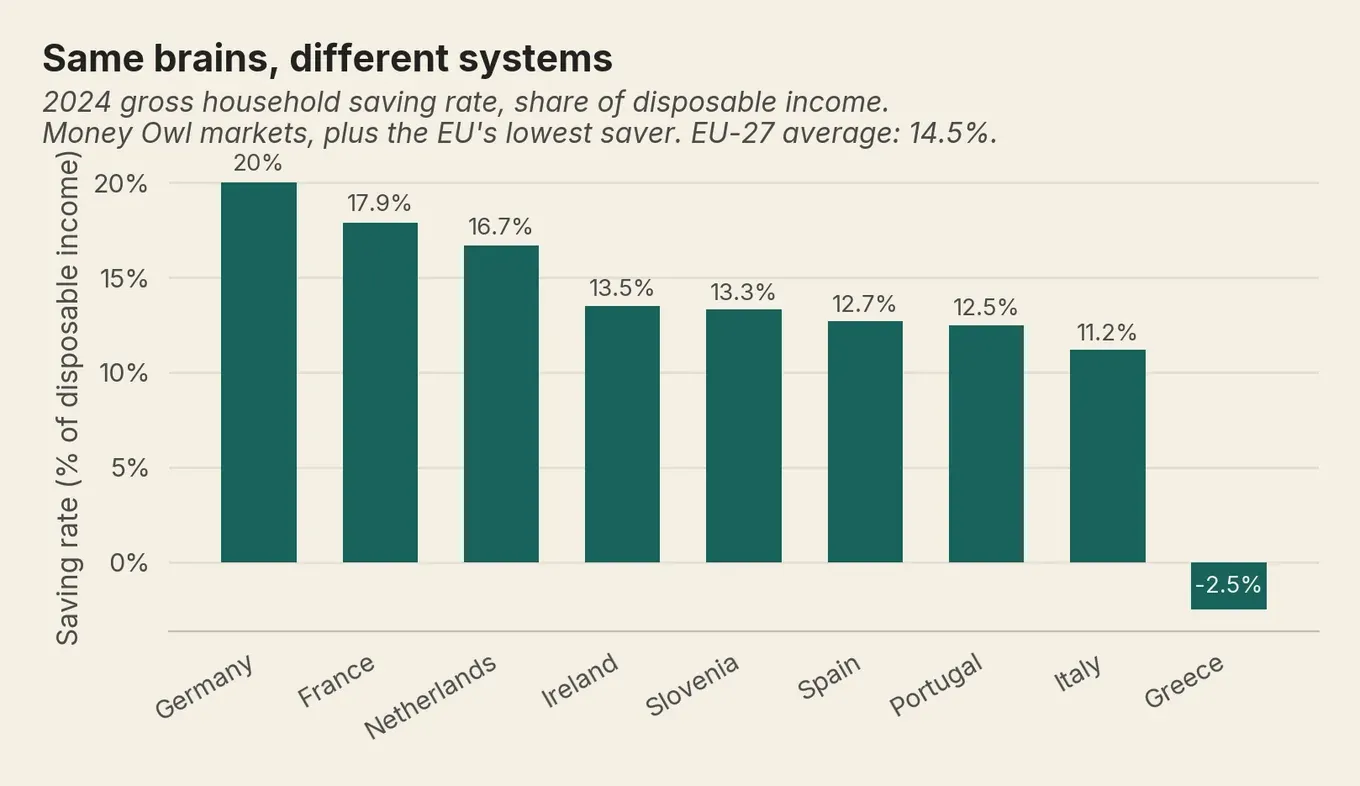
Nobody seriously thinks Germans are born more disciplined than Greeks. The difference comes down to the machinery: incomes, housing costs, tax breaks, pension schemes, and the defaults each system sets in the background. Most of that spread is incomes and the cost of living, which no individual can rewrite; the defaults and the design are the one part you can, and that’s where the rest of this goes.
What happens when you change the default?
When one US employer switched its workplace pension from opt-in, where you have to join, to automatic, where you’re in unless you opt out, participation jumped from 37.4% to 85.9% (Madrian and Shea, NBER (opens in new tab)). Same company, comparable new hires: the researchers compared two intakes at a matched stretch of tenure, one hired just before the switch and one just after. The only thing that changed was the default, the thing that happens when you do nothing.
Company-wide, participation went from 61% to a projected 86%, and not one of the people it swept in grew a stronger character to manage it. Willpower didn’t move. The set-up did, and behaviour followed.
But isn’t it about willpower?
Even willpower is mostly the set-up. The famous marshmallow test, where children who waited for a second marshmallow supposedly did better in life, got a careful re-run in 2018. Once you accounted for the child’s home, family background and early cognitive ability, about two-thirds of the effect vanished (Watts and colleagues (opens in new tab), whose re-run focused on children whose mothers had not finished college). Self-control turns out to be far less fixed than the story goes. So even the thing you’ve been blaming was mostly your circumstances wearing a costume.
How do you make saving the default?
You make saving the default by arranging things so it happens automatically, and you’d have to act to stop it. Governments proved this works at national scale with pensions, and in a minute you’ll run the same trick on your own everyday cash. First, the proof. They flipped the pension default from opt-in to opt-out, and left the choice fully intact.
Auto-enrolment: a whole country flips the default
The clearest proof runs at national scale. From 1 January 2026, Ireland made pension saving the opt-out option: eligible employees who aren’t already in a workplace pension are enrolled by default, though anyone can still opt out (gov.ie (opens in new tab)). The money is stacked to make staying worth it. For every €3 you put in, your employer adds €3 and the State adds €1, so €3 becomes €7. Next door, the UK has run the same opt-out experiment since 2012 with the same result: only about one in ten eligible workers opts out (House of Commons Library (opens in new tab)).
Read that opt-out design again, because the trick is hiding in it. Saving is the thing that happens on its own. Not saving is the thing that takes effort and paperwork. That single reversal explains why auto-enrolment works where “please try to save more” never did.
The regulator that runs the UK scheme states the mechanism flatly:
A jobholder has the right to opt out of pension scheme membership, but cannot opt out of automatic enrolment.
The Pensions Regulator, “Automatic enrolment: an explanation of the automatic enrolment process” (opens in new tab).
Save More Tomorrow: saving that grows with your pay
A gentler version of the same idea exists, and it’s a good one to steal for yourself. In a programme called Save More Tomorrow, workers agreed in advance to put a bigger slice of each future pay rise into savings (Thaler and Benartzi, JPE (opens in new tab)). Because each increase was tied to a raise, take-home pay never fell, so it never felt like a cut. Their average saving rate climbed from 3.5% to 13.6% across four pay rises. 78% signed up, and 80% were still in it after the fourth raise.
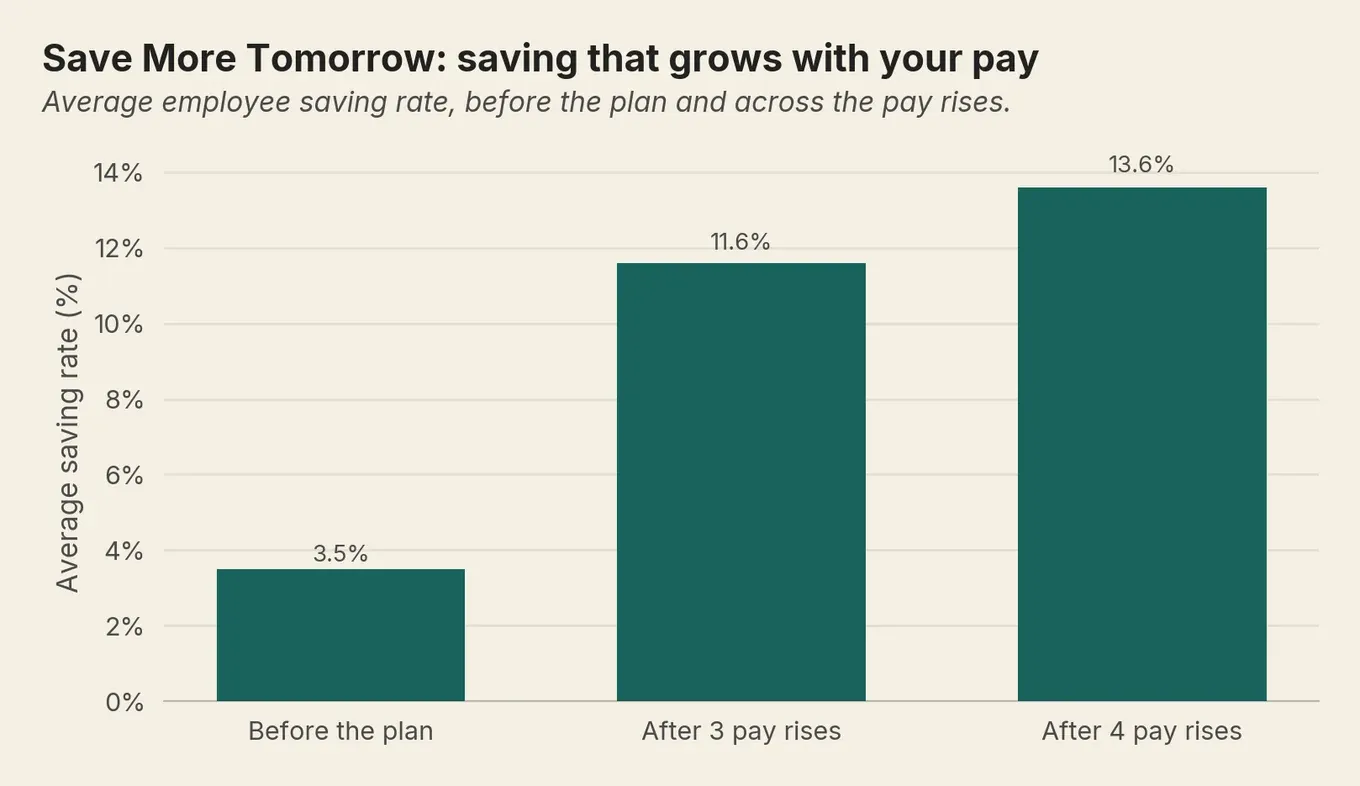
Nobody in that study was asked to be more disciplined. They were asked, once, to schedule their later self to save. Then inertia, the usual villain of this whole story, worked in their favour for a change.
The authors draw the wider lesson:
The results suggest that behavioral economics can be used to design effective prescriptive programs for important economic decisions.
Richard H. Thaler and Shlomo Benartzi, “Save More Tomorrow”, Journal of Political Economy (opens in new tab) (Thaler was awarded the 2017 Nobel Memorial Prize in Economics).
The pay-yourself-first system, in four moves
You can run the same play on your own money, though it’s the weaker cousin of those schemes: no employer or State match, and nobody auto-enrols you, so the first move is on you. After that, inertia takes over. The principle is called pay yourself first: move a set amount into savings the moment you’re paid, before the rest of life gets to it. Here’s the set-up, in four moves you do once and then forget.
1. Open a separate pot and put it at arm’s length
Two things to sort before the pot. Keep a small emergency buffer you can actually reach, and clear or prioritise expensive debt first, a credit card, an overdraft, because no savings account pays what that debt costs you.
Now open a savings account that isn’t your current account, ideally at a different bank, with no card attached. Money you’ve labelled and walled off is money you’re far less likely to raid; that’s a field-experiment finding, not a vibe (Soman and Cheema (opens in new tab)). You want friction in the right direction: easy to pay in, mildly annoying to pull out. That’s for money you won’t need soon, though; your emergency buffer wants to sit somewhere you can reach the same day, where an instant transfer back is fine. If you’d like it earning something while it sits there, that’s the job of a high-yield savings account.
2. Automate the transfer for the day after payday
Set up an automatic recurring transfer (a standing order) for a fixed amount, dated a day or two after your salary lands. Not before, or you’ll overdraw the account and pay a fee for the privilege of saving, which rather ruins the point. That’s the whole move: set it once, and the saving happens on its own. One honest caveat, though: if there’s truly nothing left to move once rent and the essentials are paid, no standing order can fix that, because it’s an income-and-costs problem rather than a plumbing one. Start small enough that you won’t feel it. €25 you’ll never notice beats €250 you cancel in a panic in March.
3. Let it grow when your pay grows
Borrow the Save More Tomorrow move for yourself. Each time your income goes up, nudge the transfer up with it, before the extra has a chance to become your new normal spending. Your take-home never drops, and the habit grows along with the balance.
4. Mind the small print
Two boring, important things. In the EU your savings are protected up to €100,000 per person, per licensed bank (Directive 2014/49/EU (opens in new tab)). A second pot at the same bank shares that one limit rather than adding a fresh €100,000, which only starts to matter once the balance is big. And a money-market fund (an investment product, not a savings account) does not count as a deposit, so it sits outside that protection entirely. Worth knowing before anyone sells you one as a “savings” account.
How do you become a saver?
You become a saver by letting the set-up do the saving, then noticing that it did. Once the transfer has run on its own for a few months, the evidence stacks up: you are, plainly, a person who saves. The identity follows the plumbing.
Tiago, 34, drives a delivery van in Porto, and until last year he’d have told you flatly that he wasn’t a saver. He’d tried before, the way everyone does: watch the balance, resolve to do better, watch it drain anyway.
Then he did the boring version instead. He opened a savings account at a bank he didn’t otherwise use, no card attached, and set a standing order, say €80 a month, to move across the day after payday. That was the whole project. No budgeting harder, no app to check. Ten months on, roughly €800 sits in an account he mostly forgets exists, and it got there without a single act of willpower. He changed one setting and let it run. The saver was the by-product.
It helps to name the pot for what it’s for: “moving fund”, “leaving-the-bad-job fund”, “roof that will one day leak and ruin everything fund”. A named goal sticks better than a bare number, and it makes the money feel already spoken for rather than spare. If you’re not sure what the pot is even chasing, it’s worth sorting the short-term goals from the long-term ones first, because they don’t want to live in the same account.
Keep it in proportion, though. The identity is the reward for a system that already works. The engine is the standing order. You don’t have to feel like a saver, or read the book about being one. You just have to let the transfer run.
You change the plumbing once, then get on with your life. Open the second account this week. Set one transfer for the day after payday, even a small one. Then close the tab and go do something better with the evening.
The saving will happen without you. That was always the trick, and the people who look like they’re good with money mostly found it a bit sooner.
Frequently asked questions
Why can't you save money?
Why do saving rates differ so much across Europe?
What happens when you change the default?
But isn't saving really about willpower?
How do you make saving the default (pay yourself first)?
How do you become a saver?
Sources (9)
- Eurostat, Household saving rate (dataset tec00131)
- NBER (Madrian & Shea), The Power of Suggestion: Inertia in 401(k)
- Watts, Duncan & Quan (2018), Revisiting the Marshmallow Test
- Government of Ireland, My Future Fund
- House of Commons Library, Pensions: Automatic enrolment
- The Pensions Regulator, Automatic enrolment: an explanation of the AE process
- Thaler & Benartzi, Save More Tomorrow, Journal of Political Economy
- Soman & Cheema, earmarking field experiment (JMR)
- EUR-Lex, Directive 2014/49/EU (deposit guarantee schemes)
— That's the lot. It is now night.
Want more of this in your Google results?
Add Money Owl as a preferred source, and Google will show our finance pieces higher when you search for them.
By Jure Jaklič
Founder and editor of Money Owl. Data analyst by trade; personal finance learned first-hand across six European countries.
Recommended

How to teach your brain to delay gratification
Delayed gratification is a skill, not a flaw you were born with. Four small levers turn it into a saving habit instead of a daily willpower fight.

How to get back on track after overspending, without starting over
The bad month cost you one month. The nine you didn't go back cost nine times more. Restart at a figure that survives December, and keep the balance.

Loud budgeting: how to turn down plans you can't afford without shame
Someone's booked a hen weekend that costs a week's groceries. Loud budgeting is how you say no to it without sounding cheap, broke, or mean.