
The point.
- Wanting is the point, not the having. The brain rewards the chase before you own anything, which is why browsing feels good and the parcel lands as a faint let-down.
- The brake got engineered out. Tap-to-pay, stored cards and buy-now-pay-later mute the pain of paying, and the Central Bank of Ireland measured 4.39% more spending with split payments than with debit.
- Low moods, boredom and a future that looks foreclosed all route to the same shop. Buying hands back a flicker of control; the lift fades fast, so you go again.
- Willpower is the wrong tool. Put the friction back: name the trigger, delete saved cards, wait 24 to 48 hours, and spend against your values rather than your mood.
The point.
- Wanting is the point, not the having. The brain rewards the chase before you own anything, which is why browsing feels good and the parcel lands as a faint let-down.
- The brake got engineered out. Tap-to-pay, stored cards and buy-now-pay-later mute the pain of paying, and the Central Bank of Ireland measured 4.39% more spending with split payments than with debit.
- Low moods, boredom and a future that looks foreclosed all route to the same shop. Buying hands back a flicker of control; the lift fades fast, so you go again.
- Willpower is the wrong tool. Put the friction back: name the trigger, delete saved cards, wait 24 to 48 hours, and spend against your values rather than your mood.
A €200 jacket, split into four payments of €50, reads to your brain as a €50 jacket. That small lie is most of the story.
The psychology of spending is the study of why we buy, and especially why we buy things we don’t need. It looks at how the brain rewards wanting, why a low mood so often ends in a purchase, and the quiet ways shops and payment apps nudge you past the point where you would normally stop.
Here’s the part nobody tells you. Wanting things is not the fault. Your brain has rewarded the chase since long before you had a current account, and it always will. What changed is the braking system. The small, useful ache of handing over money, the thing that used to make you pause at the till, has been quietly engineered out of modern life by tap-to-pay, stored cards, one-click checkout and buy-now-pay-later. You are not weak. You are a normal person standing in a shop that has removed every speed bump and then blamed you for the crash.
Why we buy things we don’t need: the short version
Strip the psychology of spending back to its parts and you get six reasons, in plain order:
- The thrill arrives before you own anything. Wanting feels good on its own.
- Paying stopped hurting. Cards and instalments mute the moment you would once have felt.
- Buying patches a mood, briefly. A bad afternoon does respond to a purchase.
- The lift fades fast, so you go again. New things stop feeling new.
- Shops pull the levers on purpose. Discounts, countdowns and crowds are designed, not accidental.
- Sometimes it is the future you are spending against, not the jumper. When tomorrow looks bleak, a small treat today feels like the only thing you can control.
Why do we buy things we don’t need?
Start with the wanting, because it is older and stranger than people think.
Why does wanting feel better than having?
When you spot something you like, a reward part of the brain lights up before you’ve decided anything, and that flicker of anticipation predicts whether you go on to buy. In brain-scan work by Knutson and colleagues (opens in new tab), that flicker showed up before the price did. The reward system fires hardest on the approach, which is not the same thing as the moment it is yours. This is why browsing feels nice, and why the wishlist becomes a small hobby of its own. It is also why the box, when it finally lands, is a faint let-down. The brain rewarded the hunt. That jacket was almost incidental.
What happened to the pain of paying?
It got engineered out. Parting with money registers as a small, useful discomfort, the brake the economists Prelec and Loewenstein named the pain of paying (opens in new tab). Counting out cash made you feel the cost right at the moment of spending. Cards softened that. Stored cards and one-click checkout removed the pause altogether. And buy-now-pay-later does something sharper still, which the behavioural economist Abigail Sussman calls payment depreciation (opens in new tab): you see only today’s instalment, not the price. A €200 jacket in four goes shows up as €50, so the brain quietly files it as a €50 decision.
This is not a hunch. In a 2025 experiment, the Central Bank of Ireland (opens in new tab) found people spend, on average, 4.39% more with buy-now-pay-later than with a debit card. Having used it before lifted the odds of buying something discretionary by 22.2%. Even the mere expectation of being able to split a future payment raised current spending by 3.1%. The brake is being muted on purpose, and the spending climbs to fill the gap.
And before anyone reaches for the willpower lecture: the same study found that higher financial knowledge and stronger self-control each shaved only seven to eight percentage points off the likelihood of using it. They help. They do not fix it. This was never a “just try harder” problem, which is why trying harder keeps not working.
The researchers who ran the experiment did not treat the result as a curiosity. They drew the obvious conclusion from it:
“These findings highlight the dual psychological impact of BNPL on spending, support the rationale for consumer protection efforts, and establish the relevance of BNPL as a financial product of interest to macroeconomic policymakers.”
Anu Jose, Jane Kelly, Michael King and Yvonne McCarthy, Central Bank of Ireland Research Technical Paper, 2025
The European Union has, in effect, agreed. Its updated consumer-credit rules (opens in new tab) now pull buy-now-pay-later into the same frame as ordinary credit, and raise the upper limit they cover from €75,000 to €100,000. National measures are due to apply from late 2026, though the exact timetable is still being finalised across member states. None of that is advice for or against splitting a payment. It is simply the regulator deciding that something marketed as frictionless convenience needed watching.
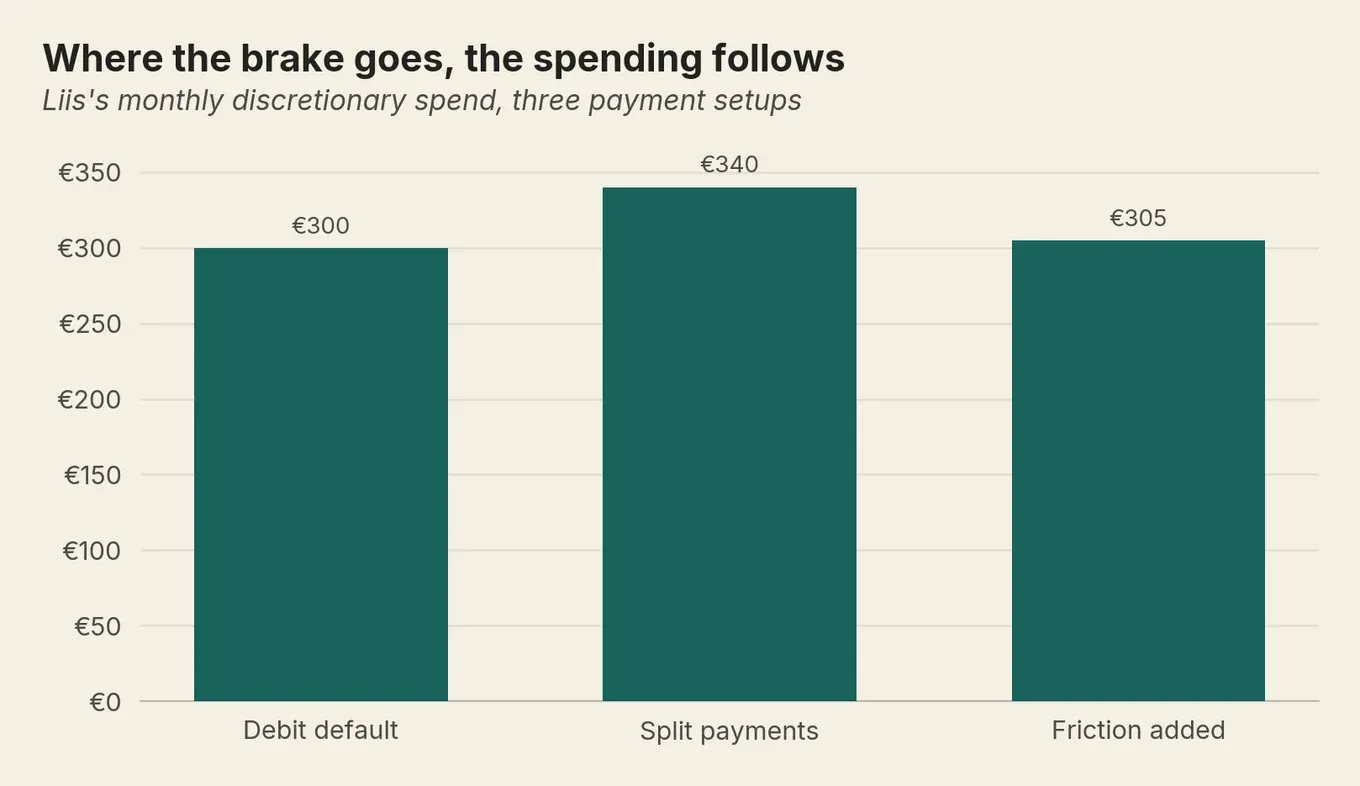
Liis, 29, in Tallinn, could not see where her money went, because nothing she bought ever felt big. She had four buy-now-pay-later plans running at once, each reading as “only €25 a month”, together €100 of commitments she had quietly filed as nothing. Her debit-paid discretionary spending used to sit near €300 a month, back when she felt each purchase land. Once splitting became the default, her own rough tally drifted to about €340. The Central Bank of Ireland measured the same nudge in a controlled test: people spend 4.39% more with buy-now-pay-later than with a debit card. Liis did not white-knuckle it. She deleted her saved cards, so paying took a few deliberate seconds again, and left anything tempting in the basket for 48 hours. Her discretionary spending settled back to around €305.
Why do we shop when we’re stressed, bored, or sad?
Because it works, a little, for a short while. That’s the honest answer, and pretending otherwise only makes people feel daft for noticing the relief.
Why does buying lift a low mood?
Because it hands back a feeling of control. Sadness comes with a sense that things are happening to you, and making any purchase puts you briefly back in charge. Research summarised by the Cleveland Clinic (opens in new tab) finds this genuinely eases lingering low mood in moderation. The object barely matters. The decision is the medicine. Closely related is buying to patch a dent in how you see yourself, what researchers call compensatory consumption (opens in new tab): something bruises your sense of status or worth, and a product promises to fill the gap. That same research is blunt about the catch: it rarely does. The wound and the wallet are not connected, however much an advert insists they are.
When the future is what you’re spending against
There’s a newer pattern that European writers have started calling doom spending, and it deserves a gentler reading than a budgeting lecture. It is buying to cope with pessimism about the future rather than a passing bad afternoon. When the big thing feels out of reach (a flat of your own, real security), the small thing now becomes the only affordable comfort.
The backdrop is real and structural: in 2025, almost three in ten people in the EU (29.2%) (opens in new tab) could not have covered an unexpected expense from their own money, and young Europeans now leave the family home at an average age of 26.2 (opens in new tab), well past 30 in parts of southern Europe. Inês in Porto, priced out of the flat she wants, is not being frivolous when she buys the small nice thing. She is buying ten minutes of agency in a decade that keeps refusing to offer her any. The clearest dated figure here is British, not euro-area: Ipsos found (opens in new tab) that 49% of GB adults, and 67% of those aged 18 to 34, buy small treats more often when they feel down. Treat it as a useful neighbour’s number, not a European one.
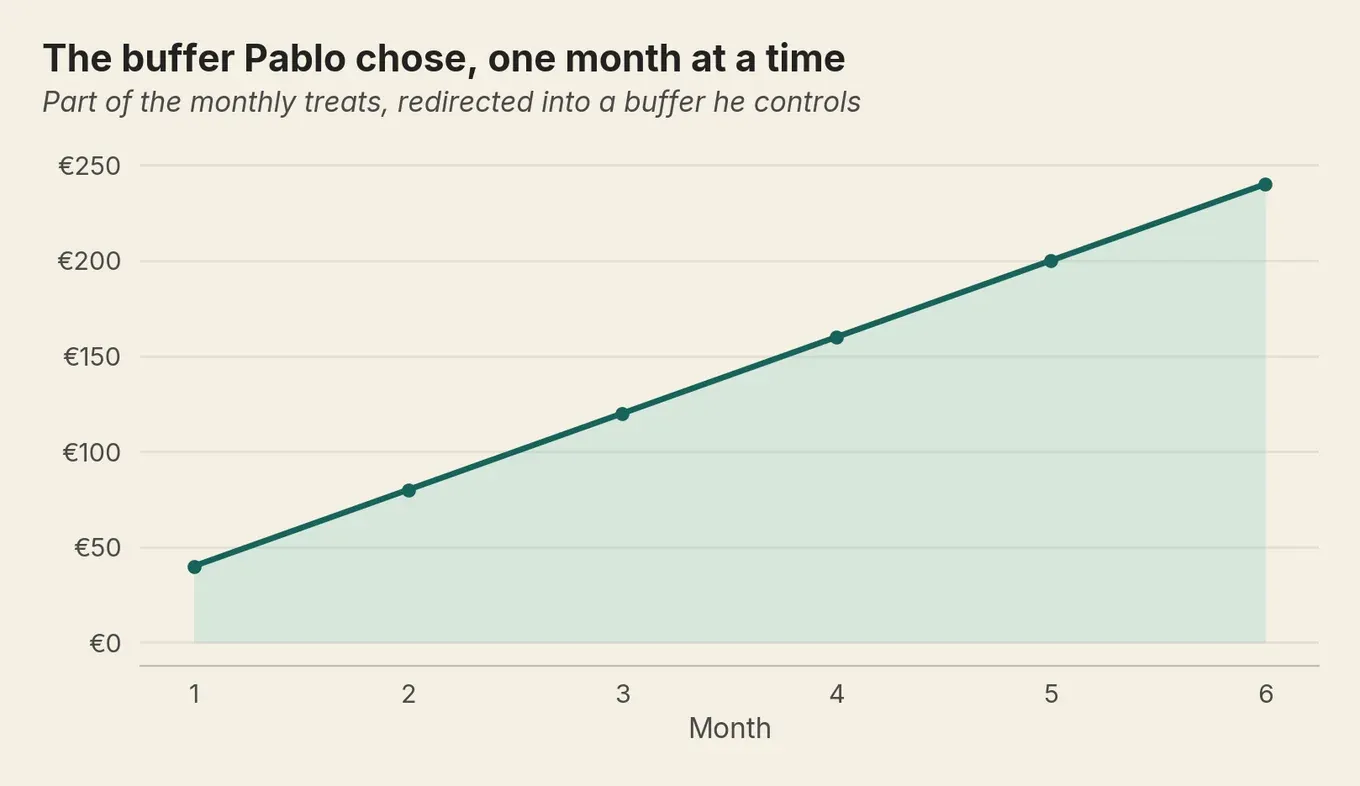
Pablo, 26, in Valencia, was not being frivolous. He shares a flat and cannot see a route to one of his own, in a country where young adults now leave home at around 30, against an EU average of 26.2. When the housing news turned bleak, he bought small nice things, roughly €60 a month, for the few minutes of agency they handed back. A cooling-off pause does little here, because the pessimism does not lift overnight. What helped was deciding in advance what he wanted the money to do. He kept about €20 of the treats, because they are human, and moved the other €40 into a small buffer he controlled. Six months on, that’s €240 he chose. This is ordinary coping under real pressure, not the compulsive-buying tail that affects around one in twenty adults.
When buying stops feeling like a choice
For most people, occasional retail therapy is just that: occasional. For around one in twenty adults, by the pooled estimate from Maraz and colleagues (opens in new tab), it tips into compulsive buying, where the urge runs the show and the consequences mount. The line, as the Cleveland Clinic puts it (opens in new tab), is intention and consequences, not the act of shopping itself. If that is where you are, the kind thing to say is the true thing: it is a recognised pattern, not a character flaw, and asking for help is a sign of strength rather than the opposite. That’s a different conversation from this one, and a worthwhile one to go and have.
Cleveland Clinic psychologist Dr Susan Albers is clear that when shopping tips over into compulsion, it is doing a job, not revealing a flaw:
“Shopping often becomes a way of coping with stress, anxiety and depression.”
Dr Susan Albers, PsyD, Cleveland Clinic
How does marketing manipulate us into spending?
The levers aren’t subtle once you can name them. They are simply well practised.
Why does a discount feel like a win?
Because the crossed-out price does the work. Show a “was €80” beside a “now €48” and the higher number becomes the anchor your sense of value clings to, so the lower one feels like a bargain. Park and Jang (opens in new tab) found that placing the old price to the left of the new one inflates how big a saving the brain thinks it is getting. So Lena in Leipzig comes away feeling she saved €32. She did not. She spent €48 on a coat she had not planned to own this morning. The bargain was on money she was never going to part with.
Why does a countdown make you buy?
“Only 2 left.” A timer ticking down in red. A drop that ends at midnight. These press on a specific nerve: the fear that other people are getting something good and you are about to miss it, which Przybylski and colleagues (opens in new tab) studied as fear of missing out. Urgency does not add value. It removes the pause where you would normally think, and converts a maybe into a now. A useful rule of thumb: treat every countdown as a tell.
Why does “bestseller” work on us?
Because under uncertainty we copy what similar people seem to be doing. “Bestseller”, “10,000 sold” and “people also bought” all borrow that instinct, a shortcut Cialdini and Goldstein (opens in new tab) documented at length. It’s an efficient way to choose a restaurant. It’s a worse way to decide whether you need a thing, because the crowd was assembled by the shop, and it doesn’t know your bank balance.
What is retail therapy, and why does spending give us a dopamine hit?
Retail therapy is using a purchase to lift your mood. It’s real and common, and it gets explained badly, almost always by the same line about a “dopamine hit.”
The dopamine part is true but mistimed in the telling. That spike is in the wanting, the anticipation, not in the moment the card goes through. By the time the bag is in your hand, the chemistry has mostly done its work and is already winding down. This is why the good feeling rarely survives the walk home.
Then a second thing happens, and it is the quiet engine of the whole cycle. Whatever lift the new thing gave you fades back to where you started, an effect Frederick and Loewenstein called hedonic adaptation (opens in new tab). The jacket that thrilled you in March is just a jacket by May. To feel that lift again, you need a new thing, and then another. Nothing is wrong with you when this happens. It’s the standard-issue setting on the standard-issue human brain, which is exactly the setting a retail economy is built to exploit.
How do I stop emotional spending and impulse buying?
Not with more willpower. Everything above points one way: willpower is the wrong tool, and the evidence agrees. The fix is to put the brakes back where shops took them out. Five moves, in order:
- Name the trigger before you name the thing you want. Tired, bored, stung by something, scrolling at 11pm? The feeling is the real customer. Once you can see it, the jacket loses some of its grip.
- Put friction back. Delete saved cards from your phone and your favourite shops, so paying takes a few deliberate seconds again. Sussman’s own advice is exactly this: make the rails slightly annoying on purpose.
- Wait 24 to 48 hours, in a calm state. Maja in Ljubljana leaves the full cart overnight, twice. Most of it does not survive the morning, because the anticipation has cooled and the deciding has moved from the reactive part of her brain to the sensible one. You will occasionally miss a genuine deal. You will keep almost everything else in your account.
- Spend against your values, not your mood. Because mood-buys and self-worth-buys are about a feeling, decide in advance what spending matters to you, and meet the feeling some other way. What money buys more happiness is a real question, and a better one, but it is its own subject and not this one.
- Design the trigger out. Unsubscribe from the retailer emails. Mute the drop alerts. You can’t be anchored, rushed or out-crowded by a message you never see.
Behavioural economist Abigail Sussman, of Chicago Booth, puts the cold-state rule in terms anyone who has shopped hungry already understands:
“[Y]ou can go to the supermarket when you’re starving or you can go to the supermarket when you’ve come with a plan.”
Abigail Sussman, PhD, University of Chicago Booth School of Business
| The trigger | What is really going on | How to put the brake back |
|---|---|---|
| Boredom, idle scrolling | The thrill sits in the wanting, not the owning; the reward fires before you buy anything | Name the feeling first. Browsing is the hobby; you do not have to check out to enjoy it |
| Tap-to-pay, a stored card, “split it into four” | Payment depreciation: you see only today’s instalment, so a €200 jacket files as a €50 decision | Put friction back. Delete saved cards so paying takes a few deliberate seconds again |
| Stress, or a bruised sense of worth | Compensatory consumption: a product promises to patch a dent in status or self-image | Meet the bruise another way. The wound and the wallet are not connected, whatever the advert says |
| A low, flat mood | Buying hands back a flicker of control, which genuinely eases low mood in moderation | Spend against your values, not the mood. Decide in advance what spending is for, and find the lift elsewhere |
| ”Only 2 left”, a countdown ticking in red | Fear of missing out: urgency removes the pause where you would normally stop and think | Treat every countdown as a tell. Leave it in the basket for 24 to 48 hours |
| A crossed-out “was €80” beside the “now €48” | Anchoring: the old price inflates how big a saving your brain believes it is getting | Anchor on what you would otherwise spend, not the discount. The saving is on money you were never going to part with |
| ”Bestseller”, “10,000 sold”, “people also bought” | Social proof: under uncertainty you copy what similar people seem to be doing | Remember the crowd was assembled by the shop, and it does not know your bank balance |
One honest caveat. If the driver is doom spending, the chronic kind rooted in a future that feels foreclosed, the 24-hour pause helps less, because the pessimism does not cool overnight. There, the values work and the structural pressure, frankly, both matter more than any single trick. Real help is closer to building some resilience than to freezing a card.
The brakes were taken out of your shopping without anyone asking you. You are allowed to put them back. Delete one saved card today, and watch how much of what you “needed” this week turns out to be a smooth, frictionless road to a checkout someone else built.
Frequently asked questions
Why do we buy things we don't need?
Why do we shop when we're stressed, bored, or sad?
How does marketing manipulate us into spending?
What is retail therapy, and why does spending give us a dopamine hit?
How do I stop emotional spending and impulse buying?
Sources (16)
- Knutson et al.: Neural Predictors of Purchases (Neuron, via PMC)
- Prelec & Loewenstein: The Red and the Black, Mental Accounting of Savings and Debt (Marketing Science)
- American Psychological Association: Abigail Sussman on the psychology of budgeting (Speaking of Psychology)
- Central Bank of Ireland: Behavioural Mechanisms of Buy-Now-Pay-Later (Research Technical Paper 15, 2025)
- EUR-Lex: Consumer Credit Directive II, Directive (EU) 2023/2225
- Cleveland Clinic: What retail therapy does to a low mood
- Cambridge Handbook of Consumer Psychology: Compensatory Consumption
- Eurostat: share unable to face unexpected financial expenses (ilc_mdes04, 2025)
- Eurostat: Young people leaving the family home at an average age of 26.2 (2024)
- Ipsos: Around half of Britons engage in doom spending
- Maraz et al.: The prevalence of compulsive buying, a meta-analysis (via PubMed)
- Cleveland Clinic: Shopping addiction, when buying stops feeling like a choice
- Park & Jang: Price presentation and perceived savings (Frontiers in Psychology, 2025)
- Przybylski et al.: Motivational, emotional and behavioral correlates of fear of missing out (Computers in Human Behavior)
- Cialdini & Goldstein: Social influence, compliance and conformity (Annual Review of Psychology, via PubMed)
- Frederick & Loewenstein: Hedonic Adaptation
— That's the lot. It is now night.
Want more of this in your Google results?
Add Money Owl as a preferred source, and Google will show our finance pieces higher when you search for them.
By Jure Jaklič
Founder and editor of Money Owl. Data analyst by trade; personal finance learned first-hand across six European countries.
Recommended
How your upbringing and 'money scripts' shape your financial habits
Money scripts are the childhood beliefs that drive how you save and spend. Meet the four types, find yours with a short self-check, and rewrite them.
Mental accounting: why a euro from a refund spends differently
A euro is a euro, but your brain files it into pots and spends each by a different rulebook. Spot the pots quietly costing you, keep the ones that save you.
Loud budgeting: how to turn down plans you can't afford without shame
Someone's booked a hen weekend that costs a week's groceries. Loud budgeting is how you say no to it without sounding cheap, broke, or mean.