

The point.
- Financial therapy treats your relationship with money rather than the money itself, working on the hidden "money scripts" you soaked up in childhood.
- It is not regulated financial advice, coaching, or counselling. Only financial advice (telling you which product to buy) is a regulated activity in the EU.
- It is not only for people in crisis. Constant over-saving and money worry show up in high earners too, because the beliefs follow you whatever you earn.
- The evidence is young and thin. The strongest review to date (Tsai et al. 2024) covers finance-based interventions generally, not financial therapy specifically, and calls for more research.
- There is no EU "financial therapist" register or badge. Check a real psychology qualification (EuroPsy), then find a money-aware therapist through your national body.
The point.
- Financial therapy treats your relationship with money rather than the money itself, working on the hidden "money scripts" you soaked up in childhood.
- It is not regulated financial advice, coaching, or counselling. Only financial advice (telling you which product to buy) is a regulated activity in the EU.
- It is not only for people in crisis. Constant over-saving and money worry show up in high earners too, because the beliefs follow you whatever you earn.
- The evidence is young and thin. The strongest review to date (Tsai et al. 2024) covers finance-based interventions generally, not financial therapy specifically, and calls for more research.
- There is no EU "financial therapist" register or badge. Check a real psychology qualification (EuroPsy), then find a money-aware therapist through your national body.
You know what you should do with your money. You’ve known for years. You’ve read the threads, downloaded the budgeting app, watched the video where the cheerful man draws a triangle. And still, on the first of the month, the same thing happens. You avoid the banking app, or you spend in a small panic, or you over-save until it hurts, and you feel a bit stupid about all of it.
If budgeting advice were going to fix this, it would have fixed it by now.
That gap, between knowing and doing, is the whole reason financial therapy exists. It isn’t a budgeting app with feelings. It isn’t your bank in a cardigan. It’s a small, new practice that treats your relationship with money rather than the money itself, and for some people it’s the missing piece that twelve spreadsheets never were. So here’s what it is, who it tends to help, what it costs, whether it works, and how a person living in Europe finds a good one.
What does a financial therapist do, and how is it different from coaching and advice?
Financial therapy is a new practice that blends know-how from psychology and money to work on the feelings, beliefs, and habits behind your money choices. A financial therapist looks at why the same money pattern keeps repeating, not just which account to open. The work is on your relationship with money rather than on the money itself. It’s ordinary therapy, pointed at money instead of at, say, your relationship with your mother. Although those two turn out to be related more often than anyone would like.
A working European therapist puts it far better than any chart or number can. Here’s money psychotherapist Vicky Reynal, author of Money on Your Mind:
Money is a powerful symbol, one that people use unconsciously to act out emotional issues.
The thing it works on has a name. Money scripts.
What is a money script?
A money script is a mostly hidden belief about money you soaked up in childhood, often from your family, and carried into adult life without noticing. “There will never be enough.” “Money is dirty.” These quiet beliefs steer how you earn, spend, and save. They sit underneath the scarcity and abundance mindsets most of us never stop to look at.
The Klontz Money Script Inventory (opens in new tab), a quiz built by studying 422 people across 72 money beliefs, groups these into four broad themes: money avoidance, money worship, money status, and money vigilance. Three of the four were tied to a person’s income and wealth, which matters for a reason we’ll come back to. A 2025 study of the revised inventory (opens in new tab), on a larger and more varied sample, found that four-part structure fits the data poorly, so treat the labels as a prompt to think rather than a diagnosis. Most of us never look at these scripts. We just live inside them, blaming our willpower for the result.
Want to see your own four? The money scripts self-assessment scores all four patterns and names your likely main script and its backup.
Here’s the part most articles skip. There are four different things sold under similar names, and telling them apart is most of the battle.
| Approach | What it does | Is it regulated? |
|---|---|---|
| Financial advice | Recommends specific products and investments (which pension, which fund) | Yes. This is the only one of the four that is a regulated financial activity in the EU. |
| Financial coaching | Forward-looking habits and accountability; helps you do the thing you already know you should | No |
| Financial counselling | Practical help with budgeting and debt, often in a supportive setting; the “financial counselling” label is live in Ireland | No |
| Financial therapy | The emotional, behavioural, and relational roots of money trouble, using therapeutic technique | No |
Only financial advice is regulated. That’s the load-bearing fact. When someone tells you to buy a specific product in the EU, they fall under investment rules and a regulator is watching. Therapy, coaching, and counselling don’t give regulated financial advice and aren’t a substitute for it. So the quick test. If the problem is a knowledge gap (“which pension?”), you want regulated advice. If it’s a habit gap (“I know what to do, I just don’t get round to it”), coaching or counselling. If the same painful pattern keeps repeating no matter what you earn, that’s the ground financial therapy was built for.
A therapist draws the same line the article does, in her own words. Vicky Reynal again:
These are not financial planning sessions and I won’t be offering investment advice.
Who is financial therapy for, and what are the signs you might benefit?
The big myth is that this is only for people in serious debt or money crisis. It isn’t. The money-scripts work is about beliefs that follow you whatever you earn. That’s why constant over-saving, and a money worry that never quite switches off, show up in high earners too. Three of the four money patterns track with how much you have, in both directions. Plenty of people with a healthy balance still can’t open the app without a small flinch first. That’s what happens once you’ve quietly started letting your net worth grade you as a person.
So treat the list below as a rough guide, not a diagnosis. It’s a way of asking “is this me?”, and nothing more. You might recognise yourself if:
- Money stress is affecting your sleep, your work, or your relationships.
- You avoid checking your accounts, opening statements, or thinking about money at all.
- You spend on impulse, or you save so hard it starts to hurt, and you can’t seem to stop either one.
- The same money argument keeps happening with your partner, on a loop.
- You earn enough, on paper, and still feel a low hum of dread about it.
None of that means anything’s wrong with you. It means money stopped being plain sums a long time ago, which, for most of us, it did. If the spending end is where it bites, it’s worth knowing what your money actually buys in terms of happiness, because the answer surprises most people. And if that low hum has tipped into something heavier, the practical work of calming both the worry and the bank balance is worth reading alongside this.
Take Niamh (not a real person, but a familiar one). She is forty-one, has a steady job in Cork, and a savings balance most people would envy. None of it helps. She checks the account, sees a healthy number, and her chest tightens anyway, so mostly she stops checking. “I keep waiting for it to feel like enough,” she said once, “and it never does.” She had read the threads and run the budgets. The numbers were never the problem. What finally shifted was small: not another budget, but the quiet thought that the dread might be the thing to work on, rather than the balance. She went looking for a registered psychologist who works on money, the way you’d check any other badge, and started with one conversation. That is the whole move here. Not a cure. A first, honest look at the why.
Can financial therapy help couples with money conflict?
Yes. Couples are one of the most common reasons people seek it out. Money arguments that keep coming back are a clear signal. The work borrows from relationship and family therapy, then points it at the joint account rather than at either partner. The goal is fewer loops, not a winner.
One honest boundary. Financial therapy isn’t clinical mental-health treatment. A good therapist should send you to a licensed mental-health professional if something more serious is going on, such as a gambling addiction, hoarding, or depression, though the label itself is unregulated, so that obligation comes from a practitioner’s own professional registration rather than from the field. It sits alongside care, never instead of it.
What happens in a session, and how much does it cost?
A session is led by what you work out for yourself rather than someone telling you what to do. Early on, you tend to map your money history: the messages you grew up with, the moments that shaped how you handle cash now. Later sessions turn to the here and now, the exact spots where the spending or the ducking-out kicks in. Therapists draw on a few named tools. There’s solution-focused therapy, which builds on the strengths you already have toward a goal rather than picking over past failure. There’s the financial genogram, a family tree of money habits drawn out across the generations, to make those inherited scripts visible. And there’s money-script work itself. It tends to run as a short, focused run of sessions rather than something open-ended. Nobody publishes a reliable average, though, so don’t anchor on a number.
Now cost. Here the honesty has to be sharper, because there’s no single European answer and anyone who gives you one is guessing.
Does insurance or a public health scheme cover financial therapy?
No. Not by that name, anywhere in the EU; no public-health or insurance scheme pays for “financial therapy” as such. Insured routes cover recognised psychotherapy only, and only when a referral and a diagnosis fit. So in practice you pay the going private rate for talk therapy with a money-aware therapist.
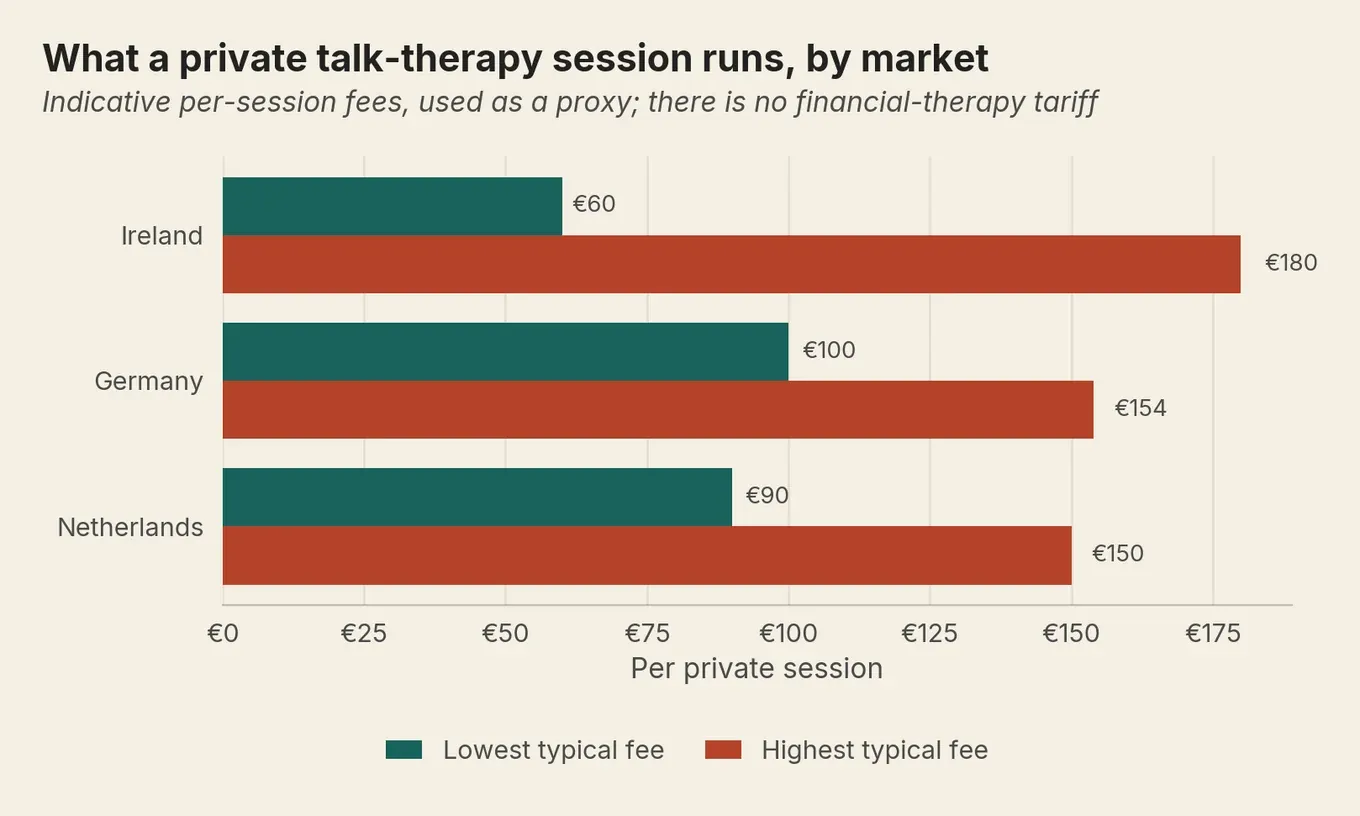
There’s no “financial therapy” price list anywhere in Europe. The work is done by a money-aware therapist or psychologist, so what you pay is the going rate for private talk therapy in your country. Read the figures below as the cost of seeing a private therapist who works on money, because that’s exactly what they are.
| Market | Private session (proxy: general talk therapy) | Public or insured route | Is “financial therapy” itself covered? |
|---|---|---|---|
| Ireland | €60 to €100 (counsellor/psychotherapist); €90 to €180 (psychologist); €30 to €70 at low-cost services | Counselling in Primary Care via GP referral; free online support through Turn2Me | No. General counselling routes only. For debt, MABS is free but is money advice, not therapy. |
| Netherlands | About €90 to €150 per 45 to 60 minutes, private | GP (huisarts) referral into insured mental healthcare; the 2026 compulsory deductible (eigen risico) is €385 | No. Recognised psychotherapy only; private-pay otherwise. |
| Germany | About €100 to €154 per 50 minutes, private | Public insurance covers only four recognised therapy methods, and the practitioner needs an insurance slot | No. Not a recognised method, so private-pay. |
A note on confidence. The Irish figures come from the HSE (opens in new tab), so they’re firm. German and Dutch ranges lean on secondary sources, so read them as “approximately”. For France, Spain, Italy, and Portugal, the find-a-practitioner directories are solid (more on those below), but session cost and insurance vary too much to quote without misleading you, so check locally.
If money is really tight and the worry is sharp, you’re not stuck with private fees. Ireland’s Turn2Me offers free online support; debt-specific help through MABS is free and state-funded. Most markets have a low-cost or charity tier. This article is here to inform, not a crisis service, but you should never be left at a dead end.
Does financial therapy work, and what does the evidence say?
Honestly? The evidence is young and thin, and you deserve to hear that plainly rather than be sold to.
This is a young field. The Financial Therapy Association was set up in the United States after a 2008 meeting in California and formally created in 2010 (opens in new tab), with Sonya Britt among the founders. By research standards, that’s yesterday. So far the strongest piece of evidence anyone can point to is a 2024 systematic review in Psychiatric Services (opens in new tab), and even that needs careful reading. It screened 544 studies, kept 18, and looked at finance-based interventions for mental-health conditions in general, not financial therapy specifically. Its strongest finding was for a different kind of programme entirely, helping at-risk people handle benefit payments, and it ended by calling for more careful research. So it’s honest support for “this broad area shows promise and is under-studied”. It isn’t proof that financial therapy works.
The strongest review anyone can point to ends, in its own authors’ words, by asking for more. Here’s Tsai and colleagues, in Psychiatric Services (2024):
Further research is needed to assess the impact of interventions beyond representative payee programs on objectively measured outcomes.
That shouldn’t put you off, and it’s not a reason to be cynical either. A field can be useful before it’s fully proven; talk therapy itself was once exactly here. But walk in with clear eyes. Anyone promising to fix your relationship with money in a fixed number of sessions is selling, not practising. The truth is more modest, and more trustworthy. For some people, sitting with the why behind their money habits, alongside a trained person, helps in a way that a spreadsheet never could. If your trouble is less about a deep pattern and more about the quiet mental rules you apply to your own money, that may be the lighter, faster fix. We just can’t yet tell you the odds.
How do you find a qualified financial therapist in Europe?
Start with the thing nobody tells European readers. There’s no “financial therapist” register you can search, and there’s no EU financial-therapy training you can hold up. The term isn’t regulated. That American badge you’ll see mentioned, the CFT, is a US one that’s not currently open to international applicants and grants no right to practise in Europe, so it isn’t the thing to go looking for.
What does exist in Europe is solid. It’s just a different route. You check that a therapist is a properly trained psychologist, then find a money-aware one through your national body.
Step one: check the training
The pan-European backbone is the EuroPsy Register, run by EFPA, the European Federation of Psychologists’ Associations (opens in new tab). EuroPsy is a recognised standard: five years of approved study plus a supervised year of practice, the “five plus one” model. You can search the register (opens in new tab) by name and country to confirm someone holds it.
One trap worth flagging, because the names are almost identical. The body you want is EFPA, the psychologists’ federation. There’s a separate organisation called EFPA Europe, which is a financial-planners’ body. Different thing entirely. The route to a money-aware therapist runs through the psychologists’ one.
Step two: find a therapist through your national body
Then go local. Every Money Owl market has an official directory of registered psychologists or therapists, and “registered” carries legal weight (in several countries you can’t legally practise without it).
- Ireland: the IACP therapist directory and the IAHIP therapist directory.
- Germany: the BDP, Germany’s largest psychologists’ association, runs practitioner finders.
- Netherlands: the NIP “find a psychologist” register.
- Spain: buscopsicologo.es, the official finder run by the General Council of Psychology (opens in new tab), where everyone listed is registered and accredited.
- Italy: the CNOP national register of psychologists.
- Portugal: the Order of Portuguese Psychologists (opens in new tab) directory, where you must be registered by law before you can practise.
- France: the state health-professional directory at annuaire.sante.fr.
When you contact one, ask plainly whether they have training or a keen interest in money and how people behave around it. You’re looking for a qualified therapist who works on money. That’s the real European version of “a financial therapist”, and the version that comes with a real qualification behind it.
That’s the honest shape of it. Financial therapy is young, mostly unproven, and impossible to look up in a tidy register. It’s also, for the right person at the right moment, the first thing that treats money trouble as the human problem it nearly always is. If you recognised yourself a few sections ago, you’re allowed to take that seriously. Check the training, find someone local who works on money, and start with one conversation.
Frequently asked questions
What does a financial therapist do?
What is the difference between financial therapy, coaching, counselling, and advice?
Who is financial therapy for, and what are the signs you might benefit?
How much does financial therapy cost in Europe?
Does financial therapy actually work?
How do you find a qualified financial therapist in Europe?
Sources (11)
- Financial Therapy Association: Become a CFT (certification requirements)
- Financial Therapy Association (homepage and field definition)
- Grable, McGill & Britt (2010): The Financial Therapy Association, A Brief History, Journal of Financial Therapy (founding history)
- Tsai et al. (2024): Systematic Review of Financial Interventions for Adults With Behavioral Health Conditions, Psychiatric Services (PubMed)
- EFPA: About EuroPsy, the European Certificate in Psychology (5+1 standard)
- EuroPsy Register (searchable pan-European credential verification)
- HSE (Ireland): Getting talk therapy privately (cost ranges and accreditation)
- Klontz et al. (2011): Money Beliefs and Financial Behaviors, the Klontz Money Script Inventory, Journal of Financial Therapy (open access)
- BuscoPsicologo: official psychologist finder, Consejo General de la Psicologia de Espana
- Ordem dos Psicologos Portugueses: members directory (Portugal)
- Vicky Reynal: Money Focus (money psychotherapy practice page)
— That's the lot. It is now night.
Want more of this in your Google results?
Add Money Owl as a preferred source, and Google will show our finance pieces higher when you search for them.
By Jure Jaklič
Founder and editor of Money Owl. Data analyst by trade; personal finance learned first-hand across six European countries.
Recommended

Money dysmorphia and doom spending: the money anxieties the internet named
The internet named two money anxieties, money dysmorphia and doom spending. What each means, whether either is a real diagnosis, and what helps.

How your upbringing and 'money scripts' shape your financial habits
Money scripts are the childhood beliefs that drive how you save and spend. Meet the four types, find yours with a short self-check, and rewrite them.

Mental accounting: why a euro from a refund spends differently
A euro is a euro, but your brain files it into pots and spends each by a different rulebook. Spot the pots quietly costing you, keep the ones that save you.