
The point.
- Money is fungible. A euro from a tax refund is the exact same euro as one from your wages, even when it feels like found money you can blow.
- The instinct has two faces. The same earmarking habit that robs you on windfalls and high-interest debt is also one of the best saving tools ever invented. Keep the pots that help, bin the ones that cost.
- Run the net-interest check. A typical carried card at around 18% costs roughly EUR540 a year on EUR3,000; the same EUR3,000 in a 0.26% savings pot earns about EUR8. Keep a real emergency buffer, then point the surplus at the dear debt.
- Relabel windfalls as plain income the moment they land, and run them through the same priority list you use for your wages.
- Once a month, look at every account at once. The simplest way is a monthly net-worth check, which lines up every balance and quietly strips the labels off.
The point.
- Money is fungible. A euro from a tax refund is the exact same euro as one from your wages, even when it feels like found money you can blow.
- The instinct has two faces. The same earmarking habit that robs you on windfalls and high-interest debt is also one of the best saving tools ever invented. Keep the pots that help, bin the ones that cost.
- Run the net-interest check. A typical carried card at around 18% costs roughly EUR540 a year on EUR3,000; the same EUR3,000 in a 0.26% savings pot earns about EUR8. Keep a real emergency buffer, then point the surplus at the dear debt.
- Relabel windfalls as plain income the moment they land, and run them through the same priority list you use for your wages.
- Once a month, look at every account at once. The simplest way is a monthly net-worth check, which lines up every balance and quietly strips the labels off.
You count every euro at the till. You put back the nice cheese because the good stuff is two euro more, and two euro is two euro. Then a tax refund lands, a clean €1,000 you forgot you were owed, and by Sunday it’s a weekend away and a coat you’d never have bought from your salary. Meanwhile a credit-card balance sits there, quietly charging you about 18% a year, right next to a savings pot you won’t touch because it’s for something.
Same person. Same week. Same euros.
That’s mental accounting: the reason a euro from a refund somehow spends differently from a euro from your wages. It shouldn’t. A euro is a euro. Money doesn’t know which pot you put it in, even when you feel certain that it does.
What is mental accounting?
Mental accounting is the habit of treating money differently depending on where it came from or what it is “for”: splurging a tax refund you’d never blow from your salary, even though a euro is a euro. The economist Richard Thaler named it. It costs us quietly, because money is fungible and our mental pots are not.
That word, fungible, is doing a lot of work. It means interchangeable. Every euro is identical to every other euro and carries no label. The €50 from your nan’s birthday card is the exact same €50 as the €50 from your payslip. They buy the same shopping. The shop gives no discount for sentiment.
Mental accounting is what happens when your brain ignores that. You file money into little accounts, by where it came from (wages, refund, gift, lottery), or by what it’s for (rent, fun, the holiday pot), and apply a different rulebook to each one. Thaler found we do this constantly, and that it quietly breaks the one thing economists assume about money: that you treat it all the same.
Here’s the part nobody tells you. You’re not being stupid. You’re being human, and a fair chunk of what you’re doing is genuinely smart. Hold that thought. We’ll come back to it, because it’s the whole point.
What are some everyday examples of mental accounting?
The examples cluster where money arrives feeling different from your wages. Three patterns cover almost all of it: found money you spend too freely, expensive debt parked next to a sacred savings pot, and “winnings” you gamble as you never would with your own cash.
The windfall you treat as found money
A tax refund feels like a gift. It isn’t. It’s your own money, handed back because you overpaid through the year. You earned it, you lived without it for months, and now it’s returned. Yet the moment it lands it gets filed under “fun”, and out it goes.
Behavioural researchers have watched this for decades. Arkes and his colleagues, back in 1994, found that people spend money they didn’t see coming far more freely than money they expected or earned. Give someone an unexpected twenty and they treat it like Monopoly money. Give them the same twenty as wages and they think twice. The cash is identical. The label is not.
Say Lena in Leipzig gets a €1,000 refund. From her salary, €1,000 is a month of careful budgeting. As a refund, it’s a city break by Tuesday. Nothing about the euros changed. Only the pot they landed in.
The savings pot guarding the door while the debt runs up the bill
This is the expensive one, so it gets its own section further down. The short version: a lot of careful, sensible people keep a savings pot they won’t touch while carrying a credit-card balance that costs them far more than the pot earns. The savings feel sacred. To them the debt is a separate problem, for another day. It isn’t. It’s the same money wearing two hats.
House money on the markets
Thaler borrowed a phrase from gamblers: “house money”. Win a bit at the casino and you stop thinking of it as yours. It’s the house’s money, so you bet it on something daft you’d never risk with the notes you walked in with.
Investors do the identical thing. A few good months, the portfolio’s up, and suddenly that gain is “winnings” to punt on something speculative. But your portfolio holds one balance. A euro of gains carries exactly the same risk as a euro you put in yourself. The market can’t tell which euros you feel sentimental about.
How does mental accounting affect our financial decisions?
It changes your decisions by breaking fungibility: the mental accounting bias lets the source or the label of money override its actual value, so you make choices you’d reverse if all your money sat in one pile. The pot is steering, not the maths.
It works because of how feelings attach to money. We don’t weigh a gain or a loss against our total wealth. We weigh it against a reference point, against what we expected. A small refund stapled to a big tax bill gets mentally peeled off and enjoyed on its own, a little silver lining, because that feels better than netting it against the bill. And a loss stings more than the same-sized gain pleases, which is why closing a “pot” at a loss, selling the investment, draining the holiday fund, feels almost physical.
There’s also the small matter of how paying feels. Hand over cash and you feel it leave. Tap a card and you barely register it. Pay for a holiday in March and by August it feels free, because the paying and the having got separated in time. Every contactless tap, every “buy now, pay later” button, every prepaid thing widens the gap between how easy spending is and how much it costs you. The technology excels at this. It isn’t an accident.
So the everyday damage isn’t dramatic. It’s a slow leak. You optimise hard inside each little pot, two euro on cheese, and ignore the much bigger leak between them, the card balance next to the savings. You’re being penny-careful and euro-careless, and the careless bit is where the real money goes.
It wears the same face whoever you are. Here are three more, across three more cities, and one of them is the instinct working in your favour.
| Persona (market) | The mental-account trap | What the labels hide (the fungible euros) | The fix |
|---|---|---|---|
| Inês, Porto | Two sacred pots: a €2,000 holiday fund kept whole while €2,000 sits on a revolving card balance. “The holiday money is for something. The card is a separate problem for later.” | The pot earns ~€5 a year at 0.26%; the balance costs ~€360 a year at a typical ~18%. Keeping them apart costs ~€355 a year for one feeling. | Keep a real buffer, then point the holiday-fund surplus at the balance. The pot comes back once the dear debt is gone. |
| Matteo, Milan | House money on the markets: a €1,200 bonus reframed as “winnings” and punted on one speculative bet. “This is the house’s money, not mine, so I can gamble it.” | One portfolio, one balance. A bonus euro carries the identical downside to a salary euro; the market cannot tell which euros you feel sentimental about. | Relabel the bonus as plain income the moment it lands, then size any bet against your whole pile, not against “winnings”. |
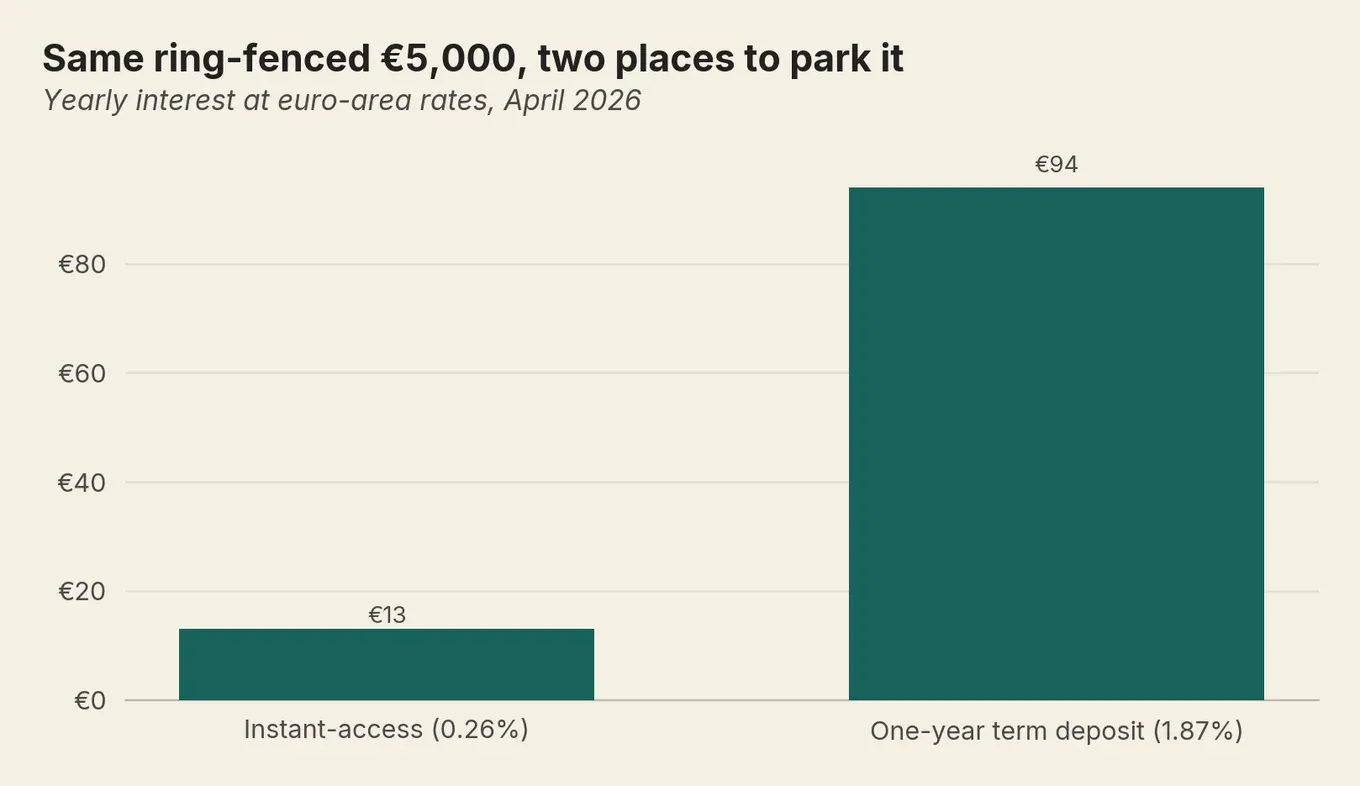
| Maja, Ljubljana | The good version: a €5,000 house-deposit pot ring-fenced and named, so it never gets raided. “This is the deposit. It does not get touched.” (correct, and useful) | Same €5,000 earns ~€13 a year left in instant-access at 0.26%, or ~€94 a year in a one-year term deposit at 1.87%: ~€80 more for the same money, still ring-fenced. | Keep the pot. Earmarking here is mental accounting working for her. Just park it where it earns its keep. |
Should you use savings to pay off high-interest credit-card debt?
Mostly yes, once you have kept a small emergency buffer. If a card charges far more than your savings earn, money sitting in the “sacred” pot is paying for the privilege of feeling separate. Here is what that costs, in euros, as of mid-2026.
Picture Aoife in Dublin. She has €3,000 saved in an instant-access account, and €3,000 on a credit card she’s been carrying for a while. The savings are for “emergencies and someday”. The card is “a separate thing I’ll sort out”. Two pots, two rulebooks.
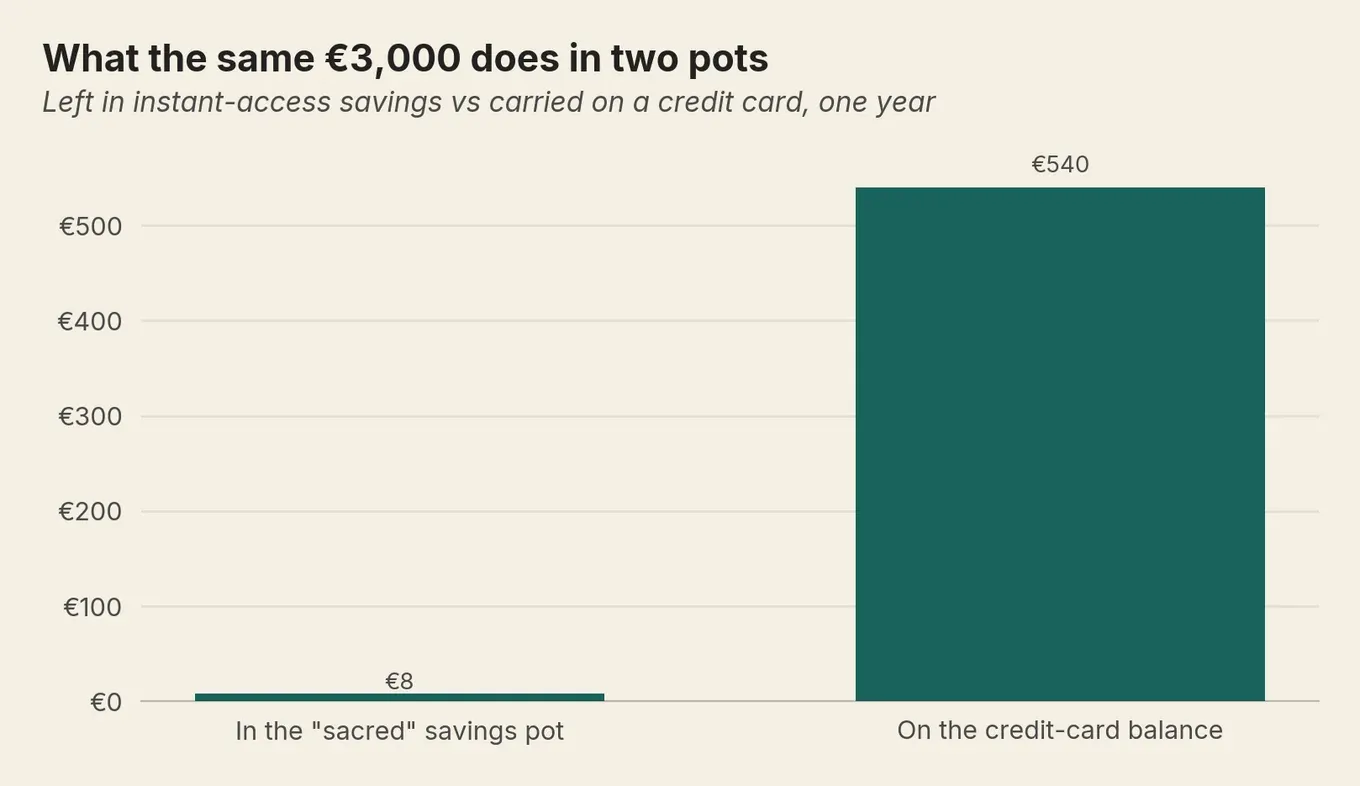
Now the numbers. A typical carried credit-card balance costs around 18% a year. So her €3,000 of debt costs roughly €540 a year in interest (€3,000 multiplied by 18%). Her €3,000 of savings, sitting in an instant-access account, earns the going euro-area rate on overnight household deposits, which the European Central Bank put at 0.26% in April 2026 (opens in new tab). That’s about €8 a year.
Read that again. The pot earns €8. The debt costs €540. By keeping the two separate, Aoife is paying roughly €530 a year for the warm feeling that her savings are untouchable. The card isn’t a separate problem. It’s eating her savings, at a distance, every single month.
Why doesn’t she just clear it? Because nobody behaves like a spreadsheet, and “just pay off the card” is the most useless advice in personal finance. The savings pot is doing a job for her: it’s proof that she isn’t the kind of person who has nothing put by. Draining it to zero feels like admitting defeat, even when it’s the smart move. That feeling is real, and it’s exactly what mental accounting protects. If that knot in your stomach is the thing actually stopping you, it’s worth reading up on how money worry tangles with your mental health, because the fix there is as much about the feeling as the figure. Understanding why you don’t clear it is the first honest step. The shame isn’t.
And the industry is delighted with all of this, by the way. The same banks that pay you 0.26% on the sacred pot (opens in new tab) are charging the high rate on the card. That gap, between what your money earns and what your debt costs, is in a real and deliberate sense their business model. The pot isn’t protecting you from the bank. It’s helping the bank.
One firm exception, because this matters. Netting savings against debt doesn’t mean draining everything to zero. Keep a genuine emergency buffer, the bare minimum you’d need if the boiler died or the job vanished. Clear every cent into the card, then watch an emergency hit, and you’re straight back on the same card at the same rate, worse off. Keep the buffer. Net off only the surplus above it. The skill is precision, not a fire sale.
Is mental accounting always bad, and how do you avoid the costly version?
No, and this is the bit the textbooks get wrong. The same habit that robs you on windfalls and debt is also one of the best saving tools ever invented. The trick isn’t to abolish your mental pots. Keep the ones that help, bin the ones that cost.
The man who named mental accounting was blunt about whether it even matters that it’s illogical:
“I see no useful purpose in worrying about whether or not mental accounting is ‘rational’.”
Thaler said so himself. Think about how you save: you give money a job before you have a chance to spend it. The holiday pot, the house-deposit account, the named “space” in your banking app, the old envelope stuffed with cash for the gas bill. Every one of those is mental accounting, working for you. The deliberate version even has a name and a following: the envelope system, or cash stuffing is mental accounting turned into a method on purpose. Ring-fence money for a purpose, and you stop yourself raiding it for a takeaway. Thaler and his colleague Shefrin called this using mental accounts as a self-control device, and decades of research backs them up. The pot that feels sacred is the same machinery as the pot that saves your future. One points forward and protects you. One points backward and traps you.
So the goal was never “treat all money the same and feel nothing”. That’s robotic, and you wouldn’t do it anyway. The goal is to spot which pots are quietly costing you, and defuse only those.
What is the one test that catches it?
Ask one question whenever the source or the label of money pulls at a decision: would I make the same call if every euro I owned were sitting in one single pile? It takes about four seconds, and it catches nearly everything.
If the answer is yes, carry on, your pot is helping. If the answer changes, a mental account is steering you, and it’s worth a second look. That’s the whole diagnostic. The “this came from a refund, so different rules apply” reflex is exactly the one it flushes out.
What should you do with a windfall?
Run a refund, a bonus or an inheritance through the same priority list you use for your wages: clear the expensive debt, top up the buffer, then choose where the rest goes the way you would for any money earmarked for short-term versus long-term goals. Carve off a slice for fun on purpose if you like; that part is fine, and spending a little deliberately tends to buy more happiness than splurging the lot. The error is the autopilot splurge, where the money’s gone before you decided anything.
Deciding to spend some of it is a choice. Spending all of it because it “didn’t count” is the pot driving the car. Re-labelling the windfall as plain income, the moment it lands, is what disarms it.
How do you run the net-interest check?
Before you ring-fence any savings as untouchable, compare two numbers: what that money earns where it sits, and what your most expensive debt costs. If the debt costs more, the earmarking is costing you the gap.
Keep your emergency buffer, then send the surplus at the debt. The pot can come back once the expensive debt is gone. This is the single check that turns a sacred-feeling pot back into plain, fungible money.
Look at the whole pile, once in a while
Most of the damage hides in the spaces between your accounts. Once a month, look at everything at once, every account, every pot, every card. The simplest way to do that is a monthly net-worth check, which lines up every balance in one view and quietly strips the labels off. Not to feel bad. Just to see the euros as what they are: one pile, yours, fungible, indifferent to your filing system.
No insight required. That’s the point. You already know how to save, you’ve proved it. You’re just learning to stop the same instinct from quietly charging you €530 a year on the side. Keep the pots that protect you. Bin the ones that cost you. Then go and buy the good cheese after all, because two euro is two euro, and you can afford it now.
Frequently asked questions
What is mental accounting?
What is an everyday example of mental accounting?
How does mental accounting affect our financial decisions?
Should you use savings to pay off high-interest credit-card debt?
Is mental accounting always bad?
What should you do with a windfall like a refund, bonus or inheritance?
Sources (5)
- European Central Bank: Euro area bank interest rate statistics, April 2026
- Richard H. Thaler: Mental Accounting Matters (Journal of Behavioral Decision Making, 1999)
- Arkes, Joyner, Pezzo et al.: The Psychology of Windfall Gains (Organizational Behavior and Human Decision Processes, 1994)
- Federal Reserve Bank of St. Louis: How Mental Accounting Shapes Our Financial Choices (Page One Economics)
- The Decision Lab: Mental Accounting (bias reference)
— That's the lot. It is now night.
Want more of this in your Google results?
Add Money Owl as a preferred source, and Google will show our finance pieces higher when you search for them.
By Jure Jaklič
Founder and editor of Money Owl. Data analyst by trade; personal finance learned first-hand across six European countries.
Recommended

How your upbringing and 'money scripts' shape your financial habits
Money scripts are the childhood beliefs that drive how you save and spend. Meet the four types, find yours with a short self-check, and rewrite them.

The psychology of spending: why we buy things we don't need
A €200 jacket split into four payments reads to your brain as €50. The psychology of spending, and how to put the brake back.

Loud budgeting: how to turn down plans you can't afford without shame
Someone's booked a hen weekend that costs a week's groceries. Loud budgeting is how you say no to it without sounding cheap, broke, or mean.