

The point.
- A scarcity money mindset is a measurable cognitive state when the lack is real, not a character flaw; genuine shortage quietly taxes your decisions, and the answer is material, not a mood.
- The defensible bit of an abundance mindset is calmer attention that lets you see more of your choices, not attraction. Manifestation correlates with riskier investing and bankruptcy history; the researchers found no objective evidence it works.
- You cannot reframe a genuine shortfall. If the income does not cover the needs, the lever is the situation (more income, every support you are owed, real debt help), never a gratitude journal.
- When the numbers are fine but the fear is loud, the tools with evidence are boring: a standing transfer that fires on payday and one if-then plan beat affirmations and vision boards.
The point.
- A scarcity money mindset is a measurable cognitive state when the lack is real, not a character flaw; genuine shortage quietly taxes your decisions, and the answer is material, not a mood.
- The defensible bit of an abundance mindset is calmer attention that lets you see more of your choices, not attraction. Manifestation correlates with riskier investing and bankruptcy history; the researchers found no objective evidence it works.
- You cannot reframe a genuine shortfall. If the income does not cover the needs, the lever is the situation (more income, every support you are owed, real debt help), never a gratitude journal.
- When the numbers are fine but the fear is loud, the tools with evidence are boring: a standing transfer that fires on payday and one if-then plan beat affirmations and vision boards.
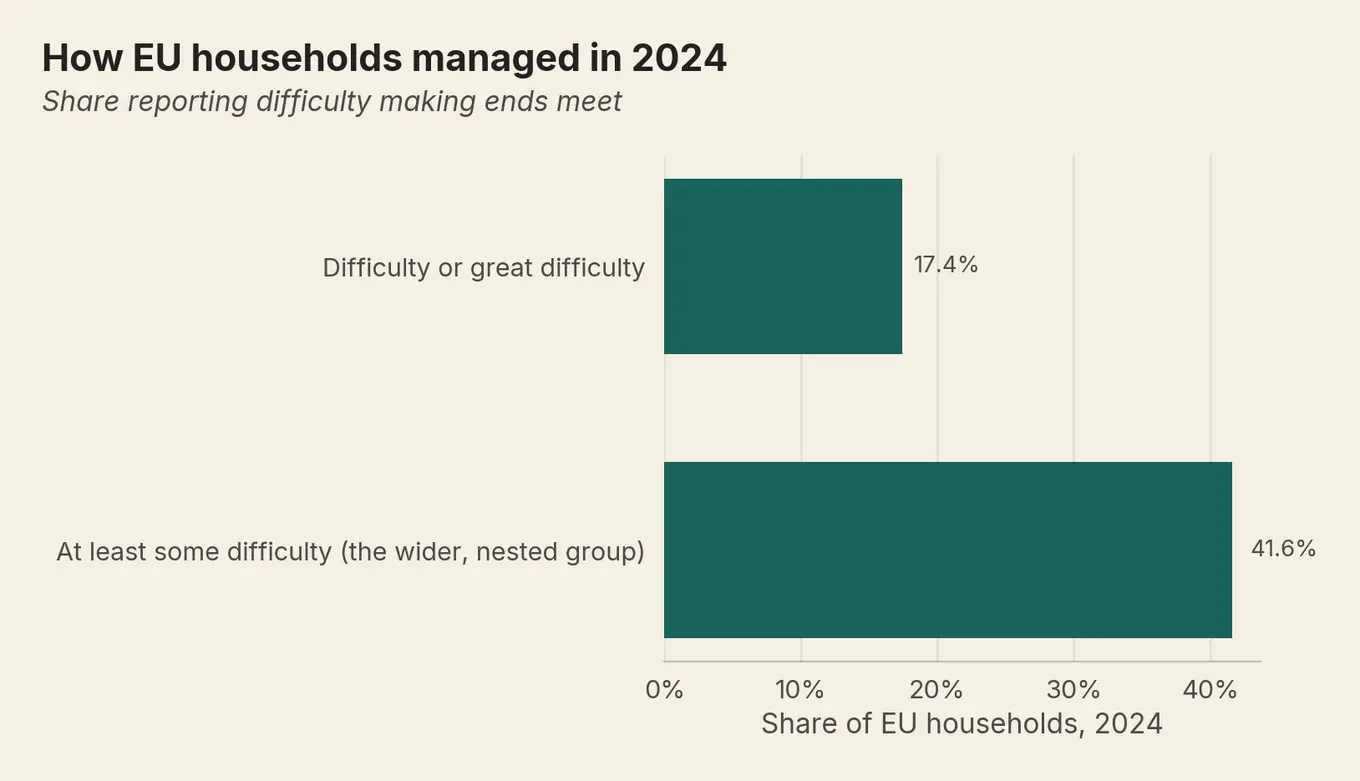
In 2024, 17.4% of EU households said they had difficulty or great difficulty making ends meet. Another 41.6% had at least some difficulty. So if money keeps you up at night, you’re not unusual, and you’re not bad at this. You’re one of a great many people doing sums in the dark.
That’s the backdrop. Now the thing the self-help internet keeps selling you: the scarcity vs abundance mindset. The promise is that your wealth comes down to which one you pick. Choose abundance, the story goes, and the money follows. It’s a tidy story, and in the form most people meet it, wrong in a way that can cost you real euros. Your money mindset is real, and it matters. It just doesn’t work the way Instagram says.
First, sort yourself into one of two rooms. Room one: the numbers are genuinely fine, but the fear is loud anyway. Room two: the lack is real and current, and the income doesn’t cover the needs. If you’re in room two, most of the “think abundant” advice below isn’t for you, and I’ll say so plainly when we get there. Reframing an empty account isn’t a mindset trick. It’s a magic trick, and it doesn’t work.
What’s the difference between a scarcity and an abundance money mindset?
A scarcity money mindset is the nagging fear that there will never be enough, even when the numbers say otherwise, which pushes you into short-term, jumpy money decisions. An abundance money mindset treats money as something you can grow and steer, which makes calmer, longer-term choices easier to see.
One frame narrows what you notice. The other widens it. That’s the whole comparison; everything below is detail, starting with where each frame comes from.
What is a scarcity money mindset, beneath the slogans?
Start with the bit nobody on a vision board will tell you. Real scarcity is a state of mind you can measure, and it comes from your situation, not your character.
The behavioural economists Sendhil Mullainathan and Eldar Shafir described it best. When you have less of something than you feel you need, the lack grabs your attention and won’t let go. They call the result tunnelling (opens in new tab): a narrow focus on the pressing shortage, at the cost of everything outside it. The next bill swallows the headspace you needed for the pension, the insurance, the cheaper supermarket two streets over. Their famous study put a number on it, comparing the mental hit to a sizeable drop in IQ. That figure has been formally disputed in the same journal (opens in new tab) and hasn’t replicated cleanly, so treat the exact number with care. The broader idea, that real lack quietly taxes your decisions, has held up far better.
This draws the line the whole topic turns on. If the scarcity is real, the answer is real things. Money, time, support. Not a mood. A scarcity mindset, in the looser sense people mean, is the left-over fear that keeps running the tunnel after the emergency has passed. The bank balance is fine. The tunnel never got the memo. That’s the version a reframe can help, so be honest about which one you’ve got.
What causes a scarcity money mindset?
A scarcity money mindset tends to grow from real experience: a stretch of genuine lack, a money shock, or a shaky home you grew up around. The fear is learned, and it hangs on after things change, which is why a healthy balance doesn’t always switch it off.
That learned fear usually rides on a money script you picked up long before the balance mattered. The money scripts self-assessment puts a name to the one steering you.
What is an abundance money mindset, and what is it definitely not?
The term has a respectable origin and a disgraceful afterlife.
Start with the respectable bit. It comes from Stephen Covey, back in 1989. His “abundance mentality” was about other people: the idea that someone else’s success isn’t automatically your loss, that there’s enough to go round. A decent, grown-up thought. Covey wasn’t promising the universe would wire money into your account if you believed hard enough.
The part that holds up is just as modest, and just as real. Barbara Fredrickson’s broaden-and-build research (opens in new tab) shows that fear narrows the options a person can see and act on, while calmer states widen them. Map that onto money and you get the only “abundance mindset” worth keeping: a less frightened state in which you notice more of your choices. Not attraction. Attention.
Now the disgraceful afterlife. Somewhere between Covey and your feed, “abundance” got hollowed out into manifestation, the law of attraction, think yourself rich. Here the evidence isn’t mixed. A 2023 study from the University of Queensland surveyed 1,023 people across three studies (opens in new tab). About a third held manifestation beliefs. Those who scored higher were more likely to be drawn to risky investments, and more likely to have experienced bankruptcy. That’s a correlation, not proof that manifesting bankrupts you. But the researchers found no objective evidence that manifestation works at all, and a fair amount that the people doing it felt successful while their finances quietly went the other way. Feeling like it’s working is, it turns out, the trap.
So check which one a seller means. The Fredrickson version is a tool. The manifestation version is a sales funnel with a candle.
What do scarcity and abundance look like with real money?
A scarcity frame cancels the pension contribution to feel safer this month, then panics over a €40 surprise. An abundance frame keeps the standing transfer running, treats the same €40 as a known cost, and looks past this week to this year.
Scarcity frame versus abundance frame, side by side
Two ways of holding the same euro. The left column is the tunnel; the right is the widened view. Most of us live in between, drifting left under stress.
| Money behaviour | Scarcity frame | Abundance frame |
|---|---|---|
| Where attention goes | The next bill, on a loop | The next bill, plus the next year |
| Time horizon | This week | This decade |
| Risk behaviour | Either frozen, or chasing a quick fix | Steady, boring, repeatable |
| Other people’s money wins | Their gain feels like your loss | Their gain is just their gain |
| Decision quality | Defensive, made in dread | Calmer, made with the numbers in front of you |
Note what the table doesn’t say. It doesn’t say the abundance column is available to everyone by choice. That’s the next distinction, and the most important one.
What are the signs you are stuck in a scarcity tunnel?
Spotting this in yourself is about what you do, not how you feel. Don’t ask whether you feel positive. Ask what your money fear makes you do. A few tells:
- You avoid looking at your bank balance, because looking feels worse than not knowing.
- You cancel the pension contribution to feel safer this month, even when the maths says keep it.
- A small surprise, a €60 dentist bill, lands like a catastrophe and eats the week’s headspace.
- Someone else’s pay rise leaves a sour taste, as if the pie got smaller.
- You under-invest or hoard cash out of dread rather than a plan.
If several of those land, go back to the room question. Are the numbers genuinely tight, or are they fine while the fear runs on old fuel? From the inside, the signs look identical. The fix is completely different. When the balance is fine but the dread isn’t, part of the work is steadying the anxiety that money sets off.
Can you have an abundance mindset on a low income?
This is the question the manifestation crowd can’t answer honestly, so here’s the honest answer. If your income genuinely doesn’t cover your needs, then no. Be suspicious of anyone who says otherwise.
When the lack is real, the tunnelling is your brain doing what brains do under real pressure, not a flaw in your thinking. Telling someone in that spot to “adopt an abundance mindset” lands as toxic positivity (opens in new tab): a cheerful order to feel better that quietly blames you for a problem you didn’t cause. “Good vibes only” is a belief you can only afford with a cushion of real money underneath it.
So if you’re in room two, the lever is the situation, not your mindset: more income where that’s reachable, every benefit and support you’re entitled to, free and real debt help, a frank look at which costs can be cut without pretending the cutting is painless. None of that is glamorous. All of it does more than a gratitude journal. Take the reality at face value first, fix the numbers where you can, and treat anyone selling calm instead of solutions with the contempt they’ve earned. The abundance reframe is a tool for a fear that’s out of step with the facts, not a patch for a real shortfall.
Is an abundance mindset just toxic positivity?
It becomes toxic positivity the moment it’s used to deny a real shortfall. Telling a person who can’t pay rent to “think abundant” waves the problem away. Aimed at a fear that’s out of step with the facts, where the numbers are fine, the same reframe is fair and useful.
How do you shift out of it, without the affirmations?
For the room-one reader, here’s the part with evidence behind it. And no, it isn’t affirmations.
The best tool psychologists have for turning a good intention into something you actually do is the implementation intention (opens in new tab), a plain “if-then” plan. A meta-analysis of 94 studies found a medium-to-large effect on whether people follow through. There’s nothing like that evidence behind affirmations changing your finances. So write the plan, not the mantra. “If my salary lands, then the transfer goes first.” That does more work than a year of telling yourself you’re abundant.
Three concrete moves. All boring. All the point.
Automate the behaviour so it doesn’t depend on your mood. Set a standing transfer to fire the day your pay arrives, €50 to start if that fits, before the money has a chance to feel spent. Willpower is unreliable. A direct debit isn’t. Where that €50 lands is its own decision about matching short-term and long-term savings to the right home.
Write one if-then plan and leave it where you’ll see it. One, not a manifesto. “If it’s the 1st, then I move €50 across before anything else.”
Name the fear in actual euros, then open the statements you’ve been avoiding. A number you can see is smaller than a fear you can’t. Start by going through the recurring charges you’ve stopped noticing. That’s what opens the tunnel: not deciding to feel calm, but giving the worry an exact size and finding it survivable.
What’s deliberately not on this list: vision boards, gratitude journalling as the headline fix, and any instruction to feel abundant. They feel better on Monday and change nothing by Friday. The transfer and the if-then plan feel mundane, and they’re the ones with the research behind them, the same way what the evidence actually says about spending for happiness beats the slogans.
Pick your room first, because the right advice in the wrong room is still wrong. If the numbers are tight, the answer is material, and there’s no shame in needing it. If the numbers are fine and the fear is just loud, set one standing transfer this week, write one if-then plan, and open the statement you’ve been dreading. None of it is clever. That’s rather the point.
Frequently asked questions
What is the difference between a scarcity and an abundance money mindset?
What causes a scarcity money mindset?
Can you have an abundance mindset on a low income?
Is an abundance mindset just toxic positivity?
How do you shift out of a scarcity mindset without affirmations?
Sources (8)
- Eurostat: 17.4% of EU households have difficulty making ends meet (EU-SILC, ilc_mdes09)
- Eurostat: Household saving rate decreases to 14.4% in the euro area (Euro indicators)
- Mani, Mullainathan, Shafir & Zhao: Poverty impedes cognitive function (Science, via PubMed)
- Wicherts & Zand Scholten: Comment on Poverty impedes cognitive function (Science, via PubMed)
- Dean, Schilbach & Schofield: Poverty and Cognitive Function (MIT Department of Economics)
- Dixon & Hartley: Manifesting your way to bankruptcy (University of Queensland Business School)
- Gollwitzer & Sheeran (2006): Implementation Intentions and Goal Achievement: A Meta-Analysis of Effects and Processes (Adv. Exp. Soc. Psychol. 38, 69-119; 94 studies, d=0.65)
- Fredrickson: Broaden-and-build theory of positive emotions (Phil Trans R Soc B, via PMC)
— That's the lot. It is now night.
Want more of this in your Google results?
Add Money Owl as a preferred source, and Google will show our finance pieces higher when you search for them.
By Jure Jaklič
Founder and editor of Money Owl. Data analyst by trade; personal finance learned first-hand across six European countries.
Recommended

Loud budgeting: how to turn down plans you can't afford without shame
Someone's booked a hen weekend that costs a week's groceries. Loud budgeting is how you say no to it without sounding cheap, broke, or mean.

Money and mental health: how to calm the worry and the bank balance
Money worry and a worried mind feed each other in two loops. Here's how to ease both at once, with free EU mental-health and debt help near the end.

How shops trick you into spending more, and which of it is illegal.
Consumer authorities checked 314 online traders across Black Friday 2025, and only 40% fully complied with the EU's discount rules. Other tricks here are illegal too.