

The point.
- Experiences outlast objects: the same €60 buys a few weeks of adapting to a gadget, or months of remembering a dinner out
- Spending on others lifts your own mood, even with as little as US$5, and the pattern shows up in survey data from 136 countries
- Buying time (handing a dreaded chore to someone else at roughly €15 to €22 an hour) is linked to higher life satisfaction, though later work found that link less reliable
- Small, frequent pleasures beat one big purchase: happiness tracks how often you feel good, not how intensely
- For most Europeans the EU-27 median sits around €22,939 a year, well below the US thresholds where the income debates even start; the question worth acting on is how to spend differently, not how to earn more
The point.
- Experiences outlast objects: the same €60 buys a few weeks of adapting to a gadget, or months of remembering a dinner out
- Spending on others lifts your own mood, even with as little as US$5, and the pattern shows up in survey data from 136 countries
- Buying time (handing a dreaded chore to someone else at roughly €15 to €22 an hour) is linked to higher life satisfaction, though later work found that link less reliable
- Small, frequent pleasures beat one big purchase: happiness tracks how often you feel good, not how intensely
- For most Europeans the EU-27 median sits around €22,939 a year, well below the US thresholds where the income debates even start; the question worth acting on is how to spend differently, not how to earn more
You can buy happiness. The research is fairly clear on this. You’re probably just buying the wrong things.
That is the honest, slightly annoying finding behind decades of studies on money and wellbeing. The problem was never that money can’t buy you a better evening. It’s that most of us, when we go looking for how to buy happiness, spend it the exact opposite way to what the evidence recommends, then conclude the money let us down. It didn’t. Our shopping did.
Two psychologists, Elizabeth Dunn and Michael Norton, gathered this work into a book called Happy Money (opens in new tab) (Simon & Schuster, 2013). Strip out the studies and it leaves four rules for spending money so it does some lasting good:
- Buy experiences, not things.
- Spend on other people, not just yourself.
- Buy lots of small pleasures, not one big one.
- Buy time. Pay to skip the chores you dread.
Almost nobody does all four. That is the gap, and it is the whole article.
Is it true that money can’t buy happiness?
Short version: no. The proverb is comforting and roughly wrong. Money and wellbeing rise together. The genuine argument among researchers isn’t whether more money helps, but how much it keeps helping once you’re comfortable. Worth knowing, that argument, because it changes what you do with the money you already have.
Here’s the honest history of the fight. In 2010, Daniel Kahneman and Angus Deaton (opens in new tab) looked at more than 450,000 American survey responses and found that day-to-day emotional wellbeing rose with income up to a point, then stopped improving past roughly US$75,000 a year. That’s the figure that escaped into a thousand headlines. Then in 2021, Matthew Killingsworth (opens in new tab) sampled more than 1.7 million moments from 33,000 employed US adults and found no such ceiling at all. Wellbeing kept climbing with income. No plateau. Two famous studies, flatly contradicting each other.
So in 2023 they did the grown-up thing. Kahneman, Killingsworth and Barbara Mellers ran a joint study designed to settle it (opens in new tab), and both turned out to be partly right. For most people, happiness keeps rising with income, and for the happiest group it even speeds up. The flattening was real, but only for the least happy fifth or so, whose wellbeing stops improving once they pass roughly US$100,000. That early plateau? Partly a quirk of how the first study measured things.
Killingsworth, who co-ran that 2023 study with Kahneman, sums up where it leaves things (opens in new tab):
“Money is just one of the many determinants of happiness. Money is not the secret to happiness, but it can probably help a bit.”
Now the part that matters for you, and that no one else seems to mention. Those are US figures, in US dollars, from US studies. Most Europeans are nowhere near them. The median equivalised income across the EU is about €22,939 a year (opens in new tab) (Eurostat, 2025 figures), which is the typical adjusted take-home once a household’s size is accounted for, not a gross salary. It ranges from about €14,465 in Portugal to about €50,046 in Luxembourg, with Ireland near €35,138, Germany near €28,891 and Spain near €20,367. Lisbon, Ljubljana or Lyon, it doesn’t matter: you sit well below the income level where the American researchers even started arguing about whether more money stops helping.
That’s genuinely good news. It means the question most Europeans can act on isn’t “how do I earn the next US$25,000”, which is often not in your gift, but “how do I spend what I have so it does some good”. One caveat, and it isn’t optional: if you’re not comfortably covering the basics, more income still helps, and no clever spending trick beats it. When money is genuinely tight, the worry itself does more damage than any spending rule can undo. That’s its own subject; the link between money and mental health is where the fear gets addressed properly. The four rules sit on top of enough, not instead of it.
What kind of spending makes you happier?
Spending that buys experiences, helps other people, comes in small frequent doses, or hands a dreaded chore to someone else. Across the research, those four patterns lift wellbeing more than buying objects for yourself, whatever the size of your budget.
Why do experiences make us happier than things?
Buy a thing and your brain gets used to it, fast. The new sofa thrills you for a fortnight, then it’s just the sofa. Psychologists call this hedonic adaptation, and it isn’t a flaw in you. It’s the standard setting on every human mind. Experiences slip the trap. That’s why an experience tends to outlast an object bought for the same money.
Thomas Gilovich at Cornell (opens in new tab) has spent years on why. Four reasons keep showing up. The first is that adaptation: “we tend to adapt to the things around us”, he says, while experiences “last longer in your mind” precisely because they come and go. The second is anticipation. Waiting for a trip is its own small pleasure; waiting for a parcel is mostly impatience. A four-study paper from 2014 (opens in new tab) found people get real happiness just from looking forward to an experience, before they’ve spent a cent of it.
The third reason is that experiences resist comparison. A neighbour’s bigger car can sour your own; a neighbour’s holiday rarely ruins the memory of yours. The fourth is identity. “Your experiences are a part of you in a way that your material goods aren’t”, Gilovich puts it. The weekend in the mountains becomes part of your story. The gadget never does.
Here’s the European version of buy experiences not things, in practice. Spend €60 on a homeware piece and in a month you’ll walk past it without seeing it. Spend roughly the same €60 on a dinner out with someone you like, or a gig, and you keep the evening. One quiet exception is worth naming, because it rescues a lot of guilty purchases: a thing that creates experiences behaves like one. A bike, a decent pair of skis, an instrument. Nominally objects, but they hand you years of doing, so they earn their place.
What can you buy to be happy on a normal budget?
Small, shared, or experiential things, not big objects. A €50 dinner with a friend, a €40 gig ticket, a €4 weekly coffee, or €20 to outsource a hated chore. The research says how you spend beats how much.
How do experiences and things compare?
The same money, two wildly different half-lives of joy.
| What you buy | Roughly | Happiness half-life | Why |
|---|---|---|---|
| Homeware or a gadget | €60 | Weeks | You adapt to it and stop noticing |
| Dinner out with a friend | €50 to €80 | Months, as a memory | Shared, savoured, part of your story |
| A mid-range gig or event | €40 to €70 | Months | Anticipated beforehand, replayed after |
| A “thing that makes experiences” (bike, instrument) | varies | Years | Behaves like an experience, not an object |
The price brackets are illustrative; Dublin is not Ljubljana, and you will know your own city’s numbers better than any table does.
How does spending on others make you happier?
This one has the cleanest experiment in the whole field, and it’s faintly comic. Researchers handed people an envelope of cash (opens in new tab), either US20, and told them to spend it by the end of the day. Half on themselves, half on someone else. That evening, the people who’d spent on others were measurably happier. The ones who’d treated themselves were not. And the amount made no difference at all. Five dollars bought the same lift as twenty.
It isn’t a fluke of rich countries either. A survey across 136 countries (opens in new tab), paired with experiments on several continents, found the same effect in poor and rich places alike. Prosocial spending (spending on others) lifts the spender. The psychologists think the mechanism is a warm glow that runs through our need to feel connected.
There’s a condition, though, and it’s the bit most articles skip. The lift is strongest when the giving carries a real connection, is your own free choice, and lands somewhere you can see. Buying the coffee round for your colleagues, around €12 to €20, does more than the same euros set up as an anonymous monthly direct debit to a charity you never think about again. The transfer still does good in the world. It just does less for you, because it never reaches the part of your brain that needed to feel the connection. Want the warm glow as well as the good deed? Choose something you can picture landing.
Does buying time make you happier?
Probably, and you almost certainly aren’t doing it. This is the most under-used rule of the four. And the people who skip it most aren’t the broke ones. They’re the ones who could most easily afford it.
The evidence is a 2017 study led by Ashley Whillans (opens in new tab), published in PNAS (the Proceedings of the National Academy of Sciences), covering 6,271 people across the United States, Canada, Denmark and the Netherlands. People who paid to outsource tasks they disliked reported greater life satisfaction, and the benefit wasn’t bigger for the rich. A larger follow-up by the same lab found that link less reliable, so treat it as promising rather than settled. The thing it relieves, the grinding sense of having too much to do and too little time, isn’t a problem only the wealthy have.
Then the detail that lands the point. The same researchers surveyed 818 Dutch millionaires, and just under half of them had spent nothing at all on outsourcing a disliked task in a typical month. People who could buy back every dreaded hour they owned, scrubbing their own floors instead, out of some vague sense that paying for it would be soft. The lever was right there. Most of them never pulled it.
For a European reader the shape of this rule is specific, and again no one says so. We already get more statutory paid leave than American workers, so spending for happiness here is rarely about buying holiday. It’s about the recurring chore you dread most. Hiring a cleaner runs roughly €15 to €22 an hour privately in much of Europe, a little more through a platform. So for something like €20 you can hand off the one weekly task that quietly sours your Sunday, and the research suggests that helps across incomes, though the later work is shakier. Price it before you decide it’s extravagant. Most people never price it. They just assume it is.
What about many small pleasures versus one big splurge?
Happiness tracks how often you feel good far more than how intensely. That single finding, from the late Ed Diener’s work on wellbeing (opens in new tab), quietly rearranges how you should spend. Frequency beats intensity.
So a budget split into many small, spaced treats tends to outperform the same budget blown on one peak. A good €4 coffee on a Friday, fifty-two times a year. Or a streaming subscription at around €12 a month that you genuinely use, as opposed to the three you forgot you were paying for, which is what a quick subscription audit is for. Those small pleasures against one €200 one-off that thrills you in May and is wallpaper by July. The splurge is a single tall spike that hedonic adaptation flattens within weeks. Small pleasures keep arriving.
There’s one exception, predictably. The high-anticipation experience: a long-saved-for trip earns back some of the frequency penalty through the months of looking forward, because the anticipation is doing the work. That kind of purchase rewards planning, which is partly a question of where you park money for a short-term goal versus a long-term one while the anticipation builds.
Should you buy many small pleasures or one big one?
Many small ones, for most budgets. Happiness tracks how often you feel good more than how strongly, so several spaced €4 treats out-deliver one €200 splurge you adapt to within weeks. The big buy only wins when months of anticipation come with it.
So, does how to buy happiness have a simple answer?
Pick one rule and one euro this week. Not all four, not a system, not a fresh way of being. One.
Got a purchase already in mind? Run it past the levers before you commit. Ask the cheap, clarifying question: will I still notice this in three months? If the honest answer is no, the money will probably do more as an experience, or a small recurring pleasure, or an hour bought back from the chore you hate. And if you’ve been treating yourself for a while and it’s gone flat, try treating someone visible to you instead, once, and watch what it does.
What does this look like in practice?
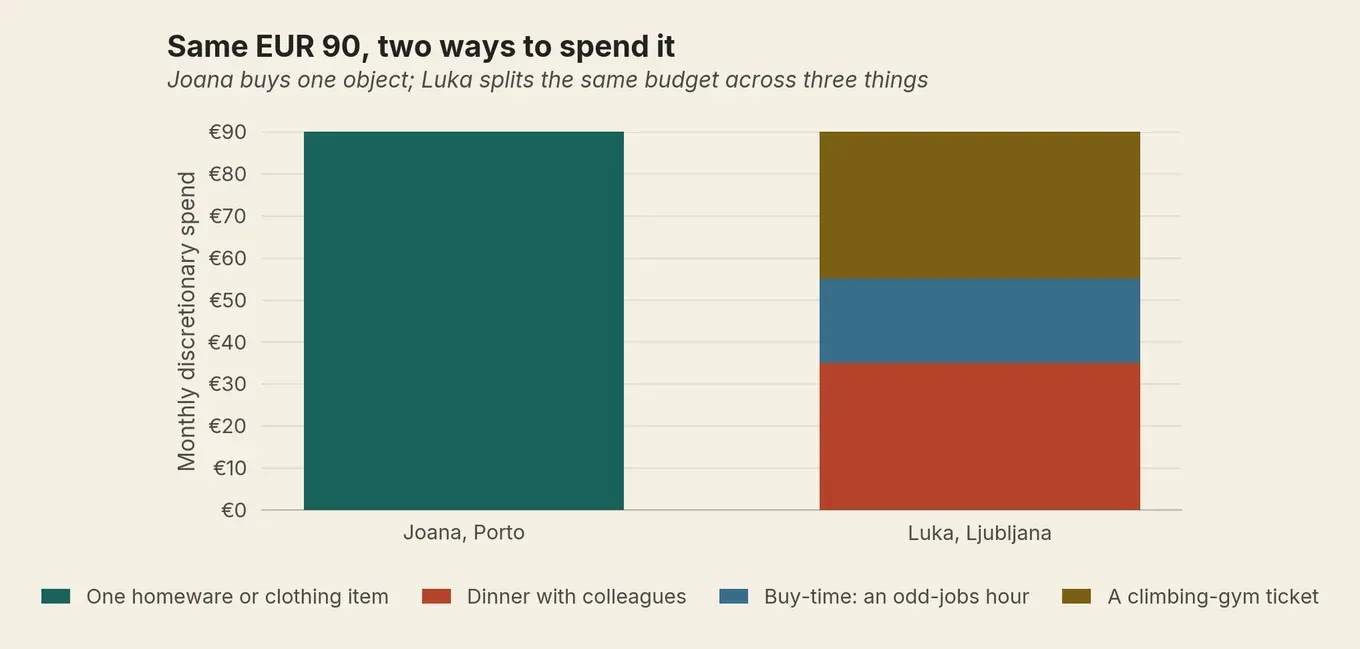
Two people, the same modest discretionary pot, one month apart in how they spent it.
Joana, in Porto, had roughly €90 of genuinely free money most months. She spent it on one thing each month: a new homeware piece, a piece of clothing she had been meaning to buy, something for her flat. It felt like a treat when it arrived. Three weeks later she would walk past it without seeing it. “I kept thinking the next thing would stick,” she says. “It never did.” She did not change her budget. She changed one purchase. The next month she booked a cooking class with a friend instead, at roughly the same cost. She is still talking about it six weeks later. Same euros, different half-life.
Luka, in Ljubljana, has the same rough budget: about €90 most months. He split last month’s across three things. Roughly €35 went on a meal out with two colleagues after a tight deadline. About €20 covered an odd-jobs platform hour to fix a dripping tap he had been dreading for three weeks. The remaining €35 bought a ticket to a climbing-gym session he had been looking forward to for a fortnight. “It sounds boring when I list it out,” he says. “But I remember all of it.” No single purchase broke the €40 mark. No single purchase faded in a week. The same budget that bought Joana one object that vanished into her flat bought Luka three evenings he can still account for.
None of this is a verdict on what you’ve bought before. Adaptation is the factory setting on every human brain, not a personal failing, and wanting nice things is not a character flaw. The four rules aren’t commandments. They’re just what the evidence keeps finding once you check it against your own week.
The owl’s filing system, for what it’s worth, keeps “happiness” in the same drawer as “things I keep meaning to do”, a drawer the owl audits with great solemnity and rarely opens. Yours doesn’t have to be like that. Buy the dinner. Keep the receipt for the cleaner. Walk past the sofa you were going to buy, and book the trip you were not.
Frequently asked questions
Is it true that money can't buy happiness?
What kind of spending makes you happier?
Why do experiences make us happier than things?
How does spending on others make you happier?
Does buying time make you happier?
Should you buy many small pleasures instead of one big purchase?
What can you buy to be happy on a normal budget?
How does the US income research apply to European earners?
Sources (16)
- Happier Lives Institute: How to Best Buy Happiness (2025)
- Cornell University: This Holiday Season, Try Shopping for Experiences (Gilovich, 2023)
- Harvard Gazette: Money spent on others can buy happiness (Dunn, Aknin & Norton, 2008)
- SAGE Journals: Prosocial Spending and Happiness (Dunn, Aknin & Norton, 2014)
- PubMed: Waiting for Merlot - anticipation of experiential vs material purchases (Kumar, Killingsworth & Gilovich, 2014)
- PubMed: Prosocial spending and well-being, cross-cultural evidence (Aknin et al., 2013)
- PMC: Buying time promotes happiness (Whillans, Dunn et al., 2017)
- PMC: Benefits of prosocial spending and buying time moderated by age, gender or income (Lok & Dunn, 2022)
- PubMed: High income improves evaluation of life but not emotional well-being (Kahneman & Deaton, 2010)
- PubMed: Experienced well-being rises with income, even above $75,000 per year (Killingsworth, 2021)
- PubMed: Income and emotional well-being, a conflict resolved (Killingsworth, Kahneman & Mellers, 2023)
- PMC: How spending decisions shape happiness in everyday life (Stenlund et al., 2024)
- Google Books: Happy Money - The Science of Happier Spending (Dunn & Norton, Simon & Schuster, 2013)
- Eurostat: Mean and median income by age and sex - ilc_di03 (2025)
- Eurostat: Living conditions in Europe - income distribution and income inequality (2024)
- Penn Today: Does more money correlate with greater happiness? (Killingsworth, 2023)
— That's the lot. It is now night.
Want more of this in your Google results?
Add Money Owl as a preferred source, and Google will show our finance pieces higher when you search for them.
By Jure Jaklič
Founder and editor of Money Owl. Data analyst by trade; personal finance learned first-hand across six European countries.
Recommended

How to teach your brain to delay gratification
Delayed gratification is a skill, not a flaw you were born with. Four small levers turn it into a saving habit instead of a daily willpower fight.
Loud budgeting: how to turn down plans you can't afford without shame
Someone's booked a hen weekend that costs a week's groceries. Loud budgeting is how you say no to it without sounding cheap, broke, or mean.
Why you can't save money (it was never willpower)
You keep failing the willpower test because it was never a willpower test. Change the set-up, automate one transfer, and saving happens without you.