
The point.
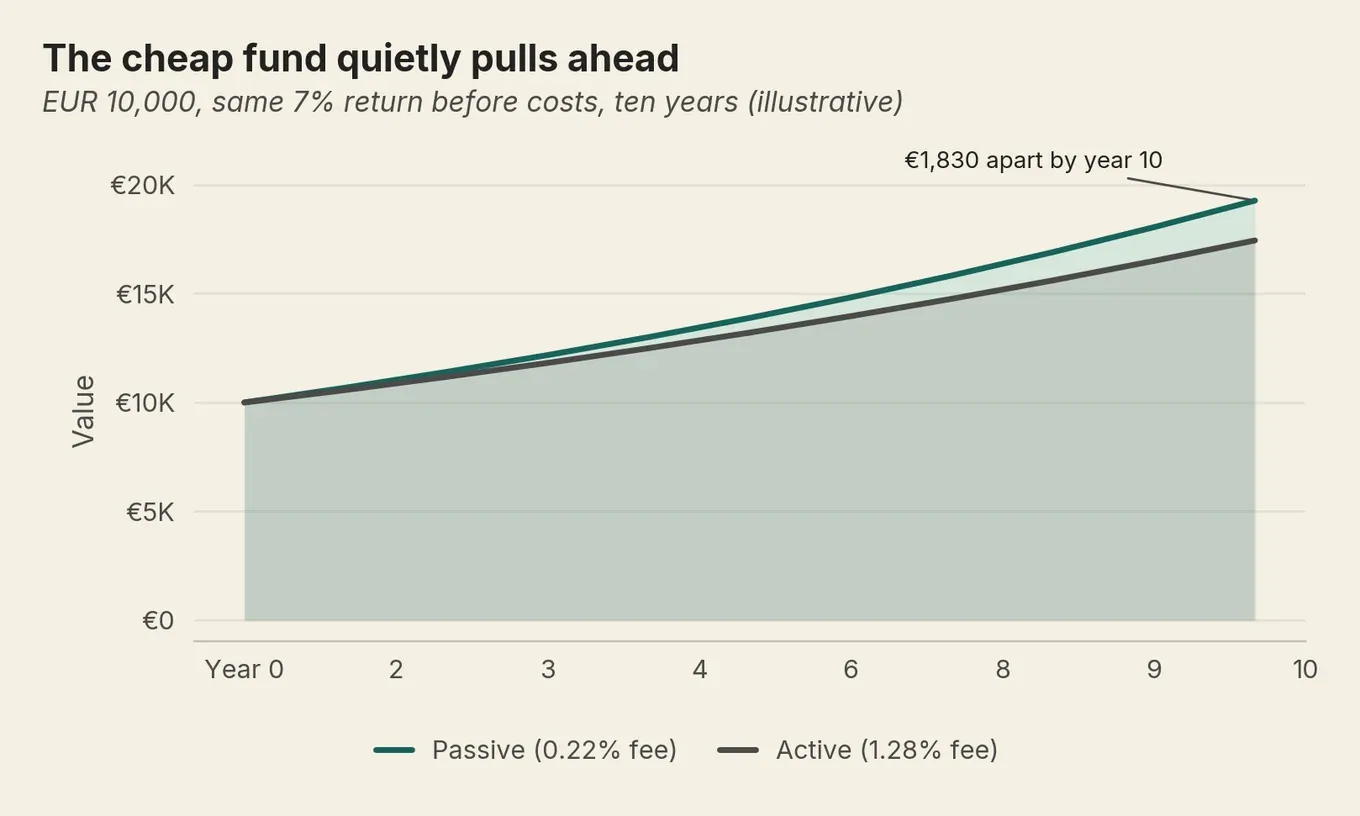
- In euros, the average active equity fund charges about 1.28% a year against 0.22% for a passive one, and that fee gap compounds: on a EUR 10,000 ten-year hold at the same 7% return, the passive fund ends roughly EUR 1,830 ahead on fees alone.
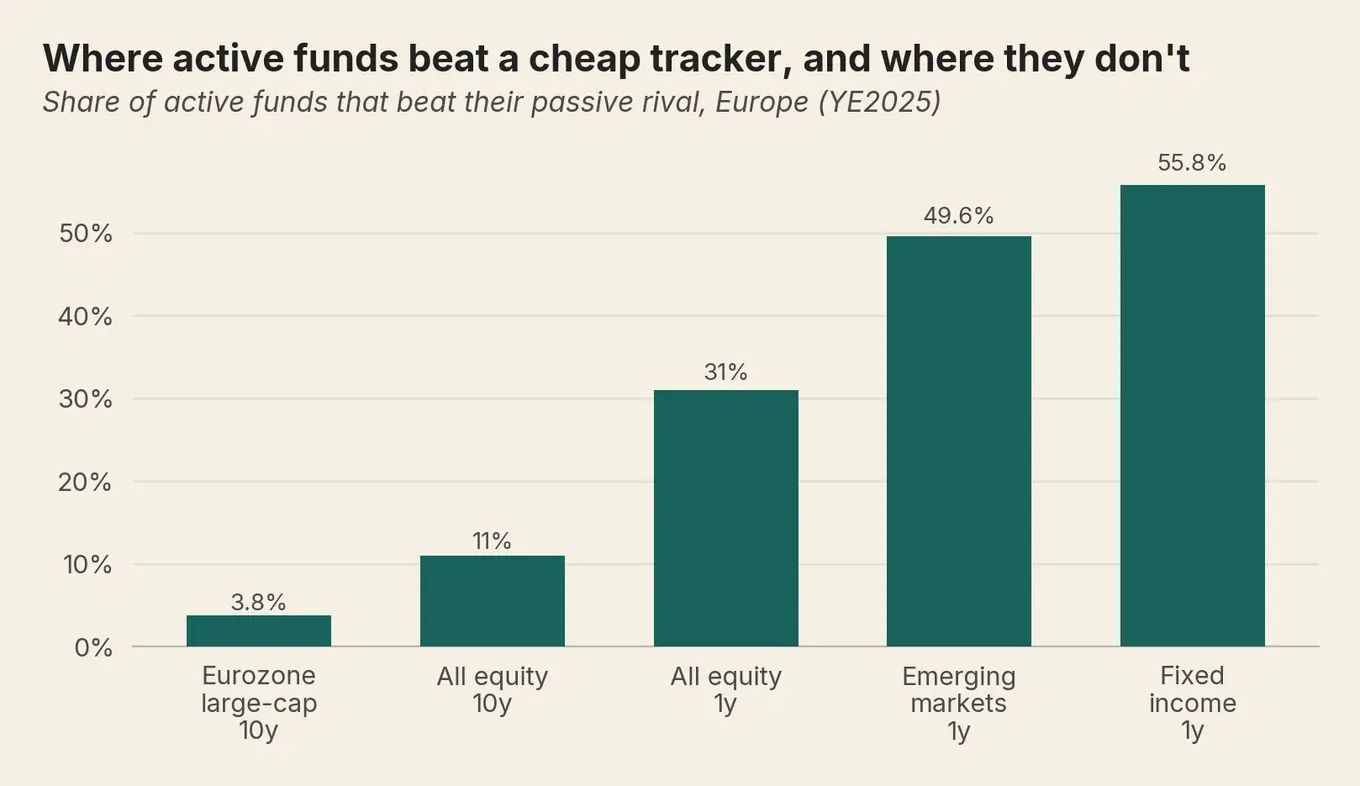
- Most active funds lose after fees. In 2025 only 31% of active European equity funds beat a cheap passive rival over one year, and just 11% over ten; among eurozone large-cap funds the ten-year figure is 3.8%.
- Active still earns its fee in less-efficient corners: ESMA shows active bond funds returned 7.2% net in 2024 against 6.3% for passive, and emerging-markets and small-cap success rates run far higher than large-cap.
- The tax wrapper never shrinks the gap, it widens it: a German taxable Depot adds the Vorabpauschale (2026 base rate 3.20%), while a UK ISA (GBP 20,000 allowance for 2026-27) leaves the fee gap as the whole story.
The point.
- In euros, the average active equity fund charges about 1.28% a year against 0.22% for a passive one, and that fee gap compounds: on a EUR 10,000 ten-year hold at the same 7% return, the passive fund ends roughly EUR 1,830 ahead on fees alone.
- Most active funds lose after fees. In 2025 only 31% of active European equity funds beat a cheap passive rival over one year, and just 11% over ten; among eurozone large-cap funds the ten-year figure is 3.8%.
- Active still earns its fee in less-efficient corners: ESMA shows active bond funds returned 7.2% net in 2024 against 6.3% for passive, and emerging-markets and small-cap success rates run far higher than large-cap.
- The tax wrapper never shrinks the gap, it widens it: a German taxable Depot adds the Vorabpauschale (2026 base rate 3.20%), while a UK ISA (GBP 20,000 allowance for 2026-27) leaves the fee gap as the whole story.
Everyone tells you to “just buy an index fund,” then walks off pleased with themselves before anyone explains what you’re giving up.
So here is the passive vs active investing trade you’re being asked to make. A passive fund copies a market. An active fund pays a human to beat it. The cheap one is dull. The dear one promises more and mostly doesn’t deliver. What follows is the maths that proves it, in euros, plus the narrow cases where the dear option genuinely earns its keep. The owl will be honest about those. The moment a comparison only ever lands on one side, you can smell the sales pitch.
What’s the difference between passive and active investing?
A passive fund tracks an index. It buys the benchmark’s shares in the benchmark’s proportions, and changes only when the index does. Its goal, per FINRA (opens in new tab), is to “recreate market performance over time.” It isn’t trying to be clever. Being un-clever is the product. If “tracks an index” is already doing too much work, start with our plain-English explainer on how the stock market works.
An active fund does the opposite. A manager picks securities, times trades, and aims to beat a benchmark by judgement. You pay for that judgement whether or not it works, and mostly it doesn’t.
In Europe both arrive in the same legal box: a UCITS fund, the EU-regulated wrapper that lets a fund sold in Frankfurt be bought in Dublin. A passive one is often a UCITS index fund or a UCITS ETF, a fund that trades like a share. Choosing between dozens of near-identical trackers is its own small skill, which our guide to picking an ETF for a European portfolio walks through. The annual cost is the TER, or Total Expense Ratio, sometimes labelled OCF for Ongoing Charges Figure: the slice the fund takes every year, win or lose. A “tracker” is a passive index fund. A “success rate” is the share of active funds that beat their cheap passive rival over a stretch of years. Even a passive fund never copies its index perfectly, because fees and the trading needed to mirror it drag a little, a slippage Vanguard (opens in new tab) calls tracking difference.
Do active funds beat index funds after fees in Europe?
Mostly, no. In 2025 only 31% of active equity funds in Europe beat a cheap passive rival over the year, and over ten years that falls to about 11%. Among eurozone large-cap funds the ten-year figure is just 3.8%, so roughly 96 in 100 fell short (Morningstar European Active/Passive Barometer, Year-End 2025 (opens in new tab)).
That’s the heart of the active vs passive funds Europe debate. Large-cap is the most picked-over corner there is, which is exactly why the dear option struggles most there.
The reason is duller than skill. It’s cost. The EU regulator, ESMA (opens in new tab), found that in 2024 the average active equity UCITS fund charged about 1.28% a year against 0.22% for the average passive one. ESMA measured the gap: passive funds are “on average about 60-80% cheaper than active funds.” That gap doesn’t sound like much. Watch what it does over time.
One worked example, in euros, holds everything else equal. Picture Lukas, 34, in Munich. He leaves €10,000 alone for ten years, with both funds earning the same illustrative 7% a year before costs. (Illustrative matters there: investment values can fall as well as rise, and actual returns depend on the fund’s performance and its charges, not on a number the owl picked for a clean table.) Only the annual fee differs.
| Strategy | Yearly fee | Net return | Value after 10 years |
|---|---|---|---|
| Active equity UCITS fund | 1.28% | 5.72% | about €17,440 |
| Passive equity UCITS fund | 0.22% | 6.78% | about €19,270 |
Lukas ends roughly €1,830 ahead with the passive fund. Not because the index manager was smarter, but because the fund was cheaper, and cheaper compounds. That €1,830 is the head start the active manager has to claw back before earning you a single extra euro. Every year. Just to draw level. And the quoted fee isn’t even the whole bill: ESMA notes distribution costs alone make up 48% of what UCITS investors pay, so the headline yearly fee understates the true drag.
When do active fund managers win?
Now the honest half. “Passive always wins” is a slogan, not a fact. Active managers do win. Just rarely, and only where winning is still possible. The pattern, per Morningstar (opens in new tab), is simple: the less efficient the market, the better active does. In a corner thousands of analysts already comb over, an extra clever person finds nothing left to find. In a quiet, under-researched one, they sometimes do.
Do active managers beat passive funds in bonds?
In 2024, yes. ESMA’s own numbers: active bond funds returned 7.2% net that year, against 6.3% for passive funds and 5.7% for bond ETFs. Here active management earned its fee, because bond indices are harder to copy cleanly and a good manager can dodge the worst issuers in a way an index cannot.
Where else can active still win?
Two awkward corners. In global emerging-markets equity, the active success rate hit 49.6% over one year and held near 19.6% over ten, far above the eurozone large-cap rate. Small companies tilt the same way, though their returns are lopsided: a handful of stocks drive the whole index, and a manager who misses them underperforms badly. In 2025, 97% of UK small-cap active funds still failed to beat their benchmark (SPIVA Europe (opens in new tab)). “Less efficient” means a fighting chance, not a guarantee.
Why do most active funds lose money net of fees?
Three reasons, and none of them needs a chart.
The first is arithmetic, and it’s brutal. Before costs, the average active euro and the average passive euro earn the same market return; both are in the same market. After costs, the active euro has paid more for the privilege, so the average active fund must, by simple maths, lag. The economist William Sharpe wrote this down in 1991, and as the CFA Institute (opens in new tab) sums it up, after costs active management becomes “a zero-sum, and ultimately negative-sum, game.” Higher fees buy lower returns, not higher ones.
The second is survivorship, where the marketing quietly cheats. A fund that does badly gets closed or merged away, and vanishes from the league table. Count only the funds left standing and active looks respectable. Count the dead ones too, as SPIVA (opens in new tab) and the Morningstar Barometer (opens in new tab) both insist you should, and the honest question gets harder: did this fund survive the decade and beat the cheap passive alternative you could’ve bought? Most did not.
Can’t you just pick last year’s winning fund?
You can try, and the data is unkind to it. Funds that top the table one year rarely repeat; SPIVA finds “relatively few funds can consistently stay at the top.” That’s the third reason: persistence. One good year is luck wearing a nice suit. It isn’t a plan.
There is a real argument on the other side, and skipping it would be dishonest. The academic Lasse Pedersen has challenged the strict zero-sum view: active managers, he argues, do useful work setting prices and providing liquidity as a market churns, so the index isn’t a fixed pie they merely slice. A serious point. It still doesn’t change what the average retail active fund hands back after fees: less.
Where does the tax wrapper change the answer?
So far this is a fee story. Tax is the second drag, and it depends entirely on the account your fund sits in. It never shrinks the active-versus-passive gap; where it shows up, it widens it. The mechanics belong to a separate conversation about tax-efficient investing. The same fund, three accounts, three outcomes.
- Lukas’s German Depot, a plain taxable account. Hold an accumulating fund and the Vorabpauschale applies: an advance tax on a notional gain, charged even in a flat year. The base rate for 2026, the Basiszins, is 3.20%, set by the Bundesfinanzministerium (opens in new tab). The drag bites hardest here, especially on a busy active fund.
- Camille’s French PEA. Gains roll up tax-deferred, and after five years withdrawals escape income tax, though social levies (opens in new tab) still apply. The catch: the wrapper pushes you toward EU and EEA shares, which sits awkwardly with a buy-the-whole-world passive instinct.
- Sarah’s UK ISA. The clean one. Inside the £20,000 annual allowance (opens in new tab) for 2026-27, gains and income simply aren’t taxed, so the fee gap from earlier is the entire story.
| Account | Where | What the wrapper does | Effect on the passive-vs-active gap | The catch |
|---|---|---|---|---|
| Depot (taxable) | Germany (Lukas) | Charges Vorabpauschale, a tax up front on a gain you have not banked yet, even in a flat year (2026 base rate 3.20%) | Widens the gap most | Busy active funds drag hardest here |
| PEA | France (Camille) | Gains roll up tax-deferred; after five years, withdrawals escape income tax (social levies still apply) | Roughly neutral | Pushes you toward EU and EEA shares only |
| ISA | UK (Sarah) | No income tax or capital gains tax inside the wrapper | Leaves the gap untouched | The clean one; the fee gap is the whole story |
So tax bites hardest for a German holder of a busy active fund in a taxable account, and barely at all inside an ISA.
Which strategy fits your goals?
Reason about your own money here, rather than letting the owl do it for you. Start with the segment. For broad developed-market exposure, eurozone or global large companies, passive is the rational default; that’s where the fee gap is hardest to overcome and active’s record is worst. There’s no shame in average here. Average, after costs, beats most of the people trying to beat it. If your target is a truly awkward corner, some bond categories, emerging markets, smaller companies, then active is at least a real question, though you’d need a fund whose edge clears its higher fee year after year. Rare. Then check the account: a clean wrapper leaves the fee gap as the whole story; a taxable account, especially a German one, stacks tax on top.
A pension is a long campaign. You commit in your twenties, contribute for forty winters, and at the end there is a number. No horn, no feast, no song about it. Over that distance the cheap, dull fund’s small yearly advantage compounds into a big lead. Which is why passive wins on the maths for the boring core of most portfolios, and active is the exception rather than the rule.
The man who invented the index fund framed this cost reality decades before ESMA put numbers on it. As Vanguard founder John C. Bogle told a 2005 audience:
In investing, realize that you get what you don’t pay for. Whatever future returns the markets are generous enough to deliver, few investors will succeed in capturing 100% of those returns, simply because of the high costs of investing.
Pick the strategy whose costs you can live with, set it up, and the only question left is whether to feed it all at once or drip the money in over time. Then go and do something that is not this.
Frequently asked questions
Do active funds beat index funds after fees in Europe?
How much does the fee gap actually cost over time?
When do active fund managers actually win?
Why do most active funds lose money net of fees?
Does the tax wrapper change the passive vs active answer?
Sources (12)
- ESMA: Costs and Performance of EU Retail Investment Products 2025
- Morningstar: European Active/Passive Barometer, Year-End 2025 (via Paperjam)
- Morningstar: Active vs. Passive Fund Performance, When Do Active Managers Win?
- Morningstar: Active/Passive Barometer methodology
- S&P Dow Jones Indices: About SPIVA
- SPIVA Europe: UK Equity Active Fund Performance in 2025
- CFA Institute: From Sharpe to Pedersen, Why Active Management Isn't Zero-Sum After All
- FINRA: Active vs. Passive Investing
- Vanguard: What affects index tracking
- Bundesfinanzministerium: Basiszins zur Berechnung der Vorabpauschale, 2. Januar 2026
- Service-Public.fr: PEA (Plan d'Epargne en Actions)
- GOV.UK: Individual Savings Accounts (ISAs)
— That's the lot. It is now night.
Want more of this in your Google results?
Add Money Owl as a preferred source, and Google will show our finance pieces higher when you search for them.
By Jure Jaklič
Founder and editor of Money Owl. Data analyst by trade; personal finance learned first-hand across six European countries.
Recommended

Dividend investing in Europe: is it really passive income?
Pooled across 2018, 2019, 2021 and 2022, 70.6% of European once-a-year dividend payments arrived in April, May and June. What that does to a monthly budget, and what living off it really costs.

The three-fund portfolio for European investors
Europe's three-fund portfolio has its own shape. A single all-world UCITS fund owns the whole world, so most first-timers need two funds, not three.
Warren Buffett's principles, translated for Europe
For 60 years Buffett beat the market, then told everyone else to index. His principles, translated for Europe: UCITS ETFs, the 90/10 rule and tax wrappers.