
The point.
- Diversification lowers the swings in your portfolio without lowering the return you expect from the market you hold. It is the one move in investing that does not charge you for safety.
- It removes the risk tied to one company or sector, which the market never paid you to carry anyway. It cannot remove market risk: in a genuine panic, holdings that normally drift apart fall together.
- A home-market fund kills single-company risk but leaves single-country risk completely intact. The euro area was about 8% of world stock-market value when the ECB measured it in 2018, yet euro-area investors held far more than that at home.
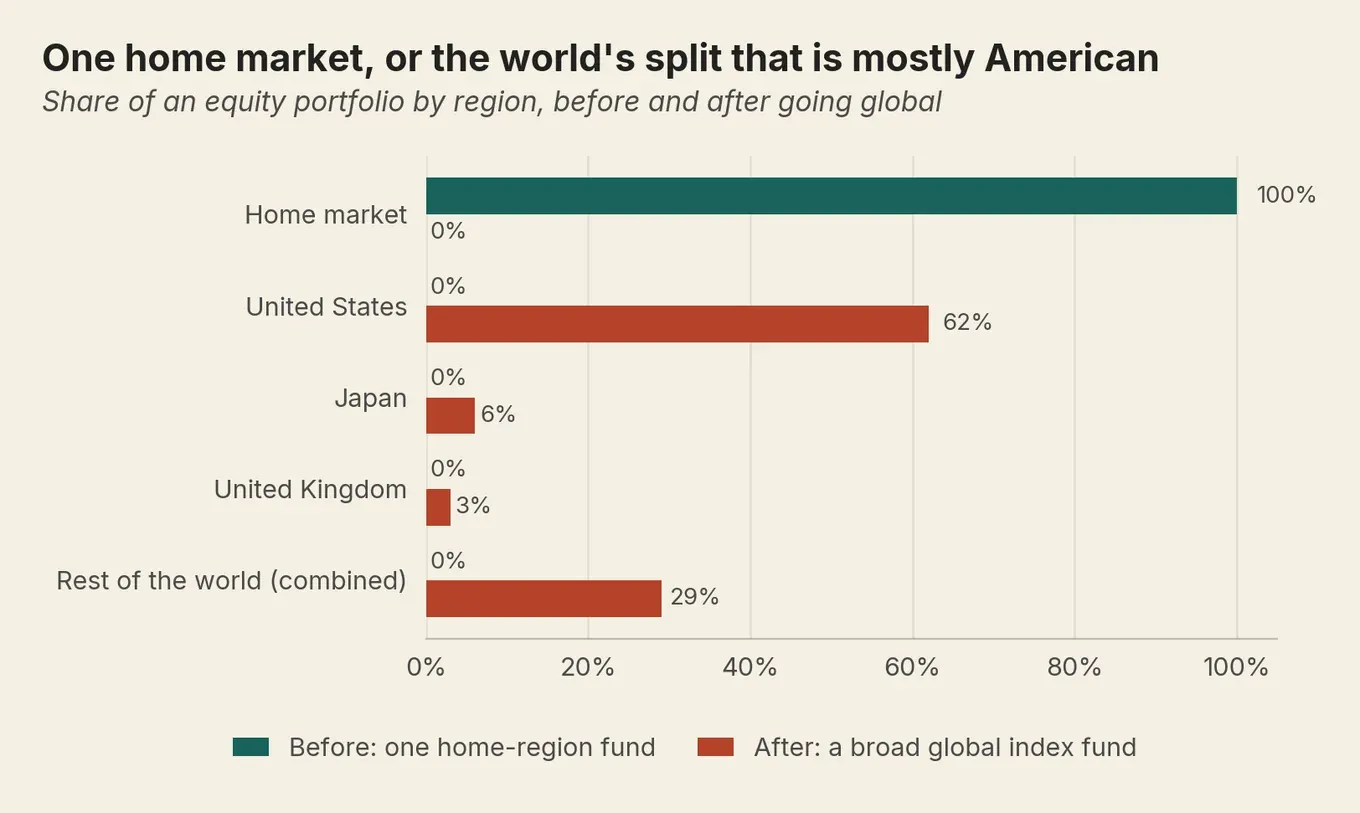
- "Own the world" still means mostly own America: a broad global index fund was roughly 62% US (FTSE All-World) to 64% (MSCI ACWI). You are not escaping concentration, you are choosing which concentration with your eyes open.
- You can over-diversify. Past 8 to 30 holdings the extra names do almost nothing, while a drawer full of funds piles on cost and overlap. One good broad global fund and the discipline to leave it alone does most of the job.
The point.
- Diversification lowers the swings in your portfolio without lowering the return you expect from the market you hold. It is the one move in investing that does not charge you for safety.
- It removes the risk tied to one company or sector, which the market never paid you to carry anyway. It cannot remove market risk: in a genuine panic, holdings that normally drift apart fall together.
- A home-market fund kills single-company risk but leaves single-country risk completely intact. The euro area was about 8% of world stock-market value when the ECB measured it in 2018, yet euro-area investors held far more than that at home.
- "Own the world" still means mostly own America: a broad global index fund was roughly 62% US (FTSE All-World) to 64% (MSCI ACWI). You are not escaping concentration, you are choosing which concentration with your eyes open.
- You can over-diversify. Past 8 to 30 holdings the extra names do almost nothing, while a drawer full of funds piles on cost and overlap. One good broad global fund and the discipline to leave it alone does most of the job.
You bought a fund. Maybe two. You did the single hardest thing in investing, which is start. Then a bad week made you open the app, see a column of red, and wonder whether you were ever as safe as you assumed.
Here’s the honest answer. You’re safer than the person who owns one share of one company, and less safe than you think. Not because you got it wrong. Because you swapped one kind of risk for another, and nobody finished explaining the second kind. That gap is fixable in an afternoon. Let’s close it.
What is portfolio diversification, and why does it matter?
Portfolio diversification means spreading your money across investments that don’t all rise and fall together, so a bad result in one is softened by a steadier result in another. It lowers the swings in your whole portfolio without lowering the return you expect from the market you hold. That second half is the part people skip.
The principle is not just a financial-writer’s hunch; the regulators say it too. The SEC’s own investor-education guide puts the mechanism like this:
By including asset categories with investment returns that move up and down under different market conditions within a portfolio, an investor can protect against significant losses.
The old line is “don’t put all your eggs in one basket.” True, as far as it goes. Harry Markowitz won a Nobel Prize for working out the bit the proverb leaves out: not just how many baskets, but which ones, and how they behave when the floor wobbles. His phrase for it, that diversification is “the only free lunch in financial markets” (opens in new tab), is the whole reason this is worth your Tuesday evening. It’s the one move that lowers your risk without asking you to accept a lower expected return. Everything else in finance charges you for safety. This one’s on the house.
Still working out what a share or an index even is? Start with our explainer for new investors and come back. The rest of this assumes you own something and want to know whether it’s doing what you hoped.
How does diversification work, and what can’t it touch?
It works because of correlation. That’s just a measure of whether two holdings tend to move together or apart. When they move apart, a loss in one is partly cancelled by the other, and your portfolio’s ride gets smoother than the average of its parts. FINRA (opens in new tab), the US markets regulator, gives the classic pairing: shares and high-quality bonds often move in different directions, so holding both steadies the whole.
The reason this matters is that there are two kinds of risk, and only one of them responds to spreading your money.
Which risk can you spread away?
The kind you can spread away is tied to one company or one sector: a scandal, a lost court case, a foolish boss. Hold that firm alone and it stings. Spread it among hundreds and it barely registers, because the bad news is local.
The Corporate Finance Institute (opens in new tab) calls this the risk specific to one firm. Markets won’t pay you to carry it, because you could have spread it away for free. Carrying it anyway is just an expensive hobby.
Which risk can’t you?
The kind you can’t spread away is the whole market falling at once: a pandemic, a credit crisis, a war. No number of holdings saves you, because everything drops together. This is what diversification can never reach.
The same source (opens in new tab) calls it market risk, and it marks the honest boundary of the whole subject. Diversification removes the first kind cheaply. It can’t touch the second. Anyone who tells you otherwise is selling something.
What does genuine diversification look like across asset classes?
Think of it as a ladder. Each rung adds a way for your holdings to be less alike, which is the one thing that genuinely reduces risk.
The bottom rung is one company’s share. Climb to several shares across different sectors, and one firm’s bad year stops being your bad year. Climb again to a fund that holds your home country’s whole market, and single-company risk all but vanishes. The next rung is global equities, your money spread across many countries instead of one. Above that sits diversifying across asset classes entirely: shares, bonds, property, cash, which behave differently from one another. Higher still are currency and time, the latter meaning you keep the mix steady by rebalancing (opens in new tab), selling a little of what has run up and topping up what has lagged.
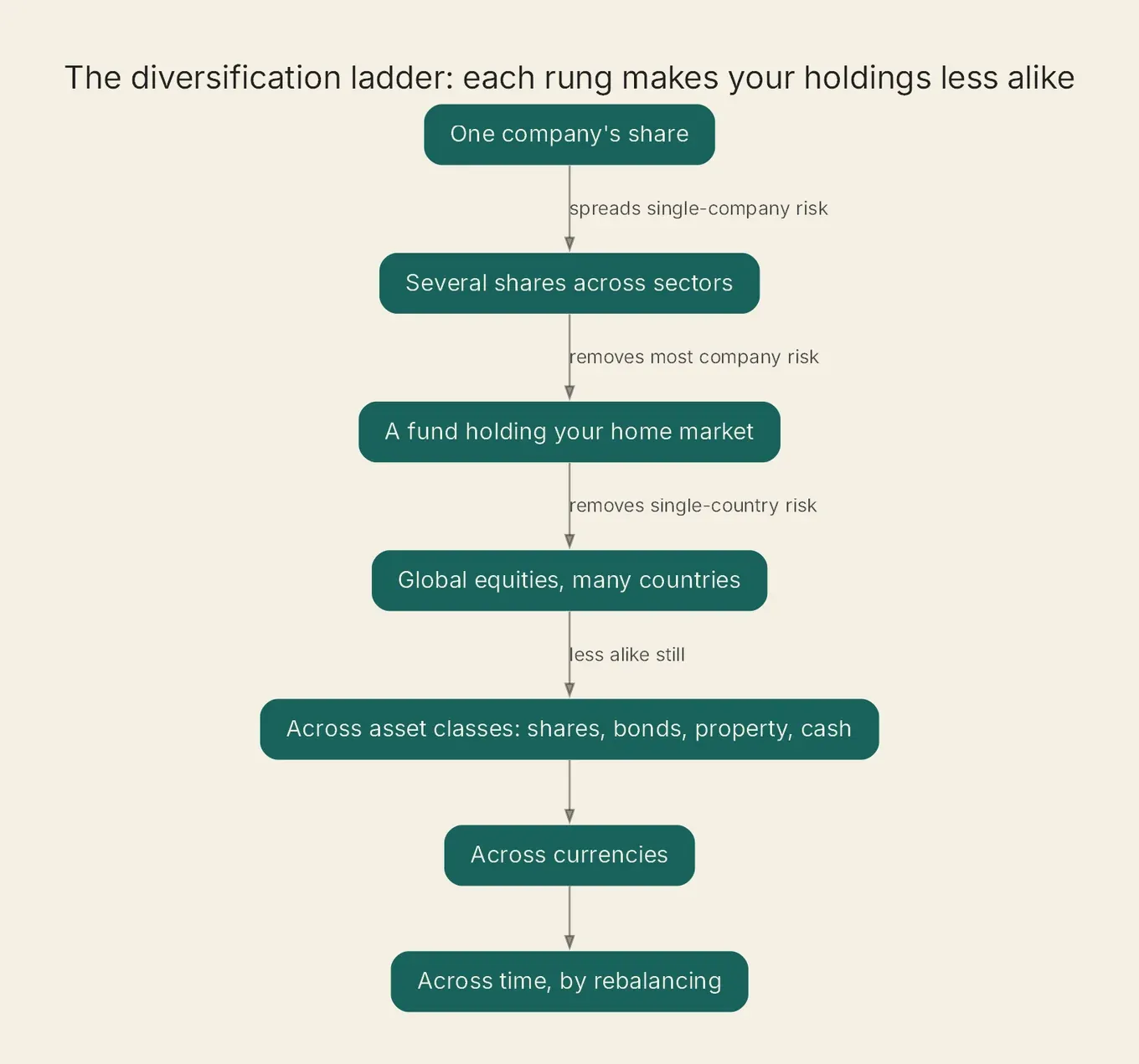
Most beginners climb two or three rungs, stop, and assume they’ve reached the top. That assumption is what this guide is about. One quiet but useful warning: a fund that simply weights companies by size can pile up in its biggest few names. So “I own an index” isn’t the same as “I own thousands of things equally.” Worth knowing before you relax.
Are you diversified, or just home-biased?
Here’s the rung almost everyone misses. A fund tracking your home market removes single-company risk and leaves single-country risk completely intact. If your one economy has a rough decade, so does your portfolio, index or no index.
And your home market is smaller than it feels. As the European Central Bank measured in 2018, listed companies in the euro area made up about 8% of world stock market value (opens in new tab), yet euro-area investors held roughly 15% of their shares at home, close to double the global weight. The number is a few years old now. That pull hasn’t moved.
This is home bias, and let’s be clear: it is rational, and almost everyone does it. You lean toward what’s familiar, what your bank put in front of you, and what’s priced in the currency you spend. That makes sense on its own terms. The ECB itself notes that once you look past where a fund is registered to where its investor lives, the home tilt shrinks by a fair margin, so the bias is partly real and partly a measurement quirk. A modest home lean can even be sensible, for currency and tax reasons worth understanding before you tilt. The trouble isn’t having a tilt. It’s having a tilt you never chose.
Leaning toward home has a name, and a central bank that measures it. The ECB defines the tendency this way:
investors tend to hold a disproportionate share of domestic assets in their portfolio, a phenomenon known as ‘home bias’.
Picture Lena in Leipzig, comfortable holding the DAX because German firms are names she knows. Or Aoife in Dublin, whose broker quietly defaulted her into an Ireland-and-Europe fund. Or Maja in Ljubljana, holding a home-region pick because it felt close to home. Same instinct, three cities, one consequence: a portfolio betting heavily on a small slice of the world.
So the fix is “own the world in proportion,” through one broad global fund. Mostly right, with a twist worth your attention. A broad global index is itself well over half American. The widely held Vanguard FTSE All-World fund (opens in new tab) was about 62% US as of 31 May 2026; the MSCI ACWI index (opens in new tab) was nearer 64%. Britain? About 3% of the All-World. So “own the world” still means “mostly own America.” A global fund is still the sensible default. The job is to know what you hold. You aren’t escaping concentration. You’re choosing which concentration, with your eyes open, which is the entire job.
Can a portfolio be too diversified?
Yes. And the trap is sneakier than under-diversifying, because it feels responsible. After a scare, the instinct is to buy more funds to feel safer. Past a point, more funds stop cutting risk and start adding cost and overlap.
The shape of it has been studied for decades. Evans and Archer found in 1968 that 8 to 10 shares across different sectors already capture most of the benefit; Statman argued in 1987 that you want at least 30 (opens in new tab). Either way, the curve is steep at first and then flat. Once company-specific risk is gone, extra names do almost nothing.
The cost side is blunter. CFA Institute research (opens in new tab) found that going from one fund to ten cut active risk from 3.3% to 1.2%, while the fee paid per unit of that risk almost trebled. You pay steadily more for steadily less. Peter Lynch had a word for it: diworsification.
The practical relief is that a single broad global fund already holds thousands of companies across dozens of countries. You don’t need a drawer full of funds. You need one good one and the discipline to leave it alone. If you want the nuts and bolts of picking it, fees, accumulating versus distributing, where it’s domiciled, that’s a job of its own, and we cover it in how to choose ETFs in Europe. The hub you’re reading explains why; the spoke explains which.
Does diversification reduce your returns, or protect you in a crash?
Two fears, one section, because they’re the same worry asked twice: is this whole thing oversold?
On returns: no, diversification doesn’t lower the return you can expect from the market. It narrows the range of outcomes. You give up the small chance that one lucky holding makes you rich, in exchange for not being sunk by one unlucky one. What you shed is that unrewarded company-specific risk from earlier, the kind the market never paid you for. Concentration is extra risk with no extra reward attached.
Does diversification protect you in a crash?
Not from a systemic one. Diversification cushions ordinary volatility and one-company disasters, but in a genuine panic the holdings that normally drift apart fall together, so the protection thins exactly when you want it most. It removes avoidable risk, not market risk.
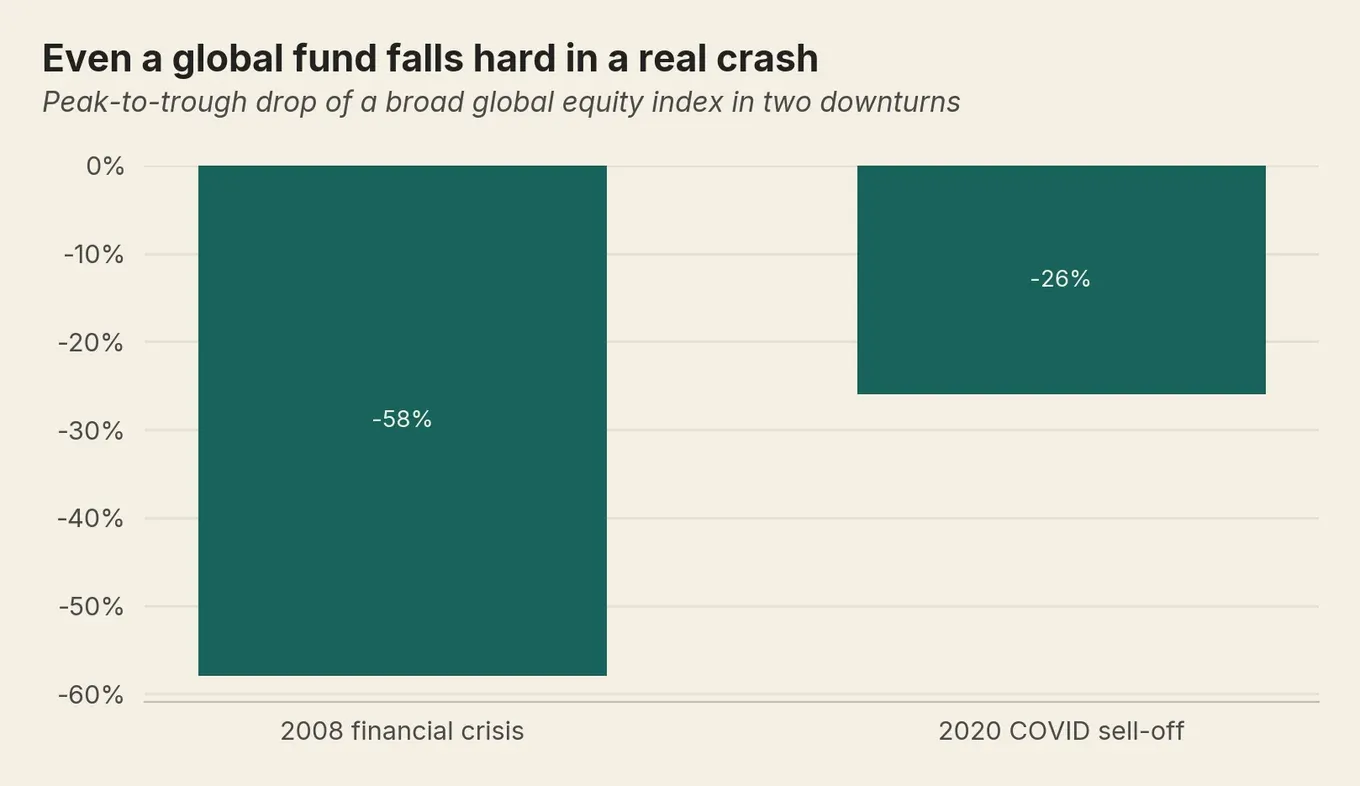
On crashes, the honest answer is the one no brochure prints. In an ordinary year, diversification works beautifully. In a genuine panic, the holdings that normally drift apart start falling together. Researchers Page and Panariello documented it in a 2018 study tellingly titled “When Diversification Fails” (opens in new tab): in the worst moments, holdings that looked unrelated start moving as one, and the spread of risk you were counting on quietly closes up. The drops are real. Global shares fell by more than half in the 2008 crisis (opens in new tab) and around 26% in the fast 2020 COVID sell-off (opens in new tab). And the old comfort that bonds always cushion shares depends on the weather: through 2022’s inflation shock, shares and bonds fell together (opens in new tab).
One thing does still tend to help when shares fall hard, in normal conditions: high-quality government bonds. When investors panic, they often run toward safety, which props up government bonds while shares sink. That flight to safety, what the trade calls flight-to-quality, is why a shares-plus-bonds mix tends to ride out a crash better than shares alone. Tends to, not always, as 2022 reminded everyone.
So why bother? Because diversification was never meant to stop a systemic crash; nothing does. It removes the avoidable risk, cheaply, every other day of the decade. That’s the deal, and it’s still the best one going. There’s one more wrinkle worth holding in mind: even a global fund carries a concentration tail, because the US itself is unusually top-heavy right now. The IMF noted in 2025 (opens in new tab) that technology makes up about 35% of the US market, with a handful of giant firms accounting for about a third of the whole US index, a concentration above the dot-com peak. Owning the world buys you a lot of safety, and a quiet bet on a few American companies you didn’t pick.
How should a European beginner approach portfolio diversification?
Step back and check what you hold, by exposure rather than by count. Three funds that are all home-market shares is one bet wearing three coats. Count won’t tell you. Ask what each holding is exposed to, not how many you own.
Tilted hard toward your home country? That’s the common gap, not a failure, and it’s the one worth fixing first. A broad global share fund, just one, low in cost, does most of the work for most people. Adding some high-quality bonds lowers the swings further, at the cost of a little expected return; that trade is about your nerves and your timeline, not a formula. Once the mix is set, how you feed money in matters less than people fear, and we weigh the two camps in drip-feeding versus investing a lump sum.
You did the hard part when you started. The worry that brought you here wasn’t a mistake. It was the next thing, the one nobody had got round to telling you. Now someone has.
Frequently asked questions
What is portfolio diversification and why does it matter?
How does diversification work?
Does diversification reduce your returns?
Does diversification protect you in a market crash?
How many funds do you need for a diversified portfolio?
Am I diversified if I only own a home-market fund?
Sources (12)
- European Central Bank: Is the home bias biased? New evidence from the investment fund sector
- International Monetary Fund: Global Financial Stability Report, October 2025, Chapter 1
- CFA Institute / Financial Analysts Journal: Does Overdiversification Harm Mutual Fund Returns?
- Page and Panariello, Financial Analysts Journal: When Diversification Fails (via RePEc)
- Statman, Journal of Financial and Quantitative Analysis: How Many Stocks Make a Diversified Portfolio? (via RePEc)
- MSCI: Asset allocation and index futures during market crises (MSCI ACWI 2020 drawdown)
- Walter Scott: Downside protection (MSCI World 2007 to 2009 drawdown)
- FINRA: Asset Allocation and Diversification
- SEC Office of Investor Education: Beginners' Guide to Asset Allocation, Diversification, and Rebalancing
- Vanguard: FTSE All-World UCITS ETF factsheet (IE00BK5BQT80), country weights as at 31 May 2026
- justETF: MSCI ACWI ETFs index composition
- CEPR / VoxEU: Harry Markowitz and the foundations of modern finance
— That's the lot. It is now night.
Want more of this in your Google results?
Add Money Owl as a preferred source, and Google will show our finance pieces higher when you search for them.
By Jure Jaklič
Founder and editor of Money Owl. Data analyst by trade; personal finance learned first-hand across six European countries.
Recommended

Dividend investing in Europe: is it really passive income?
Pooled across 2018, 2019, 2021 and 2022, 70.6% of European once-a-year dividend payments arrived in April, May and June. What that does to a monthly budget, and what living off it really costs.

The three-fund portfolio for European investors
Europe's three-fund portfolio has its own shape. A single all-world UCITS fund owns the whole world, so most first-timers need two funds, not three.

Warren Buffett's principles, translated for Europe
For 60 years Buffett beat the market, then told everyone else to index. His principles, translated for Europe: UCITS ETFs, the 90/10 rule and tax wrappers.