

The point.
- The UCITS gate decides your whole shortlist first: it is the only kind of ETF your EU broker can sell you, and the words "UCITS ETF" appear right in a genuine fund's name.
- You cannot buy the famous US-domiciled ETFs because of the EU's PRIIPs disclosure rule, not a mistake you made, and the UCITS version tracks the exact same index anyway.
- The true cost is not the headline fee: add tracking difference and the trading spread, so a slightly dearer sticker can quietly be the cheaper fund to own.
- One broad world-equity UCITS ETF already spreads your money across thousands of companies, so a single fund can genuinely be a complete equity portfolio.
- An ETF is not deposit-protected: the investor-compensation scheme pays out if your firm collapses, but nothing covers a fall in the market price.
- Your country's tax can flip the accumulating-versus-distributing answer, so check the one local wrinkle before you click buy.
The point.
- The UCITS gate decides your whole shortlist first: it is the only kind of ETF your EU broker can sell you, and the words "UCITS ETF" appear right in a genuine fund's name.
- You cannot buy the famous US-domiciled ETFs because of the EU's PRIIPs disclosure rule, not a mistake you made, and the UCITS version tracks the exact same index anyway.
- The true cost is not the headline fee: add tracking difference and the trading spread, so a slightly dearer sticker can quietly be the cheaper fund to own.
- One broad world-equity UCITS ETF already spreads your money across thousands of companies, so a single fund can genuinely be a complete equity portfolio.
- An ETF is not deposit-protected: the investor-compensation scheme pays out if your firm collapses, but nothing covers a fall in the market price.
- Your country's tax can flip the accumulating-versus-distributing answer, so check the one local wrinkle before you click buy.
It’s 23:07 on a Sunday. Your brokerage account is funded. You’re finally ready to do the sensible grown-up thing the whole internet keeps telling you to do, and you can’t.
You go to buy the famous American S&P 500 fund the forums swear by, and your broker throws an error. So you open the screener instead, and it offers you several thousand funds that all look identical. You ask a forum, and four people give you four different tickers and then start arguing with each other.
So you close the laptop. Again.
None of this is your fault. Europe genuinely changes the rules. You can’t buy the American fund because of a paperwork rule, not a mistake you made. The list feels endless because it truly is. And once you know the one gate that quietly decides your whole shortlist, picking an ETF in Europe shrinks to something a checklist handles in an evening. Let’s sort it out.
How do you choose an ETF in Europe, step by step?
You work down a short, weighted list, in order, and stop fussing once the big things settle. Cost and fit decide nearly the whole outcome for a long-term holder. The structure choices matter far less than the internet would have you believe. Here’s the order, ranked by how much each thing actually moves your outcome.
| # | What to check | Why it matters | How much it moves the needle |
|---|---|---|---|
| 1 | Is it a UCITS ETF? | It’s the only kind your EU broker can sell you. Defines your whole shortlist. | The gate. Non-negotiable. |
| 2 | What does it track? | The index (a world tracker, the S&P 500, and so on) decides what you end up owning. | Large. This is the real decision. |
| 3 | What does it truly cost? | The headline fee plus tracking difference plus the spread you pay to trade. | Large, and compounds for decades. |
| 4 | How big is the fund? | Enough size means it trades cheaply and rarely shuts. Past a point, more does nothing for you. | Medium. A floor, not a contest. |
| 5 | Accumulating or distributing? | Reinvests your dividends, or pays them to you as cash. | Small for the mechanics. Your country’s tax can change it. |
| 6 | Where is it domiciled, and how does it copy the index? | Ireland or Luxembourg; physical or synthetic. Mostly a tax and plumbing question. | Small, and partly chosen for you. Check it, then read up. |
Notice the shape of that. The top three rows hold where the money is. The bottom three earn a glance, occasionally a real decision, but they aren’t where beginners should spend their anxiety. Most forum threads you’ve read just compare four funds tracking the same index with a 0.05% argument bolted on.
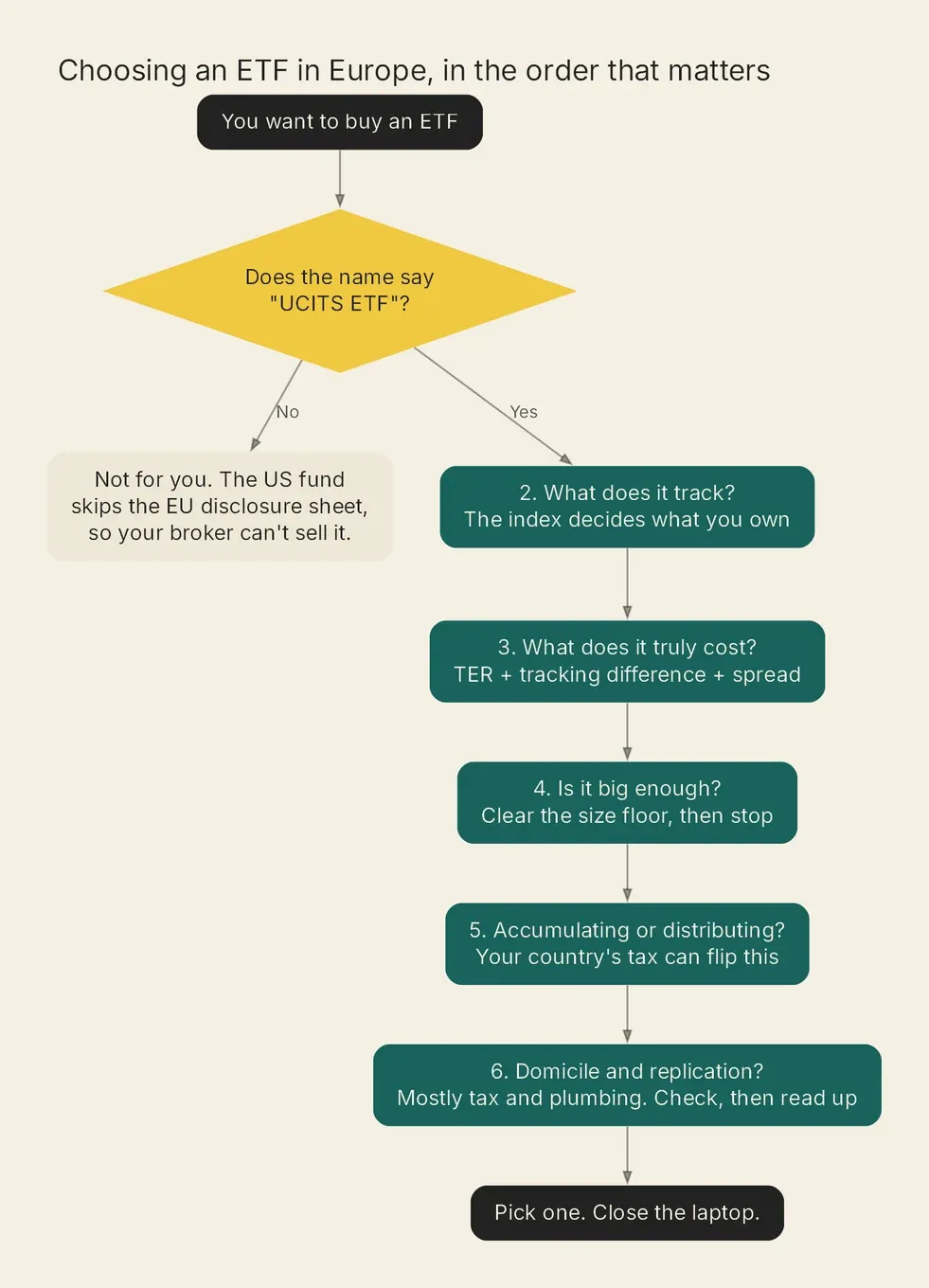
Work top to bottom, settle each one, move on. The rest of this guide explains those rows.
What is a UCITS ETF, and why can’t EU residents just buy US ETFs?
A UCITS ETF is the European-standard investment wrapper, and you can’t buy the famous American funds because they skip a mandatory EU disclosure sheet. The name stands for a long phrase about collective investment; in practice it means a fund authorised in one EU country that can then sell across the whole bloc, and that has to spread its money across many holdings rather than bet the lot on one company.
That diversification is baked into the rules under the UCITS Directive (opens in new tab). It’s why the European fund world runs overwhelmingly on UCITS ETFs. The wrapper is what makes a fund legal to sell to you.
Can you buy US-domiciled ETFs as an EU resident?
No, not as an ordinary retail investor, and the reason genuinely isn’t you. The EU’s PRIIPs rules block your broker from offering US-domiciled ETFs because the American providers skip a disclosure sheet the EU demands. Nothing wrong with your account.
Here’s the actual machinery. Under the EU’s PRIIPs rules (opens in new tab), the EU rule on packaged investments, the maker has to hand every retail buyer a short fact sheet before any sale, a Key Information Document, or KID. American ETF providers skip that sheet, because they don’t need it back home. No sheet, no sale. Your broker can’t offer it to you. This rule has governed European retail investors since 1 January 2018.
The practical effect is simple. Your selectable universe holds UCITS ETFs, and the screen carries a tell: a genuine one shows the words “UCITS ETF” right there in its name. If the product in front of you is missing them, it’s probably the American one you can’t have, or some other thing you don’t want.
Are you missing out by buying the UCITS version instead?
No. A UCITS version tracks the exact same S&P 500 or world index as the famous American fund, holds the same underlying companies, and follows the same benchmark. You’re getting the only one on the menu, not the budget option. This is the bit where most people feel stupid, so let me be plain. There’s no cleverer fund you were locked out of, and no edge the American buyers hold over you.
What should you look for in an ETF’s costs and quality?
Cost compounds quietly for thirty years, so it pays to get right. The trap is thinking the cost is the advertised fee. It isn’t.
Why does a fund’s headline fee not tell you the real cost?
The headline fee misses two costs you also bear: tracking difference and the trading spread. A fund quotes a yearly charge, the total expense ratio (TER), which on a broad world tracker runs between 0.05% and 0.50% a year, as of 2026.
On €10,000 invested, a 0.20% fund costs you about €20 a year. Real over decades, but small. The number you truly bear is the tracking difference: how far the fund’s real return drifts from the index after all its frictions, sometimes above and sometimes below what the headline fee implies. (You’ll also see tracking error, a related measure of how consistently the fund hugs the index.) A fund with a slightly higher TER can quietly track its index better and leave you better off. The cheapest sticker rarely wins outright.
Take Bram in Antwerp, choosing between two funds that track the same world index. He’s about to grab the lower headline fee, because that’s the obvious move. Watch what tracking difference does to that logic:
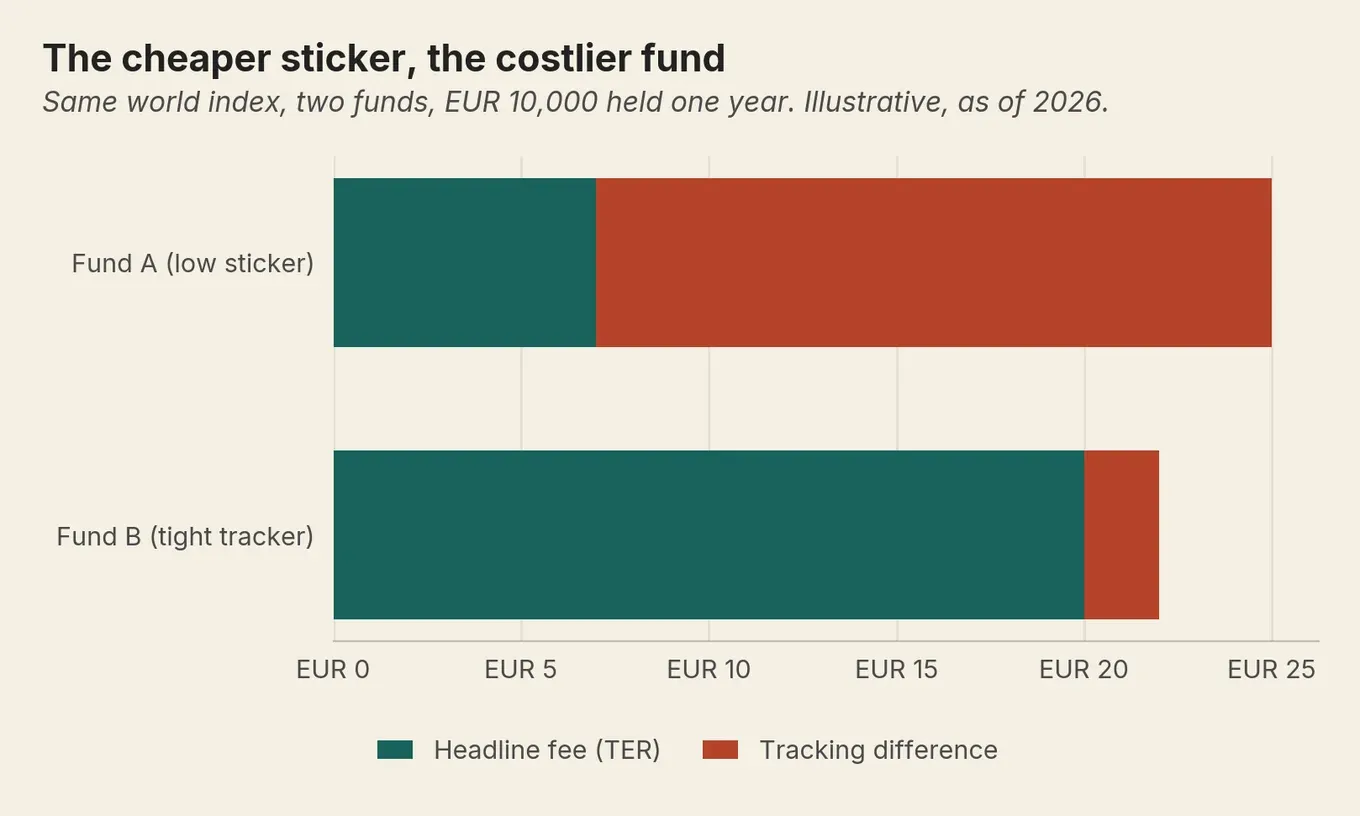
Fund A’s sticker is a third of Fund B’s, yet it costs Bram more to own once the tracking drift lands. The cheapest headline fee bought the more expensive fund. Read the tracking, not just the tag.
ESMA (opens in new tab), the EU markets regulator, makes index funds disclose their expected tracking, precisely because the headline charge hides this. Then there’s the bid-ask spread, the small gap between the buy and sell price each time you trade. On a big, liquid fund it stays tiny. On an obscure one it doesn’t.
Is a bigger ETF (higher AUM) better?
Bigger helps up to a point, then stops mattering. A larger fund trades more cheaply, holds tighter spreads, and far more rarely gets quietly shut and merged away. Past a sensible threshold, extra billions do nothing for you. A €1bn fund and a €40bn fund tracking the same index will treat you almost identically. So clear the size hurdle and move on. One more thing, and it matters: don’t mistake a big fund for a safe one. Those words mean entirely different things.
Does an investor-compensation scheme cover ETF losses?
No. An ETF falls outside the deposit guarantee that protects bank savings, and no safety net covers market losses. Two separate schemes exist in Europe, and neither does what you might hope.
The deposit guarantee that covers cash in a bank doesn’t extend to investments. Investments instead sit under a separate investor-compensation scheme, with an EU minimum of €20,000, which pays out if your investment firm collapses and can’t return assets that were yours, through fraud or failure. (Your bank deposits carry a separate, higher €100,000 deposit-guarantee floor; the two protect different things.) As the European Commission (opens in new tab) puts it, the scheme does not cover investment risk, “such as when an investor has bought stocks which then fall in value.” So if your firm goes bust, a floor exists. If the market drops, none does, and none was ever meant to. That’s the deal, and it’s worth signing up for on purpose rather than by accident.
How many ETFs do you need, and what risks should you weigh?
Fewer than the forums imply. Often one.
A single broad world-equity UCITS ETF already spreads your money across thousands of companies in dozens of countries. The UCITS diversification rules cap how much can sit in any single holding. So one fund can genuinely be a complete equity portfolio. Maja in Ljubljana, putting €200 a month into one all-world tracker, hasn’t missed a clever second step. She’s finished.
The one-fund answer isn’t a Money Owl quirk. The EU markets regulator puts the same instinct on its own list of what every retail investor should do.
spread your investments to reduce risk
ESMA, Get ready to invest (opens in new tab).
People add a second or third fund for real reasons: to tilt towards emerging markets, to add a bond holding for stability, to control the mix themselves. Those reasons hold up. What doesn’t hold up is owning five funds that all contain roughly the same large American companies, paying five fees, and calling it diversification. That just buys you overlap with extra admin.
“Stability” is what people want from bonds, and the word is doing a lot of work. Bond prices move when interest rates do, and sometimes hard. The bond price impact calculator puts a figure on the movement before you commit.
The honest split among sensible investors runs from one fund to a handful. If you genuinely can’t decide, one good world tracker is the boring, defensible answer, and boring is the entire goal. (Decide first whether this money should be invested at all: how much you can reach at short notice shapes the whole question. Cash you might need within a few years has no business in an ETF, and your emergency buffer belongs in a proper savings account, deposit-protected and not bouncing around with the market.)
Which structure choices matter, and where do you go deeper?
These rows sit at the bottom of the checklist. Check each one, grasp it in a sentence, and dig into the full maths only when you need it. None of them should hold up your decision.
Should you pick an accumulating or distributing ETF?
An accumulating fund (“Acc” in the name) reinvests dividends inside the fund automatically; a distributing one (“Dist”) pays them out as cash. Most people who don’t need the income now hold the accumulating version, and it saves them reinvesting by hand. The complication is tax, where your country quietly rewrites the answer.
Does ETF domicile (Ireland vs Luxembourg) affect your returns?
Yes, modestly, for funds holding US shares. Irish-domiciled funds lose less US dividend tax than Luxembourg ones, thanks to an Ireland-US tax treaty, as of 2026. The edge is real but small, and your broker’s range partly decides it for you. The reason: where the fund is based changes how much US tax is skimmed off a dividend before the fund ever sees it. So check it, note that the edge runs in Ireland’s favour for US-heavy holdings, and look up the numbers for your own case before you commit. Those US holdings sit in dollars too, so whether to pay for a currency hedge is the neighbouring call to settle once and move on. The currency hedge carry calculator puts a number on that call, in cash, before you settle it.
Should you pick a physical or synthetic ETF?
Physical, for most people. A physical ETF owns the shares in the index; a synthetic one gets the return through a bank contract, cheaper for some markets but reliant on that bank to pay up. If a fund runs synthetic, check why.
Where does your country change the answer?
The tax flips it. The mechanics above stay the same across Europe, but a country’s tax rules can reverse the accumulating-versus-distributing decision entirely. Here’s the short version; the detail lives in each country’s own rules.
| Your country | The wrinkle to know | What it changes |
|---|---|---|
| Ireland (IE) | A 38% exit tax (down from 41% as of 1 January 2026), plus a “deemed disposal” that taxes your gains every 8 years even if you never sell, with no relief for losses. | The single biggest local quirk in Europe. Aoife in Dublin really wants to know the Irish rules before buying. |
| Germany (DE) | The Vorabpauschale, an annual advance tax on accumulating funds. | Makes accumulating less automatically tidy for Lena in Leipzig. Worth checking the German rule. |
| Portugal (PT) | A flat 28% capital-gains tax on ETF gains; accumulating defers the dividend tax until you sell. | Tilts Inês in Porto towards accumulating. Worth a look at the Portuguese rule. |
| Netherlands (NL) | Box 3 taxes a deemed return on what you hold, not on the dividend event. | Makes accumulating versus distributing largely tax-neutral. Worth knowing the Dutch rule. |
The point of that table isn’t to hand you the figures. It’s to flag that a question exists to ask before you click buy: the one trap your country sets, so you don’t walk into it by accident.
That tax line also explains why this guide names no specific fund to buy. The right pick genuinely depends on where you live and what you already hold, and anyone confidently handing you a ticker on the internet knows neither. The framework is yours; the choice has to be too. To see how an ETF holding fits the rest of your money, tracking your net worth monthly is the dull habit that makes it all legible.
Open your broker on Tuesday. Filter for “UCITS ETF”. Sort by cost, clear the size hurdle, pick one broad world tracker, and check the tax line for your country before you confirm. Then close the laptop and come back in a year. Not one step of that is clever. That’s the point.
Frequently asked questions
How do you choose an ETF as a European investor?
What is a UCITS ETF, and why does it matter?
Can you buy US-domiciled ETFs as an EU resident?
What is the real cost of an ETF beyond the headline fee?
How many ETFs do you actually need?
Are ETF losses covered by an investor-compensation scheme?
Sources (5)
- EUR-Lex: UCITS Directive 2009/65/EC (collective investment in transferable securities)
- EUR-Lex: PRIIPs Regulation (EU) No 1286/2014 (key information documents)
- European Securities and Markets Authority: guidelines on ETFs and index-fund tracking disclosure
- European Commission: investor-compensation schemes (securities markets)
- European Securities and Markets Authority: Get ready to invest (Investor Corner)
— That's the lot. It is now night.
Want more of this in your Google results?
Add Money Owl as a preferred source, and Google will show our finance pieces higher when you search for them.
By Jure Jaklič
Founder and editor of Money Owl. Data analyst by trade; personal finance learned first-hand across six European countries.
Recommended

Tax-efficient investing in Europe: the fee you can cut
A 0.5% annual tax drag can cost a European investor tens of thousands over a working life. Cut it with the right wrapper, fund and filling order.

What ESG investing means, and what it changes about what you own
Two funds, same ESG label. One index targets a quarter of each sector's tradable market value, the other half. That figure is not on your factsheet.

European bond ETFs: how they work, and how they're taxed where you live
Euro government bond ETFs fell about 18% in 2022, never mature like a single bond, and are taxed differently in every country. Here's how they actually work.