

The point.
- Rebalancing is risk control, not a return-booster: drift quietly raises your risk above the level you signed up for, and putting the mix back is how you fix it.
- Work cheapest move first: steer new money at the underweight asset, switch inside a tax-free wrapper next, and sell in a taxable account only as a last resort.
- You often don't need to sell at all: contribution rebalancing can hold a roughly €25,000 portfolio with €500 a month in band through ordinary drift, often for several years, using buy orders only.
- Whether a rebalance costs tax depends entirely on your country and account: free inside a GB ISA or French PEA, €0 to switch in the Netherlands (though Box 3 still taxes your wealth yearly), but a 38% exit tax in Ireland and a taxable switch in a German Depot.
- An annual check is plenty; no schedule meaningfully beats another, so pick the one you'll actually keep doing.
The point.
- Rebalancing is risk control, not a return-booster: drift quietly raises your risk above the level you signed up for, and putting the mix back is how you fix it.
- Work cheapest move first: steer new money at the underweight asset, switch inside a tax-free wrapper next, and sell in a taxable account only as a last resort.
- You often don't need to sell at all: contribution rebalancing can hold a roughly €25,000 portfolio with €500 a month in band through ordinary drift, often for several years, using buy orders only.
- Whether a rebalance costs tax depends entirely on your country and account: free inside a GB ISA or French PEA, €0 to switch in the Netherlands (though Box 3 still taxes your wealth yearly), but a 38% exit tax in Ireland and a taxable switch in a German Depot.
- An annual check is plenty; no schedule meaningfully beats another, so pick the one you'll actually keep doing.
You picked 60% shares and 40% bonds three years ago, felt good about it, and never looked again. The shares had a good run. So you’re now sitting on something closer to 85% shares, which is not the portfolio you chose. It’s a different, riskier portfolio wearing the old one’s clothes.
Nobody sold you that risk. You didn’t buy it. It arrived on its own, quietly, the way these things do, while you were getting on with your life. That drift is the whole reason this job exists, and learning how to rebalance your portfolio is mostly learning how to put the mix back where you left it.
Good news first: it isn’t hard, and you might not have to sell anything at all. The less cheerful news, which the thin US explainers skip, is that whether fixing it costs you tax comes down to which country you live in and which account the money sits in. We’ll get to that. First, the drift.
What is portfolio drift, and why does it make you poorer at sleeping?
Your target mix is the split you chose for the risk you can stand: say 60% shares, 40% bonds. That choice should track your time horizon, since how long until you need the money is what makes holding shares worth it at all. Shares and bonds earn different returns, so over time the one that does better grows into a bigger slice of the pie. Nothing in your account moves. The split moves anyway.
That’s drift. And here’s the catch: the way it pulls. It almost always drifts towards the riskier asset, because the riskier asset is the one that just went up. Vanguard’s own education team states the purpose: rebalancing is there “to manage risk, not maximize returns.” Drift quietly raises your risk above the level you signed up for. That matters most right before a bad year, when the extra risk is the part that hurts.
Here’s the mechanic, stripped to the bone. Start at 80% shares, 20% bonds. After a strong year you’re at 85% shares, 15% bonds. To get back to target you sell the 5 percentage points of extra shares and buy bonds with the cash. The US markets regulator, the SEC (opens in new tab), runs exactly that worked example on its investor-education page. That’s rebalancing. The sums are the same in Dublin, Lisbon, or Ljubljana. Tax on the selling part is not, which is the bit worth slowing down for later.
How do you rebalance your portfolio, step by step?
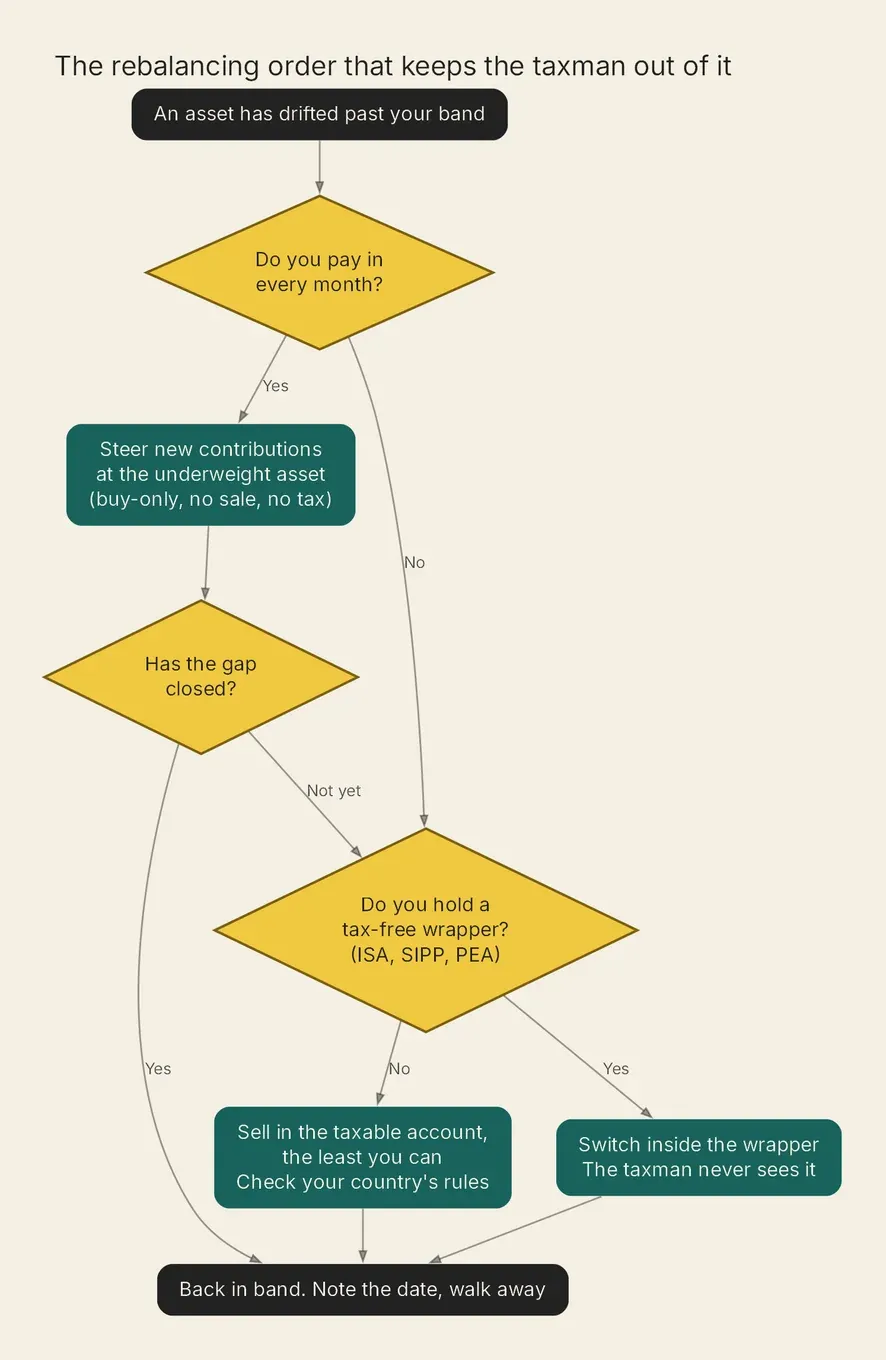
Work in order, cheapest move first. Selling is the last resort, not the first instinct.
- Check the gap. Compare where each asset sits now against your target. Write down the difference in percentage points. If nothing has moved more than a few points, you’re done; close the tab.
- Steer your new money first. If you pay in every month, point the next few contributions at whatever is underweight. This buys the lagging asset back up to target without selling a thing. More on this below; for a lot of people it’s the entire job.
- Rebalance inside your tax-sheltered accounts next. If you hold a wrapper where switching funds isn’t a taxable event (a GB ISA or SIPP, a French PEA, and others, covered market by market further down), do your selling and buying in there. The taxman never sees it. If your market has no such wrapper (Germany and Ireland have none for ordinary investments), there’s nothing to use at this step, so go straight on to the taxable account.
- Touch the taxable account last. Only if steps 2 and 3 haven’t closed the gap do you sell inside an ordinary brokerage account, where a sale can trigger tax. Sell the least you can to get back in range, and check your country’s rules first.
- Write down the date and walk away. Note when you did it. Then leave it alone until your next scheduled check. The fiddling is the enemy, not the friend.
That sequence is the difference between a rebalance that costs nothing and one that hands a slice to the tax authority for no reason. Notice that selling your winners, the thing everyone assumes rebalancing means, sits at step 4. The last resort.
| Step | The move | Why it sits here | Tax hit |
|---|---|---|---|
| 1. New money | Point your next contributions at the underweight asset | Buys the laggard back up with no sale at all | None |
| 2. Tax-sheltered account | Switch inside a wrapper if your market has one (GB ISA/SIPP, FR PEA) | The switch is not a taxable event inside the wrapper | None |
| 3. Taxable account | Sell the least you can in an ordinary brokerage account | The last resort, only if steps 1 and 2 left a gap | Your country’s rate on the gain (or €0 in NL) |
How often should you rebalance your portfolio?
Less often than you think. The data is unusually relaxed about it. Vanguard ran the long study most people quote, comparing how a 60/40 portfolio fared from 1926 to 2018 under wildly different rebalancing habits, from checking monthly to checking once a year. Across nearly every approach the outcome barely budged: tax-adjusted returns clustered around 8.2% a year, with near-identical risk-adjusted scores. (These are illustrative figures from a Vanguard study built on US tax assumptions, not a forecast for your account. Investment values can fall as well as rise, and your actual returns depend on the fund’s performance and charges.)
The lesson isn’t which schedule wins. It’s that no schedule meaningfully wins, so pick the one you’ll keep doing.
Vanguard’s own investor-education team reaches the same conclusion and tells investors not to agonise over the calendar:
“For many investors, implementing an annual rebalance is optimal. However, if this doesn’t work with your schedule, don’t stress about the specifics. The important thing is to pick a schedule that’s easy to follow, so set a reminder on your calendar and stick with it.”
Vanguard, Rebalancing your portfolio, investor-education page
You’ve got three honest options.
| Method | How it works | Suits you if | The catch |
|---|---|---|---|
| Calendar | Reset to target on a fixed date, say once a year | You want set-and-forget and hate watching markets | You might trade when nothing has moved much |
| Threshold | Act only when an asset strays past a set band | You’ll check now and then and want to act only when it matters | You have to remember to check |
| Hybrid | Check on a calendar, but only act if the band is breached | You want low effort without pointless trades | Slightly more thought than pure calendar |
Calendar or threshold: which should you pick?
Whichever you’ll keep up. The choice comes down to two honest options and one hybrid of them. Calendar rebalancing resets to target on a fixed date and suits the set-and-forget investor. Threshold rebalancing only acts when an asset strays past a band, so it trades only when drift matters. Both end up in much the same place over the long run.
For the threshold band, the most-quoted rule of thumb is Larry Swedroe’s 5/25: act when an asset moves an absolute 5 percentage points, or 25% of its own target weight, whichever comes first. The 25% part matters for small holdings. A 10% sleeve gets a tight band of 7.5% to 12.5%, where a flat 5-point band would almost never fire and would let that little sleeve drift halfway to nothing before you spotted it.
Michael Kitces, the financial-planning researcher behind Kitces.com, reached the same verdict when he reviewed the academic work on rebalancing intervals:
“the researchers found that rebalancing quarterly or monthly produced no improvement in long-term risk or returns; it simply drove up the turnover rate.”
Michael Kitces, Finding the Optimal Rebalancing Frequency, Kitces.com
And resist the urge to do it all the time. In the same study, checking monthly meant rebalancing more than 1,100 times to land the same result a once-a-year check reached in 14. All that extra trading bought nothing except cost and, in a taxable account, tax. Once a year is fine for most people. The SEC’s education page lands in roughly the same place, pointing to a look every 6 to 12 months.
Can you rebalance your portfolio without selling anything?
Often, yes. It’s the move most worth knowing, and it has a name: contribution rebalancing, sometimes called cash-flow rebalancing. It works by steering money rather than swapping holdings around.
The mechanics are simple. Send every new contribution, plus any dividends and interest, into whatever asset is short of target. Same logic as drip-feeding money in steadily over time, just pointed at the side that lags. You’re topping up the laggard with fresh money, which nudges the mix back toward target using only buy orders. As justETF (opens in new tab), the pan-European ETF education site, puts it, this “only requires buy transactions and avoids tax-impacting sell transactions.” When you finally draw money out, you flip it: take from whatever is over target first, which is also where keeping some of your money easy to reach starts to matter.
This settles it at the size most DIY investors sit at. Say you hold around €25,000 and pay in €500 a month. Six grand of fresh money a year, all of it aimable at the short side, will hold a portfolio that size in band for years without a single sale. A €400,000 pot with €200 going in each month can’t be steered the same way; the top-ups are too small next to the drift, and in the end you have to sell. Size and how much you pay in decide whether selling ever comes up at all.
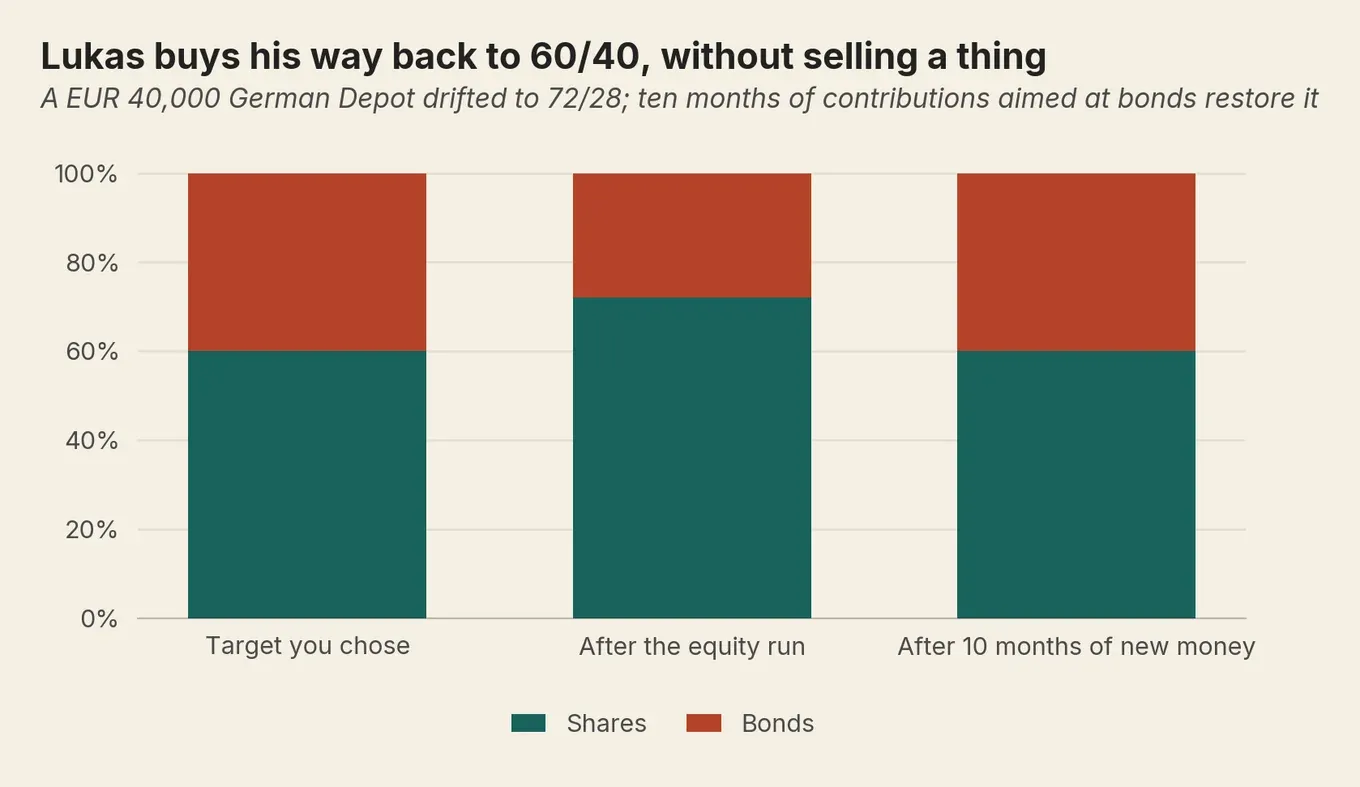
Take Lukas, a 38-year-old developer in Cologne with €40,000 in a German Depot, split 60% shares and 40% bonds when he set it up and never touched since. A strong run has pushed him to 72% shares, 28% bonds. Germany gives him no tax-free wrapper, so selling shares to buy bonds would book a gain he’d rather not trigger. Instead he points his €800 monthly contributions entirely at bonds. About €8,000 of fresh money, roughly ten months of payments, lifts the bond sleeve back to 40% with buy orders only. No sale, so none of Germany’s flat investment tax (the Abgeltungsteuer) falls due on the rebalance, and no winners are cashed in. Where no shelter exists, buying your way back isn’t a nicety; it’s the only way to get back on target without paying for the privilege.
Does rebalancing cost you tax? The honest, country-by-country answer
Here’s where the clean story breaks, and where almost every guide written for an American reader quietly leads a European one astray. The neat model goes: switch for free inside a tax wrapper, pay capital gains tax if you switch in an ordinary account. Which wrappers exist, and how to use the right account for the right money, is a whole topic in its own right. That neat model holds in some Money Owl markets and falls apart in others. There’s no single European rule, because there’s no European capital gains tax. The answer is national. Every time.
| Market | Is a fund switch in a taxable account a tax event? | Tax-free / tax-deferred wrapper to rebalance inside? | What it costs in a taxable account | Tax year |
|---|---|---|---|---|
| GB | Yes, in a GIA | Yes, ISA and SIPP, switches inside are free of CGT | CGT 18% or 24% on the gain; £3,000 allowance | 2026/27 |
| IE | Yes | No, there is no ISA-equivalent | 38% exit tax on the gain (cut from 41% on 1 Jan 2026), plus an 8-year deemed-disposal clock | 2026 |
| FR | Yes, in a CTO | Yes, PEA and assurance-vie, switches untaxed until you withdraw | Income-tax-free after 5 years in a PEA, but social charges still apply | 2026 |
| DE | Yes, in a Depot | No tax-free wrapper exists | Abgeltungsteuer (25% + Soli); the Vorabpauschale taxes you yearly anyway; €1,000 allowance softens it | 2026 |
| NL | No, Box 3 taxes wealth, not the gain on a sale | Not applicable, a switch is simply not a CGT event | €0 from the rebalance itself; the tax is on your year-start wealth | 2026 |
| ES | Yes, on disposal | Partial, the traspaso defers tax on fund-to-fund switches, but ETFs were cut out on 1 Jan 2022 | IRPF savings rates on ETF switches; €0 on qualifying mutual-fund traspasos | 2026 |
| IT | Yes, in a conto titoli | No ISA-equivalent (only a fondo pensione) | 26% on the gain (12.5% on white-list government bonds) | 2026 |
| PT | Yes | No general wrapper; the PPR is retirement-only | 28% autonomous rate, falling for longer holds; PPR 8% on a qualifying redemption | 2026 |
| SI | Yes | New: the INR wrapper (from 5 Mar 2026) defers tax until withdrawal | Flat 25% (no more holding-period taper since 1 Jan 2026) | 2026 |
| EU | Depends on your country | No single EU wrapper; PEPP is the nearest and barely used | There is no EU-level capital-gains tax; the rule is national, every time | n/a |
Which markets let you rebalance tax-free inside a wrapper?
A handful do, and they each do it differently. Britain lets you switch free inside an ISA or SIPP. France lets you switch untaxed inside a PEA or assurance-vie, right up until you withdraw. Spain puts off the tax between qualifying funds through a fund-to-fund transfer the Spanish call the traspaso.
Take GB first. A switch inside a Stocks and Shares ISA or a SIPP is fully free of capital gains tax, per HMRC (opens in new tab). In an ordinary General Investment Account the same switch books a gain taxed at 18% or 24%, with only a £3,000 tax-free allowance now, down from £6,000. That shrinking allowance is why moving holdings into the wrapper, the “Bed and ISA” move, has got more worthwhile, though you can only move across up to the £20,000 annual ISA limit each year, so a large pot takes several years to shift fully. France runs on a delay rather than a free pass: switches inside a PEA aren’t taxed until you withdraw, and after five years the gains are free of income tax, though social charges still apply. So a PEA is not “tax-free” outright. Assurance-vie works the same way, untaxed until you cash out. Spain lets you move between qualifying mutual funds without booking a gain, the traspaso again, but ETFs were cut out of it on 1 January 2022. The fund type decides, not just the account. (If you’re still working out which funds to actually hold, that choice quietly shapes your tax bill too.)
Which markets have no tax-free rebalancing wrapper?
Germany, the Netherlands, and Ireland, each broken in its own way. Germany taxes every switch and adds an annual charge on top. The Netherlands taxes wealth rather than gains, so a switch isn’t a taxable event at all. Ireland taxes switches at a 38% exit tax and gives you no wrapper to shelter in. One shelter does exist nearly everywhere, mind: switches inside a pension (an Irish PRSA, a UK SIPP, the Italian fondo pensione) aren’t taxable events. This section is about ordinary, non-pension investing, where those three markets leave you exposed.
Germany has no tax-free wrapper, full stop. A switch in a Depot is taxable, and there’s a small yearly advance tax on top, the Vorabpauschale, which charges your funds a little every year even if you never sell. It’s worked out from a base rate the BMF (opens in new tab) resets each year (3.20% for 2026). Your only softeners are a 30% partial exemption on equity funds and a €1,000 saver’s allowance. The honest German line: no rebalancing wrapper exists, so you work within the allowance instead.
Now the Netherlands, which breaks it the other way entirely. Dutch tax doesn’t touch the gain when you sell, because the Belastingdienst (opens in new tab) taxes the value of your assets each year (the Box 3 system, with a €59,357 tax-free amount in 2026), not the profit on a disposal. For a Dutch investor, rebalancing creates no capital gains event to worry about. Nothing to defer, so the whole “sequence your wrappers” logic just doesn’t apply.
Ireland is the hardest case, which matters because plenty of Money Owl readers are there. There’s no ISA-equivalent, and a switch between ETFs is a taxable disposal at a 38% exit tax (cut from 41% on 1 January 2026, per Revenue (opens in new tab)). Worse, an eight-year “deemed disposal” rule lands a tax bill on a timer, whether you rebalance or not, so there’s no quiet wrapper to retreat into. The rest follow the pattern. Italy taxes a switch in an ordinary brokerage account, the conto titoli, at 26% (12.5% on government bonds). Portugal charges 28%, a rate that falls for longer holds. Slovenia still tapers its rate with the holding period, from 25% under five years down to 0% after fifteen, and gained a tax-deferred wrapper, the INR, from 5 March 2026, so it’s one to watch.
The same trade tells the story better than any rule. Niamh in Cork and Bram in Utrecht each hold €120,000 that has drifted from 60/40 to 75/25, and each has to sell €18,000 of shares to get back on target. Niamh, in Ireland, faces the 38% exit tax with no wrapper to hide in: on a gain of, say, roughly €5,100, that is about €1,950 handed over for a routine rebalance, and the eight-year deemed-disposal clock ticks all the same. Bram, in the Netherlands, pays nothing on the switch at all, because Box 3 taxes his wealth, not the gain on the sale. Same portfolio, same trade, two very different bills.
The pan-European takeaway, then, is short and slightly annoying: rebalancing tax depends entirely on your country and your account type. Anyone who tells you otherwise has read a US blog and copied it. None of these figures is advice, and rates move, so check your own market’s tax authority before you sell.
Will rebalancing make you more money?
No. And this is the part people most want to be untrue. Rebalancing is risk control. It’s not a return-booster, and the long data is blunt about it.
In that same Vanguard study, the portfolio that was never rebalanced earned the highest raw return, about 8.74% a year against roughly 8.2% for every rebalanced version. It earned more for one reason: it drifted to 85% shares and rode the bull market with more risk on the table. But it also carried the highest volatility, 14.0% against around 11.5%, and the worst risk-adjusted score (using the same illustrative US-tax-assumption figures as above; values can fall as well as rise, and actual returns depend on the fund’s performance and charges). More money, more risk, a worse deal per unit of risk. That’s the trade.
So rebalancing doesn’t buy you a bigger number. It buys you a tighter, calmer range of outcomes, and a portfolio that still matches the risk you can live with when a bad year arrives. Selling some of what just went up to buy what just went down feels backwards, which is exactly the point. It’s a rule that removes the emotion, not a clever read on the market. What sets it off is always your own drift, never a hunch about where things are headed.
The SEC frames it as plain housekeeping rather than a market call:
“It’s always a good idea to regularly check on your investment portfolio to see if any rebalancing needs to be done.”
Lori Schock, former Director, SEC Office of Investor Education and Assistance, investor.gov
Where this leaves you
So, no need to overthink it. Open your account. Check whether any asset has drifted more than a few points from where you set it. If it has, point your next contributions at the lagging side, and only sell if that doesn’t close the gap, inside a tax-sheltered account first if your market has one. If nothing has drifted, do nothing, which is allowed and underrated.
Then put a yearly reminder in the calendar and get on with your week. The real product here isn’t a fatter return. It’s a portfolio you can ignore for twelve months without it quietly turning into something you never agreed to.
Frequently asked questions
How do you rebalance your portfolio?
How often should you rebalance your portfolio?
Can you rebalance your portfolio without selling anything?
Does rebalancing improve your returns?
Do you pay tax to rebalance your portfolio?
Sources (6)
- SEC (investor.gov): Is It Time to Rebalance Your Investment Portfolio?
- justETF: What is portfolio rebalancing?
- HMRC (GOV.UK): How ISAs work
- Bundesfinanzministerium (BMF): Basiszins zur Vorabpauschale zum 2.1.2026
- Belastingdienst: Box 3 heffingsvrij vermogen
- Revenue (Ireland): Taxation of investment undertakings (Part 27-01a-02)
— That's the lot. It is now night.
Want more of this in your Google results?
Add Money Owl as a preferred source, and Google will show our finance pieces higher when you search for them.
By Jure Jaklič
Founder and editor of Money Owl. Data analyst by trade; personal finance learned first-hand across six European countries.
Recommended

European bond ETFs: how they work, and how they're taxed where you live
Euro government bond ETFs fell about 18% in 2022, never mature like a single bond, and are taxed differently in every country. Here's how they actually work.

Warren Buffett's principles, translated for Europe
For 60 years Buffett beat the market, then told everyone else to index. His principles, translated for Europe: UCITS ETFs, the 90/10 rule and tax wrappers.

Dividend investing in Europe: is it really passive income?
Pooled across 2018, 2019, 2021 and 2022, 70.6% of European once-a-year dividend payments arrived in April, May and June. What that does to a monthly budget, and what living off it really costs.