

The point.
- Investing a lump sum immediately has historically beaten drip-feeding it about two-thirds of the time: 68.1% on the UK FTSE All-Share and 66.5% on the MSCI Europe index, per Vanguard's research.
- The reason is dull, not magic: cash waiting its turn earns none of the return shares and bonds pay for holding them, so holding back gives up that expected return.
- Drip-feeding lowers your worst case, not your average outcome. It cushions a crash by keeping cash on the sidelines, and you pay for that calm in expected return.
- The currency fee is a wash. Converting once or in twelve chunks at the same percentage costs the same; the real friction is twelve dealing commissions plus the lost risk premium.
- Phase in when the sum dwarfs your net worth, when you know you would panic-sell, when the money is needed soon, or when it is an inheritance and the maths has to make room for grief.
The point.
- Investing a lump sum immediately has historically beaten drip-feeding it about two-thirds of the time: 68.1% on the UK FTSE All-Share and 66.5% on the MSCI Europe index, per Vanguard's research.
- The reason is dull, not magic: cash waiting its turn earns none of the return shares and bonds pay for holding them, so holding back gives up that expected return.
- Drip-feeding lowers your worst case, not your average outcome. It cushions a crash by keeping cash on the sidelines, and you pay for that calm in expected return.
- The currency fee is a wash. Converting once or in twelve chunks at the same percentage costs the same; the real friction is twelve dealing commissions plus the lost risk premium.
- Phase in when the sum dwarfs your net worth, when you know you would panic-sell, when the money is needed soon, or when it is an inheritance and the maths has to make room for grief.
You’ve got €50,000 sitting in a current account, and you’ve been staring at it for three weeks. The money’s real. The decision isn’t getting made. Invest it all at once, or feed it in monthly so you don’t buy the day before a crash? That’s the whole of dollar-cost averaging vs lump sum. The second option feels careful and grown-up. It mostly isn’t.
The bit nobody says first: deciding at all beats the months already lost to dithering. Going in now or phasing it in matters far less than that. Both are reasonable, and on the evidence one edges ahead.
First, the names, because they multiply. “Dollar-cost averaging” is the American phrase; in Britain, pound-cost averaging; in the euro area, euro-cost averaging; in plain speech, drip-feeding. All the same thing: splitting a sum into smaller regular buys instead of one. Lump sum means the obvious. All of it, now. Here’s the short answer.
Investing a lump sum immediately has historically beaten drip-feeding it about two-thirds of the time, 68% on the UK FTSE All-Share and 66.5% on the MSCI Europe index per Vanguard’s research (opens in new tab), because markets rise more often than they fall and your money is exposed to that rise sooner. Drip-feeding mainly buys emotional comfort, at a small cost to returns.
How often does investing the lump sum win, and why?
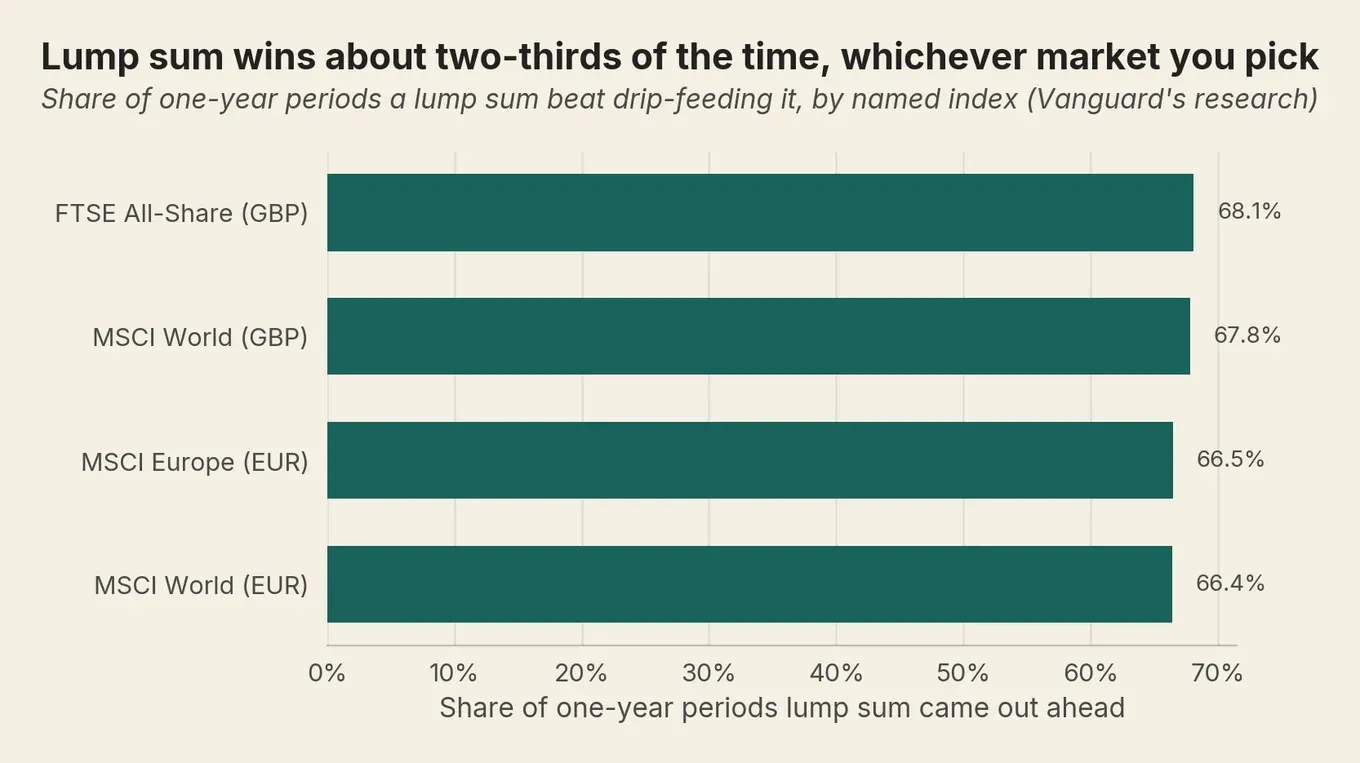
Two-thirds of the time, give or take. And it holds in your market, not just America’s. Vanguard’s 2023 research (opens in new tab), backed up by the CFA Institute (opens in new tab), ran the numbers on named indices in the reader’s own currency. The lump sum beat drip-feeding 68.1% of the time on the UK FTSE All-Share, 66.5% on the MSCI Europe index, 66.4% on the MSCI World in euros, and 67.8% in sterling. Pick your market. The answer barely moves.
The reason is duller than the stat. Cash waiting its turn earns nothing of the return that shares and bonds pay for the risk of holding them. Hold back, even briefly, and you give up that expected return on average. Vanguard calls it the opportunity cost of lost risk premium; the CFA Institute got there by a different route and named the culprit cash drag.
The moment your drip-feed finishes and both pots hold the same fund, the bigger pot stays bigger forever, because the same percentage gain on more money makes more money. So the contest settles while you deploy, not over the decades you hold.
Stefan, a 34-year-old software tester in Vienna, has a €30,000 bonus he won’t touch for a decade. Drip-feeding it over a year feels grown-up. On Vanguard’s numbers it mostly costs him. An all-equity lump sum has historically edged out the drip by roughly 2% after a year, and splitting the buys doesn’t even save the currency fee.
| Stefan’s €30,000, invest now vs drip over 12 months | Lump sum (one buy) | Drip-feed (12 buys) |
|---|---|---|
| Win-rate on expected return (Vanguard, MSCI World in EUR) | wins ~66% of the time | loses ~66% of the time |
| Illustrative median edge after one year (all-equity) | about €640 ahead | about €640 behind |
| FX conversion cost (foreign-currency fund; DEGIRO 0.25%) | €75 once | €6.25 x 12 = €75 (identical) |
| Dealing commission (€1 per order) | €1 | €12 |
Those figures are illustrative; investments can fall as well as rise, and the actual return depends on the fund’s performance and its charges.
Does dollar-cost averaging reduce risk?
It reduces one kind of risk, and not the one you think. This is the bit the industry quietly sells.
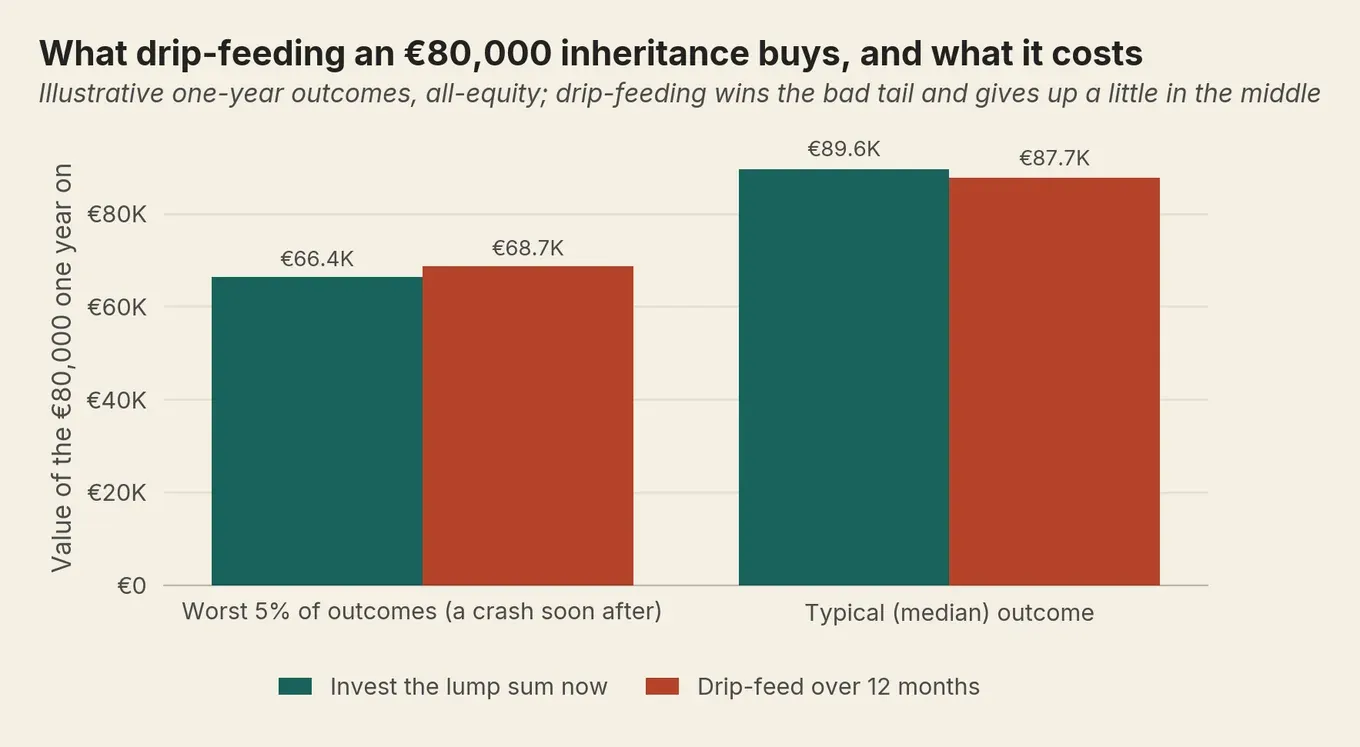
Drip-feeding lowers your worst case. In the ugliest outcomes, a sharp fall right after you’d have gone all in, the drip-feeder’s still holding cash and loses less. Vanguard’s data (opens in new tab) shows it: in the bottom 5% of outcomes for an all-equity pot, drip-feeding came out ahead. That cushion is exactly what your nervous gut keeps asking for.
What it won’t do is raise your average outcome. It narrows the spread of results, the volatility, by keeping cash on the sidelines longer. The CFA Institute (opens in new tab) found that once you adjust for the risk taken, the lump sum still edges ahead. That lower volatility isn’t free; you pay for it in return. A banking leaflet telling you cost averaging “reduces the risk of investing at the highest price” states a half-truth and quietly leaves out the bill.
Holding your cash and feeding it in slowly is itself a bet that prices will fall later. Waiting doesn’t avoid market timing. It is market timing, gently, with patience as the cover story.
What does drip-feeding cost you?
Less than your fear, more than zero, and not in the way most people assume. The currency fee varies by broker. Trade Republic (opens in new tab) adds no separate conversion charge, though for a non-euro fund the cost is buried in the exchange spread instead, and the most popular UCITS funds trade in euros anyway, so it rarely bites. N26 (opens in new tab) charges nothing either. DEGIRO (opens in new tab) takes 0.25%, Lightyear (opens in new tab) 0.35%, with a roughly €1 dealing commission per order. These are cost illustrations, not recommendations; pick a regulated broker on its merits.
| What pays the currency cost | Lump sum (one buy) | Drip-feed (twelve buys) |
|---|---|---|
| Flat percentage FX fee (e.g. 0.25%) | charged once on the full sum | same total percentage, just split |
| Per-trade dealing commission | one commission | twelve commissions |
| Minimum-fee floor | trivial on a large sum | can bite on each small chunk |
The honest line is plainer than “drip-feeding triples your currency bill”. The real friction sits elsewhere.
Does drip-feeding pay the currency fee twelve times over?
No. The myth gets the maths backwards. Converting €50,000 once at 0.25%, or as twelve monthly chunks at 0.25% each, costs €125 either way. The percentage doesn’t care how many slices you cut.
What are the real extra costs of phasing in?
Dealing commissions, charged per trade, so twelve buys cost twelve commissions instead of one. Minimum-fee floors that stay trivial on €50,000 but bite on €4,167. And, dominating both, the lost risk premium from sitting in cash. That last one, not the currency fee, is what makes phasing in slightly worse than it looks.
That is the small end of the per-order bill. A year of buying and selling runs the same lines rather more often, and it prices them.
How do lump sum and drip-feeding compare at a glance?
Five things people weigh, side by side.
| Criterion | Lump sum (invest it all now) | Drip-feeding (phase it in) |
|---|---|---|
| Expected return | Higher; wins about two-thirds of the time | Lower on average; gives up some risk premium |
| Worst-case outcome | Worse; full exposure if it falls right after | Better; cash on the sidelines cushions a crash |
| Costs | One set of dealing fees | More dealing fees, minimum-fee floors on small chunks |
| Behavioural comfort | Lower; one big nerve-wracking moment | Higher; the decision feels spread out and safer |
| Best-fit reader | Long horizon, steady nerves, money you won’t need soon | A known panic-seller, a large sum, or money needed soon |
What is the owl’s pick?
The evidence favours the lump sum. If the money is headed for a sensible, diversified, low-cost fund you won’t touch for years, and it’s a fair-sized but not life-altering slice of what you have, going in at once is the higher-expected path, and the fall drip-feeding would have cushioned stays survivable. One thing sits outside this entirely: your emergency fund, which belongs in cash on either schedule.
Two caveats taped to that pick. First, the qualifiers the rules demand of anyone showing you a return: any figure here is illustrative, investments can fall as well as rise, and your actual returns depend on the fund’s performance and its charges. Second, if you genuinely can’t stomach going all in, don’t let the perfect answer stop you acting at all. If drip-feeding gets the money invested this month rather than next year, drip-feed. But keep the window short: Vanguard’s own advice runs to about three months (opens in new tab), not a thin year. The drag grows the longer cash sits out.
When is drip-feeding the right call?
When the worst case would genuinely hurt you, not just frighten you. Three cases, and a fourth that needs a gentler voice.
Is the sum enormous relative to your net worth?
If this windfall is your wealth, a badly-timed fall isn’t a survivable wobble. It destabilises you. A sum that dwarfs everything else you own buys down the worst case, and the cushion earns its modest price.
Do you know yourself to be a panic-seller?
If history says you bail at the first 20% drop and crystallise the loss, a theoretically-optimal lump sum you sell in a fright beats nothing. A drip-feed you keep wins. The best strategy survives your own nerves.
There’s real weight behind that instinct, though the size of it is still argued over. Reviewing the evidence for the CFA Institute in 2020, Brian F. Lomax put it this way:
“The potential for losses is on average twice as powerful a motivator as the potential for gains.”
Is the money needed soon?
If part of this sum is spoken for within a couple of years, that part shouldn’t sit in the market on either schedule. It has a job, and the job is not growth. Park it somewhere safe, and leave it alone.
Which part of the sum is already spoken for is worth settling before the timing argument matters. The three things that come off are known bills, a reserve, and anything on a card.
What if the money is an inheritance?
If this is an inheritance, the maths bends to something more human. Money that arrives because someone died does not feel like a windfall, and the instinct to be careful with it, to not risk what they left you, is not a mistake to be corrected. Drip-feeding a large inheritance slowly, so you can sleep, is a legitimate, research-backed choice. The numbers say the lump sum wins more often. The numbers do not have to carry your grief. If feeding it in gently is what lets you invest it at all, rather than freeze, that is the right answer for you, and there is no lecture coming.
Mira in Dresden was left €80,000 by her mother, more than everything else she owns put together. Her fear of investing it the week before a fall is not irrational here; this money is most of her safety. The numbers are not the point for her, but they happen to back her up. In the worst tail of outcomes, drip-feeding it over a year would have cushioned a crash by roughly €2,400, for an expected cost of around €1,900. For her, the calm is worth the price. These figures are illustrative; investments can fall as well as rise, and actual returns depend on the fund’s performance and charges.
Does where you hold it matter more than when?
Often, yes, and this is the bit the comparison guides skip. The wrapper your money lands in can move more than the timing decision ever will.
| Market | Wrapper or rule | The figure (2026) | Why it can move more than the timing |
|---|---|---|---|
| GB | Stocks & Shares ISA allowance | £20,000 / yr | A windfall above £20k can’t all shelter this year, so the allowance, not your nerves, stages how you deploy it. |
| GB | Pension (SIPP) annual allowance | £60,000 / yr | A lump sum into a pension captures tax relief on the whole amount at once, instead of dripping the relief in. |
| IE | CGT on directly-held shares | 33% + €1,270/yr exempt | The €1,270 exemption is per person per year, so spreading direct-share sales across tax years can matter at the margin. |
| IE | UCITS ETF exit tax + deemed disposal | 38% (was 41%); 8-yr deemed disposal; no €1,270 | The big Irish gotcha: ETF gains sit in a separate 38% regime with a forced 8-year tax event, reshaping the maths far more than timing does. |
| FR / NL | PEA (FR) / box-3 (NL) | varies by country | A French PEA shelters gains after a holding period; the Dutch box-3 base is set on 1 January, so a large year-end purchase shifts it. |
Sources: gov.uk (ISA, pension annual allowance), Revenue Commissioners (Irish CGT; Tax and Duty Manual Part 27-01A-02, Investment Undertakings), retrieved 24 June 2026. The Irish ETF rate fell from 41% to 38% on 1 January 2026; any guide still quoting 41% is out of date.
The figures sit in the table; what they do to your decision is the part worth keeping. For a UK reader, the ISA allowance (opens in new tab) stages a big windfall whether your nerves agree or not, while a pension (opens in new tab) grabs the relief on the lot at once. For an Irish reader the wrapper is the headline: UCITS funds sit in their own exit-tax regime (opens in new tab), with a forced eight-year tax event and no annual CGT exemption (opens in new tab), which bends the maths more than timing ever could. Elsewhere it depends; the Dutch box-3 base is fixed on 1 January, so when you buy can outrank how. The wrapper earns at least as much thought as the timing did.
That €50,000 doesn’t care which way you choose. It only minds that you choose, and then leave it alone. Pick the move you’ll actually go through with, and set it up this week.
Frequently asked questions
Is it better to invest a lump sum or drip-feed it monthly?
How often does lump-sum investing beat dollar-cost averaging?
Does dollar-cost averaging actually reduce risk?
Does drip-feeding pay the currency fee twelve times over?
When should you drip-feed a lump sum instead of investing it all at once?
Sources (10)
- Vanguard: Cost averaging: Invest now or temporarily hold your cash? (2023)
- CFA Institute: Dollar-Cost Averaging (DCA): A Reappraisal
- GOV.UK: Individual Savings Accounts (ISAs)
- GOV.UK: Tax on your private pension contributions: Annual allowance
- Revenue Commissioners: How to calculate CGT
- Revenue Commissioners: Tax and Duty Manual Part 27-01A-02, Investment Undertakings
- DEGIRO Ireland: Fees
- Lightyear: Pricing
- Trade Republic: How does foreign currency exchange work?
- N26: Stocks and ETFs
— That's the lot. It is now night.
Want more of this in your Google results?
Add Money Owl as a preferred source, and Google will show our finance pieces higher when you search for them.
By Jure Jaklič
Founder and editor of Money Owl. Data analyst by trade; personal finance learned first-hand across six European countries.
Recommended

Should I wait to invest? Five reasons people give
We ran 107,454 windows of European tracker-fund history since 2008. Waiting won three times in ten. Five reasons Europeans give for holding off, cross-examined: three lose, two hold up.

European bond ETFs: how they work, and how they're taxed where you live
Euro government bond ETFs fell about 18% in 2022, never mature like a single bond, and are taxed differently in every country. Here's how they actually work.

Warren Buffett's principles, translated for Europe
For 60 years Buffett beat the market, then told everyone else to index. His principles, translated for Europe: UCITS ETFs, the 90/10 rule and tax wrappers.