

The point.
- A bond ETF never matures the way a single bond does: it rolls its holdings forever, so there is no fixed date when your capital comes back at face value. Only defined-maturity "iBonds"-style funds actually wind up and repay you.
- There are three ways to lose money in a bond ETF: rising rates push prices down (euro government funds fell about 18% in 2022), an issuer can default or slip in credit quality, and non-euro holdings can lose value when the exchange rate moves.
- Two numbers do most of the work: yield to maturity is the forward-looking return if the fund holds its bonds to the end, while duration tells you how far the price moves when rates shift, so a duration of 7 means about a 7% swing for a one-point rate move.
- The same fund is taxed completely differently depending on where you live: Germany taxes an accumulating fund yearly even with no cash paid out, Ireland taxes paper gains every 8 years, and the Netherlands taxes your wealth rather than your income.
- Boring is not the same as safe. A bond ETF is an investment, not a protected deposit, and carries no deposit-guarantee cover; understand the three risks first and it becomes plumbing you can stop watching.
You’ve got cash sitting in a bank account. It feels like the sensible thing. And every year it quietly loses a little of its worth, because eurozone prices rose 2.7% in the year to June 2026 (opens in new tab) and your balance didn’t.
So you start reading about European bond ETFs, the boring, grown-up end of investing, the bit that’s meant to be safer than shares. Then someone mentions 2022, the year “safe” euro government bond ETFs fell about 18%, and you close the tab.
Fair enough. But boring doesn’t mean safe. It means boring. That gap is the whole point.
A bond ETF is a fund that holds hundreds of bonds at once and trades on an exchange like a share. That wrapper isn’t the confusing part. What’s confusing is that it behaves almost nothing like the single bond you were picturing, and nobody warns you first.
How do bond ETFs work, and how do they differ from owning a bond?
Buy a single bond and you know the deal. You lend a government or a company money, they pay you interest, the coupon, along the way, and on a fixed date they hand your money back. There’s a finish line.
A bond ETF has no finish line. It holds a rolling basket of bonds: as older bonds get close to their repayment date, the fund sells them and buys newer ones (opens in new tab) to stay in its target range. A fund labelled “7 to 10 year” is always 7 to 10 years from maturity, forever. The bonds inside it mature. The fund itself never does.
So do bond ETFs mature? Most don’t, so there’s no set date when your capital comes back at face value. Only defined-maturity funds, the “iBonds”-style ETFs (opens in new tab) built to close in a stated year, actually mature and pay you back.
What is a defined-maturity bond ETF?
A defined-maturity ETF holds its bonds to a set year, then winds up and pays out whatever it’s worth on that date, not a guaranteed return of your original capital. It’s like a single bond with hundreds of names inside, the useful exception when you want a finish line.
One product note, because the search results will try to sell you the wrong thing. The big US bond ETFs you may have read about, the ones with three-letter tickers, aren’t sold to euro-area retail investors. EU rules require a plain-language key information document before a broker can offer you a packaged fund, and most US-domiciled ETFs don’t produce one (opens in new tab). Your options are UCITS bond ETFs (the EU-regulated fund format), almost always based in Ireland or Luxembourg. Picking one, the ongoing charge and fund size, is the usual ETF drill, which our guide to choosing an ETF in Europe walks through. Here we care only about what changes once the fund holds bonds.
Government, corporate, or aggregate: which type of euro bond ETF should you hold?
There are five broad types of euro bond ETF, and they line up as a ladder. Roughly, the more a type pays, the more risk it takes to get there, though inflation-linked trades yield for protection of your purchasing power and sits a little apart. The yield is never free, the most important line here.
Here’s the ladder, with real funds as dated examples, not recommendations. The yield-to-maturity and duration figures are illustrative snapshots from July 2026, not promises: bond and investment values can fall as well as rise, and actual returns depend on the fund’s performance, its charges and where interest rates go next. Check the current numbers before you act on any of them.
| Type | Example fund (as of July 2026, not an endorsement) | Ongoing charge | Yield to maturity | Effective duration | Fell in 2022 |
|---|---|---|---|---|---|
| EUR government | iShares Core Euro Govt Bond | 0.07% | 3.11% | 7.05 years | -18.50% |
| EUR corporate (investment grade) | iShares Core EUR Corp Bond | around 0.10% | 3.44% | 4.54 years | -14.14% |
| EUR aggregate | SPDR Bloomberg Euro Aggregate Bond | 0.17% | 3.40% | 6.13 years | -17.34% |
| EUR high-yield | iShares EUR High Yield Corp Bond | around 0.50% | 5.70% | 2.66 years | -10.29% |
| EUR inflation-linked | iShares Euro Inflation Linked Govt Bond | 0.09% | 3.21% (see note) | 7.14 years | -9.84% |
Figures as of 20 July 2026, from provider factsheets (State Street, iShares) via justETF. Examples for illustration, not advice, not endorsements; verify current figures before acting. The inflation-linked “yield” isn’t a like-for-like number, because a linker’s real yield works differently. Treat that row’s yield as a rough guide only.
Read across the rows. High-yield pays the fattest yield, 5.70%, because it lends to companies that might not pay it back. Government carries the least credit risk and one of the longest durations, so it fell hardest in 2022. Aggregate is a one-fund blend of government and corporate. Inflation-linked swaps some of your interest-rate bet for protection of your purchasing power.
Passive bond ETFs also sit at the cheap end of the fund world. The EU markets regulator, ESMA, found that passive bond funds cost around 0.5% a year (opens in new tab), against roughly 2% for active equity funds. Those charges in the table, 0.07% to 0.50%, are a big part of the case for them.
So which type? Depends what you want the money to do. If you want a low-drama core holding, an aggregate or a government fund is the plain-porridge option. Pairing a bond sleeve with a share-heavy portfolio like an MSCI World core? The government end tends to pull against equities more reliably. Reach for high-yield, though, and go in knowing it behaves like shares when a recession hits, not like a cash substitute.
What do yield to maturity and duration actually tell you?
Two numbers do most of the work when you compare bond ETFs, and both get misread.
What does yield to maturity tell you?
Yield to maturity is the forward-looking one. It’s roughly the average yield of the bonds it currently holds, if yields don’t move and nothing defaults. That beats the “distribution yield” or “12-month yield” splashed across comparison sites, which only look backward at what got paid out last year (opens in new tab). Chase the trailing number and you’re driving by the rear-view mirror.
What does duration tell you?
Duration is the one that bites. It measures how far the fund’s price moves when interest rates move. The rule of thumb (opens in new tab): a fund with a duration of 7 years falls about 7% if rates rise 1 percentage point, and rises about 7% if they fall 1 point. A duration of 2 means about a 2% move. That’s the whole scary mechanism, written out.
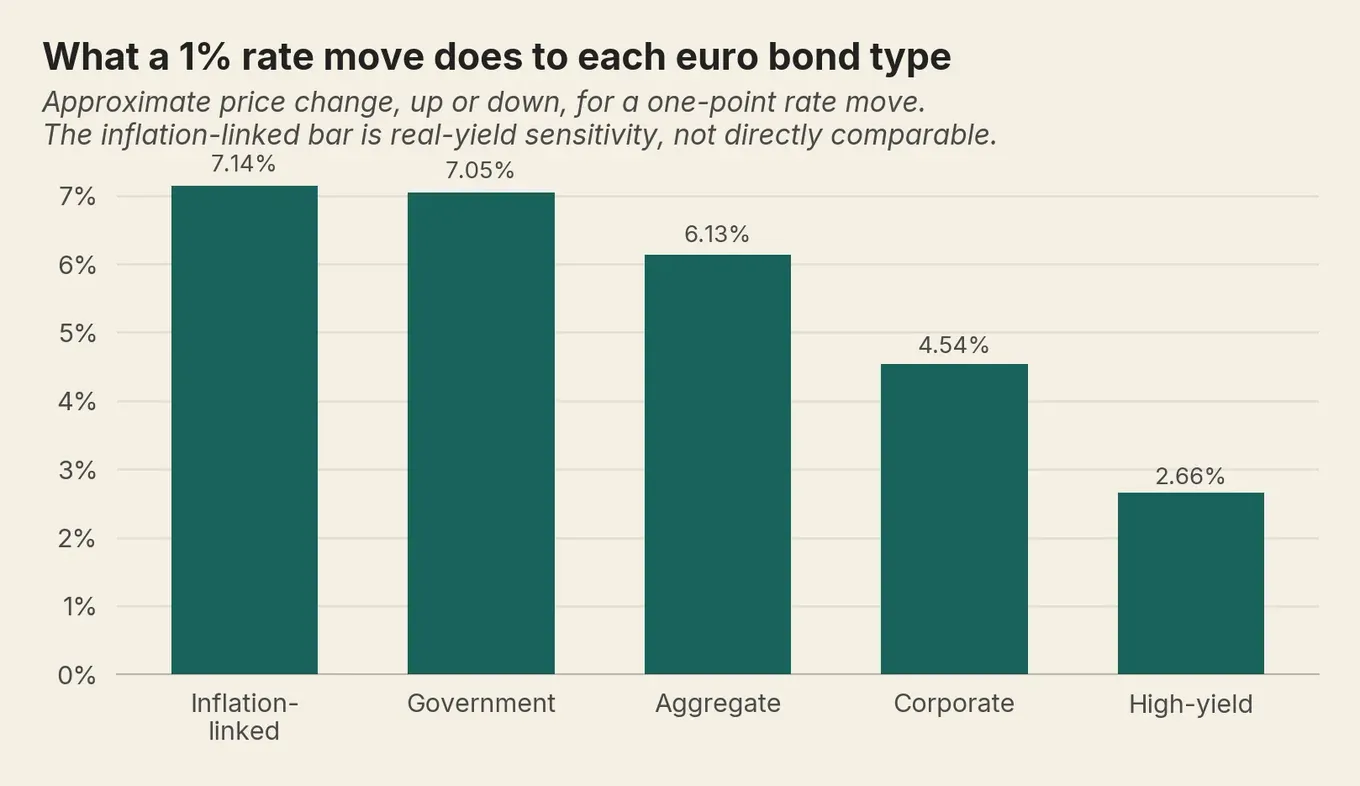
Now look back at that government fund. Duration 7.05 years. In 2022, euro interest rates rose fast, and the fund did roughly what the arithmetic said it would: it fell about 18%. Nothing broke. The maths simply worked, in the direction nobody enjoys.
So when a bond ETF offers you more yield, check what you’re paying for it. More duration means a bigger swing when rates move; more credit risk means a bigger chance of not being paid back. The yield is the wage. Duration and credit are the job.
Picture Silvia. She is 48, works as a pharmacist near Bologna, and has about €25,000 in cash she finally wants put to work. The 2022 headlines still make her wince. Two funds are on her screen: a euro government ETF (yield to maturity 3.11%, duration 7.05 years) and a euro aggregate ETF, which blends government and corporate bonds (yield to maturity 3.40%, duration 6.13 years).
The aggregate looks like a free lunch. It pays a little more and, with the shorter duration, swings a little less when rates move. On her €25,000, a one-point rise in rates would knock roughly €1,530 off the aggregate against about €1,760 off the government fund; a one-point fall would do the reverse. But the extra yield is not free: the aggregate earns it by lending to companies, which is credit risk the pure-government fund avoids. These are illustrative figures. Bond and investment values can fall as well as rise, and actual returns depend on the fund’s performance, its charges and where rates go next.
Can you lose money in a euro bond ETF?
Yes. Let’s not be coy about it.
You can lose money in a bond ETF in three ways. Rising interest rates push bond prices down, which is why euro government bond ETFs fell about 18% in 2022. A bond issuer can default or slide in credit quality. And a fund holding non-euro bonds can lose value when the exchange rate moves. A bond ETF is an investment, not a protected deposit.
Take them one at a time.
Rates first, the big one that caught people out in 2022. When rates rise, the older bonds paying yesterday’s lower interest are worth less, and a bond ETF is a bag of older bonds. The longer the duration, the harder the fall. That year the euro government fund dropped 18.50% (opens in new tab), the aggregate 17.34%, the corporate 14.14%. “Safe” did not mean “won’t fall.”
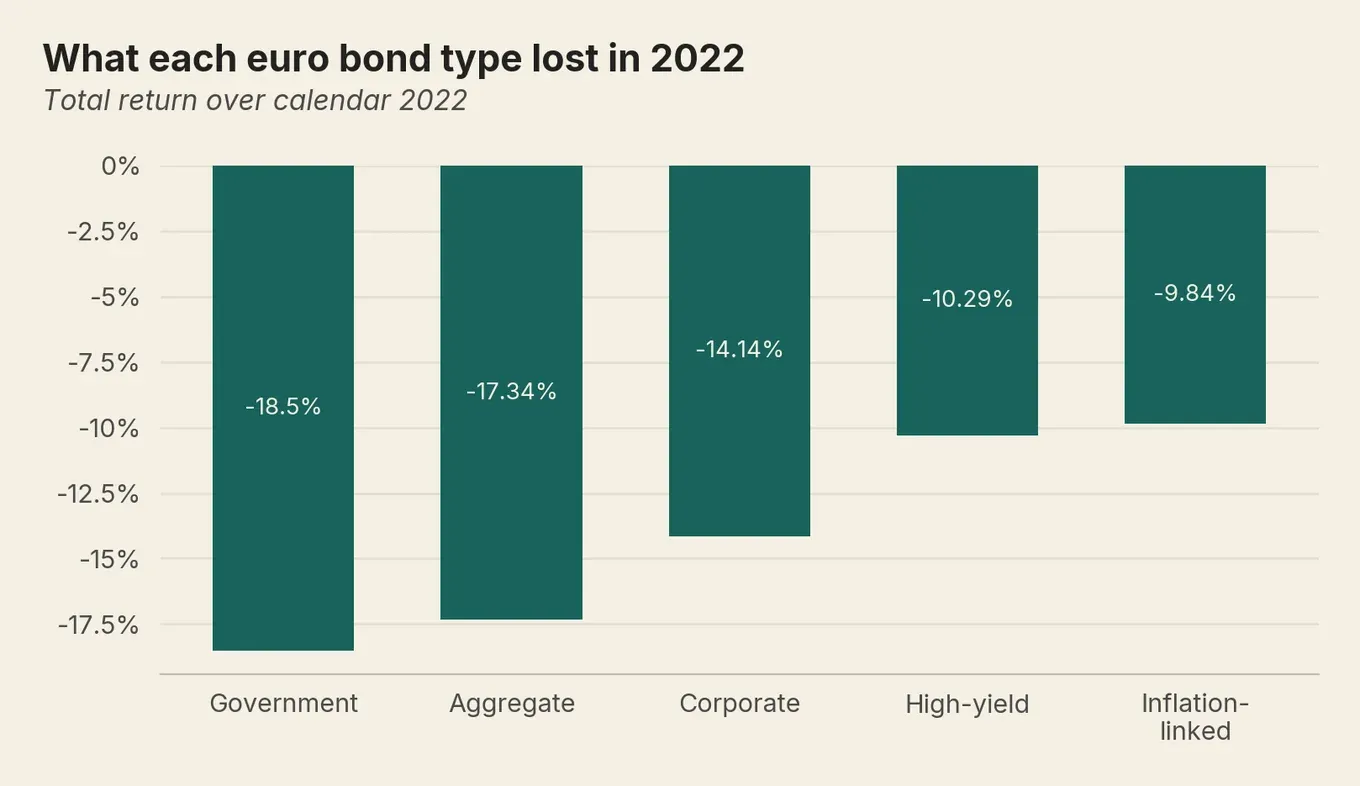
That order reflects one shock, not a ranking of safety: inflation-linked fell least only because surging inflation lifted its payouts. On the rate-sensitivity chart it’s the most rate-sensitive of the five, longest duration at 7.14 years, so it can fall hardest when real rates rise or inflation cools; “fell least in 2022” is not the same as “safest”.
Credit next. A bond is a loan, and loans go bad. Across a broad, diversified fund, euro-area government bonds rarely default, though a single-country government fund concentrates that one country’s risk: if markets start doubting that government, its bonds can fall faster than the euro-area average. High-yield corporate bonds default more readily, which is precisely why they pay more. In a recession, credit is the risk that turns up, and high-yield behaves more like shares than the quiet harbour people imagine.
Currency last. Buy a fund holding US dollar or other non-euro bonds and the exchange rate becomes part of your return. A euro-denominated euro-area bond ETF sidesteps that entirely. Whether to hedge that currency risk is its own decision; here, the risk is real and it’s yours.
Then the one people forget, because a bond ETF feels bank-like. It isn’t. Cash in a euro bank account is covered up to €100,000 per person, per licensed bank (the harmonised EU limit), by the scheme in the country where that bank holds its licence. A bond ETF is not a deposit and carries no such cover; its value can fall, as 2022 showed. Hold it for what it’s for, income and diversification over years, and keep money you might need soon in cash instead.
None of this is a fringe worry. Back in 2023, with euro rates still climbing, the EU markets regulator ESMA warned (opens in new tab) of exactly this risk:
There is a high risk of corrections in a context of fragile market liquidity in equity and bond markets, with short-term risks for consumers due to volatility and the impact of inflation on real investment returns.
That was a then-marker, not today’s forecast. Rates have since come well off their peak. But the thing it describes, that bonds can fall and that inflation can quietly eat your real return, has not gone away.
How are euro bond ETF coupons taxed where you live?
Here’s where a bond ETF stops being a European product and turns into a national one. The fund is the same across the euro area. The tax on what it pays you is not, and it’s the part every comparison site quietly leaves out.
Two things to hold in your head before the table.
First, tax can flip the accumulating-versus-distributing decision (whether the fund reinvests your interest or pays it out as cash) in the next section, because some countries tax a fund that pays you no cash at all.
Second, where the fund is based (its “domicile”, most often Ireland or Luxembourg) is a fund-level detail about how efficiently it collects its own interest. It is not the same as where you live, which sets your tax bill. An Irish-domiciled fund is not “an Irish tax product” for a Spanish investor. Mixing them up is an easy, expensive mistake.
Every figure below was checked against the national tax authority in July 2026. Tax rules change; treat this as a map, not a guarantee, and confirm your own position before acting.
| Country | How your coupon or gain is taxed | The catch worth knowing |
|---|---|---|
| Germany | Abgeltungsteuer (opens in new tab) (flat capital tax) 25% plus solidarity surcharge, so 26.375%; first €1,000 tax-free (€2,000 for couples) | An accumulating bond fund is taxed each year via the Vorabpauschale (opens in new tab) (an advance charge, 2026 base rate 3.20%) even though it pays you no cash. Bond funds get no partial exemption, unlike equity funds. |
| Netherlands | Box 3 wealth tax (opens in new tab): a deemed 6.00% return on your investment value, taxed at 36% (about 2.16% of value a year), above a €59,357 tax-free amount per person | Tax lands on what you hold, not what you’re paid, so accumulating versus distributing makes no difference here. The regime is being reformed, so check the current year’s numbers. |
| Ireland | Exit tax of 38% (opens in new tab) on gains and distributions (down from 41% since 1 January 2026) | An 8-year “deemed disposal”: you’re taxed on paper gains every 8 years even if you don’t sell a thing. |
| France | Flat tax (PFU) 31.4% (opens in new tab) (12.8% income tax plus 18.6% social levies) | Bond ETFs don’t fit in the tax-friendly PEA wrapper, so you hold them in an ordinary account or an assurance-vie. |
| Italy | 26% standard, but 12.5% (opens in new tab) on the “white-list” government-bond slice, which includes euro-area govvies | A near-100% euro-government ETF is taxed at roughly half the rate of a corporate or high-yield one. The fund’s mix sets the blend. |
| Spain | Savings-income tax (opens in new tab), banded 19% up to 30% (30% only above €300,000) | Spain’s traspaso rule lets you switch funds tax-deferred, but whether foreign-listed ETFs qualify is widely reported to be a problem in practice. We couldn’t confirm that with the tax authority, so check before relying on it. |
| Portugal | IRS 28% flat (opens in new tab) on income; capital gains fall to an effective 25.2% (held 2 to 5 years), 22.4% (5 to 8), 19.6% (8 or more) | Holding longer cuts the gains rate. Distributions stay at 28%. |
| United Kingdom (non-euro comparator) | Interest taxed as savings income (opens in new tab) at 20/40/45% above the Personal Savings Allowance (£1,000/£500/£0); tax-free inside an ISA | The ISA shelter has no direct euro-area twin. A useful contrast, not the rule for most readers here. |
The headline: an accumulating fund is not the tidy, tax-deferred choice it looks like. Your country writes the rules; the fund just sits there.
Take one fund, a euro aggregate in its accumulating share class, and hand €50,000 of it to two residents.
Matthias, 55, an engineer near Cologne, gets a small tax bill on it every year, even though the fund pays him no cash. Germany’s Vorabpauschale charges an advance amount up front: his €50,000 times the 2026 base rate of 3.20%, times 0.7 (a fixed factor the law applies to every fund), gives a taxable base of about €1,120. In a normal year his €1,000 tax-free allowance soaks up most of that, so the tax at 26.375% is only around €32. In a year the fund falls, like 2022, the charge shrinks or vanishes, because it can’t exceed the fund’s actual gain that year (opens in new tab). The worst case comes only once that allowance is spent elsewhere. The fuller charge, about €295, lands on a fund that sent him no cash, and his German broker takes it straight from the cash in his account (opens in new tab), so keep some there.
Deirdre, 42, a nurse near Cork, holds the identical fund and pays nothing yearly, then, at year eight, meets the whole bill at once. Ireland runs an eight-year deemed disposal: at year eight she is taxed on her paper gains even without selling, at the 38% exit-tax rate. If her €50,000 has grown to, say, €62,000 by then, the charge is 38% of the €12,000 gain, about €4,560, due while she still owns every unit. It is credited against her final bill when she sells, so it is not double tax, but she has to find the cash at year eight. Same fund, same €50,000, two completely different tax lives. (Illustrative: values can fall as well as rise, and actual returns depend on fund performance, charges and rates.)
Accumulating or distributing: which should you pick?
Every bond ETF comes in two flavours. Accumulating funds keep the interest inside and reinvest it (opens in new tab), so your holding grows in value. Distributing funds pay the interest out as cash. Same bonds, same fund, different plumbing.
The textbook answer: accumulating if you’re building up and don’t need the income, distributing if you want the cash now. True, and only half the story. The other half is tax, which the last section covered.
| If you… | Lean towards | Because |
|---|---|---|
| are saving for years and want it to compound quietly | accumulating | one less job; the interest reinvests at no cost |
| want regular income to spend or live on | distributing | the cash lands in your account without selling anything |
| live in Germany | run the sums | an accumulating fund gets taxed yearly anyway, so its tax edge shrinks |
| live in the Netherlands | either | Box 3 taxes your wealth, not your income, so it’s a wash |
| live in Portugal and plan to hold 8 years or more | accumulating can suit | you defer the gain, and the long-hold rate is lower |
There’s no answer that’s right for everyone, the honest and slightly annoying truth. Pick the plumbing that matches how you’ll use the money, then let your country’s tax rules break the tie.
Is now a good time to buy euro bond ETFs?
Everyone wants to know this, and nobody can honestly answer it, so here’s what’s true instead of a forecast.
For years, euro bonds paid almost nothing, and some even had negative yields. That era is over. The ECB’s deposit rate sits at 2.25% (opens in new tab). It was cut to 2.00% in mid-2025, then nudged up a quarter-point in June 2026, and euro government bonds now yield a little over 3%. After a long famine, bonds pay something again.
That is not the same as “now is a good time,” and I won’t pretend it is. On the same illustrative basis as before, values can fall as well as rise, and what happens next hangs on inflation, ECB decisions, and things nobody has priced in yet. If rates rise again, prices fall again; the 2022 arithmetic hasn’t been repealed. But that arithmetic cuts both ways: the same rate rise that cost holders about 18% in 2022 is why euro government bonds now yield a little over 3%. Because a rolling fund keeps buying at those higher yields, over roughly its duration in years the income tends to repair a price hit rather than lock it in. If rates fall instead, prices rise, a tendency over years, not a promise, and no date guarantees it.
Even now, with the worst of the rate shock behind us, the euro area’s own central bank still sees downside in bond prices. Its May 2026 Financial Stability Review (opens in new tab) noted that the extra yield investors demand for holding corporate bonds had grown unusually thin:
At the same time, corporate bond risk premia have remained compressed globally, so that pricing is vulnerable to the unusually high level of geopolitical and policy uncertainty.
In plain terms: a thin cushion leaves less room if something goes wrong.
What you can do is dull and useful. Lean to shorter duration for money you’ll need sooner; it swings less. But a rolling bond ETF never matures, so no date guarantees a paper loss reverses; for a set sum on a set date, use a defined-maturity fund. Buy the type that fits the job, not the one with the biggest number on the screener. And before you hand a provider a cent, check it’s properly authorised on your national regulator’s register: BaFin in Germany, the AMF in France, the Central Bank of Ireland, CONSOB in Italy, and their neighbours. All of them are coordinated at EU level by ESMA (opens in new tab). You buy one through an investment broker or platform. Starting out, a low-cost euro government or aggregate UCITS ETF held for years is the plain default; our guide to choosing an ETF in Europe is the next step.
It isn’t a clever product, and it isn’t trying to be. A bond lends money and charges for the risk. A bond ETF does that hundreds of times at once, so you don’t have to read a single prospectus. It can still fall, and now you know the three ways. Boring, it turns out, is something you have to understand before it counts as safe. Understand it, and a euro bond ETF turns back into what it should be: plumbing you can stop watching.
Frequently asked questions
Do bond ETFs mature?
Can you lose money in a euro bond ETF?
What is the difference between yield to maturity and duration?
Should you choose an accumulating or distributing bond ETF?
How are euro bond ETF coupons taxed?
Sources (21)
- Eurostat: euro-area consumer price index (HICP)
- justETF: how to choose a bond ETF
- Amundi ETF: fixed-maturity bond ETFs
- EUR-Lex: PRIIPs Regulation (EU) No 1286/2014 (key information documents)
- European Securities and Markets Authority: distribution costs of retail investment products
- State Street Global Advisors: bond yield metrics explained
- Invesco: understanding bond duration
- justETF: euro government bond ETF profile
- European Securities and Markets Authority: prevailing market uncertainty, downside risks rise
- Gesetze im Internet: EStG section 32d (Abgeltungsteuer)
- Bundesfinanzministerium: Vorabpauschale base rate 2026
- Belastingdienst: Box 3 income calculation 2026
- Revenue (Ireland): exit tax and deemed disposal on funds
- Service-Public.fr: flat tax (PFU) on investment income
- Agenzia delle Entrate: taxation of financial income
- Agencia Tributaria: savings-income tax bands
- Portal das Financas (Portugal): Lei 31/2024 on investment taxation
- GOV.UK: tax on savings interest
- European Central Bank: key ECB interest rates
- European Central Bank: Financial Stability Review, May 2026
- European Securities and Markets Authority (ESMA)
— That's the lot. It is now night.
Want more of this in your Google results?
Add Money Owl as a preferred source, and Google will show our finance pieces higher when you search for them.
By Jure Jaklič
Founder and editor of Money Owl. Data analyst by trade; personal finance learned first-hand across six European countries.
Recommended

Staying the course: how to handle market panic and volatility
A falling market is a paper loss until you sell. How to sit through the panic, tell when selling is actually rational, and how long crashes really last.

Loss aversion: why you're too scared to sell losing stocks
That losing share isn't an investment any more. It's a small shrine you tend, waiting for it to apologise. Here's the disposition effect, and the way out.

The three-fund portfolio for European investors
Europe's three-fund portfolio has its own shape. A single all-world UCITS fund owns the whole world, so most first-timers need two funds, not three.