

The point.
- Buffett's own principles are few: buy only what you understand, treat the market as a servant, demand a margin of safety, and if you invest part-time, own a low-cost index fund and sit still.
- The 90/10 (90% S&P 500 index fund, 10% short-term government bonds) is a specific instruction for a cash bequest, not a universal rule; a European should currency-match the bond sleeve in euros, not US Treasuries.
- You cannot buy Buffett's named US fund (PRIIPs has blocked US funds for EU retail since 2018), but a UCITS S&P 500 ETF tracks the same index, and Berkshire's Class B trades in euros on EuroTLX.
- Pick the tax wrapper before the fund: Ireland's 8-year deemed disposal (38% from 2026) breaks "never sell", France's PEA excludes a plain UCITS S&P 500, and the Netherlands taxes value, not gains.
The point.
- Buffett's own principles are few: buy only what you understand, treat the market as a servant, demand a margin of safety, and if you invest part-time, own a low-cost index fund and sit still.
- The 90/10 (90% S&P 500 index fund, 10% short-term government bonds) is a specific instruction for a cash bequest, not a universal rule; a European should currency-match the bond sleeve in euros, not US Treasuries.
- You cannot buy Buffett's named US fund (PRIIPs has blocked US funds for EU retail since 2018), but a UCITS S&P 500 ETF tracks the same index, and Berkshire's Class B trades in euros on EuroTLX.
- Pick the tax wrapper before the fund: Ireland's 8-year deemed disposal (38% from 2026) breaks "never sell", France's PEA excludes a plain UCITS S&P 500, and the Netherlands taxes value, not gains.
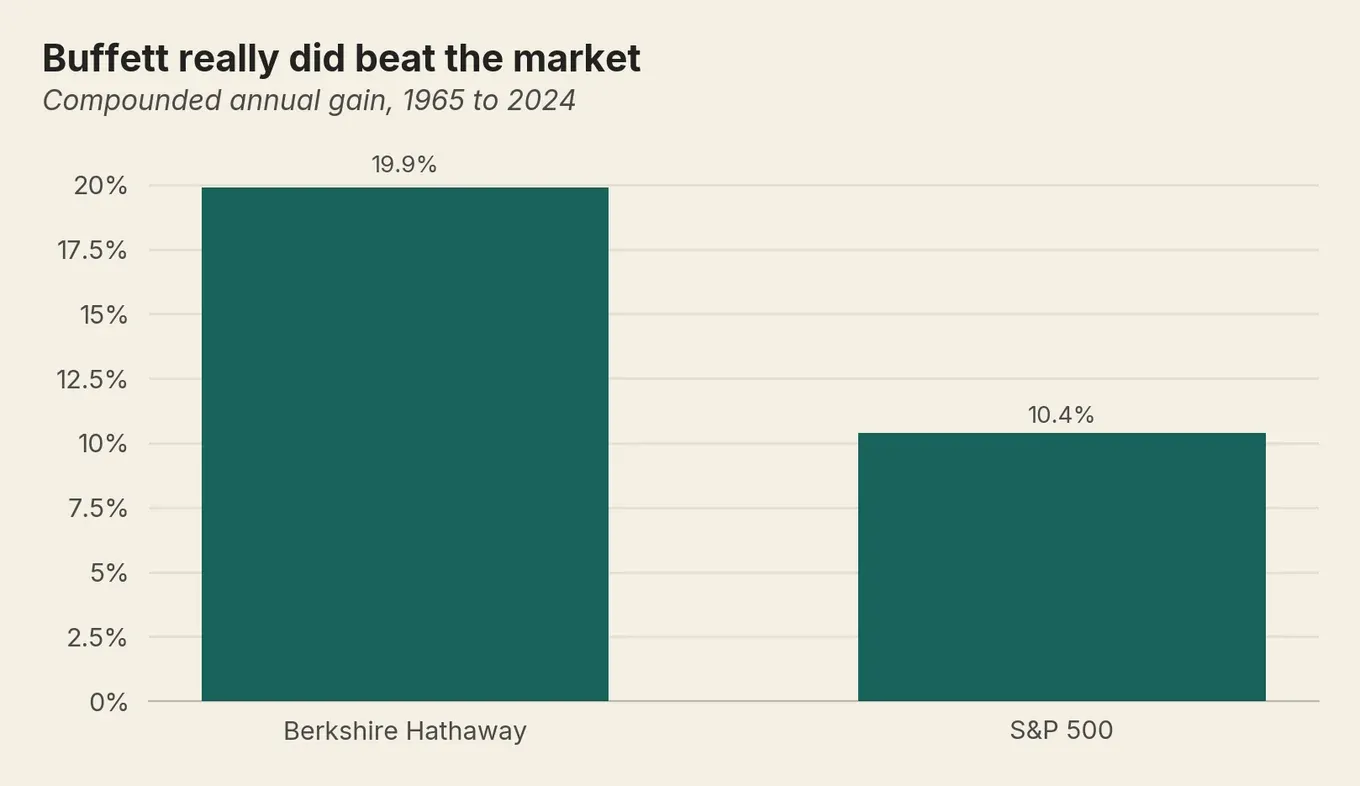
Warren Buffett beat the market for 60 years. From 1965 to 2024 his company grew 19.9% a year against the S&P 500’s 10.4% (opens in new tab). And most years he uses his letter to tell you not to copy his own investment strategy.
That reads like a man pulling the ladder up behind him. It isn’t. He’s making a bet about odds, and once you see it, most of Warren Buffett’s investment principles get simpler. The catch, if you’re doing this from Europe, is that almost every guide stops at the American border.
What are Warren Buffett’s main investment principles?
Buffett’s main principles are few. Here they are, with the part American guides skip.
- Stay in your circle of competence. Buffett buys only what he understands: “if there’s lots of technology, we won’t understand it.” You need a patch of ground you grasp, not a view on every hot stock.
- Treat Mr Market as a servant, not a signal. His 1987 letter (opens in new tab) casts the market as a manic partner “there to serve you, not to guide you”: short term it votes on mood, long term it weighs what a business is really worth.
- Demand a margin of safety. Buy only when worth clears price with room to spare. His 1992 letter (opens in new tab) calls that the cornerstone of investment success.
- Value and growth are “joined at the hip.” Buffett thinks “value investing” is a redundant phrase: growth is just one ingredient in what a business is worth, and it adds value only when each euro the firm reinvests earns back more than it cost. In a poor business, growth can destroy value. What you pay against what you get is the point.
- Judge a share as if buying the whole firm: a business you understand, with good prospects, honest managers and a fair price. That one test holds what other guides split into four.
- If you invest part-time, index and behave: “own a cross-section of businesses (opens in new tab),” add to it for years, and don’t sell on bad news. A low-cost S&P 500 index fund, one that holds around 500 of America’s biggest listed companies, does that job.
Point six is the tension, so start there.
Why does Buffett tell almost everyone to skip stock-picking?
The puzzle looks like hypocrisy: the best stock-picker alive tells you to buy an index fund and pick nothing. Look closer: it’s a claim about odds.
Real long-run winners exist, he says, but are rare. In his 2016 letter he named “only ten or so professionals (opens in new tab)” he expected to beat the S&P 500 over decades. Short term, luck looks like skill. A thousand monkeys flipping coins would throw up a genius too.
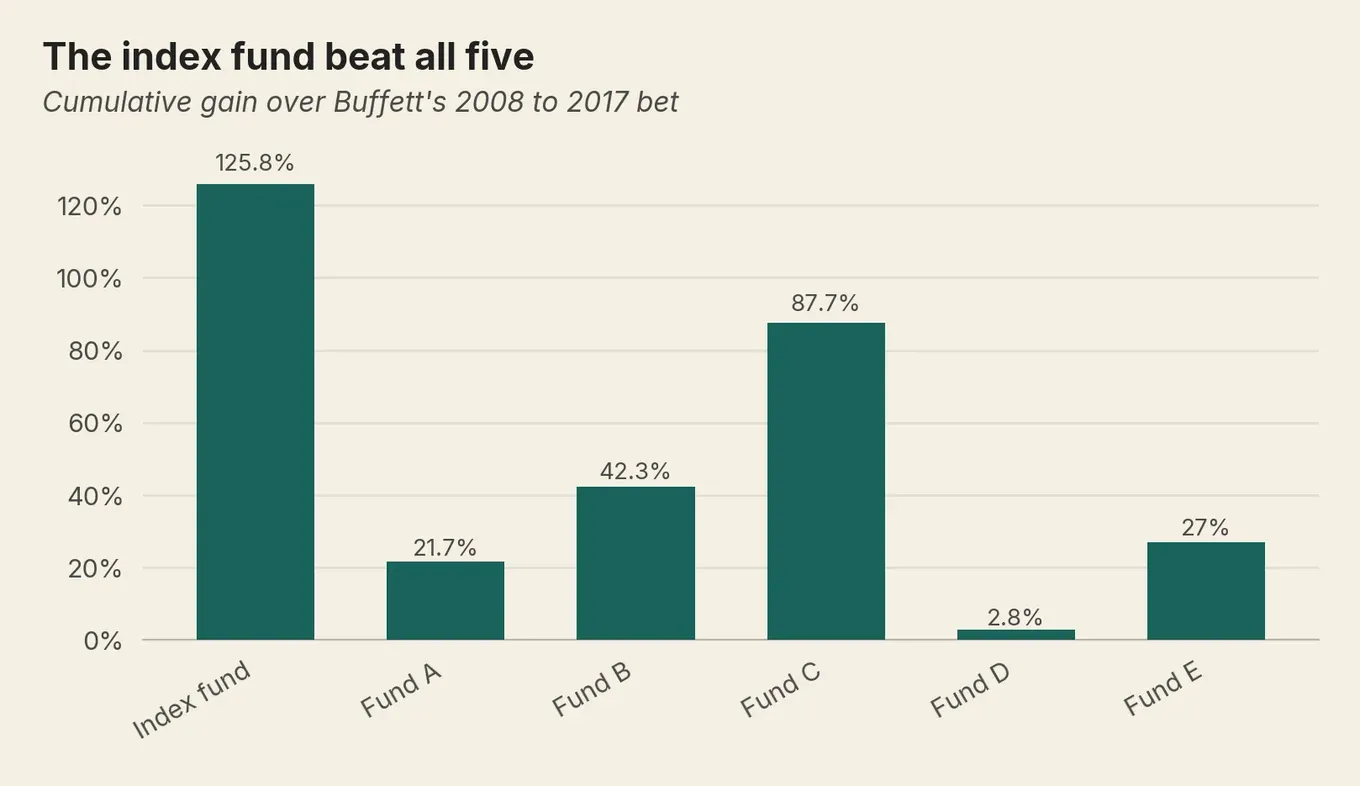
Then he proved it with money. In a ten-year bet ending in 2017, a low-cost S&P 500 index fund gained 125.8%, about 8.5% a year (opens in new tab). Five hand-picked funds all trailed it. Roughly 60% of their gains went on two layers of fees. His line: “Performance comes, performance goes. Fees never falter.”
Europe’s own cost data says the same. ESMA found (opens in new tab) that active funds charge more and, after costs, return less than passive ones. As an illustration of the drag, ESMA’s figures show a €10,000 pot growing to a net €18,500 between 2012 and 2021, after roughly €3,000 in costs. That is a cost finding, not a forecast; past performance is not a guide to future returns.
The man who built the low-cost index fund said it more bluntly:
In investing, you get what you don’t pay for.
John C. Bogle (opens in new tab), Vanguard’s founder.
Even Buffett’s own edge was partly borrowed money. AQR researchers (opens in new tab) traced it to roughly 1.6 to 1 of cheap borrowing funded by his insurance business. His Sharpe ratio (return per unit of risk) of 0.76 is superb, not superhuman. You can’t buy that engine, so “be like Buffett” means indexing cheaply and holding your nerve.
What is Warren Buffett’s 90/10 rule, and does it work for a European?
The 90/10 isn’t a universal rule. It’s Buffett’s order to the trustee of a cash gift for his wife: 90% in a low-cost S&P 500 index fund, 10% in short-term government bonds. That suits a widow’s lump sum, not a thirty-year-old still saving.
There’s a euro catch in the “10% short-term government bonds.” For a dollar trust, that means US Treasuries. Copy it from Porto or Ljubljana and the safe tenth carries US-dollar risk, which defeats the point. (An S&P 500 fund carries dollar exposure too, but a currency swing can swamp a low-yield bond sleeve while barely denting decades of share returns, so the match matters here, not there.) Match the currency instead: as a dated example, the iShares EUR Government Bond 0-1yr UCITS ETF (IE00B3FH7618) charged 0.07% a year in July 2026. Not a recommendation, and fees move; check the live one.
How can a European buy the fund Buffett recommends?
Buffett’s own fund is blocked here, and it helps to know why.
Why can’t you buy Buffett’s own US fund?
EU rules want a Key Information Document, a short plain-language sheet, before a packaged investment can be sold to ordinary savers (the rules are called PRIIPs). American funds like Buffett’s don’t produce one, so since 2018 they cannot be sold to EU retail buyers (opens in new tab).
What is the European stand-in?
A UCITS ETF: an EU-based fund that carries the sheet and tracks the same index. As dated July 2026 examples, the iShares Core S&P 500 UCITS ETF (IE00B5BMR087) charged 0.07% a year, and the State Street SPDR S&P 500 UCITS ETF (IE000XZSV718) charged 0.03%, among the cheapest. For Buffett’s wider “cross-section of businesses,” a UCITS MSCI World ETF reaches beyond the US: the iShares Core MSCI World (IE00B4L5Y983) charged 0.20%. These are examples, not advice; confirm each fee on the day.
You buy them through a European broker (Trade Republic, DEGIRO and Lightyear are common ones). Confirm it’s an authorised investment firm; ESMA (opens in new tab) and your national regulator both let you check.
| Buffett principle | What a European does |
|---|---|
| Own a low-cost S&P 500 index fund | Buy a UCITS S&P 500 ETF (US funds are blocked), e.g. iShares Core (IE00B5BMR087, 0.07%) or SPDR (IE000XZSV718, 0.03%) |
| Own a wide cross-section of businesses | A UCITS MSCI World ETF, e.g. iShares Core MSCI World (IE00B4L5Y983, 0.20%), widens beyond the US |
| Keep 10% in short-term government bonds | Currency-match with a euro short-term govt-bond UCITS ETF, e.g. iShares EUR Govt Bond 0-1yr (IE00B3FH7618, 0.07%) |
| Keep costs low, hold long, don’t sell on bad news | Hold inside your market’s tax wrapper; watch Ireland’s 8-year deemed disposal, which breaks “never sell” |
| Fees are the enemy | Compare fund fees (0.03% to 0.20% above) with active-fund costs, where passive tends to win net of fees |
Examples as of July 2026, not endorsements or advice; verify current figures before acting.
Can Europeans buy Berkshire Hathaway shares, and should they?
Berkshire’s Class B is a single share, so you can buy it, in euros, in Milan. What EU rules block is US funds, not single US shares.
How do you buy Berkshire in euros?
EuroTLX, part of Borsa Italiana (opens in new tab), lists Berkshire’s Class B in euros under the ID US0846707026. The other route, the New York line through a European broker, needs a W-8BEN form (the US tax-treaty form that trims the tax America takes on US dividends) plus some euro-to-dollar cost. Berkshire pays no dividend, so on Berkshire itself that tax never bites.
Should you? Treat it as a small side bet, never your core. It’s one company run by one manager. That is the concentration an index fund exists to remove. Another reason to keep any direct US share small: it can expose a non-US resident to US estate tax above a low threshold, depending on your country’s tax treaty with the US. And it’s now Greg Abel’s Berkshire: Abel became chief executive in January 2026, and as of 2026 Buffett stays on as chairman (opens in new tab). You’d be betting on the successor, not the legend.
| Route | Vehicle | Friction |
|---|---|---|
| S&P 500 exposure | UCITS S&P 500 ETF (carries the EU disclosure sheet, not blocked) | Yearly fee 0.03% to 0.07%; some wrappers (France’s PEA) exclude it |
| Berkshire, in euros | BRK.B on EuroTLX (US0846707026); single share, not blocked | Exchange cost built into the euro price; single-manager risk |
| Berkshire, in US dollars | BRK.B on the NYSE via an EU broker; single share, not blocked | W-8BEN form plus euro/dollar FX; no dividend, so no dividend tax |
| US index fund direct (VOO, SPY) | US-domiciled ETF; blocked from EU retail since 2018 | Not sellable to EU retail |
Which tax wrapper comes first, market by market?
Here’s the part the American guides never reach. The tax wrapper you hold the fund in can matter more than the choice between two near-identical ETFs, and in some countries decides which fund you may use. Pick the wrapper first. The table works through five markets as examples; the rule holds in every EU market.
Take Lena, 34, a DIY investor in Leipzig. Before choosing a fund, she checks her German tax position: Teilfreistellung leaves 30% of an equity fund’s returns tax-free. Then, with decades of pay cheques ahead, she skips the 10% bond sleeve and puts the lot in one low-cost S&P 500 UCITS ETF on a monthly standing order. In Germany, the tax rules are on her side.
The funds and fees work the same way everywhere in the EEA; after that, markets split, and Buffett’s “never sell” breaks wherever a country taxes you without a sale. Ireland and the Netherlands both do. In Ireland the eighth-year bill lands on paper gains you have not sold, so keep cash aside or you may have to sell part of the holding to pay it. France is the odd one out: its tax-sheltered PEA won’t hold a plain UCITS S&P 500, though a swap-based “PEA S&P 500” ETF gets around that, like the Amundi one (FR0011871128, 0.12% in July 2026).
| Market | Wrapper or rule | The figure that matters |
|---|---|---|
| Ireland (IE) | Exit tax (opens in new tab) + 8-year deemed disposal (opens in new tab) | 38% from 1 January 2026 (was 41%); taxed every 8 years even without a sale |
| France (FR) | PEA (opens in new tab) (EU-based holdings only) | €150,000 ceiling; plain UCITS S&P 500 excluded; swap-based PEA S&P 500 workaround |
| Germany (DE) | Teilfreistellung (opens in new tab) on equity funds | 30% of returns tax-free |
| Netherlands (NL) | Box 3 (opens in new tab) (deemed return on value) | “Never sell” defers no tax; rate changes yearly, so check |
| United Kingdom (GB) | ISA (opens in new tab) / SIPP (comparator only) | £20,000 tax-free in 2026/27 |
Italy, Spain and Portugal run their own tax-advantaged long-term wrappers too (Italy’s PIR, Spain’s Plan de Pensiones, Portugal’s PPR); reliefs shift yearly, so check with your tax authority. Either way, a UCITS ETF or a single US share is an investment, not a savings deposit, so it sits outside the deposit-guarantee schemes that protect your bank account. Its value can fall as well as rise.
Where do Buffett fans go wrong?
First, “value means cheap.” It does not. Buffett’s value is price below worth, so it can mean paying up for a growing business. A low price with a rotting company behind it is bait.
Second, the idea that you can clone Berkshire from its public filings. That filing shows the visible US shares and nothing else: not the wholly-owned businesses, not the insurance float, not the cheap leverage that quietly amplifies the returns. Copy the list and you copy the shadow.
Third, “Buffett never sells.” He does, and Berkshire proved it by dumping its Energy Future Holdings bonds when the thesis broke. “Forever” is what he hopes for a great business while it stays great, not a vow.
What to do this week
Pick the wrapper before the product. Find your market’s tax-sheltered account, or the rule that applies where there isn’t one; in Ireland at least learn the eight-year clock before you start.
First, a gate. Invest only money you won’t need for at least five years, and only what you can afford to watch fall. Do this once you have an emergency fund of three to six months of costs, with no high-interest debt like a credit-card balance behind you. Its value can fall as well as rise. Then choose one low-cost UCITS fund, an S&P 500 or MSCI World tracker, set a monthly standing order, and leave it alone.
Leaving it alone is the hard part, and it’s almost the whole of Buffett’s advice to everyone who is not Warren Buffett. It was never meant to be exciting. Excitement is what the fees are for.
Frequently asked questions
Can Europeans buy Berkshire Hathaway shares?
Does Berkshire Hathaway pay a dividend?
Is a UCITS S&P 500 ETF the same as VOO or SPY?
What is a Key Information Document (KID)?
Sources (18)
- AMF: application of the PRIIPs Regulation to US packaged products
- ESMA: costs of retail investment products continue slow decline
- Revenue.ie: taxation of Exchange Traded Funds (TDM Part 27-04-01, exit tax)
- Revenue.ie: Exchange Traded Funds and the 8-year deemed disposal (TDM Part 27-01A-03)
- Service-Public.fr: Plan d'Épargne en Actions (PEA)
- Gesetze im Internet: Investmentsteuergesetz Paragraph 20 (Teilfreistellung)
- Belastingdienst: Box 3, inkomen uit sparen en beleggen
- GOV.UK: Individual Savings Accounts (ISAs)
- Borsa Italiana: Berkshire Hathaway B on EuroTLX (US0846707026)
- Berkshire Hathaway 2024 Chairman's letter
- Berkshire Hathaway 2017 Chairman's letter (the Bet final tally)
- Berkshire Hathaway 2016 Chairman's letter
- Berkshire Hathaway 2013 Chairman's letter (90/10 bequest)
- Berkshire Hathaway 1992 Chairman's letter (margin of safety)
- Berkshire Hathaway 1987 Chairman's letter (Mr Market)
- AQR Capital Management: Buffett's Alpha (Frazzini, Kabiller, Pedersen)
- John C. Bogle: World Money Show keynote, 2005
- PBS NewsHour: Warren Buffett to remain chairman after Greg Abel takes over as CEO in 2026
— That's the lot. It is now night.
Want more of this in your Google results?
Add Money Owl as a preferred source, and Google will show our finance pieces higher when you search for them.
By Jure Jaklič
Founder and editor of Money Owl. Data analyst by trade; personal finance learned first-hand across six European countries.
Recommended

Loss aversion: why you're too scared to sell losing stocks
That losing share isn't an investment any more. It's a small shrine you tend, waiting for it to apologise. Here's the disposition effect, and the way out.

10 cognitive biases that are costing you money (and how to fix them)
Find €100 and you get a small lift; lose the same €100 and it lands harder. That one quirk drives ten money mistakes, each with a fix you can actually set up.
Dividend investing in Europe: is it really passive income?
Pooled across 2018, 2019, 2021 and 2022, 70.6% of European once-a-year dividend payments arrived in April, May and June. What that does to a monthly budget, and what living off it really costs.