

The point.
- US ETFs like VOO are blocked for EU retail buyers by the PRIIPs/KID rule, not by your broker; a UCITS version tracking the same index is the fix.
- The cost gap is index versus active, not ETF versus mutual fund; a UCITS index fund can match a UCITS index ETF on charges.
- You read the cost straight off the ongoing charges figure (OCF, also called TER) on the key information document.
- For long-term investing, an accumulating UCITS tracker reinvests dividends and keeps things simple; distributing pays them out as cash.
- Pick on the OCF and broad ownership, not on the ETF-versus-fund label.
The point.
- US ETFs like VOO are blocked for EU retail buyers by the PRIIPs/KID rule, not by your broker; a UCITS version tracking the same index is the fix.
- The cost gap is index versus active, not ETF versus mutual fund; a UCITS index fund can match a UCITS index ETF on charges.
- You read the cost straight off the ongoing charges figure (OCF, also called TER) on the key information document.
- For long-term investing, an accumulating UCITS tracker reinvests dividends and keeps things simple; distributing pays them out as cash.
- Pick on the OCF and broad ownership, not on the ETF-versus-fund label.
You funded a broker account, read three articles that all said “just buy VOO”, typed VOO into Trade Republic, and the order would not go through. No error you could understand. Just a polite refusal.
You are not missing something obvious. The advice was correct. It just wasn’t written for someone buying on a European broker. Every page-one result for stocks vs ETFs vs mutual funds is a US site comparing US funds for a US reader who can buy them. You can’t. That’s the whole reason this page exists.
So let’s do the comparison properly, for the broker you have, with the rules that apply to you. Three structures, one decision, no VOO.
What actually are stocks, ETFs and mutual funds?
In short: a stock buys you one company; an ETF and a mutual fund both buy you a basket of many companies in a single trade. The ETF trades on an exchange at a live price all day; the mutual or index fund prices once a day after the close. One difference matters more than the rest. Diversification.
A stock is one share of one company. You own a slice of that single business, and its fortunes are your fortunes. If you’d like the longer version of how shares and exchanges work, we’ve written a plain explainer of the stock market elsewhere; here we only need the contrast.
An ETF and a mutual fund are both baskets. Instead of one company, you buy a pooled vehicle that holds many companies at once, so a single purchase spreads your money across the lot. In Europe, nearly every fund a beginner buys is a UCITS fund, built to the EU’s harmonised fund standard (Directive 2009/65/EC (opens in new tab)). UCITS is the rulebook, not the regulator. One of its rules forces a fund to spread its holdings rather than bet the lot on one name. That diversification by construction is the thing a beginner is really buying when they buy a fund.
So what splits an ETF from a mutual fund? Mostly how you buy it. An ETF trades on an exchange throughout the day, like a stock, at a live price. A traditional mutual or index fund doesn’t trade on an exchange at all. You place an order and it fills once a day at the fund’s net asset value, struck after the market closes. Same idea, different plumbing. And here’s the part the US articles skip entirely: a mutual or index fund can track an index just as cheaply as an ETF. “Mutual fund” names a structure, not a quality. It isn’t the dowdy old relative of the ETF, just a basket that happens to price once a day.
How do stocks, ETFs and mutual funds compare on cost and pricing?
This is the part every comparison covers, so we’ll keep it tight. The honest summary fits in one table.
| Axis | Individual stocks | UCITS ETFs | UCITS mutual / index funds |
|---|---|---|---|
| What you own | One company | A basket, traded on an exchange | A basket, bought directly from the fund |
| Diversification per trade | None; one line of risk | The whole basket in one trade | The whole basket in one trade |
| Pricing | Live, all day | Live, all day | Once a day at net asset value |
| Typical ongoing cost (TER/OCF) | None on the holding | About 0.05% to 0.50% a year | 0.25% a year if index; near 1.35% if active |
| How you buy it in the EU | Any broker | Any broker (Trade Republic, DEGIRO, Trading 212) | Often platform-specific |
| Income | Dividends paid as cash | Accumulating or distributing share class | Accumulating or distributing share class |
| Best for | Deliberate, researched concentration | Cheap, hands-off, broad ownership | Cheap, hands-off, broad ownership |
Two rows deserve a word.
Does the once-a-day pricing matter?
For a buy-and-hold saver, almost not at all. The intraday price of an ETF and the once-a-day fill of a mutual fund feel like a big difference, and beginners worry about it constantly. They needn’t. If you’re paying in every month and selling nothing for a decade, the moment of the day your order fills shrinks to roughly nil. Intraday trading is a feature for people who trade intraday. You’re not one of them. That’s fine.
Why is the cost gap not about the wrapper?
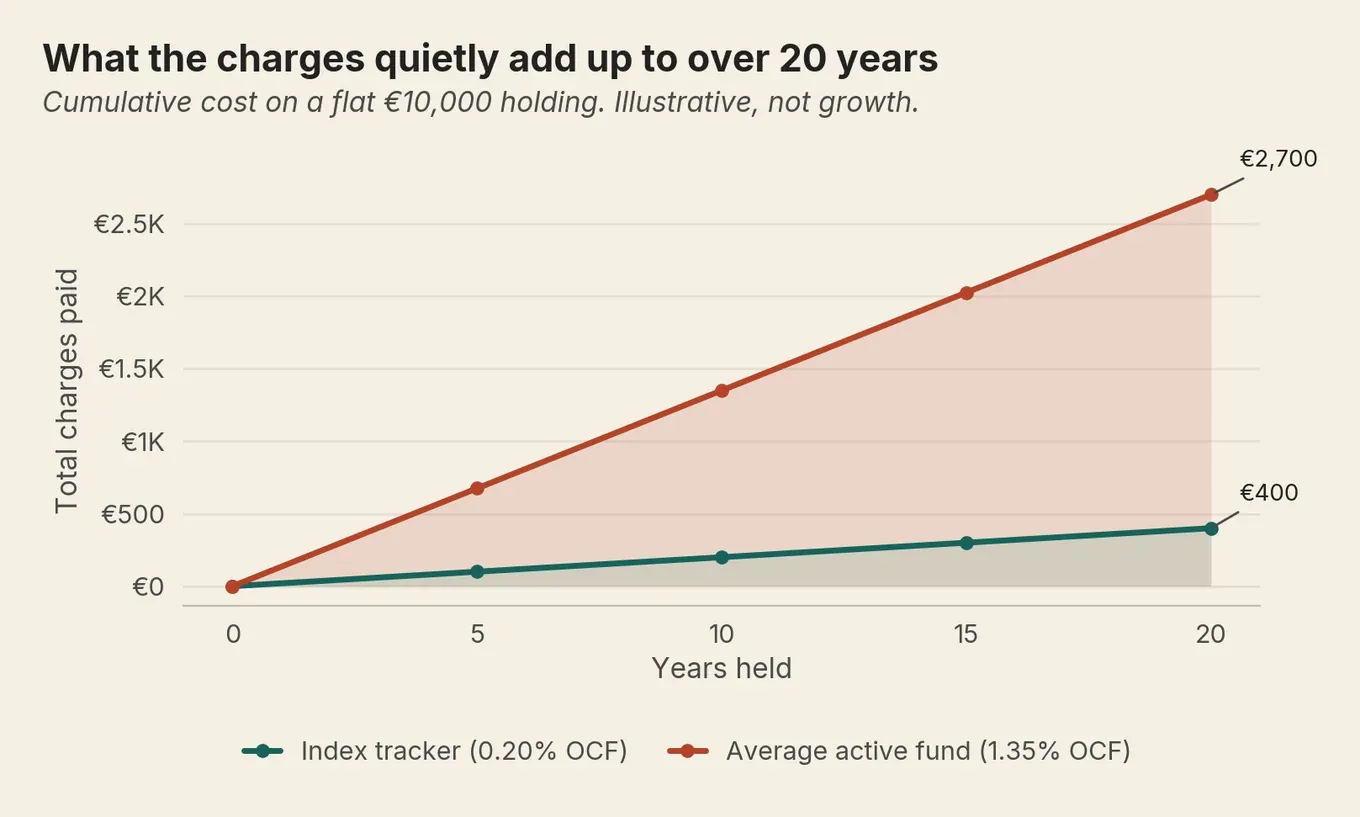
Because the thing that drives cost is whether a fund is run by a manager or simply tracks an index. Not whether it’s an ETF or a mutual fund. The EU shows you this as the ongoing charges figure, the OCF (also written as the TER), on the fund’s key information document. An average active UCITS equity fund ran about 1.35% a year, while an average index fund ran about 0.25% (Investment Company Institute, 2023 figures (opens in new tab); these are typical averages, not a current rate). A passive UCITS index fund can match a passive index ETF almost exactly. So “ETF cheap, fund expensive” is the wrong axis. The right one is index versus active. You read it straight off the OCF.
That gap is not loose change. On a holding of €10,000, an index tracker at 0.20% costs you about €19 to €20 a year. The same €10,000 in an average active fund at 1.35% costs about €135. Run your own two funds through the cost calculator and see which is really cheaper. These figures are illustrative; investment values can fall as well as rise, and what you pay depends on the fund’s charges and how it performs. But the direction is not in doubt. Over a few decades, the dull cheap one tends to win on what lands in your pocket. If you want to go deeper on picking a specific tracker, our guide to choosing ETFs for Europe does that job.
The EU’s markets regulator (opens in new tab) has reached the same conclusion repeatedly:
Active UCITS remained more expensive than passive funds and ETFs, such that their net performance was on average lower in comparison.
What does the UCITS and PRIIPs reality mean for a European investor?
Here’s the answer to why VOO wouldn’t buy. It comes down to one document.
Before any retail investor in the EU can be sold an investment product, the law requires a short standardised disclosure document, the key information document, or KID. The rule comes in two halves of the same regulation (the EU’s investor-disclosure rules (opens in new tab)). One half says the company that makes the product must produce the KID. The other half says nobody may sell that product to a retail client without handing them the KID first.
VOO is made by a US issuer. That issuer doesn’t produce an EU key information document, because it has no reason to. No KID, no sale to you. Your broker isn’t being difficult; it’s forbidden. The American on YouTube told you to buy a thing that European law won’t let your broker sell you, and nobody told you why. Now you know.
The fix is undramatic. For almost any US fund you were sent to buy, there’s a UCITS version tracking the same index, made by an issuer that does produce the KID, and your broker will sell it to you without blinking. You lose nothing real in the swap. The wall applies only to retail clients. Professional investors sit outside it, which is why you’ll read confident strangers online saying they buy US ETFs in Europe. They aren’t lying. They’re simply not you.
A note on the name, since the internet muddles it: the current document is the KID. The older UCITS version was the KIID, with two i’s, and it was retired for retail investors across 2023 and 2024 (Central Bank of Ireland (opens in new tab)). If a page tells you to read the KIID, it’s showing its age.
Should you pick accumulating or distributing?
UCITS funds usually come in two flavours of the same portfolio. A distributing share class pays the dividends it receives out to you as cash. An accumulating share class keeps them inside the fund and reinvests them, so they show up as a higher unit price rather than money in your account (Central Bank of Ireland (opens in new tab)). For most people investing for decades, accumulating wins on simplicity and on quiet compounding; for someone who wants spendable income now, distributing makes sense. Which is better for tax depends on where you live, and that’s a question for our piece on tax-efficient investing rather than this one. A global tracker can also come hedged or unhedged to the euro, and whether the currency hedge is worth its cost is a separate question.
One worked example of that tax point, lightly. An Irish resident holding an ETF faces a charge of 38% on gains from 1 January 2026, and is treated as having sold up every eight years even if they never touch a thing (Revenue Commissioners (opens in new tab)). That’s one market’s gotcha, not a pan-European rule, and it’s exactly the sort of thing the tax post exists to handle. Mentioned here only so you know it’s real.
Which is right for you as a beginner on a European broker?
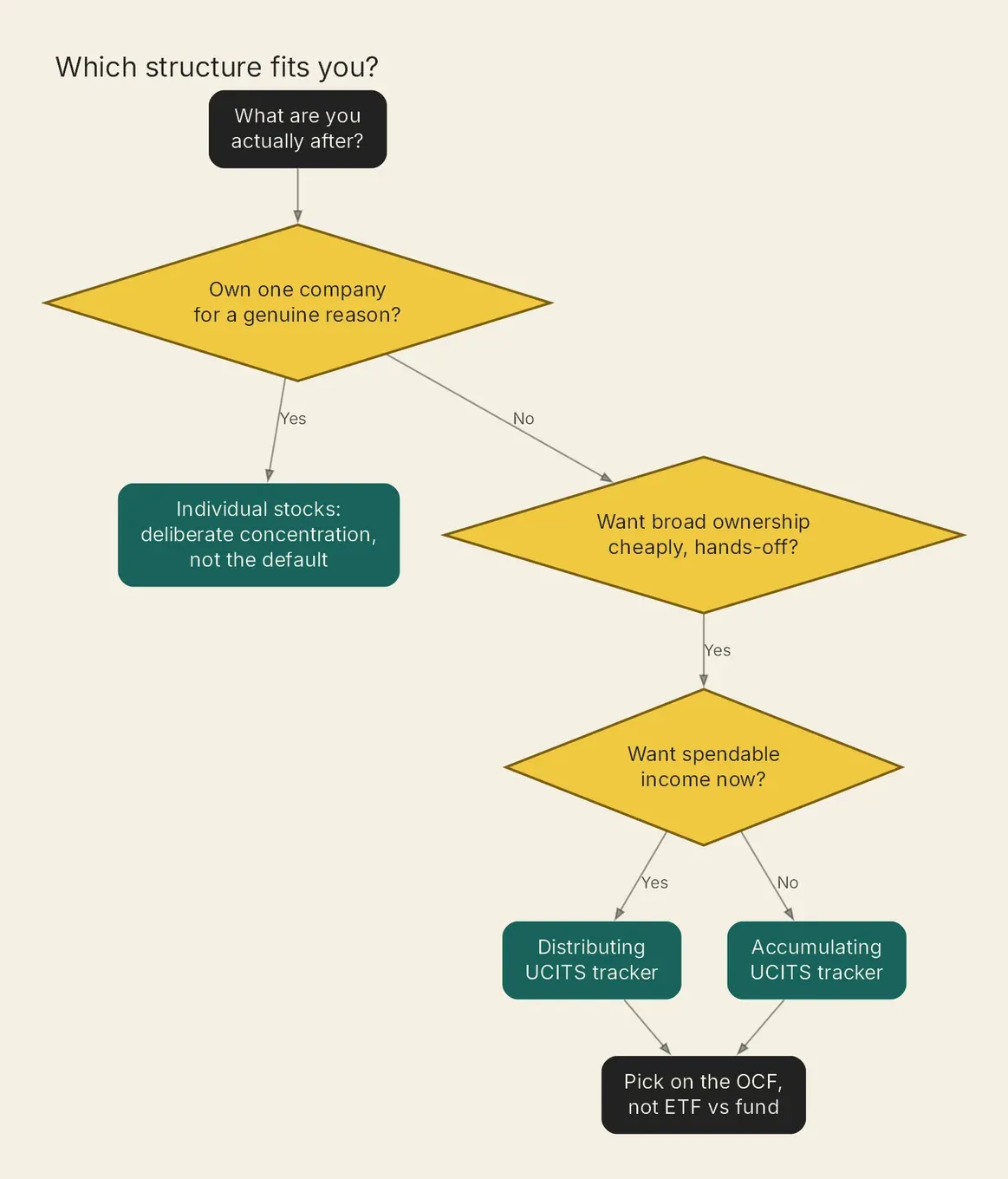
Start from what you can buy, not from what a US article told you to want. On Trade Republic, DEGIRO or Trading 212, your real menu is three things: individual stocks, UCITS ETFs, and UCITS index or mutual funds. Many of these brokers now let you buy fractions of a share from around €1, so the old “you need €500 to start” worry from US pages does not apply. Then work down a short list.
Do you want to own one company because you have a genuine reason, and can stomach that company alone carrying your money? That’s the stock-picking choice. Put your whole €2,000 into one firm you like and you own exactly one line of risk: that single company carries all your money. It can be the right call with a real reason behind it. But it’s concentrated risk taken on purpose, not the low-maintenance default, so treat it as a deliberate, separate decision.
Do you want broad ownership cheaply, with as little maintenance as possible? Then a low-cost diversified UCITS index tracker, in an accumulating share class, on the broker you already have, is the structural type that fits most beginners. Whether that tracker is an ETF or a non-traded index fund matters less than its OCF and what your broker offers. This is where the whole stocks vs ETFs vs mutual funds question quietly resolves. Compare the OCF on the key information document, pick the cheap broad one, and let it sit.
Take your €2,000. In a broad UCITS index tracker at 0.20%, the ongoing charge is about €4 a year. The same €2,000 in an average active fund at 1.35% costs about €27 a year, for the same broad ownership. €23 a year, illustrative, on a starting pot. Values can fall as well as rise, and what you pay depends on the fund’s charges and performance.
None of this is a recommendation of a specific fund, and it isn’t personal financial advice; it’s a guide to which type of thing tends to suit which type of saver. The decision you’re making is structural, and you can make it today: pick the type, check the charges figure, set the standing order, and stop reading comparison articles. Including this one.
Frequently asked questions
What is the difference between an ETF and a mutual fund?
Why can't I buy US ETFs like VOO on a European broker?
Are ETFs always cheaper than mutual funds?
Should a beginner buy individual stocks or a fund?
Sources (7)
- EUR-Lex: PRIIPs Regulation (EU) No 1286/2014
- ESMA: UCITS, Interactive Single Rulebook (Directive 2009/65/EC)
- ESMA: Costs of retail investment products continue slow decline (ESMA71-99-2076, 17 January 2023)
- Central Bank of Ireland: PRIIPs KID (UCITS applicability dates)
- Central Bank of Ireland: UCITS Prospectus Disclosures
- Revenue Commissioners: Tax and Duty Manual Part 27-01A-02, Investment Undertakings
- Investment Company Institute: Ongoing Charges for UCITS in the European Union, 2023
— That's the lot. It is now night.
Want more of this in your Google results?
Add Money Owl as a preferred source, and Google will show our finance pieces higher when you search for them.
By Jure Jaklič
Founder and editor of Money Owl. Data analyst by trade; personal finance learned first-hand across six European countries.
Recommended

Dividend investing in Europe: is it really passive income?
Pooled across 2018, 2019, 2021 and 2022, 70.6% of European once-a-year dividend payments arrived in April, May and June. What that does to a monthly budget, and what living off it really costs.

Should I wait to invest? Five reasons people give
We ran 107,454 windows of European tracker-fund history since 2008. Waiting won three times in ten. Five reasons Europeans give for holding off, cross-examined: three lose, two hold up.

Does market timing work? Seventeen European forecasts, marked.
Every year Europe's strategists publish a number for where the market ends up. As far as we can find, nobody checks. So we marked seventeen of them, and the typical miss is bigger than a typical year.