

The point.
- The core habits behind how you handle money form young, mostly by around the age of seven, and mostly by watching the adults around you rather than being taught.
- Psychologists keep finding four money scripts: avoidance, worship, status, and vigilance. Three of the four are under-explained almost everywhere, so this guide spends its time there.
- Vigilance is the one script the evidence calls broadly healthy, but taken too far it curdles into over-vigilance: comfortable, careful, and quietly anxious, with surplus never put to work.
- Money scripts are not fixed. They are rules you wrote as a child, which means an adult can read them, test them, and write better ones.
- The short self-check is a mirror, not a verdict. A 2025 review of the revised inventory found the four-factor model fits the data poorly, so treat your result as a prompt to think, not a diagnosis.
The point.
- The core habits behind how you handle money form young, mostly by around the age of seven, and mostly by watching the adults around you rather than being taught.
- Psychologists keep finding four money scripts: avoidance, worship, status, and vigilance. Three of the four are under-explained almost everywhere, so this guide spends its time there.
- Vigilance is the one script the evidence calls broadly healthy, but taken too far it curdles into over-vigilance: comfortable, careful, and quietly anxious, with surplus never put to work.
- Money scripts are not fixed. They are rules you wrote as a child, which means an adult can read them, test them, and write better ones.
- The short self-check is a mirror, not a verdict. A 2025 review of the revised inventory found the four-factor model fits the data poorly, so treat your result as a prompt to think, not a diagnosis.
You’ve probably caught yourself doing something with money you can’t fully explain. Maybe you flinch before opening your banking app, even when the balance is fine. Maybe you buy the round, every time, because not buying it feels worse than the cost. Maybe you save and save and still can’t let yourself book the holiday.
None of that is a character flaw. It’s a script. Someone handed it to you before you could read a bank statement, and you’ve been running it ever since.
This guide traces how a childhood money moment hardens into an adult habit. It walks through the four money scripts psychologists keep finding, and goes deep on the three almost nobody explains properly. There’s a quick self-assessment linked near the end to help you spot your own, and it stays honest about where the research is still arguing with itself.
Where do your money habits come from?
Mostly, you learned money the way you learned an accent: by being in the room for it.
Researchers call this family financial socialisation, a heavy phrase for a simple idea: how families pass money habits on. Gudmunson and Danes (opens in new tab), writing in the Journal of Family and Economic Issues in 2011, split it into two channels. The first is the times a parent sat you down and explained something. The second is what you soaked up by watching: how they behaved around money, how they argued about it, whether they went quiet when the bills came. That second channel does most of the work. Talk is cheap. Watching is constant.
This starts early. A review for the UK’s Money Advice Service, carried out by David Whitebread and Sue Bingham at the University of Cambridge (opens in new tab) in 2013, found that children have most of the mental foundations for handling money in place by around the age of seven. Not beliefs about compound interest. Habits of mind: whether they can wait, whether they plan, whether money feels safe or frightening. Most of that settles before we can spell.
Here’s roughly how a habit becomes a script. A charged money moment happens: a parent loses a job, a holiday gets cancelled with no word as to why. The child feels something big and has no tools to handle it, so they make up a story, and the story turns into a rule. The rule protected them then, so they keep it. Decades later it still runs, except now it fires in spots it was never built for. As Brad Klontz, the psychologist who has done most to name these patterns, says in a 2023 CNBC interview (opens in new tab): “most of our financial behaviors will make perfect sense when we understand the beliefs that are underneath them.” The behaviour looks mad. The belief underneath runs perfectly sane, for a situation that ended twenty years ago.
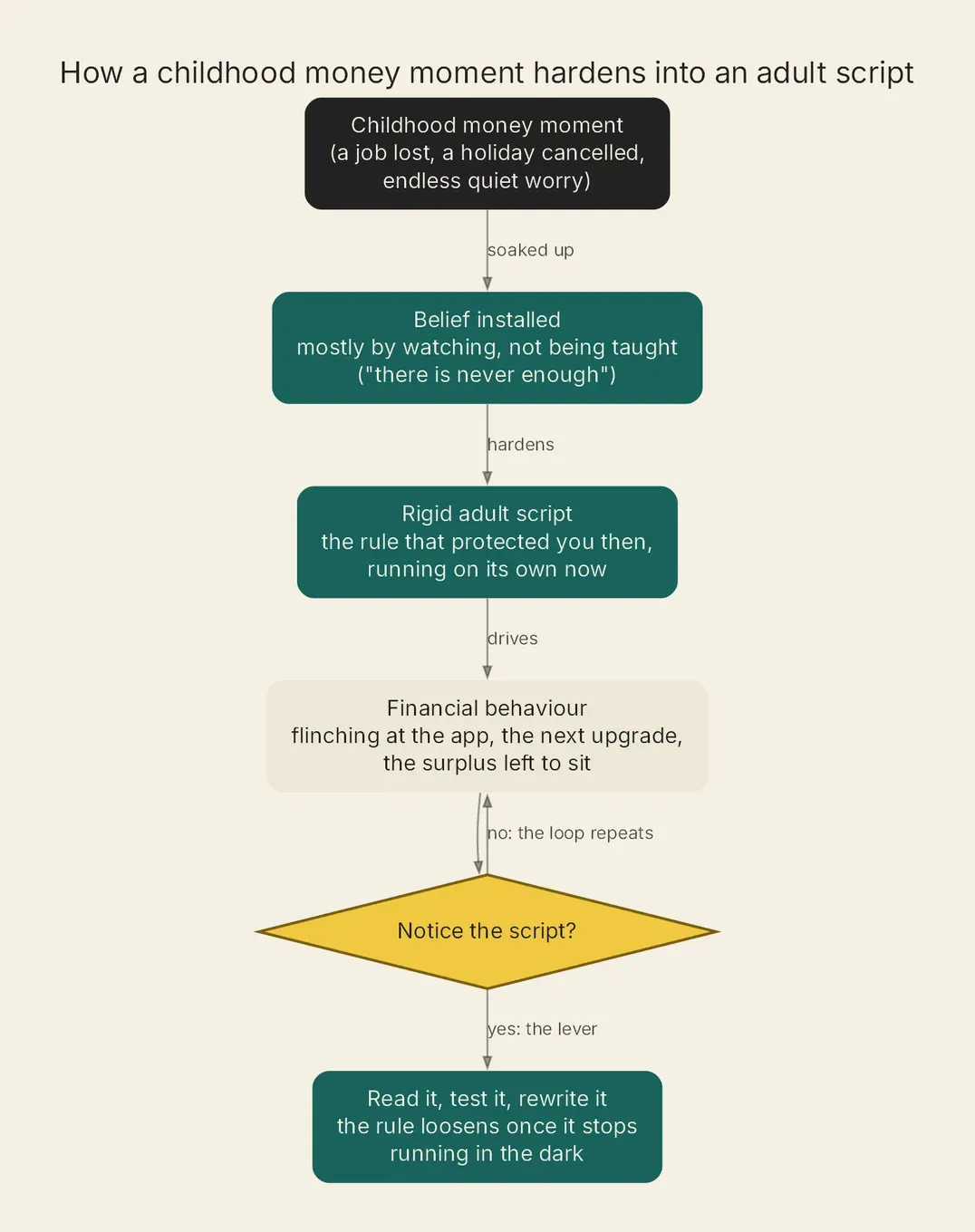
A note on blame, because the upbringing angle invites it. Your parents were running scripts too, handed down by their parents, who got them from a war or a slump or a farm that nearly failed. Klontz describes some of these as beliefs “that our great grandparents had”. Reading your own script doesn’t send anyone a bill. It just shows you that the lease on the rule has quietly expired, and that you’re now the landlord.
What are money scripts?
Money scripts are beliefs about money you soak up in childhood, mostly without noticing, that drive how you behave with it as an adult. Brad Klontz sorts them into four patterns: money avoidance, money worship, money status, and money vigilance. Most people carry traces of several, with one or two doing the steering.
The term comes from Klontz and colleagues (opens in new tab), in the Journal of Financial Therapy in 2011. They define money scripts as beliefs that are “developed in childhood”, “often passed down from generation to generation”, “typically unconscious”, and “contextually bound”. That last word matters most. A script is a partial truth that fit one particular situation, and then life moved on without telling it. “There is never enough, hold on tight” is sound survival advice in a household that genuinely had nothing. Carried into a comfortable adult life, it becomes a brake you can’t take off.
To pin these beliefs down, Klontz built a set of questions, the Klontz Money Script Inventory, or KMSI for short. It asks people how strongly they agree or disagree with a long list of statements about money, on a six-point scale, and sorts the answers into patterns. Hold on to that, because the self-assessment this guide points you to borrows its logic.
What are the four types of money scripts?
The four types of money scripts are money avoidance, money worship, money status, and money vigilance. Three of the four stay under-explained almost everywhere you look, so this guide spends its time there. Money Status is the belief that what you own is what you’re worth. It quietly reads your bank balance as a verdict on you as a person, and it tends to show up most in people who grew up with money struggle and learned to use money as proof they’d arrived. We give it a fuller treatment in our piece on self-worth versus net worth; if that one lands, read it next. The other three sit below.
| Money script | Core belief | Everyday tell | The downside | Illustrative euro cost / note |
|---|---|---|---|---|
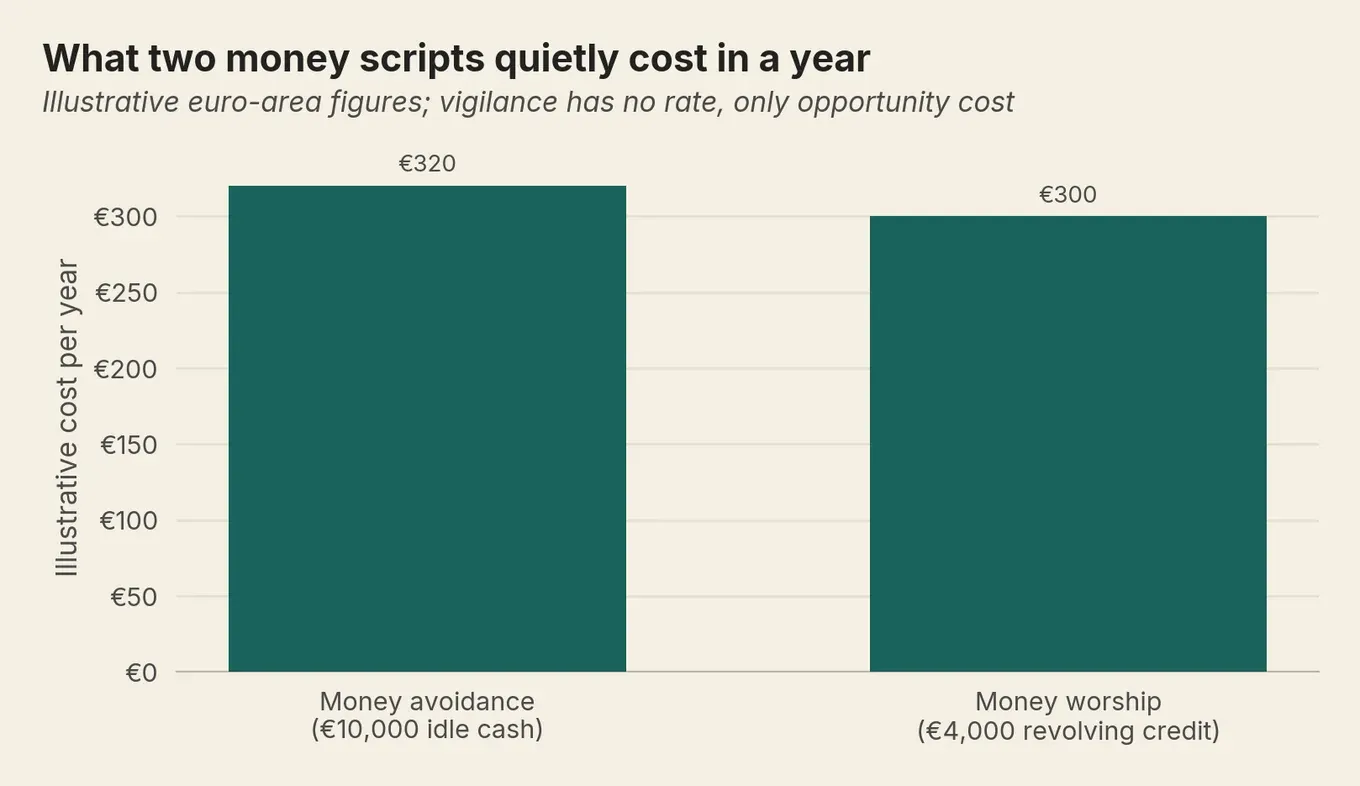
| Avoidance | Money is bad, corrupting, or undeserved | Unopened statements, vague dread, charging too little | Underspending, extreme risk aversion, never looking | ~€320/year of purchasing power quietly eroded on €10,000 of idle cash (ECB/Eurostat, illustrative) |
| Worship | More money will fix things and make you happy | Overspending to chase a lift the next purchase never delivers | Revolving credit, lower net worth, a forecast that keeps being wrong | ~€300/year of interest on €4,000 of revolving consumer credit (ECB, illustrative) |
| Status | What you own is what you’re worth | Reading the bank balance as a verdict on you | Spending to prove you’ve arrived; self-worth tied to net worth | Covered in depth in our piece on self-worth versus net worth (link-out) |
| Vigilance | Stay alert, careful, thrifty; keep money private | Frequent balance checks, hard to spend on yourself | Over-vigilance: comfortable but anxious, surplus never put to work | No rate: opportunity cost and under-spending, not a euro figure |
What is money avoidance?
Money avoidance is the belief that money is bad, corrupting, or undeserved, and it shows up as looking away: unopened statements, a vague dread around anything to do with money, an urge to give it away or charge too little. Klontz’s 2011 paper describes money, for the avoider, as “a force that stirs up fear, anxiety, or disgust”. Underneath it usually sits a scarcity mindset, a quiet belief that there’s never enough and never will be, which makes looking at the numbers feel like an act of self-harm.
The 2025 review of the inventory (opens in new tab) lists the behaviours that travel with it: spending too little, dodging risk to an extreme, and refusing to look at your money at all. Klontz is blunter in the CNBC interview: people with this script “may unconsciously not allow themselves to do well or even save up”. In Klontz’s 2011 sample, higher avoidance scores went with lower income and lower net worth, a real but modest link on a single group of people, so read it as a tendency, not a sentence.
The quiet cost is real. Picture an avoider in Germany or the Netherlands who leaves a big balance sitting in an instant-access account because choosing what to do with it feels too hard. Across the euro area, banks paid roughly 0.26% on household instant-access deposits in April 2026, according to European Central Bank data (opens in new tab), while prices rose about 3.2% over the year to May 2026 on Eurostat’s measure (opens in new tab). This is illustrative, not advice, and it points to no particular account or product. On those numbers, €10,000 left untouched earns around €26 of interest in a year while roughly €320 of what it can buy quietly slips away. The avoider isn’t losing money by gambling. They’re losing it by not looking.
What is money worship?
Money worship is the belief that more money will fix things and finally make you happy, and it shows up as overspending in pursuit of a feeling the next purchase never delivers. In Klontz’s words, the worshipper “subscribed to the belief that more money will make you happier”, and tends to put money “on a pedestal”.
Klontz describes worshippers “overestimating the sense of satisfaction and meaning they’ll get from buying things”. The next thing is always the one that does it, and it never lands, so there’s always a next one. The research on what spending actually buys in happiness backs the worshipper’s instinct only partway, and almost never in the direction they expect. In the 2011 data, worship was the script linked to carrying credit-card debt from month to month and to lower net worth.
Here’s the cost in euros. A worshipper funding the next upgrade on a credit card or overdraft pays for it. The euro-area rate on new consumer credit to households sat around 7.59% in April 2026, again per ECB data (opens in new tab), and that average tends to sit below headline credit-card rates, so treat it as a floor rather than a worst case. The mechanism is grim and simple: you borrow at a real cost to chase a satisfaction that, by the script’s own logic, the next thing was always going to deliver and never does. It’s easier to keep doing when the borrowing and the buying live in separate mental pockets, one of the tricks our mental accounting plays to keep the cost out of sight.
Take Marco, 34, in Bologna (illustrative, not a real person). He grew up watching his parents treat a new thing as the fix for a flat mood. When work was tight, the answer was a better TV, a weekend away, something. The lesson he soaked up without noticing was that the next purchase is where the good feeling lives.
As an adult the script runs on its own. A hard week ends with an upgrade funded on consumer credit, and the lift fades before the statement lands. He carries roughly €4,000 of revolving credit, and at around 7.59% a year that is about €300 in interest, paid to chase a satisfaction the forecast keeps getting wrong. Illustrative again, not advice, and pointing to no particular product. The lever starts with naming it: before the next upgrade, Marco writes down the feeling he expects to buy, then checks whether the last three purchases delivered it. They did not. The buying doesn’t stop overnight, but a forecast you’ve written down gets harder to believe.
To be fair to the script, the drive isn’t all bad. Klontz notes it can work out “to a point” for someone who channels it into real progress and climbs out of the debt. The problem is the worship, not the wanting.
What does money vigilance mean?
Money vigilance means staying alert and thrifty with money, and keeping it private. Klontz describes it as “alertness, watchfulness, and concern about money”. On paper it reads as the well-behaved script. In the 2011 data, vigilant people were the ones not carrying credit-card debt month to month, and vigilance guarded against spending you can’t stop and against bailing other people out. Tellingly, vigilance was the one script of the four that did not track with lower income or lower net worth. If you wanted to call one script “the healthy one”, this is the only one with the evidence to back it.
Which is exactly why it becomes the dangerous one to own. It never feels like a problem.
The downside has a name: over-vigilance. Klontz’s 2011 paper flags that being careful, taken too far, curdles into “excessive wariness or anxiety”. In the CNBC interview he sharpens it: “you could be so anxious around money, you hoard it and don’t enjoy life”. Over-vigilant people, he notes, tend to live comfortably off and yet carry higher-than-average money worry. The money is there. The permission to use it is not.
Picture a secure household in Ireland or France that has built a solid emergency fund and then a good deal more. It still never puts the spare money to work, still never books the trip everyone agrees they’ve earned. That’s the over-vigilance cost. It isn’t a number on a statement; it’s a life they’ve earned, quietly turned down. The reader most likely to skip this section thinking “that one’s fine, I’m just sensible” is exactly the reader it’s written for.
How do I find out my money script?
There is a short way to find out, and it beats guessing. The four scripts, money avoidance, money worship, money status and money vigilance, rarely travel alone; most of us run a main one with a quieter backup underneath.
You can start without any tool. The next time money makes you flinch, reach for a purchase, angle to be seen, or check the balance twice, note which pull was strongest. Caught a few times, that flicker usually points at your main script before you have added up a single score.
For the fuller picture, and to catch money status, the hardest of the four to spot in yourself, use the money scripts self-assessment. It rates 16 statements across all four patterns, then hands you your likely main script, your backup, and the one specific move that fits the result. Nothing is stored, your answers never leave your browser, and there is no biro required.
One honest caveat before you read too much into any result. The four-script model offers a useful lens, not a settled fact. A 2025 study of the revised inventory (opens in new tab), run on a large and varied sample of 2,686 people, found the four-factor structure fit the data poorly and did not hold up evenly across different groups. The authors concluded the questionnaire “needs significant revision before it can be used with diverse populations”. So take your result as a prompt to think, not a verdict stamped on your forehead. The patterns hold up as real and useful. The exact machinery measuring them is still being argued over, which is the sort of thing a guide should tell you.
Can you change your money script?
Yes. Money scripts aren’t your DNA. A script is a rule you wrote as a child, which means an adult can read it and write a better one.
The first lever is the cheapest and the most overlooked: just noticing. Klontz’s own line is that “just being aware that we’re living out a belief that our great grandparents had can really help us transform our relationship with money”. Naming the script loosens its grip, because most of its power comes from running in the dark. You can’t edit a rule you’ve never read.
After that, the work gets specific, and this is where generic advice falls down. “Just be more disciplined” is useless, because the problem was never discipline. Behaviour follows belief, so the lever has to match the script you carry:
- If you’re an avoider, the move is to engage with the thing you’re dodging. Open the statements. Set up one automatic transfer so the deciding happens once and then runs itself. You don’t have to learn to love money. You just have to stop flinching at it.
- If you’re a worshipper, the move is to break the link between spending and the happiness it keeps promising. Before you buy, name the feeling you expect to get, then check, honestly, whether the last few buys delivered it. The script lives on a forecast the evidence keeps proving wrong.
- If you’re over-vigilant, the move is permission. Give yourself an explicit, planned allowance to spend on something that matters and to put surplus to work rather than letting it sit. For you, looser is the discipline.
Rewriting a script you’ve run since childhood is slow work. The muscle that does it is the same one that gets you through a redundancy or a market wobble without panic, so it helps to read this alongside the wider work of building your mental financial resilience. If the script is dug in deep and clearly costing you, there’s no shame in getting help from a financial therapist or a behaviour specialist; some money beliefs wire in early and hard. Small early studies in financial therapy have linked working on money beliefs to lower money worry, though that work is at an early stage and not a promise. For most readers, the honest starting point is the cheap one. Read the script. Trace where it came from. Ask whether it still fits the life you lead now, rather than the one you were raised in.
Your money scripts were never a verdict on your worth or your willpower. They’re rules someone handed you when you were small, mostly by what you watched rather than what you were told. And because they’re scripts, you can read them, see the places they no longer fit, and start writing the next draft yourself. You’re almost certainly further along than you think.
Frequently asked questions
What are money scripts?
What are the four types of money scripts?
How does your childhood shape your money habits?
What is the difference between money avoidance and money worship?
Can you change your money script?
Is the money-scripts model actually backed by research?
Sources (8)
- Klontz et al.: Money Beliefs and Financial Behaviors (Klontz Money Script Inventory), Journal of Financial Therapy 2011
- Evaluating the Klontz Money Script Inventory-Revised (KMSI-R), Journal of Family and Economic Issues 2025
- Gudmunson and Danes: Family Financial Socialization, Journal of Family and Economic Issues 2011
- Whitebread and Bingham: Habit Formation and Learning in Young Children (Money Advice Service / University of Cambridge, May 2013)
- CNBC: To improve your finances, learn your money script (Brad Klontz interview, 2023)
- European Central Bank: euro-area overnight household deposit interest rate
- European Central Bank: euro-area consumer credit interest rate
- Eurostat: euro-area HICP inflation, all-items 12-month rate
— That's the lot. It is now night.
Want more of this in your Google results?
Add Money Owl as a preferred source, and Google will show our finance pieces higher when you search for them.
By Jure Jaklič
Founder and editor of Money Owl. Data analyst by trade; personal finance learned first-hand across six European countries.
Recommended

Mental accounting: why a euro from a refund spends differently
A euro is a euro, but your brain files it into pots and spends each by a different rulebook. Spot the pots quietly costing you, keep the ones that save you.

The psychology of spending: why we buy things we don't need
A €200 jacket split into four payments reads to your brain as €50. The psychology of spending, and how to put the brake back.

Loud budgeting: how to turn down plans you can't afford without shame
Someone's booked a hen weekend that costs a week's groceries. Loud budgeting is how you say no to it without sounding cheap, broke, or mean.