

The point.
- Money dysmorphia and doom spending are media coinages, not clinical diagnoses; neither sits in the DSM-5-TR or the WHO's ICD-11.
- Money dysmorphia is a feeling (a distorted picture of your finances); doom spending is a behaviour (a stress-driven purchase). They feed each other through the same social feed.
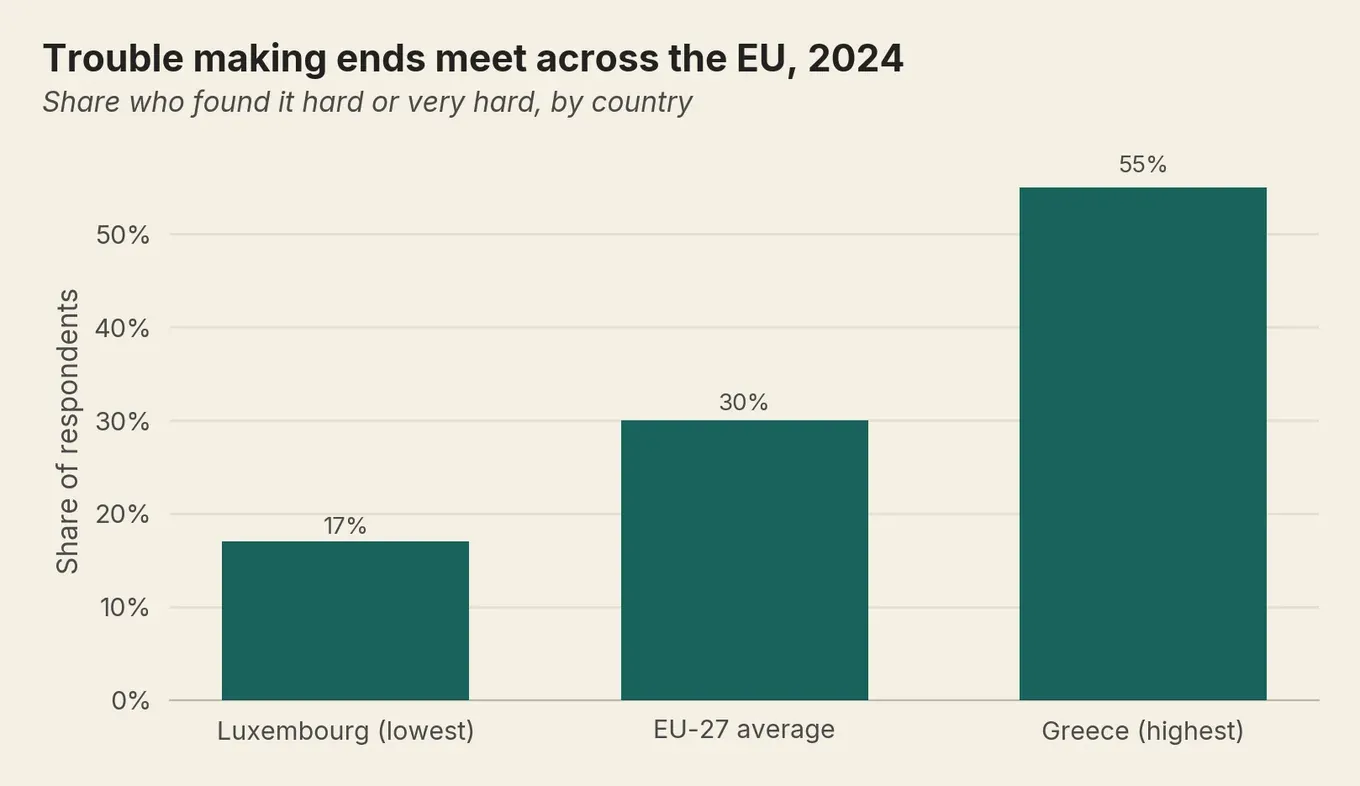
- For many people the strain is genuine: 30% across the EU found it hard to make ends meet in 2024, so the feeling is not always a distortion.
- The two responses with the strongest evidence are reality-testing your real numbers and automating your saving. Viral money trends are optional extras, not proven fixes.
- If money worry is stopping you sleeping, working, or functioning, that is past any budgeting tip; speak to a family doctor or a mental-health professional.
You feel behind. Plenty of people your age do, and for many of them the feeling isn’t a trick of the light. In 2024, 30% of people across the EU said it was difficult to make ends meet, up from 22% the year before (Eurofound (opens in new tab)). That’s real, and so is the rent.
Then there’s the other version. The balance is fine, the direct debits clear, and you still lie awake convinced you’re one bad month from ruin. In late 2023 and early 2024 the internet named both feelings, money dysmorphia and doom spending. It borrowed a medical-sounding word for one, and started selling the cure. Here’s what each means and where it comes from. And which fixes are worth your time.
What is money dysmorphia?
Money dysmorphia is a distorted picture of your finances: feeling broke, behind, or one payslip from disaster when the numbers say you’re fine. It borrows its name from body dysmorphia, a real condition, but it’s a media coinage, not something a doctor can diagnose.
The word arrived in January 2024, when the US firm Intuit Credit Karma published a survey it had run the previous December. It found 29% of 1,006 American adults “experience money dysmorphia” (Credit Karma (opens in new tab)). One commercial survey, one country, from a company that also sells financial products, not a measurement of anything in Europe. Useful for where the term came from, no more than that.
Body Dysmorphic Disorder, the real condition it borrows from, is a preoccupation with a flaw in your appearance that others can barely see (StatPearls (opens in new tab)). Swap “appearance” for “finances” and you have the idea: a gap between how your money is and how it feels. Real and familiar, but not a diagnosis: money dysmorphia sits in neither the DSM-5-TR nor the WHO’s ICD-11, the manuals clinicians diagnose from, so no doctor can put it on your notes.
What is doom spending, and how is it different from money dysmorphia?
Doom spending is buying things to feel better about a future you’ve decided is bleak. You scroll grim news about the economy or house prices, feel powerless, and a purchase hands back a hit of control. It’s an internet coinage, not a clinical condition.
The two get muddled because they arrived together. But they differ. Money dysmorphia is what you believe about your finances; doom spending is what you do about the mood. One is a thought, the other a card transaction.
They also feed each other, which rarely gets said. You doom-scroll bad economic news; the same feed shows people your age who seem to own homes and feel calm; that comparison makes your position feel worse than the figures warrant; a quick purchase soothes it for twenty minutes; then the regret lands, the gap widens, and the next scroll is primed. Round it goes.
| Money dysmorphia | Doom spending | |
|---|---|---|
| What it is | A distorted picture of your own finances: feeling broke or behind when the numbers say otherwise | Buying things to soothe a future you have decided is bleak |
| A feeling or a behaviour? | A feeling: the gap between how your money is and how it feels | A behaviour: a stress-driven purchase |
| Is it a diagnosis? | No. A media coinage; it sits in neither the DSM-5-TR nor the ICD-11 | No. An internet coinage from late 2023 |
| What drives it | Upward comparison, and a scarcity sense of “not enough” | A bleak outlook plus present bias, fed by doom-scrolling |
| What helps first | Reality-testing: check the feeling against your real numbers | Add friction, and mute the feed that primes the scroll |
What are the signs you might have money dysmorphia or be doom spending?
The signs of money dysmorphia are about perception. You earn enough but feel broke. Maybe you check your balance ten times a day, or avoid it for weeks. An affordable purchase leaves you guilty for days. Other people’s spending reads as a scoreboard you keep losing. As if your worth as a person were the same thing as your net worth.
Doom spending shows in the pattern around a purchase. Your basket fills right after a doom-scroll. The relief has faded by the time the parcel lands. Where these habits come from is often older than any buzzword: the money rules you picked up as a child. And a run of these signs isn’t proof you “have” anything. It’s a pattern to notice, not a label to claim.
Why do so many people feel broke when the numbers say otherwise?
Partly because, for many people, the numbers don’t say otherwise; the strain is genuine. But even among people whose finances stack up, the feeling is stubborn. And it’s not only individuals. Across the euro area, people consistently think inflation runs hotter than the official measure. As recently as May 2026, the typical guess was still 4.0% (ECB (opens in new tab)), while the measured rate has sat lower, currently about 2.8% (Eurostat (opens in new tab)). Prices feel higher than the figures say, year after year. If a whole continent misjudges in the gloomy direction, one person doing the same is hardly a personal failing. Three bits of settled psychology explain the rest.
Why does everyone online seem to be doing better?
They mostly aren’t; they post the holiday, not the overdraft, and feeds tilt hard toward that edited version. Social comparison is old (Festinger named it in 1954): with no fixed standard for “enough”, you measure yourself against other people. Peer-reviewed work links heavy upward comparison online to lower self-esteem and more low mood (Frontiers in Psychology (opens in new tab)). Note the wording: linked to, not causes, and low mood isn’t money dysmorphia. The feed doesn’t hand you a disorder; it widens the gap between what you have and what you think everyone else has.
Why does having money still feel like not enough?
Because scarcity acts on your mind, not just your balance. In genuine hardship, money worry measurably eats the mental bandwidth you’d spend planning ahead (APA (opens in new tab); Science (opens in new tab)). But the feeling doesn’t wait for real shortage: it crowds your thoughts when the balance says you’re fine. That’s part of the engine behind feeling broke on an income that isn’t.
Say you have three months of essential costs set aside and every direct debit clears, yet you still feel a payslip from ruin. You are almost certainly not among the Europeans who genuinely could not make ends meet last year; their strain is real, and it is a different problem. Yours is the gap scarcity opens between the balance and the feeling. Written down, a buffer is harder to argue with than dread.
If that tunnel-vision sense of never having enough is your default, it has a deeper story of its own worth reading.
Why does the easy purchase win?
Because a reward you can have now feels far bigger than a larger reward later. Economists call that present bias (Quarterly Journal of Economics (opens in new tab)). Point it at a future you’ve written off and the sums get grim. If a flat deposit is out of reach, spending €40 on something you can hold today is a fair trade when the long game looks rigged. Which is why “just show some willpower” is useless advice, and why the reasons we reach for the card when we feel low deserve their own look.
Who is affected, and is any of this new?
Mostly younger people, or at least that’s who the surveys catch. In the US survey, 43% of Gen Z and 41% of millennials reported money dysmorphia, against 14% of over-59s (Credit Karma (opens in new tab)). Europe rhymes. Intrum found almost a third of Gen Z say copying influencers’ lifestyles online has pushed them into debt, against 16% of European consumers overall (Intrum (opens in new tab)). Cost of living is the top worry for 40% of Europeans aged 16 to 30. Social media is the main news source for 42% of them (European Parliament (opens in new tab)). The people most exposed to the feed are the ones most caught by the feeling.
Triggers differ by country, though. In Ireland, 62% of Gen Z say they can’t afford a home (Deloitte (opens in new tab)). When the biggest purchase of your life is off the table, redirecting money to smaller comforts stops looking like a character flaw. The Netherlands has stripped the friction from the buy button. 13% of Dutch schoolchildren, under the legal age for it, already use buy-now-pay-later (Nibud (opens in new tab)).
France is the honest counter-example. Under the same gloom, households there have been hoarding, not doom spending, pushing the savings rate to 18.5% of income by late 2024, its highest outside the pandemic in about 45 years (INSEE (opens in new tab)). Same anxiety, opposite response.
The words are new; the behaviour is not. And here’s the part most explainers skip. The academic Bojan Savic argues that dressing cost-of-living anxiety up as “money dysmorphia”, a near-medical condition, quietly turns a structural problem into a personal defect (Savic, Emancipations (opens in new tab)). If your rent eats half your pay and a home is decades of saving away, calling the resulting worry a “distortion” to fix in your own head lets the real cause off the hook. Both are true: the feeling is real and worth taking seriously, and the label can hide why you feel it.
What genuinely helps?
Plenty, though not everything sold to you online. Most “how to stop” lists put decent evidence and this month’s trend at the same volume. Here they are, ranked by how much evidence backs them.
| Response | What it is | Strength of evidence |
|---|---|---|
| Reality-testing | Write down your real balances, debts, and essential costs, then check the feeling against them | Well-supported. The first move for a perception gap; a written number is harder to catastrophise than a felt one |
| Values-based budgeting plus automation | Set the saving to run itself, with withdrawal friction, so it survives a bad evening | Well-supported. The strongest lever; it ends the daily willpower fight |
| Talking therapy or financial therapy | Structured help for money worry, including online CBT (cognitive behavioural therapy, a structured talk therapy) | Promising but early. Good general evidence for CBT; the money-specific trials are still small and uncontrolled (Frontiers in Public Health (opens in new tab)) |
| Muting finfluencers, cutting the news diet | Reduce the comparison and doom-scroll exposure that starts the loop | Reasonable. Attacks the loop at its trigger, though not yet trial-proven for spending |
| Loud budgeting, cash stuffing, no-buy challenges | Viral money trends: social accountability, tactile cash, spending freezes | Weak, mostly anecdotal. Fine if they help you, but do not mistake a viral trend for a proven fix |
The two strongest moves are boring. Check the real numbers once, deliberately, not on an anxious loop, then automate the good behaviour with a standing order on payday, so you’re not fighting willpower at 11pm. Cutting the comparison feed starves the loop upstream. The viral trends might help too; treat them as vibes, not medicine.
Calming money anxiety day to day is a bigger subject than one article can hold. If reality-testing keeps spiralling instead of settling, a financial therapist is worth knowing about before you need one. And if reality-testing turns up a real shortfall rather than just a scary feeling, that is a different problem with a practical fix: most EU countries have a free, non-profit money- or debt-advice service, and using it is the sane next step, not a failure.
And plainly: if money worry is stopping you sleeping, working, or functioning, that’s past any budgeting tip, and a family doctor or mental-health professional is the right call. If it ever tips into feeling hopeless or unsafe, treat that as urgent: your family doctor, a crisis line, or emergency services, the same as any other health emergency. That’s not a “condition” the internet named. It’s your health, and it counts.
None of this is a diagnosis, and if your numbers genuinely stack up, you’re almost certainly not as far behind as the feeling insists. The terms earn their keep for one thing: naming the anxiety, so you can look straight at it instead of scrolling past it. Check the real number first. The internet will coin a fresh word by next year, the feeling underneath will be the same, and so will the thing that helps.
Frequently asked questions
Is money dysmorphia a real mental-health condition?
What is the difference between money dysmorphia and doom spending?
Why do I feel broke when my finances are fine?
What actually helps with money dysmorphia and doom spending?
Sources (16)
- Eurofound: Quality of life in the EU in 2024 (Living and Working e-survey)
- Intuit Credit Karma: Gen Z, millennials and money dysmorphia (2024 US survey)
- StatPearls (NCBI Bookshelf): Body Dysmorphic Disorder
- European Central Bank: Consumer Expectations Survey, May 2026
- Eurostat: HICP annual inflation, euro area (ei_cphi_m)
- Frontiers in Psychology: Social comparison on social media and young adults' mental health
- APA Monitor on Psychology: The psychology of scarcity
- Science (Mani et al.): Poverty impedes cognitive function
- Quarterly Journal of Economics (Laibson): Golden Eggs and Hyperbolic Discounting
- Intrum: European Consumer Payment Report 2025 (influencer lifestyles and debt)
- European Parliament: Eurobarometer Youth Survey 2024 (cost of living)
- Deloitte: Gen Z and Millennial Survey 2026 (Ireland)
- Nibud: Betaalgedrag scholieren 2025
- INSEE: Note de conjoncture, juin 2025 (household savings rate)
- Bojan Savic, Emancipations (2025): 'Money Dysmorphia' and the Medicalization of Struggles for Subsistence
- Frontiers in Public Health: 'Space From Money Worries' online CBT pilot
— That's the lot. It is now night.
Want more of this in your Google results?
Add Money Owl as a preferred source, and Google will show our finance pieces higher when you search for them.
By Jure Jaklič
Founder and editor of Money Owl. Data analyst by trade; personal finance learned first-hand across six European countries.
Recommended

How to teach your brain to delay gratification
Delayed gratification is a skill, not a flaw you were born with. Four small levers turn it into a saving habit instead of a daily willpower fight.

How your upbringing and 'money scripts' shape your financial habits
Money scripts are the childhood beliefs that drive how you save and spend. Meet the four types, find yours with a short self-check, and rewrite them.
Mental accounting: why a euro from a refund spends differently
A euro is a euro, but your brain files it into pots and spends each by a different rulebook. Spot the pots quietly costing you, keep the ones that save you.