

The point.
- Delayed gratification is a trainable skill, not a personality flaw or a fixed trait you were born with.
- Your brain marks down the future, so a reward now feels huge and the same reward later feels faint. That is present bias, not weakness.
- The 24-hour rule works by letting the urge deflate on its own, not by heroic willpower.
- Pin a big savings goal to one vivid, specific scene and break it into near, finishable monthly steps.
- Automate the recurring save, bundle it with a small cheap treat, and you stop fighting the same fight every day.
The point.
- Delayed gratification is a trainable skill, not a personality flaw or a fixed trait you were born with.
- Your brain marks down the future, so a reward now feels huge and the same reward later feels faint. That is present bias, not weakness.
- The 24-hour rule works by letting the urge deflate on its own, not by heroic willpower.
- Pin a big savings goal to one vivid, specific scene and break it into near, finishable monthly steps.
- Automate the recurring save, bundle it with a small cheap treat, and you stop fighting the same fight every day.
You’re at a checkout, or hovering over the “buy now” button, and there’s a thing you didn’t plan to buy. Say it costs about €90. You can feel yourself deciding to get it, and a quieter part of you already knows you’ll be cross about it tomorrow. You buy it anyway.
Then the familiar verdict lands. I have no willpower, I’m just bad with money. That’s the moment most advice on how to delay gratification gets wrong, because it treats one slip as proof of a flaw. Households in the euro area saved about 14% of their disposable income in early 2026, Eurostat says (opens in new tab), and the gap between meaning to save and doing it is exactly where that €90 lives. So you file yourself under “weak” and move on.
First, the useful thing, before any technique. You’re not weak. You weren’t born this way either. The marshmallow test, the one where small children either eat the sweet or hold out for two, has been sold for decades as proof that self-control is fixed at birth. It isn’t. When researchers ran a much larger version in 2018 (opens in new tab), the link between waiting as a toddler and doing well as a teenager shrank by about two-thirds once they accounted for the child’s home, family background and early cognitive ability, and vanished as a real effect altogether once they added how the child behaved at the same age. That re-run focused on children whose mothers had not finished college. The waiting mostly told you about the kid’s circumstances, not some inner steel.
So delayed gratification isn’t a personality transplant. It’s a skill, and skills can be trained. Here’s how to teach your brain to do it with money, one lever at a time.
Why is it so hard to delay gratification with money?
Your brain marks down the future. A reward you can have right now feels enormous; the same reward in a month feels faint; the same reward in ten years barely registers. Psychologists call this present bias. The marking-down is steepest for the nearest delays and gentler for the far ones, which is why “I’ll start saving next month” feels so reasonable and so permanent at once.
How steep? In one classic set of experiments (opens in new tab), people behaved as if waiting a single month was worth a few hundred per cent a year, while waiting a decade was worth less than 8%. Put plainly: to make you wait a little, your brain demands as if it were charging itself triple-digit interest. To make you wait a long time, it shrugs. That’s the engine under every impulse purchase.
There’s a second part, and it’s the bit that lets you off the hook. Two systems are arguing in there. One is fast and emotional, and lights up for whatever reward is in front of you right now; brain-imaging work (opens in new tab) found this hot system runs on the same dopamine-linked circuitry that fires for any immediate treat. The other is slow and deliberate, and weighs up later rewards calmly. Call them the hot system and the cool one. The hot one is faster on the draw. That isn’t a flaw in you. It’s a normal brain doing a normal thing.
The cool system, though, can be strengthened. The American Psychological Association (opens in new tab) is clear that self-control behaves less like a fixed quota issued at birth and more like something that responds to practice and good setup. So the question stops being “how do I find more willpower” and becomes “which lever fits the temptation in front of me”. Four levers follow. Together they turn delayed gratification into a saving habit instead of a daily fight, and you don’t need all of them at once.
How does the 24-hour rule work, and how do I use it?
What is the 24-hour rule for spending?
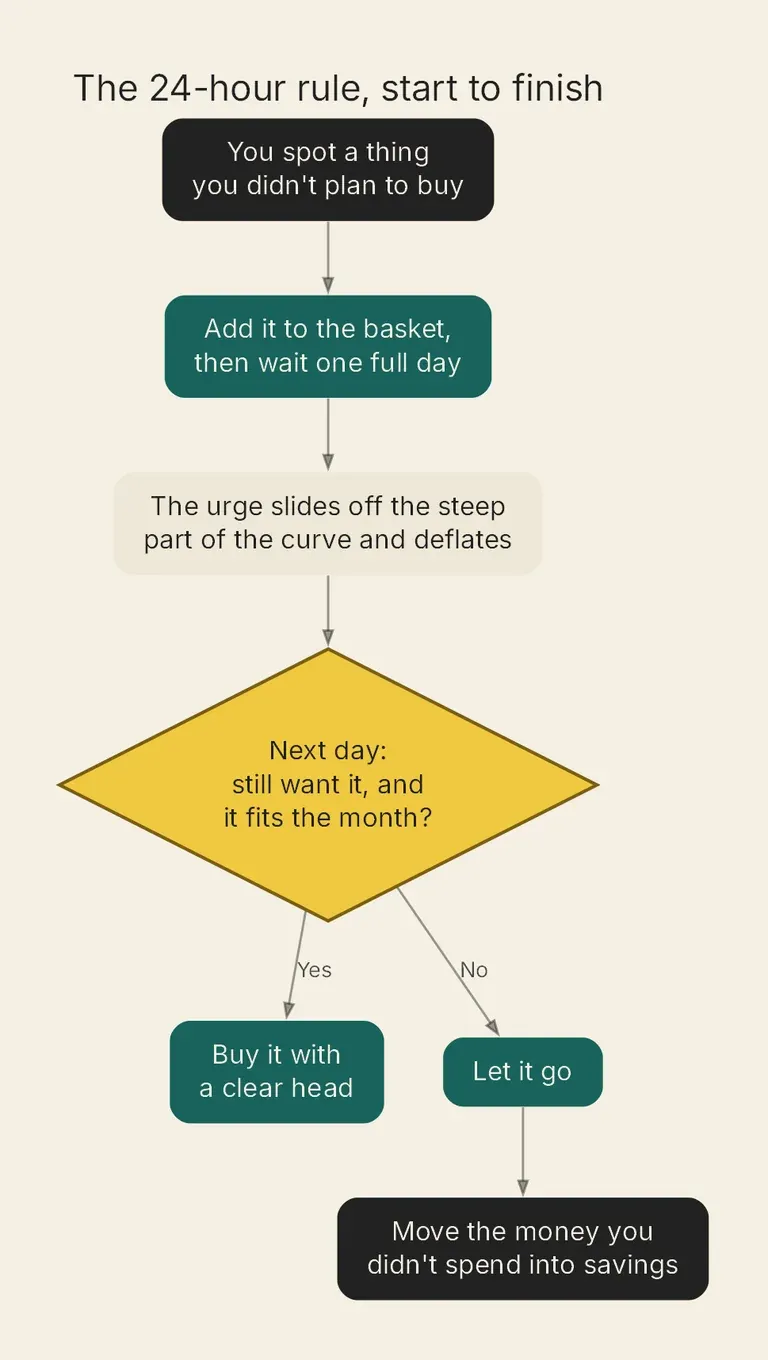
The 24-hour rule means waiting one full day before any non-essential purchase, then deciding with a clear head. No spreadsheet. No penance. You add the thing to your basket, leave it for a day, and a surprising share of the time the urge to buy it has simply faded by the time you come back.
It’s the simplest of the four levers, and the most misunderstood, because the waiting isn’t the point. People assume it works through endurance, that you spend the day heroically resisting. Wrong. It works because of the curve from earlier. A purchase that feels enormous right now slides down the steep part of that curve the moment it becomes “tomorrow”. The hot system loses its grip, the cool one gets a word in, and the wanting deflates. You’re not out-muscling the urge. You’re waiting for it to shrink, which it does on its own.
You already trust this mechanism, because the law uses it on your behalf. Buy something online in the EU and most purchases come with a 14-day cooling-off window (opens in new tab) to change your mind and send it back, no reason needed (a few categories, like personalised goods, are carved out). Lawmakers built a pause into distance selling because they know the in-the-moment “yes” and the next-day “what was I thinking” are two different people. The 24-hour rule is you giving yourself that same pause. Before the money leaves, not after.
How do you put it into practice?
Add the thing to the basket, then close the tab and do something else for a day. Take the €90 buy. If tomorrow you still want it and it still fits the month, buy it with a clear head. If the wanting has faded, and it mostly has, that €90 becomes next month’s transfer instead of a thing in a drawer.
Same money, better owner. The whole trick is doing nothing for a day and letting your own brain do the deciding. It’s the single most useful move against impulse spending, because it costs no willpower at all.
How do you picture your future self and break big goals into milestones?
Two related levers here: making the far-off reward feel real, and chopping it into pieces small enough that the cool system can see them.
Does picturing your future self help you save?
Sometimes. Only when you do it right. Picturing future-you enjoying the money helps, but the version everyone repeats is the version that fails: daydreaming about “being rich one day” does little, because the far-off you stays a stranger, and you don’t save for strangers.
Hal Hershfield, the UCLA behavioural scientist behind the future-self research, puts it more sharply:
To those estranged from their future selves, saving is like a choice between spending money today or giving it to a stranger years from now.
What the research points to is connection, not fantasy. In one US study (opens in new tab), people were shown an age-progressed image of their own face, an older version of themselves. They then put roughly twice as much toward retirement as those shown their current face (80, in a lab, in dollars, so read it as a signal of direction, not a savings target). A separate line of work found that picturing a vivid, specific future event (opens in new tab) shifted people toward the larger, later reward. The active ingredient is feeling like the future person is you, or pinning the money to one scene you can see.
So skip “imagine being wealthy”. Try the specific trip in 2029, the exact rent-free month, the named thing this pot is for. The more real the picture, the more the cool system treats the saving as worth it. Don’t overdo it, mind. This is a lever, not a religion, and the evidence for it is good but not bottomless.
How do you break a big savings goal into milestones?
Split the total into monthly steps small enough to feel. A €2,400 goal becomes twelve months of €200, and a €1,000 starter buffer becomes five of them. Each step is near and finishable, which is the size of reward the cool system will work for. Where you park that pot matters too, and short-term and long-term goals belong in different places.
The big number is the kind the hot system can’t feel, so it ignores it. Twelve steps of €200, though, are each small, near, and done by month’s end. You’re not saving for a distant abstraction. You’re hitting a thing you can reach twelve times over.
Tick them off somewhere you can see. The chart isn’t the point. The point is that “save €2,400” is a wish, while “move €200 by the 28th” is a Tuesday.
What is temptation bundling, and how can it make saving automatic?
The first three levers all ask you to resist the hot system. This last one recruits it instead, which is why it’s the one to reach for when willpower keeps losing.
Temptation bundling means pairing something you want to do with something you should do (opens in new tab), so the wanting drags the should along behind it. The idea comes from a study where people were only allowed their favourite audiobooks at the gym. It lifted gym visits by about 51% at first, then faded over the following weeks. That fade is the useful part: the trick gets you started, and then you make it structural so it survives your motivation running out.
For saving, that means tying the saving act to a small ritual you look forward to. The good coffee you only drink while you move €50 into the pot on payday. Maybe the one episode you only watch once the transfer’s gone through. The saving borrows the treat’s glow, and over a few weeks the two become one habit. Then you automate the transfer so it happens whether or not you fancy the coffee that morning.
One firm rule, because this is the easy way to fool yourself. The treat must cost far less than you save, or it isn’t bundling, it’s shopping with extra steps. A €3 coffee against a €50 transfer is a bundle. A €60 reward against that same €50 transfer is a trap, and a backwards one.
How do you put delayed gratification into a starter routine?
You don’t run four techniques at once. You sequence them, the easy high-payoff ones first, so the early wins cost nothing and pay for the harder reps later. Run them in this order:
- Remove the cue. Unsubscribe from the retailer emails, delete the saved card, and take the shopping app off your front screen, so the trigger never reaches you. The same logic that helps you hunt down and cancel the recurring charges you forgot about applies here: kill the trigger, not the willpower.
- Automate the save. Clear expensive debt first, or at least prioritise it. Credit-card interest and an arranged overdraft both cost far more than any savings account pays. Then set a standing transfer for the day after payday into a savings account that actually pays you something, so the recurring saving needs no willpower at all.
- Use the 24-hour rule. Wait a full day on anything non-essential; the urge deflates and the money stays put.
- Bundle the temptation. When plain restraint keeps failing, pin a small, cheap treat to the saving moment, then automate the transfer so it sticks.
Steps 1 and 2 win you ground with very little willpower: you bank the easy victories before you ask yourself to do the harder thing. Step 3 is where you train the skill, one pause at a time. Step 4 is the safety net for the saving that pure discipline never holds.
| Lever | When to reach for it | The saving action | Why it works |
|---|---|---|---|
| The 24-hour rule | A one-off, non-essential buy you didn’t plan | Wait a full day; if the want fades, move that money to savings instead | A one-day delay slides the purchase off the steep part of the present-bias curve, so the wanting deflates on its own |
| Future-self visualisation | When a far-off goal feels too abstract to save for | Pin the pot to one vivid, specific scene (the named trip, the rent-free month), not “being rich one day” | You save for the future you only when you feel connected to them; a concrete picture makes the cool system treat the saving as worth it |
| Milestone goal-splitting | A big savings goal you keep postponing because it feels unreachable | Break the total into near, finishable monthly steps and tick each one off | A near, beatable step is the size of reward the cool system will work for; the huge number is the kind it can’t feel, so it ignores it |
| Temptation bundling | When plain restraint keeps failing on the recurring save | Tie the saving moment to a small, cheap treat you look forward to, then automate the transfer | It recruits the immediate-reward system instead of fighting it: the want drags the should along, and automation carries it once the novelty fades |
Take Joana, a 29-year-old in Lisbon who’d spent two years meaning to start. She didn’t summon willpower. She ran the four levers in order. First she killed the cues: retailer emails unsubscribed, the saved card deleted, the shopping app off her home screen. Then she automated the boring bit, a standing transfer the day after payday, so the monthly save happened whether or not she felt disciplined. For the discretionary stuff she kept the 24-hour rule, letting most wants quietly deflate overnight. And she bundled the saving with her good Saturday coffee, a small treat that cost a fraction of what moved into the pot. Four months in, the standing order had done most of the work, the slips she did have felt like ordinary off-days rather than proof of some flaw, and the goal was no longer a wish she kept postponing.
A fair gotcha: automation is brilliant for the recurring save, but if you automate everything you never practise the pause, and the skill stays weak. So let the standing order handle the monthly money, and keep using the 24-hour rule on the discretionary stuff. That’s where the cool system gets its reps.
Another one. A routine built entirely on resistance burns out. Resisting has a cost, the APA work above found people who’d just fought off one temptation gave up sooner on the next hard task, so budget small, planned rewards in rather than banning every pleasure. This is the difference between a scarcity money mindset and an abundance one: planned spending is not the enemy of saving. An all-or-nothing month is a month you abandon by the 14th.
You’ll also slip. Everyone slips. A skipped pause or a regretted €90 is one data point, not a verdict on who you are. The whole trick is that you don’t have to win the willpower fight every time, because you’ve arranged things so most of the saving happens without a fight at all.
One lever is enough to start. Kill a cue today, or set the standing order this afternoon; the rest can wait for next month. None of it is clever. Your brain isn’t broken. It’s doing the normal thing with the future, and now you know which lever to pull when it does.
Frequently asked questions
Is delayed gratification a learned skill?
How does the 24-hour rule work?
Does picturing your future self really help you save?
What is temptation bundling?
Should I automate everything to delay gratification?
Sources (9)
- Eurostat: Household saving rate, euro area (Q1 2026)
- EUR-Lex: Consumer Rights Directive 2011/83/EU (14-day right of withdrawal)
- Watts, Duncan and Quan (2018): Revisiting the Marshmallow Test, a Conceptual Replication
- McClure, Laibson, Loewenstein and Cohen (2004): Separate Neural Systems Value Immediate and Delayed Monetary Rewards
- American Psychological Association: The psychological science of self-control
- Milkman, Minson and Volpp (2014): An Evaluation of Temptation Bundling
- Hershfield et al. (2011): Increasing Saving Behavior Through Age-Progressed Renderings of the Future Self
- Carr, Hollis-Hansen, Austin and Epstein (2021): Episodic future thinking cues improve delay discounting in adults
- Frederick, Loewenstein and O'Donoghue (2002): Time Discounting and Time Preference, a Critical Review (JEL)
— That's the lot. It is now night.
Want more of this in your Google results?
Add Money Owl as a preferred source, and Google will show our finance pieces higher when you search for them.
By Jure Jaklič
Founder and editor of Money Owl. Data analyst by trade; personal finance learned first-hand across six European countries.
Recommended

Why you can't save money (it was never willpower)
You keep failing the willpower test because it was never a willpower test. Change the set-up, automate one transfer, and saving happens without you.

The science of how to buy happiness (it's not what you think)
Science says you can buy happiness. Four evidence-based rules for spending so it lasts, with real euro examples for European readers.

How to get back on track after overspending, without starting over
The bad month cost you one month. The nine you didn't go back cost nine times more. Restart at a figure that survives December, and keep the balance.