

The point.
- The behaviour is robust: real trading records show investors cling to losers and sell winners too soon, the disposition effect, and it tends to cost them.
- The magnitude is not. The famous "losses hurt twice as much" is a contested lab estimate, not a law of physics; keep the direction, hold the number lightly.
- One question loosens its grip: if I had this cash today, would I buy this share at today's price? A clear no means only the reference point is keeping you in.
- Mind the edges: selling and reinvesting isn't free, and whether realising a loss saves you tax varies sharply by country (Germany, Ireland and Spain each differ).
- It's a scalpel for one position, not licence to panic-sell a whole diversified portfolio because the market had a rough month.
The point.
- The behaviour is robust: real trading records show investors cling to losers and sell winners too soon, the disposition effect, and it tends to cost them.
- The magnitude is not. The famous "losses hurt twice as much" is a contested lab estimate, not a law of physics; keep the direction, hold the number lightly.
- One question loosens its grip: if I had this cash today, would I buy this share at today's price? A clear no means only the reference point is keeping you in.
- Mind the edges: selling and reinvesting isn't free, and whether realising a loss saves you tax varies sharply by country (Germany, Ireland and Spain each differ).
- It's a scalpel for one position, not licence to panic-sell a whole diversified portfolio because the market had a rough month.
There’s a share in your account you stopped opening months ago. You know roughly what it’s worth. You know it’s worth less than you paid. And every time your thumb drifts toward the sell button, some quiet, reasonable-sounding voice says: not yet. Give it time. It’ll come back.
That position is barely an investment any more. It has become a small shrine to a decision you’d rather not think about, and shrines, as anyone who tends one will tell you, take a surprising amount of upkeep. This piece is about loss aversion in investing: why you built it, why almost everyone builds one, and how to decide whether to keep it standing or quietly take it down. We’ll do all of that without at any point implying you were a fool for buying the thing. You weren’t. You were human, and human is a specific, well-documented problem.
There’s a real, measurable behaviour here, the kind that shows up in millions of actual trading accounts. And there’s the tidy story the internet tells to explain it, shakier than most articles admit. The behaviour is worth fixing. The story is worth doubting.
Most of you reading this opened an account with one of the neobrokers, Trade Republic, DEGIRO, Lightyear, Revolut and the rest, or with your own bank’s app. And at some point you bought a share you picked yourself. That’s the whole condition. You can only get stuck on a losing position if you chose the position.
What is loss aversion in investing?
Loss aversion is the idea a loss hurts more than an equal gain feels good, maybe two to one, though that figure is contested. In investing it’s the usual story told to explain the disposition effect: the well-documented habit of clinging to losing shares hoping they recover, and selling winners too soon.
The engine underneath it is plainer than the jargon lets on. Your mind doesn’t price a share by what it’s worth today. It prices it against a reference point (opens in new tab), and that reference point is almost always what you paid. So the same holding counts as a “loss” or a “gain” only relative to your purchase price. That price means a great deal to you and precisely nothing to the market.
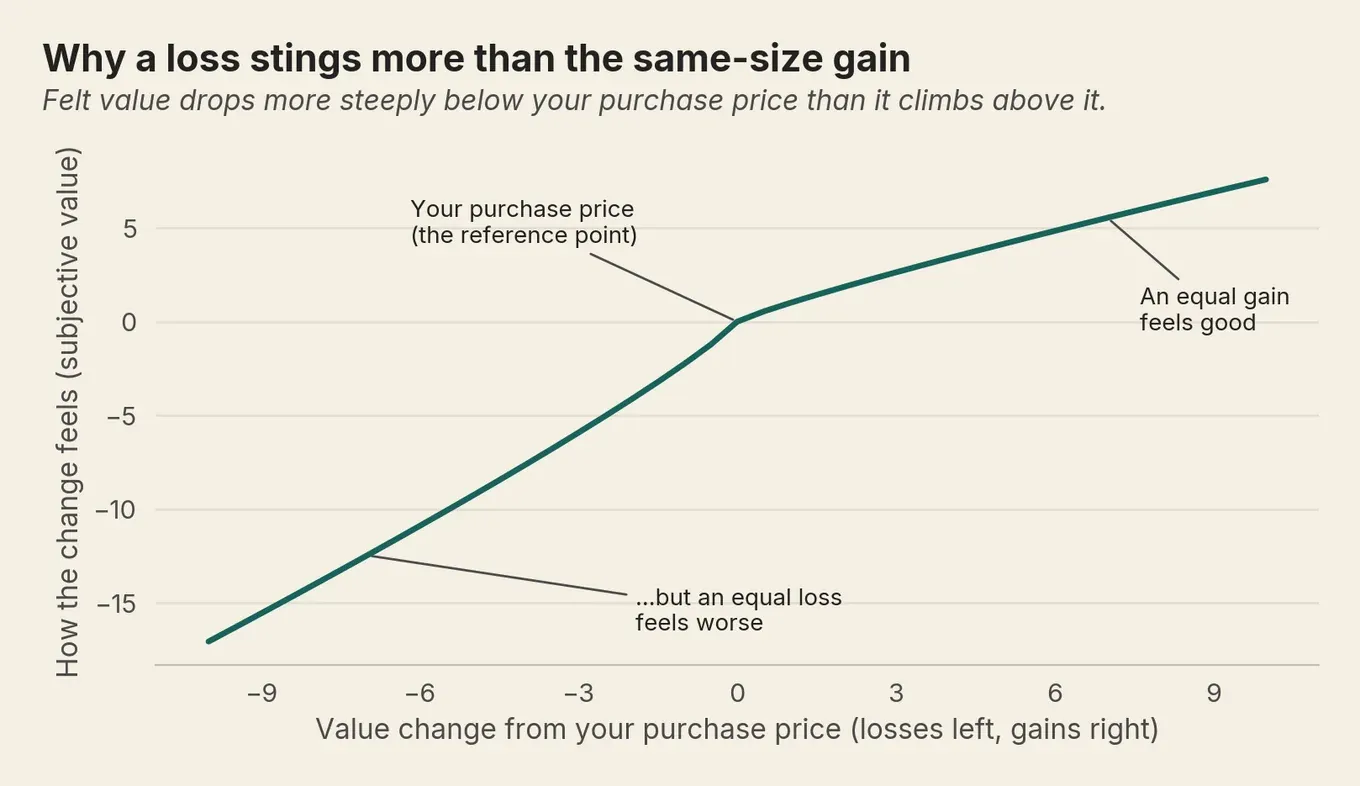
Where does the “two to one” figure come from?
The popular version, “losses hurt twice as much as gains feel good,” traces back to Daniel Kahneman and Amos Tversky, whose prospect theory, an account of how people value gambles, is the foundation for all of this. In a 1992 follow-up (opens in new tab) they put a number on it: the middle of their measurements, a loss-aversion score of about 2.25. Round it off and you get the famous two to one.
Here’s the part the internet leaves out. That 2.25 was the middle of a spread, measured from twenty-five graduate students playing lab gambles. It’s a useful average, not a law of physics, and a serious strand of research goes further, doubting whether losses reliably loom larger than gains at all, and whether loss aversion is even the right name for what drives the trading. David Gal and Derek Rucker reviewed the evidence in 2018 (opens in new tab) and put it about as bluntly as academics ever manage:
The upshot of this review is that current evidence does not support that losses, on balance, tend to be any more impactful than gains.
What’s solid is the behaviour in the data. What’s shaky is the tidy loss-aversion story we tell to explain it, and the famous 2:1 size.
Why do we hold onto losing stocks for too long?
Because selling feels like signing a confession, and the reference point turns “back to even” into a finish line you feel you’re owed. That craving to get square again is what some call the break-even effect. Holding losers too long is the most reliable mistake in retail investing, and it has a name of its own: the disposition effect, named by Hersh Shefrin and Meir Statman in 1985 (opens in new tab).
The best evidence for it isn’t a theory, it’s a receipt. In 1998 Terrance Odean went through the trading records of 10,000 real brokerage accounts (opens in new tab) at a US discount broker, covering trades from the late 1980s and early 1990s, and found that investors sold their winners at roughly one and a half times the rate they sold their losers. Then he checked whether that instinct paid off. It did the opposite.
The winners people sold went on to beat the losers they clung to by about 3.4 percentage points over the following year. Selling the good one and keeping the bad one wasn’t a wash. It was wrong on both legs. Old data, but the behaviour hasn’t aged out: the same pattern keeps turning up, across markets, right up to a 2024 study of UK retail investors (opens in new tab).
Take Katrin in Stuttgart. She put €6,000 into a single share she liked the look of, and it’s worth €3,600 now. Every month she does the same small arithmetic: it only needs to climb back to what I paid and I’m out clean. That sum is the trap in miniature. She is not deciding whether the share is worth owning today. She is waiting for it to apologise.
Is a paper loss a real loss?
At the moment you’re deciding, yes: a paper loss and a realised loss are the same thing, because the money has already moved. Whether you’ve locked it in is a fact about your paperwork, not about your wealth. The comforting story is that a loss on the screen costs nothing until you sell. It does not hold up. The only live question is a forward-looking one: knowing what you know now, is this a share you’d put money into today?
The share, for its part, has no memory of you. It’s not being stubborn, or spiteful, or holding out for an apology. It simply doesn’t know what you paid, and it never did, so it has no reason to climb back to your purchase price out of any sense of duty. Investment values can fall as well as rise, and a share that is down forty per cent can fall another forty from there. “It has to come back eventually” is a hope, not a plan.
That said, holding a loser isn’t always the bias, and it’s worth saying so plainly, because the goal here is a clear head, not a fresh source of guilt. Gal, writing for the CFA Institute (opens in new tab), points out that some of this holding isn’t irrational at all. An investor might genuinely believe a beaten-down share will recover, or simply be slow to act, and neither of those is the same as a deep flaw in how you think. So the honest framing is “predictably,” not “irrationally.” The behaviour is common and worth correcting. It doesn’t make you broken.
Is loss aversion the same as risk aversion?
No, and the mix-up is common enough to be worth thirty seconds. Risk aversion is about disliking uncertainty itself: you’d rather have a sure thing than a coin-flip for the same average payout. Loss aversion is about the reference point and the lopsided way a loss and a gain feel. Once you’re under water, the two pull in opposite directions.
| Risk aversion | Loss aversion | |
|---|---|---|
| What it turns on | Disliking uncertainty | Your reference point, most often the purchase price |
| The core feeling | A sure thing beats a gamble of equal average value | A loss stings more than an equal gain pleases |
| Behaviour with gains | Cautious | Cautious, so it grabs the sure profit early |
| Behaviour with losses | Still cautious | Risk-seeking, so it holds on and gambles on the recovery |
| The investing symptom | Holds safer assets across the board | The disposition effect: sells winners, rides losers |
The tell is the bottom two rows. A purely risk-averse person is careful everywhere. A loss-averse one turns careful with gains and reckless with losses, which is exactly the pattern that keeps a losing position open. The certain small pain of selling now feels worse than the gamble of holding on, so the gamble wins, over and over, in accounts that would swear they’re being sensible.
The opposite mistake barely feels like a mistake at all. Bram in Rotterdam put €4,000 into a share he’d researched properly, watched it climb to €5,000, and couldn’t shake the itch to bank the gain before it slipped away. So he sold, felt briefly clever, and pocketed the €1,000. Then he watched it keep climbing, past €6,000, while he stood on the pavement counting money he no longer had.
Nothing about the company had changed. He hadn’t decided the share was finished; he’d sold to quiet the fear of giving a profit back, which is the disposition effect showing its other face. A certain small win felt safer than an uncertain larger one, so he grabbed it.
The fix is the same question, pointed the other way. If I had this cash today, would I buy this share at today’s price? When the honest answer is yes, selling only to lock the gain is the reference point talking again, not a decision. It’s the flip side of the pattern Odean found in real accounts: the winners people sold tended to go on and beat the losers they clung to.
How do you overcome loss aversion when investing?
Delete the purchase price from the decision. From the investing decision, that is; for tax it’s a different story, and we’ll get to that. Take one share you picked yourself, not your whole diversified portfolio in a downturn, and ask one question: if I had this cash today, would I buy this share at today’s price? If the answer is a clear no, the only thing keeping you in is the reference point, and the reference point isn’t a reason. It’s a feeling wearing the costume of one. A clear no isn’t an order to sell tonight. It just means you finally know what was holding you there: an old price, not anything the share is doing now.
And if you honestly can’t answer, that’s an answer too. Not knowing whether you’d buy it today usually means you never had a real thesis, only a hunch about the look of it. That’s a fair sign your money belongs in a broad, diversified fund rather than single names. The answer should come from the business itself. How the red number makes you feel tonight doesn’t get a vote. Fear can fake a ‘no’.
A few habits make that question easier to answer honestly. Start by separating the price from the business: has the share just got cheaper, or has the company itself changed? A cheaper price on a thesis that still holds is a very different thing from a business quietly rotting. Then dig out why you bought it, in writing if you can, and hold that against today’s facts. And settle on your rule while you’re calm, or just check the position less often.
The one question is still the heart of it, and those moves only help you answer it straight. None of this is clever, and it isn’t ours alone; it’s simply the fastest way to loosen the grip of the one number quietly running the show. But a good tool has edges, and pretending it doesn’t is how people talk themselves into churning a portfolio for no reason. So here are the honest bounds.
When is holding a loser the right call?
If your original reason for buying still stands and you’d happily buy the share fresh today, you’re not clinging, you’re investing. Beatriz in Braga holds a broad fund that’s down thirty per cent. She runs the question, and the answer is a genuine yes: nothing about her reasons has changed, only the price. Because a broad, diversified fund falling is just the whole market on sale, a lower price there is a reason to buy more, not to panic. One company is a different animal. A steep drop in a single share can be the market pricing in something real, so ‘buy more’ isn’t the default, and the price can keep sliding. That’s a genuine exception. Don’t reach for it every time a holding is down.
Second, selling and reinvesting isn’t free. There are trading costs, sometimes a spread, and grinding a holding you only mildly want into dust on fees helps nobody but your broker. Third, tax. Realising a loss can genuinely be worth something, which is why real investors do more of it in December than in June. Two cautions, though. Some countries claw back or defer the benefit if you sell and then rebuy the same holding too soon, so check your national rule before you sell and buy straight back in. And never sell an asset you’d otherwise keep just to bank the loss; the tax tail shouldn’t wag the investment dog.
The tax angle is exactly where the American internet will lead you astray. In the United States the standard move is to “harvest” the loss for a tax break, and a lot of the advice you’ll read assumes that habit carries straight over to Europe. It does not. Whether a realised loss saves you anything, what it can be set against, and for how long, varies sharply from one market to the next. Germany, Ireland and Spain each treat it differently, and they’re only three examples of a wider patchwork, so the table below is a sample, not the whole map. Check your own country’s rule before you count on it.
The European regulator ESMA has noted (opens in new tab) that this patchwork of tax treatment is itself one of the things that puts retail investors off in the first place. So the country-by-country specifics belong in a proper, dated table, not in a sentence pretending one rule fits the whole continent.
Rules as of July 2026; tax rules change and vary by country, so check your national tax authority before acting.
| Market | How a realised loss can be used | Source |
|---|---|---|
| Germany (DE) | Ring-fenced: a realised loss on shares can be set only against gains on shares, not against other income; any unused loss carries forward within capital income. | Sec. 20 (6) Satz 4 EStG (opens in new tab) |
| Ireland (IE) | A realised loss is set against chargeable gains (taxable capital gains) in the same tax year, and any unused loss carries forward to later years; it cannot be set against ordinary income. | Revenue (Ireland) (opens in new tab) |
| Spain (ES) | A realised loss offsets gains within the savings base (the pot for investment income), with a capped further offset against other savings income; any residual carries forward over the following four years only. | Agencia Tributaria (opens in new tab) |
Sources: gesetze-im-internet.de (DE), revenue.ie (IE), agenciatributaria.gob.es (ES); retrieved 11 July 2026.
Does the reframe apply in a whole-market crash?
No, and this is the edge people get wrong most. All of this is about a single share you’re clinging to for a bad reason. It’s not licence to sell a diversified, long-term portfolio because the whole market has had a rough month. That’s a different reflex, panic-selling in a downturn, and the answer to it is nearly always to sit on your hands, which is its own subject and one we cover in the guide to staying the course through market panic. Put the same question to a broad index fund halfway down a crash and the honest answer, most of the time, is still yes.
The reframe is a scalpel for one position, not a reason to knock the whole house down. If you want the mechanical, feelings-free version of the same habit, that’s what rebalancing on a fixed schedule quietly does for you. It’s a close cousin of the mental accounting that makes us file a paper loss so differently from the cash it plainly is.
One last thing, and it matters more than the tax. If this is money you genuinely couldn’t afford to lose, or if checking these positions has become its own source of dread, that’s a bigger conversation than any single share, and one worth having with a regulated adviser rather than carrying it alone.
This week, do one thing. Open the account you’ve been avoiding, find the position you least want to look at, and put the single question to it: if I had this cash today, would I buy this share at today’s price? You don’t have to act on the answer tonight. You just have to stop letting a price you paid two years ago make the decision for you.
That losing position was never the problem. The shrine you built around it was. Take the roof off and see whether there’s anything underneath still worth keeping. The share, for what it’s worth, has long since forgotten you were ever there.
Frequently asked questions
What is loss aversion in investing?
Why do investors hold onto losing stocks for too long?
Is loss aversion the same as risk aversion?
How do you overcome loss aversion when investing?
Is a paper loss a real loss?
Sources (11)
- Kahneman & Tversky (1979), Prospect Theory, Econometrica
- Tversky & Kahneman (1992), Advances in Prospect Theory, Journal of Risk and Uncertainty
- Shefrin & Statman (1985), The Disposition to Sell Winners Too Early and Ride Losers Too Long, Journal of Finance
- Odean (1998), Are Investors Reluctant to Realize Their Losses?, Journal of Finance
- Quispe-Torreblanca, Gathergood, Loewenstein & Stewart (2024), Investor Logins and the Disposition Effect, Management Science
- Gal & Rucker (2018), The Loss of Loss Aversion, Journal of Consumer Psychology
- David Gal (2018), What Does Loss Aversion Mean for Investors? Not Much, CFA Institute
- ESMA (2026), Report on the retail investor journey
- Gesetze im Internet: Section 20 (6) Satz 4 EStG, share loss-offset rule (DE)
- Revenue: Capital Gains Tax, if you make a loss (IE)
- Agencia Tributaria: IRPF 2025, capital-loss offset in the savings base (ES)
— That's the lot. It is now night.
Want more of this in your Google results?
Add Money Owl as a preferred source, and Google will show our finance pieces higher when you search for them.
By Jure Jaklič
Founder and editor of Money Owl. Data analyst by trade; personal finance learned first-hand across six European countries.
Recommended
Mental accounting: why a euro from a refund spends differently
A euro is a euro, but your brain files it into pots and spends each by a different rulebook. Spot the pots quietly costing you, keep the ones that save you.

Staying the course: how to handle market panic and volatility
A falling market is a paper loss until you sell. How to sit through the panic, tell when selling is actually rational, and how long crashes really last.

Rebalancing your portfolio: put the mix back where you left it
Drift quietly turns your 60/40 into something riskier. Here's how to put the mix back, cheapest move first, and skip the tax where your country lets you.