

The point.
- Cognitive biases are hard-wired standard equipment, shared by everyone. You cannot delete them, and knowing about one is not enough to switch it off.
- The fix is a system you set up once, not willpower you summon in the moment. Most take minutes to put in place; a few are a rule you write down and follow in the moment.
- Automate the patient choice, decide your number before you look, pre-commit your rules, then set a dated review so no system quietly hardens into a new bad default.
- Charges bite before any behavioural mistake does: over 2012 to 2021, costs alone took roughly €3,000 out of a typical €10,000 invested. This is an illustrative, period-specific figure, and investment values can fall as well as rise.
- Over-trading is the expensive one: in a classic US study the busiest traders trailed the market by about 6.5 percentage points a year. Treat that as an illustrative, historic figure: past returns are not a guide to future returns and values can fall as well as rise. The same more-trading, lower-returns mechanism still shows up in euro funds.
The point.
- Cognitive biases are hard-wired standard equipment, shared by everyone. You cannot delete them, and knowing about one is not enough to switch it off.
- The fix is a system you set up once, not willpower you summon in the moment. Most take minutes to put in place; a few are a rule you write down and follow in the moment.
- Automate the patient choice, decide your number before you look, pre-commit your rules, then set a dated review so no system quietly hardens into a new bad default.
- Charges bite before any behavioural mistake does: over 2012 to 2021, costs alone took roughly €3,000 out of a typical €10,000 invested. This is an illustrative, period-specific figure, and investment values can fall as well as rise.
- Over-trading is the expensive one: in a classic US study the busiest traders trailed the market by about 6.5 percentage points a year. Treat that as an illustrative, historic figure: past returns are not a guide to future returns and values can fall as well as rise. The same more-trading, lower-returns mechanism still shows up in euro funds.
Find €100 and you get a small lift. Lose the same €100 and it lands harder. That’s not a character flaw. It’s standard equipment, fitted at the factory, shared by everyone you’ve ever met.
Cognitive biases are the mental shortcuts your brain uses to judge things fast. Most of the time they help. With money they misfire, so you overpay, you panic-sell, you leave the wrong account untouched for a decade. These are the cognitive biases costing you money, quietly, and the systems that stop them.
Here are the ten that do the most damage:
- Loss aversion
- Mental accounting
- Anchoring
- Confirmation bias
- Overconfidence
- Present bias
- Status-quo bias
- Sunk-cost fallacy
- Herd mentality
- Recency bias
You can’t fully switch any of them off, and knowing about one isn’t enough on its own. What works is building around them: mostly systems you set up once, plus a couple of thinking habits, like arguing the other side, that genuinely help. That’s the part most of these lists skip.
Why can’t you just think your way out of a bias?
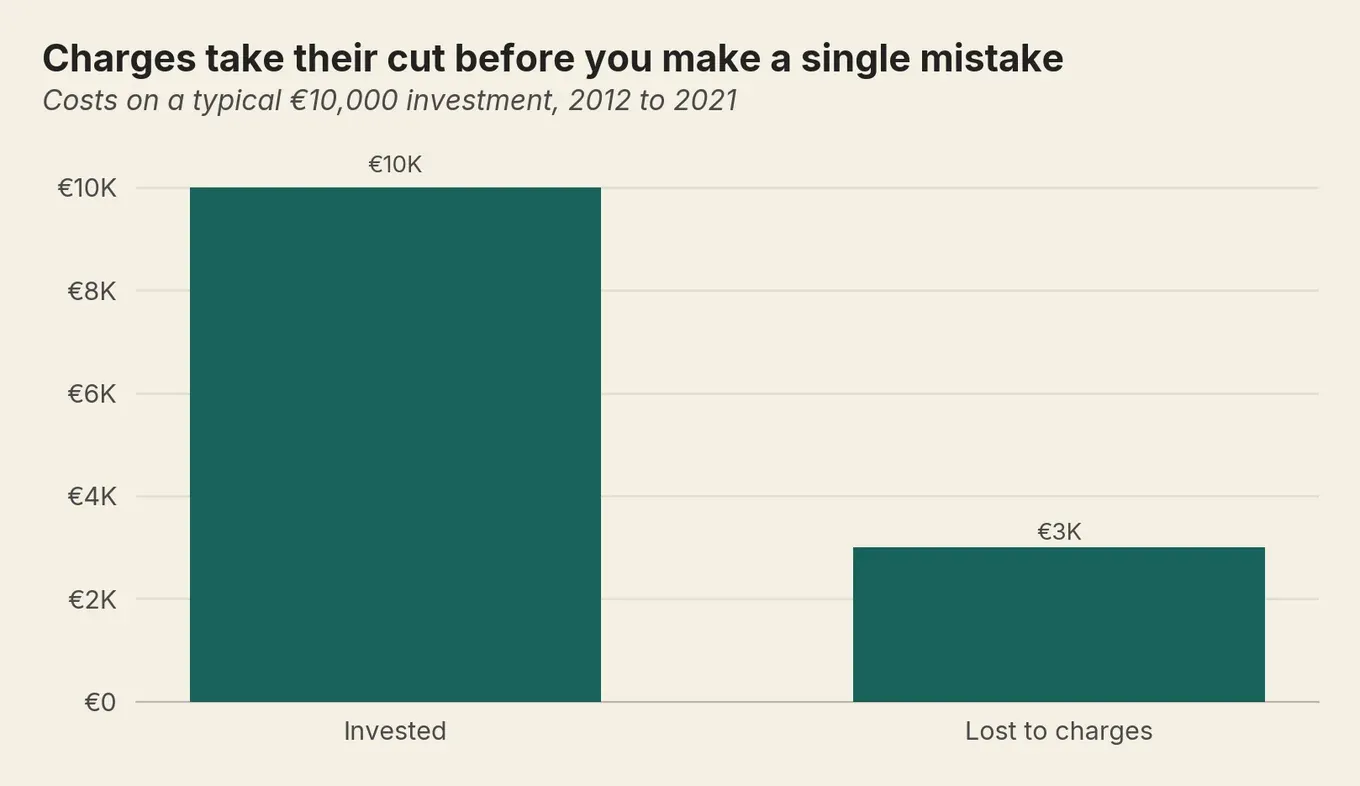
The cost isn’t abstract. Over the decade from 2012 to 2021, Europe’s markets regulator ESMA (opens in new tab) reckoned that charges alone swallowed about €3,000 of a typical €10,000 investment, before anyone made a single behavioural mistake. The biases below are what you lose on top of that.
How do cognitive biases affect financial decisions?
Biases tilt the call before you notice you’re making one. That’s how sensible people end up buying high, selling low, and leaving cash in the wrong place. Your brain runs two systems: a fast, automatic one that fires off the shortcut, and a slow, effortful one that’s meant to check it. The slow one mostly can’t be bothered. Tversky and Kahneman (opens in new tab) showed back in 1974 that these shortcuts mostly work. That’s the catch. Because they work most of the time, the errors they produce are systematic and predictable, not random. Knowing a trap is there doesn’t switch the fast system off.
Why don’t warnings and leaflets change behaviour?
Warnings do little because the pull is a feeling and a habit, so more facts rarely move anyone. The Financial Conduct Authority (opens in new tab) has used behavioural economics to ask why people don’t switch financial products, and points to inertia, inattention or the simple fear of regret. Not to a shortage of leaflets. Change the choices in front of someone and their behaviour moves. Hand them a pamphlet and it doesn’t.
What is the difference between cognitive and emotional biases?
Cognitive biases are reasoning slips you can correct with a better process. Emotional biases are feelings you have to build around instead. Anchoring, confirmation and mental accounting sit in the first group. Loss aversion, overconfidence and inertia sit in the second. It’s roughly how the CFA Institute (opens in new tab) splits cognitive errors from emotional biases. Either way, the fix has the same shape: a system you set up once, not willpower you summon in the moment. Most are a quick one-time setup; a few are a rule you write down and follow in the moment. None of them ask for willpower you have to summon fresh each day.
1. Loss aversion: why do we cling to losers?
Losses feel worse than the same-sized gain feels good, so we over-protect whatever we already hold. It’s a feeling, not a maths error, which is why it’s so stubborn. In practice we sell our winners to bank the nice feeling, and cling to our losers to avoid making the bad one real.
The fix is to take the decision out of the moment. Set your sell or rebalance rule to a date, not a mood. Rebalancing just means trimming what has grown too big and topping up what has lagged; put a recurring date for it in the calendar and write the one-line rule now, while nothing hurts. This one runs deeper than a paragraph, so if it’s your particular trap, why we cling to losing shares is the full version.
2. Mental accounting: does a refund euro spend differently?
Money is money, but your brain refuses to believe it. It sorts euros into pots by where they came from, then spends each pot by different rules. A €300 tax refund or a 13th-month salary gets spent loosely, on a treat, because it feels like a bonus; an identical €300 of ordinary wages gets guarded. Same euros, different you.
The fix is to treat every incoming euro as one pool. Set a standing rule for windfalls: the refund, the bonus, the birthday money. They get routed into the same plan as your salary, before you can relabel them as fun money. Mental accounting has its own rabbit hole: why a refund euro spends differently.
3. Anchoring: does the first number decide the price?
The first number you see grabs your judgement and won’t let go. You adjust away from it, but never far enough, so the final figure stays stuck near wherever you started. It’s one of the three original shortcuts in that 1974 paper, and it’s everywhere once you notice it.
A “was €80, now €48” tag anchors you to €80, so €48 feels like a win whether or not the thing’s worth €48. In a salary talk, the counter-offer sits forever in the shadow of the first figure someone said out loud. An “up to 4% bonus rate” on a savings promo quietly frames the whole comparison around a rate almost nobody gets.
You can’t fully switch anchoring off, even when you can feel it happening, but you can decide your number before you see theirs. For your next big purchase or negotiation, write your walk-away figure down before you browse or open your mouth, and anchor it to something real: the price per litre, the total cost over a year, a neutral comparison. Not the sticker someone else chose for you.
4. Confirmation bias: are you only reading the case you already believe?
Once you hold a view, you go looking for evidence that flatters it and quietly bin the evidence that doesn’t. Nickerson (opens in new tab) called it the seeking or interpreting of evidence in ways that are partial to a belief already in hand. Your brain isn’t trying to find the truth. It’s trying to be right.
With money that gets expensive. After you buy a fund or a coin, you read the bullish threads and skip the bearish ones. Then you search “why my coin will go up,” never “why it will crash.” Every article you finish leaves you more certain and no better informed.
The counter-move is to hunt for the disagreement on purpose. Before you research a decision, write down what evidence would change your mind, then go and look for that specifically. For anything big, write the strongest argument against your own plan and sit with it for a day. One genuine second opinion, from someone with no reason to agree with you, is worth more than ten articles that already do.
5. Overconfidence: do you honestly think you can beat the market?
It comes in three flavours, and Moore and Healy (opens in new tab) pinned them down. You think you did better than you did. You think you’re better than average. And you’re too sure your opinion is right. That last one, overprecision, is the one that quietly bleeds accounts.
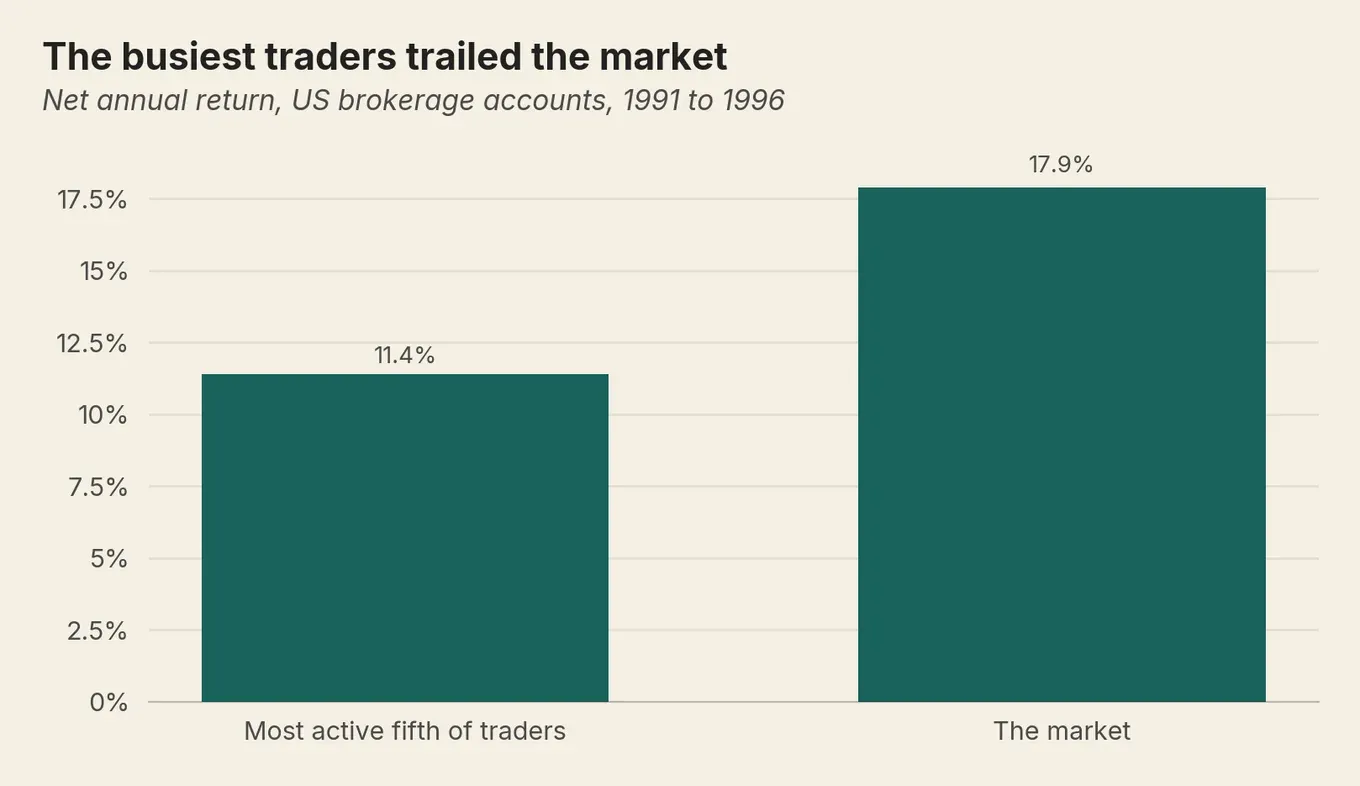
Here’s the receipt. Barber and Odean (opens in new tab) tracked 66,465 households at a US broker from 1991 to 1996. The fifth who traded the most earned 11.4% a year after costs. The market itself returned 17.9%. That is a gap of 6.5 percentage points every year, handed over for the privilege of feeling busy. It is a US study from an unusually strong stretch of the market, so treat the 17.9% as history, not a rate to expect; the mechanism is what travels: more trading, lower net returns. The same confidence shows up one level up too, in paying a manager to do the picking for you. That is a slightly different mechanism, cost drag rather than churn, but the same lesson: around nine in ten or more active euro equity funds trail their benchmark over a decade (SPIVA Europe (opens in new tab)), and ESMA (opens in new tab) finds active funds’ net performance is on average lower than passive, because they cost more.
The fix is to cap the damage rather than back your own judgement. This assumes the groundwork is already there: an emergency fund set aside, any high-interest debt cleared, and money you won’t need for at least five years. With that in place, default the bulk of your long-term investing to a low-cost diversified fund on autopilot. That means a monthly plan of the kind sold as a Sparplan in Germany, a plan d’investissement in France, or an ETF inside an Italian fondo. (Named as illustration, not a recommendation, and worth checking against current terms first.) Keep any “I can beat this” money in a small, clearly labelled sleeve, a ring-fenced slice you can afford to be wrong with. Then benchmark your real return against a plain index fund, so overprecision has to meet a number.
6. Present bias: why does future-you always get the bill?
A reward you can have now looks far bigger than a better reward later. This isn’t weak willpower: the pull is real and measured, and on one influential reading of the brain scans (opens in new tab) it runs partly on a separate, emotion-driven system that out-votes the patient one. Future-you is a stranger your brain is happy to stiff.
So you say you’ll start saving next month. Buy-now-pay-later gets a tap at the checkout. That €12 streaming subscription stays for three years because cancelling is a job for some future Tuesday that never comes. Which is €432 for a service you’ve opened twice.
The fix is to automate the patient choice so today-you can’t veto it. Point a standing order at your savings on payday, not at month-end when the money’s already spent. Start small and size it to what’s genuinely spare once the rent and bills are covered; a payday sweep should never be the thing that tips you into an overdraft. Then add friction to the impulse: delete your stored card details and put a 72-hour rule on anything non-essential. If your spending is the leak, the psychology of why we buy things we don’t need goes deeper.
7. Status-quo bias: is doing nothing your most expensive habit?
We prefer whatever is already the case. Changing means an active decision, and an active decision can be regretted, so we stay put even when moving plainly pays. It’s the same barrier the FCA (opens in new tab) keeps running into: not laziness so much as inertia, and a quiet fear of getting the switch wrong.
You know the shape of it. A savings account you opened years ago, still paying almost nothing while better rates sit in plain view. The default energy or broker tariff nobody ever leaves. Pension contributions frozen at whatever minimum you joined on. None of it’s a decision, exactly. It’s the absence of one.
The economists who coined the “nudge” put the flip side first: the same inertia that keeps you on a bad account can be pointed the other way and made to work for you.
“First, never underestimate the power of inertia. Second, that power can be harnessed.”
Richard Thaler and Cass Sunstein, Nudge (2008)
The way out is to give doing-nothing an expiry date. Put a dated switch-review in the calendar for your worst-value product. Then staying is a choice you actively re-make, not a thing that keeps happening to you. If the account you can’t face moving is a savings one, here’s why you can’t save money, according to psychology.
8. Sunk-cost fallacy: are you throwing good money after bad?
We keep going on something because of what we’ve already sunk into it: money, time, effort. Carrying on can be the worse move, and we do it anyway. Magalhães and White (opens in new tab) define it as the tendency to persist in a course of action because of prior investment. The money you already spent wants company.
It’s why people hold a losing investment “until it gets back to what I paid,” as though the shares know or care what they paid. That same logic funds the failing renovation, and finishes the course you’ve stopped enjoying, because stopping would “waste” what went before.
The fix is to judge a specific commitment only from today forward: the failing renovation, the single position whose story has actually broken, the course you’ve stopped attending. (This is not a cue to bail on a sound, diversified long-term fund in a dip. That’s the herd trap in the next section.) Ask the plain question: knowing today’s price and today’s prospects, would I buy into this now? If the answer is no, the money you already spent is gone whether you stay or go, so let it go too. Set any exit trigger while you’re calm, before you’re attached to being proved right.
9. Herd mentality: are you buying it because everyone else is?
When we’re unsure, we assume the crowd knows something we don’t. So buying feeds on buying. It builds into a trend that drowns out our own judgement. The CFA Institute (opens in new tab) notes that professionals herd too, so this isn’t a rookie problem you outgrow.
It’s the whole shape of a bubble: everyone piles into the thing everyone is piling into, at the top, then sells at once in the crash, at the bottom. There’s a gentler cousin: home bias, a quiet tilt toward the shares of your own country. It is real, though the ECB (opens in new tab) finds it smaller than the headline numbers suggest once you see through funds to what they actually hold. Smaller, but not nothing: a portfolio that leans on home turf is less diversified than it looks.
So write your rules in calm weather, then follow those rules and not the mood in the room. Mute real-time price alerts and finance-social feeds when markets lurch, because the crowd is loudest exactly when it’s least worth hearing. For the crash version, staying the course when markets panic is the longer guide.
10. Recency bias: are you steering by the last headline?
Recent, vivid events feel far more likely than they are. How easily you can call something to mind quietly stands in for its real probability. It’s the temporal edge of the availability shortcut from that same 1974 paper. Last month’s news feels like next month’s forecast.
In money it looks like performance-chasing: piling into whatever just went up and dumping whatever just fell. Which is, when you write it out, buying high and selling low with extra steps and more admin.
The fix is to anchor decisions to the long-run averages, the base rates, rather than the latest headline. Automate your contributions, so a scary week can’t quietly re-vote your plan. Keep a one-line decision journal too. In a year you can read your own recency pattern in your own handwriting, and trust it a little less.
| Bias | What it costs you | A euro example | The fix |
|---|---|---|---|
| 1. Loss aversion | You sell winners early and cling to losers to dodge the sting of a loss | Losing €100 stings more than finding €100 cheers you up | Put a recurring rebalance date in the calendar and write the sell rule now, while nothing hurts |
| 2. Mental accounting | You guard your salary but spend “bonus” money loosely, though every euro is the same | A €300 refund gets spent on a treat; an identical €300 of wages gets guarded | Set a standing rule that routes every windfall into the same plan as your salary |
| 3. Anchoring | The first number sets your sense of value, so a fake discount feels like a win | A “was €80, now €48” tag anchors you to €80 | Write your walk-away number down before you browse or negotiate, and anchor it to something real |
| 4. Confirmation bias | You collect evidence that flatters your view and bin the rest, growing surer but no wiser | After buying a fund or coin, you read the bullish threads and skip the bearish ones | Before you research, write down what would change your mind, then get one genuine second opinion |
| 5. Overconfidence | You back your own picking and over-trade, paying more and earning less | Around nine in ten active euro equity funds trail their benchmark over a decade | Once your emergency fund and high-interest debt are handled, default the bulk of long-term investing to a low-cost diversified fund on autopilot, then benchmark your real return |
| 6. Present bias | Now beats later, so you defer saving and keep subscriptions you never use | A €12-a-month subscription kept three years is €432 for something opened twice | Point a standing order at savings on payday (only what’s spare after essentials), delete stored cards, and add a 72-hour rule to impulse buys |
| 7. Status-quo bias | Doing nothing feels safe, so money sits in poor accounts and old tariffs | A savings account opened years ago, still paying almost nothing | Put a dated switch-review in the calendar for your worst-value product |
| 8. Sunk-cost fallacy | You throw good money after bad to justify what you have already spent | Holding a losing investment “until it gets back to what I paid” | For a specific stalled commitment, ask if you would buy in today at today’s price; if not, exit while calm (not a diversified long-term fund in a dip) |
| 9. Herd mentality | You follow the crowd, buying at the top and selling at the bottom | Piling into the thing everyone is buying, then selling in the crash | Write your rules in calm weather and mute price alerts and finance feeds when markets lurch |
| 10. Recency bias | You steer by the latest headline, chasing performance and buying high | Piling into whatever just went up and dumping whatever just fell | Automate contributions so a scary week cannot re-vote your plan, and keep a one-line decision journal |
Examples and fixes are condensed from this article’s own sections. The active-fund figure is SPIVA Europe / ESMA; euro amounts are illustrative and hypothetical, except that active-fund figure.
Can you get rid of these biases for good?
No. Cognitive biases are hard-wired, so you cannot delete them, and knowing about one is not enough to stop it. The realistic win is awareness plus systems: automate the patient choice, decide your number before you look, pre-commit your rules, and then put a dated review on the whole lot.
Even the psychologist who first mapped these biases reached the same conclusion the hard way: you can’t switch the fast system off, so the realistic goal is to catch yourself where it matters.
“The best we can do is a compromise: learn to recognize situations in which mistakes are likely and try harder to avoid significant mistakes when the stakes are high.”
That last part matters more than it sounds. A system set once and never checked quietly hardens into a new bad default. That’s status-quo bias wearing a helpful disguise. A payday transfer that made sense three years ago might be pointed at the wrong account today. So the final system is small: a reminder to review your systems, once a year, on a date you pick now.
Sophie had been going to move her savings for the better part of three years. The money sat in an old account paying next to nothing, and every few months she thought, right, this is the month I finally sort it. She would read up, pick her own funds, do it properly. Next month arrived with the same plan and the same nothing.
The account was never the real problem. The waiting was. What finally moved the money was a quick setup one wet Tuesday: a €150 standing order into a plain, automated investing plan, the kind Germany calls a Sparplan, set to fire on payday before the money could drift. No monthly decision, no perfect moment to catch.
A year on, €1,800 had quietly gone in. Sophie hadn’t got more disciplined; she had taken her in-the-moment self out of the loop. The system turned up every month, which is more than willpower ever managed.
You’ll never out-argue a reflex older than farming. But you can set your money up so it never gets a vote. Then go and think about almost anything else. Pick one system. The payday transfer will do. Turn it on this week.
Frequently asked questions
What are the most common cognitive biases that cost you money?
How do cognitive biases affect financial decisions?
Can you eliminate cognitive biases completely?
What is the difference between cognitive and emotional biases?
How do you overcome cognitive biases with your money?
Sources (15)
- ESMA: Costs of retail investment products continue slow decline (2023, covering 2012 to 2021)
- ESMA: Costs and Performance of EU Retail Investment Products 2025
- Financial Conduct Authority: Occasional papers on behavioural economics
- Tversky and Kahneman (1974), Judgment under Uncertainty: Heuristics and Biases (Science)
- Nickerson (1998), Confirmation Bias: A Ubiquitous Phenomenon in Many Guises (Review of General Psychology)
- Moore and Healy (2008), The Trouble with Overconfidence (Psychological Review)
- Barber and Odean (2000), Trading Is Hazardous to Your Wealth (Journal of Finance)
- S&P Dow Jones Indices: SPIVA Europe Scorecard
- McClure et al. (2004), Separate Neural Systems Value Immediate and Delayed Monetary Rewards (Science)
- Magalhães and White (2016), The Sunk Cost Effect Across Species
- CFA Institute: The Behavioral Biases of Individuals
- CFA Institute: The Herding Mentality, Behavioral Finance and Investor Biases
- European Central Bank: Is the home bias biased? New evidence from the investment fund sector
- Richard Thaler and Cass Sunstein, Nudge (2008)
- Daniel Kahneman, Thinking, Fast and Slow (Scientific American excerpt)
— That's the lot. It is now night.
Want more of this in your Google results?
Add Money Owl as a preferred source, and Google will show our finance pieces higher when you search for them.
By Jure Jaklič
Founder and editor of Money Owl. Data analyst by trade; personal finance learned first-hand across six European countries.
Recommended

The cost of doing nothing with your money, and what to fix first
Four money lines go stale at once: savings, tariffs, an uninvested surplus, and a pension rate you never set. Here's the ten-year bill, and what to fix first.

Why don't Europeans invest in stocks? Where the money went instead
Caution gets the blame. Add up all euro-area household assets and about €66 in every €100 is property. That is the area's total, not one household's.

How shops trick you into spending more, and which of it is illegal.
Consumer authorities checked 314 online traders across Black Friday 2025, and only 40% fully complied with the EU's discount rules. Other tricks here are illegal too.