

The point.
- The stock market is the activity of buying and selling shares; a stock exchange is one licensed venue where that happens, such as the London Stock Exchange, Euronext or Frankfurt's Xetra.
- Most of Europe's national exchanges run on Euronext (eight regulated venues), Germany trades mainly on Xetra, and the London Stock Exchange sits just outside the EU since Brexit.
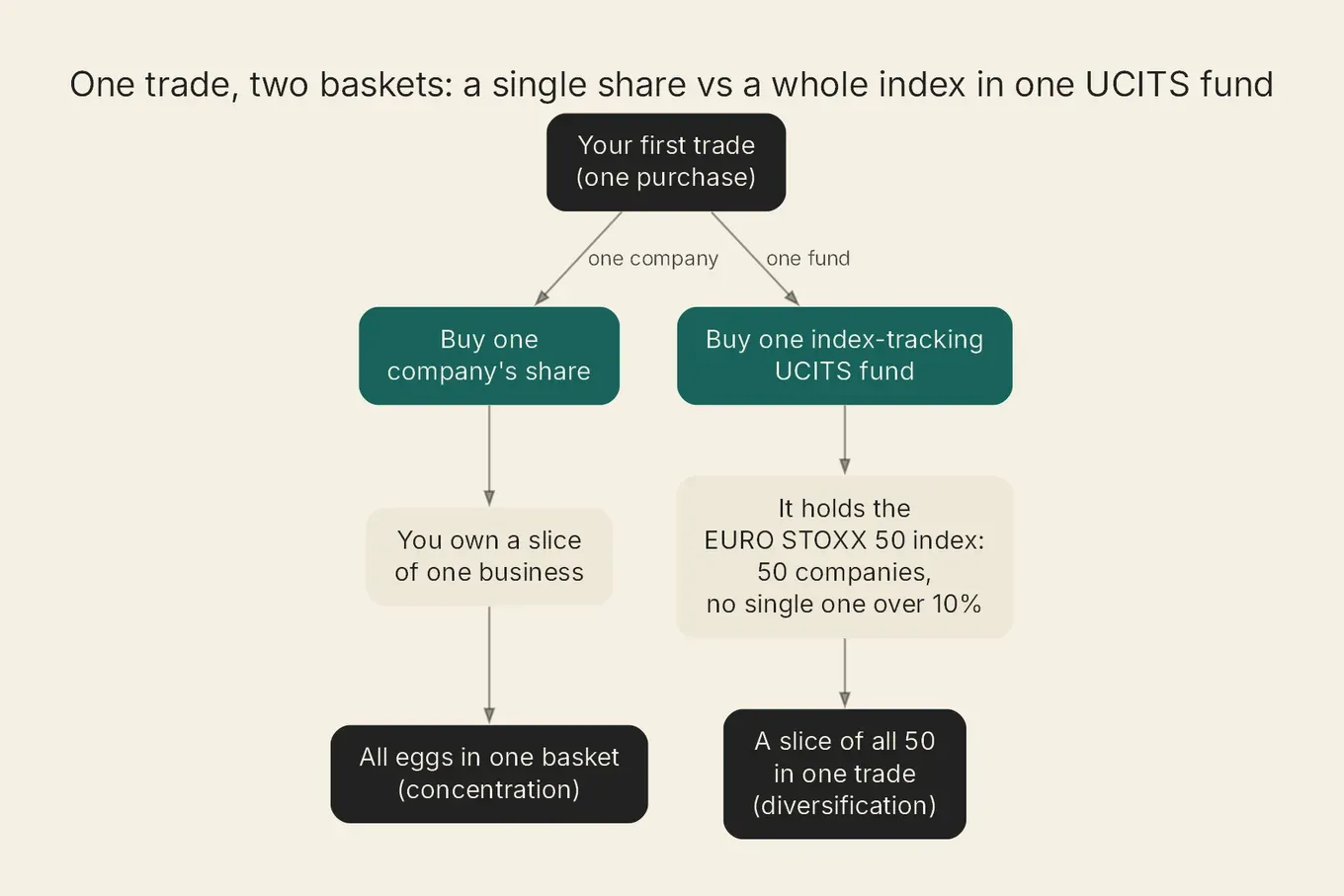
- One share is everything riding on one company; an index-tracking UCITS fund spreads a single trade across a whole list, such as the 50 companies in the EURO STOXX 50, with no single name over 10%.
- Two layers protect you: MiFID II conduct rules, and an investor-compensation scheme covering a minimum of €20,000 if your firm fails.
- That €20,000 floor covers your firm collapsing, not your investments losing value. Share prices still fall as well as rise.
The point.
- The stock market is the activity of buying and selling shares; a stock exchange is one licensed venue where that happens, such as the London Stock Exchange, Euronext or Frankfurt's Xetra.
- Most of Europe's national exchanges run on Euronext (eight regulated venues), Germany trades mainly on Xetra, and the London Stock Exchange sits just outside the EU since Brexit.
- One share is everything riding on one company; an index-tracking UCITS fund spreads a single trade across a whole list, such as the 50 companies in the EURO STOXX 50, with no single name over 10%.
- Two layers protect you: MiFID II conduct rules, and an investor-compensation scheme covering a minimum of €20,000 if your firm fails.
- That €20,000 floor covers your firm collapsing, not your investments losing value. Share prices still fall as well as rise.
You have money in the bank. Never bought a share, though. And every time you sit down to fix that, someone shows you a photo of men shouting on a New York trading floor, and you quietly close the laptop. Fair enough. That photo explains nothing, and it isn’t even your continent.
So let’s do this the boring, useful way. By the end you’ll be able to say what the stock market is, where it happens in Europe, and what protects you while you’re there. Nobody here will tell you to buy anything.
What is the stock market, in one plain sentence?
The stock market is the whole activity of buying and selling shares in listed companies. It is not a single building. It is not Wall Street. It is the network where buyers and sellers meet across many separate venues, such as the London Stock Exchange, Euronext and Frankfurt’s Xetra, to trade slices of companies. A share is one of those slices: a unit of part-ownership in a business, defined in EU law as a transferable security (opens in new tab), held by investors and traded among them.
That’s the lot. Buy a share and you own a real piece of a real company, not a lottery ticket and not a loan. The places it happens carry their own name, and that name trips up most beginners.
How is a stock exchange different from the stock market?
The stock market is the activity. A stock exchange is one specific, licensed venue where it happens: this building, these rules, signed off by the regulator. In EU law such a venue is a “regulated market”: a system, run by a market operator, that brings together many buyers and sellers under fixed, non-discretionary rules in a way that produces a contract (opens in new tab). Strip the legal Latin and it means this: orders don’t get haggled in a back room. They meet in one shared electronic book, matched by the same rules for everyone, big fund or first-timer.
The difference, worth getting right once:
| The stock market | A stock exchange | |
|---|---|---|
| What it is | The whole activity of buying and selling shares | One licensed venue where that buying and selling happens |
| Scope | Every exchange, plus the trading across them | A single regulated market, with its own rulebook |
| How many | One concept | Many: London, Paris, Frankfurt, Dublin, and more |
| Examples | ”European equities”, “the market fell today” | London Stock Exchange, Euronext Paris, Frankfurt’s Xetra |
So “which exchange should I use?” mostly answers itself. You won’t pick one. You pick a broker and a fund, and the exchange matches your order behind the scenes.
Which exchanges matter in Europe?
Not the New York Stock Exchange. Most of the continent’s national exchanges run on one operator: Euronext operates eight regulated exchanges (opens in new tab): Amsterdam, Athens, Brussels, Dublin, Lisbon, Milan, Oslo and Paris. So if Ines in Porto buys a Portuguese company, or Aoife in Dublin buys an Irish one, the venue underneath is likely a Euronext one.
Germany runs its own. Xetra, run by Deutsche Boerse, handles more than 90% of all share trading on German exchanges (opens in new tab), with around 1,200 shares and more than 2,000 exchange-traded products tradable on it. If Lena in Leipzig invests, Xetra probably matches her order.
The London Stock Exchange (opens in new tab) is a major European venue too, with one footnote: since Brexit, the UK sits outside the EU and its single fund market. A real exchange, just on a partly separate rulebook now. A neighbour, not a default.
What happens when you buy a share?
A company wants money to grow, so it sells slices of itself to the public and gets listed on an exchange. That first sale, where your money reaches the company, is the primary market (opens in new tab): the listing, or what you’d call an IPO.
After that, the company isn’t selling anymore. Investors trade those existing slices among themselves on the secondary market, where almost all of us spend our investing lives. Here’s the bit nobody tells beginners plainly: when you buy a share of a long-listed company, your money goes to whoever sold it to you, not to the company.
Once you own that slice, it can pay you back two ways. The price might rise above what you paid, and you sell: that’s price appreciation. Or the company hands shareholders a slice of its profits, which is a dividend. Neither is guaranteed, and the value of a share can fall as well as rise (opens in new tab). That isn’t a disclaimer bolted on at the end. It’s the actual rule, and the difference between investing and wishing, which is why money you’ll need soon and money you can leave for years belong in different places.
What is an index, and how does a fund let you buy one?
You now own one slice of one company, so your fortunes ride on that one company. A lot of eggs in a basket you only just learned to find. And unlike cash you can reach in a day, a share can take a bad year to sell.
An index is a defined, rules-based list of shares, measured together. The EURO STOXX 50 (opens in new tab) tracks 50 of the eurozone’s biggest companies, with a rule that no single one can be more than 10% of it. It’s a measuring stick, not a thing you buy. What you buy is a fund that holds the whole list for you, and in the EU that fund almost always carries one label.
What is a UCITS fund?
A UCITS is the EU’s regulated, retail-friendly fund structure (opens in new tab), built on spreading risk. A fund approved in one EU country can be sold across the whole bloc, which is why most European beginners meet one early.
An index-tracking UCITS fund holds the index’s shares, so one purchase buys a diversified slice of all 50 companies at once. More than €25 billion sits in funds tracking the EURO STOXX 50.
That’s why “you need a fortune to start” is mostly a myth. The wrapper exists so an ordinary saver, the sort already keeping cash in a high-yield savings account, can buy a spread of companies in one small, often fractional, trade. The popular European brokers a beginner meets (Trade Republic, DEGIRO, Lightyear, Interactive Brokers) all sell these funds. Which fund suits you is a question for another day.
| Buy one company’s share | Buy one index-tracking UCITS ETF | |
|---|---|---|
| What you own | A slice of that one business | A slice of every company in the index, in one fund |
| How many companies you’re exposed to | One | All 50 of the EURO STOXX 50 |
| Concentration | All eggs in one basket | Spread across 50, with a rule that no single company is more than 10% |
| If one of those companies has a terrible year | It hits your whole holding directly | It’s one name among 50, so its bad year is diluted by the other 49 |
| Trades needed to get there | One (one company) | One (still one trade, but 50 companies inside it) |
| Wrapper / rules | A single transferable security | A UCITS fund: the EU’s regulated, retail-friendly structure built on spreading risk |
| If your investment firm fails | Investor-compensation scheme covers a minimum of €20,000 per investor | Same €20,000 floor: it covers the firm failing, not either holding losing value |
That is what diversification means in practice, and why a first trade need not cost a fortune.
Is the stock market just gambling, and what protects me?
Let’s take the fear seriously. Values fall as well as rise, real money is at stake, and “it’s all a casino” is a fair thing to suspect before anyone explains the mechanics.
But a casino is a closed loop designed for you to lose on average. A share is a real ownership stake in a real company, traded on a licensed venue under fixed rules. Two layers of protection sit underneath, and a European beginner gets both.
The first is conduct. MiFID II, the EU’s investment-services directive (opens in new tab), overseen across the bloc by ESMA and enforced by your national regulator, requires regulated firms to act in your best interests and to spell out the risks alongside the rewards. How far a firm must check that a product suits you depends on the service you buy: an execution-only broker that simply carries out your instruction is not assessing suitability for you. The second is a backstop. If your authorised investment firm goes bust and can’t return your money or your shares, an investor-compensation scheme (opens in new tab) steps in. Across the EU the minimum cover is €20,000 per investor. In Ireland, for example, the scheme pays 90% of your loss up to that €20,000 (opens in new tab).
One line, though, is where that reassurance turns into a false promise if you miss it.
Does compensation cover stock-market losses?
No. The scheme covers your firm failing, not your investments losing value. If your fund drops in a bad year, nobody refunds you. That’s the risk you signed up for, and the bit that genuinely isn’t like a savings account.
So what should you do this week?
Nothing that costs a euro. One thing that builds the picture in your head.
Pick one broad European index, the EURO STOXX 50 is a fine example, and look up what it holds. You’ve heard of most of the companies, and owning a slice of all 50 at once is a fairly dull, sensible idea once the jargon is gone. For a nerdier version, open one index fund’s key-information document, the short standardised summary every EU fund must publish, and read the risk section. No account, no purchase, no pressure.
You weren’t behind. You were handed the wrong photo and a pile of undefined words. The market is people buying slices of companies on licensed venues, with rules and a safety net. The money can stay in the bank as long as you like. You just get to make that choice on purpose now, which is the only thing that needed fixing.
Frequently asked questions
What is the stock market in simple terms?
What is the difference between the stock market and a stock exchange?
What are the main stock exchanges in Europe?
Is investing in the stock market just gambling?
What is a UCITS fund and why do European beginners use one?
Does buying a share give my money to the company?
Sources (11)
- EUR-Lex: Investor Compensation Schemes Directive 97/9/EC
- EUR-Lex: MiFID II Directive 2014/65/EU (consolidated)
- EUR-Lex: UCITS Directive 2009/65/EC
- European Commission: Investment services and regulated markets (MiFID II)
- Central Bank of Ireland: Investing your money, consumer FAQ
- Competition and Consumer Protection Commission (Ireland): ICS protection
- Euronext: the leading European capital market infrastructure
- Euronext: Regulated Markets
- Deutsche Boerse: Cash market (Xetra)
- STOXX: EURO STOXX 50 index details
- London Stock Exchange Group: About LSEG
— That's the lot. It is now night.
Want more of this in your Google results?
Add Money Owl as a preferred source, and Google will show our finance pieces higher when you search for them.
By Jure Jaklič
Founder and editor of Money Owl. Data analyst by trade; personal finance learned first-hand across six European countries.
Recommended

How to spot an investment scam: check the firm, not the pitch
Two registers and a warning list. That is the check that works on an investment firm, because the pitch, the dashboard and the profit on it are all theirs.

The cost of doing nothing with your money, and what to fix first
Four money lines go stale at once: savings, tariffs, an uninvested surplus, and a pension rate you never set. Here's the ten-year bill, and what to fix first.

What ESG investing means, and what it changes about what you own
Two funds, same ESG label. One index targets a quarter of each sector's tradable market value, the other half. That figure is not on your factsheet.