

The point.
- The MSCI World tracks 1,283 large and mid-sized companies across 23 developed countries, weighted by company size.
- It is about 72% US (72.45% on 30 June 2026) and deliberately holds no emerging markets and no small companies.
- For many beginners, one MSCI World ETF works as a low-cost core; if you want emerging markets, switch to an all-country fund (MSCI ACWI or FTSE All-World) rather than stacking a second fund on top.
- Before you buy, open the factsheet and check two numbers: how much sits in the US, and how much sits in the top ten holdings.
The point.
- The MSCI World tracks 1,283 large and mid-sized companies across 23 developed countries, weighted by company size.
- It is about 72% US (72.45% on 30 June 2026) and deliberately holds no emerging markets and no small companies.
- For many beginners, one MSCI World ETF works as a low-cost core; if you want emerging markets, switch to an all-country fund (MSCI ACWI or FTSE All-World) rather than stacking a second fund on top.
- Before you buy, open the factsheet and check two numbers: how much sits in the US, and how much sits in the top ten holdings.
“Just buy an MSCI World ETF.” You’ve heard it. People say it the way they say “just drink more water”, as though that settles the matter. It’s decent advice, mostly. But you’re about to put real money into a single fund, and a quiet worry has surfaced. Is one fund enough, or are you being naive?
Fair worry. Before you hand over anything, it helps to see what the index holds and what it leaves out. Once you can see both halves, the “is one enough?” question gets easier to answer, and the choice becomes yours.
What is the MSCI World index, and how do you invest in it?
The MSCI World index tracks 1,283 large and mid-sized companies across 23 developed countries, weighted by size, and holds no emerging markets and no small companies. You get broad developed-market exposure from a single fund that copies it. Those numbers are as of 30 June 2026 (MSCI factsheet (opens in new tab)).
“Weighted by size” carries most of the story. Each company’s slot depends on the market value of its freely tradable shares. Bigger company, bigger slice. The 23 countries are the ones index providers class as “developed”, a formal call based on how mature and accessible a market is, not simply how rich the country is.
You can’t buy an index directly. An index is a measuring stick, not a product, and it charges no fee. What a European actually buys is a UCITS ETF (the EU’s standard regulated fund wrapper) that copies it. A few dated examples, as of mid-2026, named to show the range, not as endorsements or advice, and worth checking before you act. The iShares Core MSCI World (ticker IWDA) runs at 0.20% a year, the SPDR MSCI World (SWRD) at 0.12%, and Invesco’s MSCI World at 0.05%. That last one copies the index through a swap contract rather than owning the shares outright. Different structure, not a cheaper corner cut: its counterparty exposure is capped and collateralised under EU rules, and a swap can track a US-heavy index more tightly. Running costs across the field sit somewhere between 0.05% and 0.50% a year.
Which wrapper fits you (domicile, physical versus synthetic replication, whether it pays dividends out or rolls them up inside the fund, running cost) is a separate decision, with its own moving parts.
Why is a “World” fund about 72% one country?
The index weights companies by size, and the United States runs the biggest developed stock market by a wide margin. So the US is about 72% of the MSCI World: 72.45% on 30 June 2026 (MSCI (opens in new tab)). Nobody chose that. The maths did.
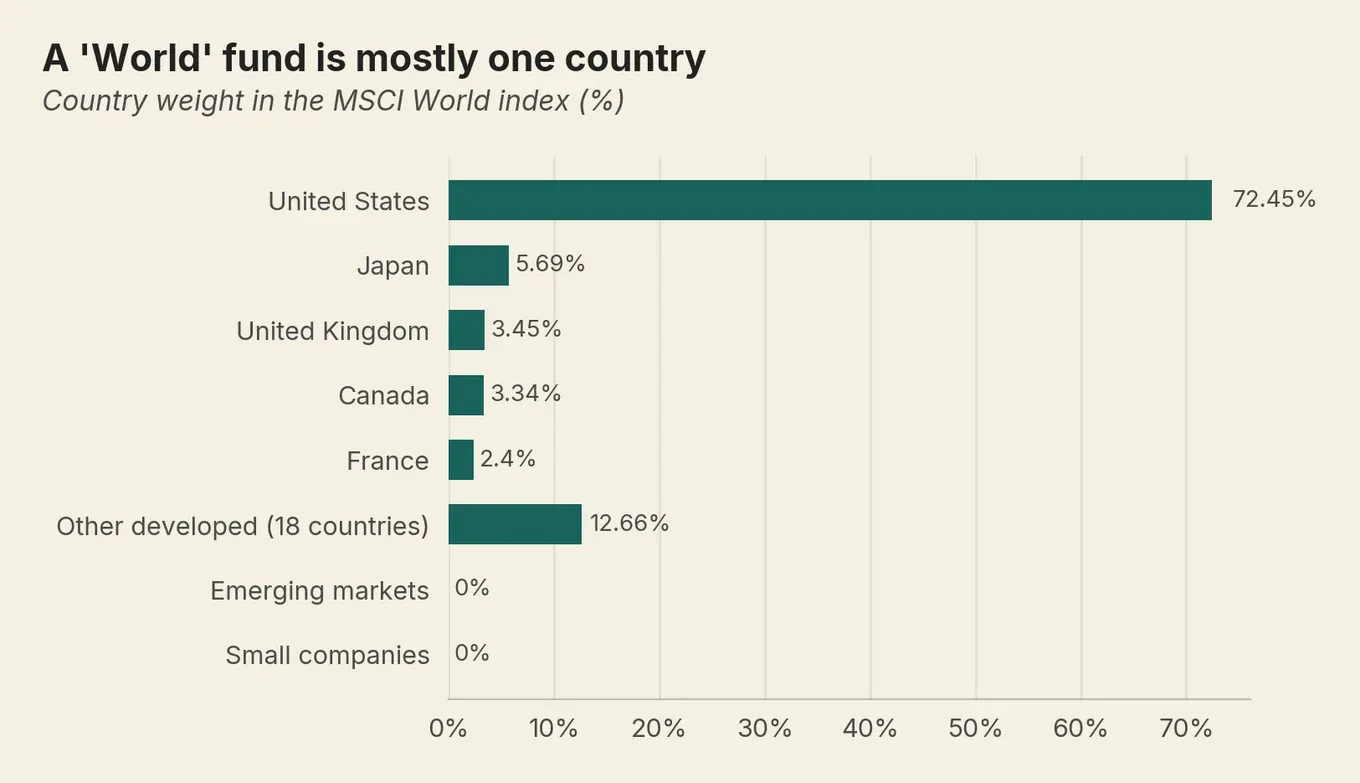
It’s called World. The world has more than one country in it, last time anyone counted.
So roughly three of every four euros in a “world” fund sit in American shares. Underneath that, it concentrates further. The ten largest holdings come to about a quarter of the index: 25.74%. Just three of them (Nvidia, Apple, Microsoft) run close to 13%. Tech fills about 30% of the fund, and every one of the top ten is an American name.
None of this is a scandal. It’s just a thing to know. Owning slices of 1,283 companies sounds diversified, and in one sense it is. But the weighting quietly points most of your money at one country and a handful of giant firms. That’s the market’s own pricing doing the steering, and the fund is only along for the ride. Whether you’re comfortable with that is the real question. It’s a preference, and a fair one. Right now it’s also a bet on America staying expensive: US shares look dear by some long-run measures, and experts genuinely split on whether the lead holds.
It is not just nervous beginners who notice this. The European Central Bank tracks the same concentration, and its May 2026 Financial Stability Review (opens in new tab) notes it is still climbing:
At the same time, market concentration among, and interconnection between, a handful of large US-based tech firms has risen further.
Does it include emerging markets and small caps?
No, to both, on purpose. The MSCI World covers developed markets only, large and mid-sized firms only. Emerging markets (India, Taiwan, Brazil and the rest) and small companies sit outside it. Together that’s a real slice of the investable world you’re choosing to skip.
That was the split inside the fund. This is the fund’s slice of the whole market.
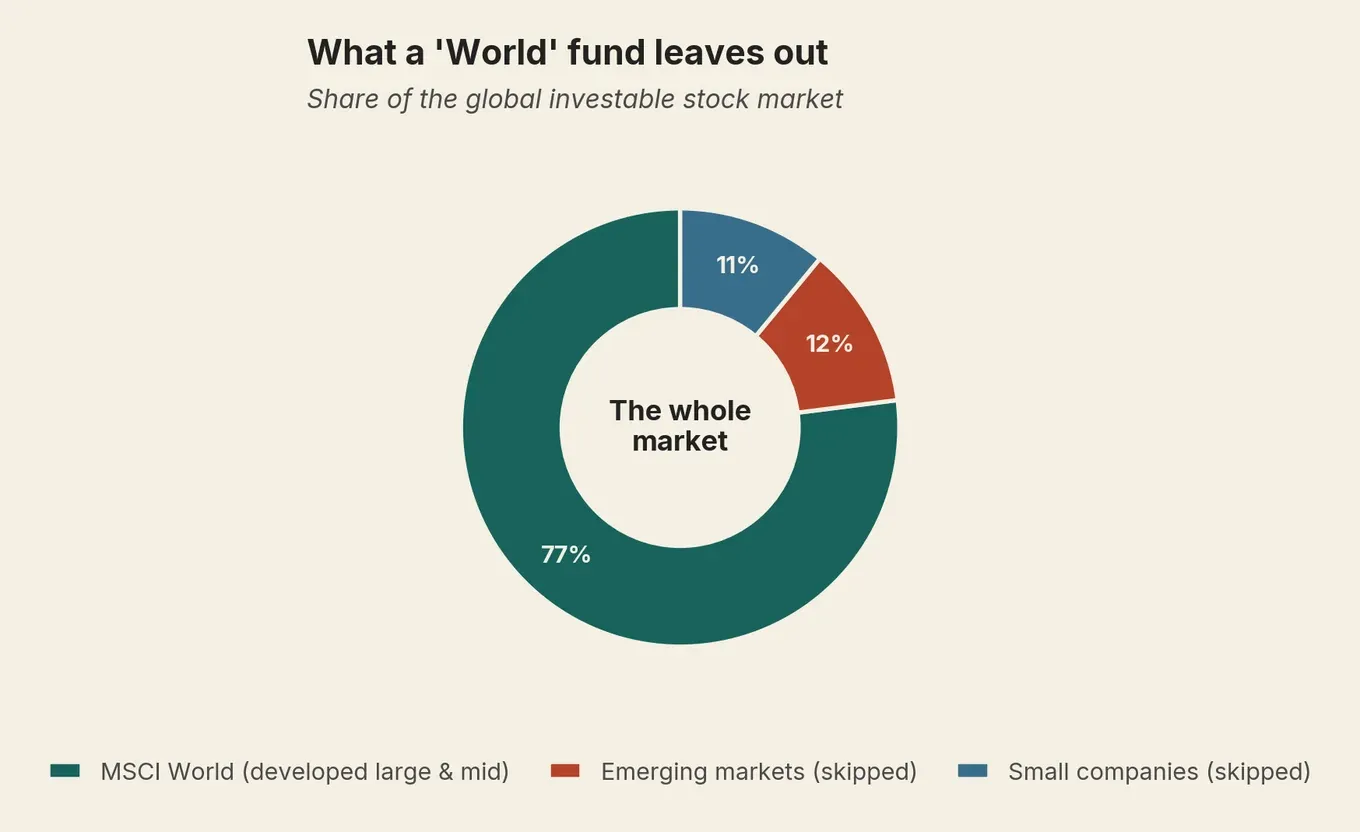
How much? Emerging markets are about 12% of the global all-country index. Small companies are about another 11% of the full investable universe. Both come straight from MSCI’s own factsheets, dated 30 June 2026. Want those? You want a different index. MSCI ACWI and FTSE All-World fold emerging markets into a single fund; MSCI ACWI IMI adds the small companies on top. FTSE All-World, despite the near-identical name, is the rough twin of ACWI, not of the developed-only MSCI World.
| Index | Markets covered | Emerging markets? | Small companies? | Companies | US weight |
|---|---|---|---|---|---|
| MSCI World | 23 developed | No | No | 1,283 | 72.45% |
| MSCI ACWI | 23 developed + 24 emerging | Yes | No | 2,461 | 63.63% |
| MSCI ACWI IMI | 23 developed + 24 emerging | Yes | Yes | 8,195 | 62.71% |
| FTSE All-World | developed + emerging | Yes | No | 4,265 | ~57% (proxy) |
Note on the table: the other three rows are index figures as of 30 June 2026 (MSCI (opens in new tab), FTSE Russell (opens in new tab)). FTSE All-World’s ~57% is different: a fund-holdings proxy from a tracking fund at a slightly earlier date (May 2026). On an index basis it is all-country like MSCI ACWI, so its true US weight sits nearer ACWI’s than the proxy suggests; FTSE just classifies a few markets differently.
Now, the worry underneath all this. By leaving emerging markets out, are you missing the growth? The honest answer surprises people. Over the ten years to 30 June 2026, the developed-only MSCI World returned about 13.7% a year, slightly ahead of the all-country MSCI ACWI at 13.3%, because emerging markets (10.5% a year) lagged over that stretch. Those are illustrative, gross figures; past performance is no guarantee of future results and the value of investments can fall as well as rise; and what you pocket depends on the fund’s own charges and performance.
So over the last decade, leaving emerging markets out didn’t cost a European investor a thing. It helped, a little. That’s one historical window, mind, and picking an allocation because it just won is the classic mistake: this stretch was unusually strong for US large-caps. Emerging markets led in other decades, and nobody knows which way the next ten years break. You haven’t obviously missed out. Which means you can make this call calmly, not out of fear.
So is one MSCI World ETF enough?
For a lot of beginners, yes. As a starting core. But “enough” sits on a spectrum, and where you land on it is personal. It depends on what you want the fund to do, and how much of the world you’re happy to leave out.
Take Mateus, 29, in Porto. He put €300 a month into a single MSCI World ETF because a colleague swore by it, then lay awake wondering whether “sensible” was quite the same as “safe”. Two worries, really: am I secretly all-in on America, and am I missing the next India or Brazil?
So he did the thing this article keeps nudging you toward. He opened the factsheet. Of every €300, about €217 lands in US shares (72.45%), and roughly €77, a quarter of the whole fund, rides on the top ten companies (25.74%), all of them American. Emerging markets: nothing. Small companies: nothing. He had signed up for all of it. Never actually looked.
None of it read as a mistake. It made the choice his, not his colleague’s. Mateus kept the one fund, eyes open, and stopped losing sleep over it. Someone else, reading the same two numbers, would add a separate emerging-markets fund. Both are fine. The point is that he chose.
When is one MSCI World ETF enough?
For a beginner who wants a simple, low-cost core and the discipline to keep buying, one broad developed-markets fund works as a defensible whole. It hands you thousands of companies across the richest economies in a single line, and it stays easy to top up month after month. For a first-time investor in Dublin or Lisbon who wants to start and then get on with life, that holds up. “Naive” is the wrong word for it. Keeping it simple, on purpose, is the smarter call.
One honesty note, since this would be your whole core: it’s 100% shares, and shares fall. The same MSCI World roughly halved in the 2007 to 2009 crash, down about 57% top to bottom (same illustrative basis as above). It suits long-term money you can leave alone for years, a cash buffer set aside first; if you’ll need it sooner, a 100%-equity index is the wrong tool, calm or not. If a drop like that would spook you into selling at the worst moment, the answer is to hold less in shares, whatever index sits underneath.
When is one fund not enough?
Say you want emerging markets too, or roughly 72% in one country makes you uneasy. Then one developed-only fund leaves gaps. The clean fix is to swap to an all-country fund (MSCI ACWI or FTSE All-World) that gives you developed plus emerging in a single line. You don’t stack a second fund on top. Or keep the MSCI World and add a separate, smaller emerging-markets fund whose size you set yourself.
What trips people up is doubling up by accident. Hold an MSCI World and an S&P 500 fund together and you don’t spread your money wider. The MSCI World already owns those same US giants, so you pile more onto America. Same story with an MSCI World and an all-country fund side by side: you pay twice to own most of the same companies. Pick one lane.
Two more questions a European should ask, and both have their own guides. Your euros ride on a mostly-dollar index. That’s a currency question worth understanding. And whether to tilt a little toward your home region instead of taking the full US weight is a fair, personal call, and entirely yours to make.
Before your next contribution goes in, open your fund’s factsheet and look at two numbers: how much sits in the US, and how much sits in the top ten holdings. A fund that actually owns the shares mirrors the index almost line for line, so those numbers will track the ones here. But weights drift as markets move, so your factsheet figure will differ, more so the longer after mid-2026 you read this. Sit with them for a minute. Then decide, eyes open, whether you want the developed-only MSCI World or an all-country fund that folds in the rest. One fund can be a fine answer. Picking it on purpose beats picking it because a stranger on the internet told you to.
Frequently asked questions
Is one MSCI World ETF enough?
Does the MSCI World index include emerging markets?
Why is the MSCI World about 72% US?
MSCI World vs MSCI ACWI: what's the difference?
MSCI World vs S&P 500: what's the difference?
— That's the lot. It is now night.
Want more of this in your Google results?
Add Money Owl as a preferred source, and Google will show our finance pieces higher when you search for them.
By Jure Jaklič
Founder and editor of Money Owl. Data analyst by trade; personal finance learned first-hand across six European countries.
Recommended

Dividend investing in Europe: is it really passive income?
Pooled across 2018, 2019, 2021 and 2022, 70.6% of European once-a-year dividend payments arrived in April, May and June. What that does to a monthly budget, and what living off it really costs.

The three-fund portfolio for European investors
Europe's three-fund portfolio has its own shape. A single all-world UCITS fund owns the whole world, so most first-timers need two funds, not three.
Warren Buffett's principles, translated for Europe
For 60 years Buffett beat the market, then told everyone else to index. His principles, translated for Europe: UCITS ETFs, the 90/10 rule and tax wrappers.