

The point.
- Most European first-timers need two funds, not three: one global all-world equity fund and one euro-hedged bond fund.
- Buy UCITS funds, not the famous US ones. American providers don't publish the EU's Key Information Document, so European brokers can't legally sell them to you.
- Prefer Irish-domiciled funds: a US tax treaty trims the withholding on their American dividends from 30% to 15%, a quiet drag many Luxembourg structures don't escape.
- The third fund is an optional tilt, usually emerging markets, not missing diversification. Add it only when you can name the reason.
- Which fund you buy and which account you hold it in are two separate decisions; the wrapper depends on where you live.
The point.
- Most European first-timers need two funds, not three: one global all-world equity fund and one euro-hedged bond fund.
- Buy UCITS funds, not the famous US ones. American providers don't publish the EU's Key Information Document, so European brokers can't legally sell them to you.
- Prefer Irish-domiciled funds: a US tax treaty trims the withholding on their American dividends from 30% to 15%, a quiet drag many Luxembourg structures don't escape.
- The third fund is an optional tilt, usually emerging markets, not missing diversification. Add it only when you can name the reason.
- Which fund you buy and which account you hold it in are two separate decisions; the wrapper depends on where you live.
You’ve read the advice a hundred times. Buy a total US stock fund, a total international fund, and a US bond fund. Three funds, done, retire happy. So you open your broker, type VTSAX, and it isn’t there. VTI isn’t there either. Neither is VOO. The internet has spent a decade recommending funds that you, sitting in Europe, aren’t allowed to buy.
There’s a reason those funds are missing, and it has nothing to do with you. It comes down to one EU rule, and the rule makes sense once you see it. The European version of the three-fund portfolio turns out simpler than the American one. For most first-timers, it needs only two.
Before any of this, two quick gates. Keep three to six months of spending in cash you can reach, and clear any expensive debt first, because paying off a credit card at around 20% beats any fund you could buy. This is money you won’t need for at least five years.
What is a three-fund portfolio, and why doesn’t the American version fit Europe?
For a European, a three-fund portfolio is a low-cost, buy-and-hold mix of broad UCITS ETFs (funds built under the EU’s own rulebook): a global or developed-world equity core, an optional emerging-markets tilt, and a euro bond sleeve (a slice of the portfolio) to steady the whole thing. You build it from that EU format. That’s the entire idea.
The model came out of the American Bogleheads community, retail investors who followed the low-cost index style of John Bogle. Their split is home versus abroad: one fund for US shares, one for everywhere else, one for US bonds. It works because a handful of broad index funds owns thousands of companies at their market weight. The enemy is cost and fiddling, not the number of funds.
Here’s where it stops translating. An American has a home market to build around. You don’t. The euro area is a small slice of the world’s shares, so “home versus abroad” means little from a desk in Madrid or Munich. And the split is already done for you. A single all-world UCITS fund holds developed and emerging markets in one line. The Vanguard FTSE All-World fund (opens in new tab) held 3,763 companies as at 31 May 2026, with about 61.8% of it in the United States. Buy that one fund and you own the developed world and the emerging world at the same time.
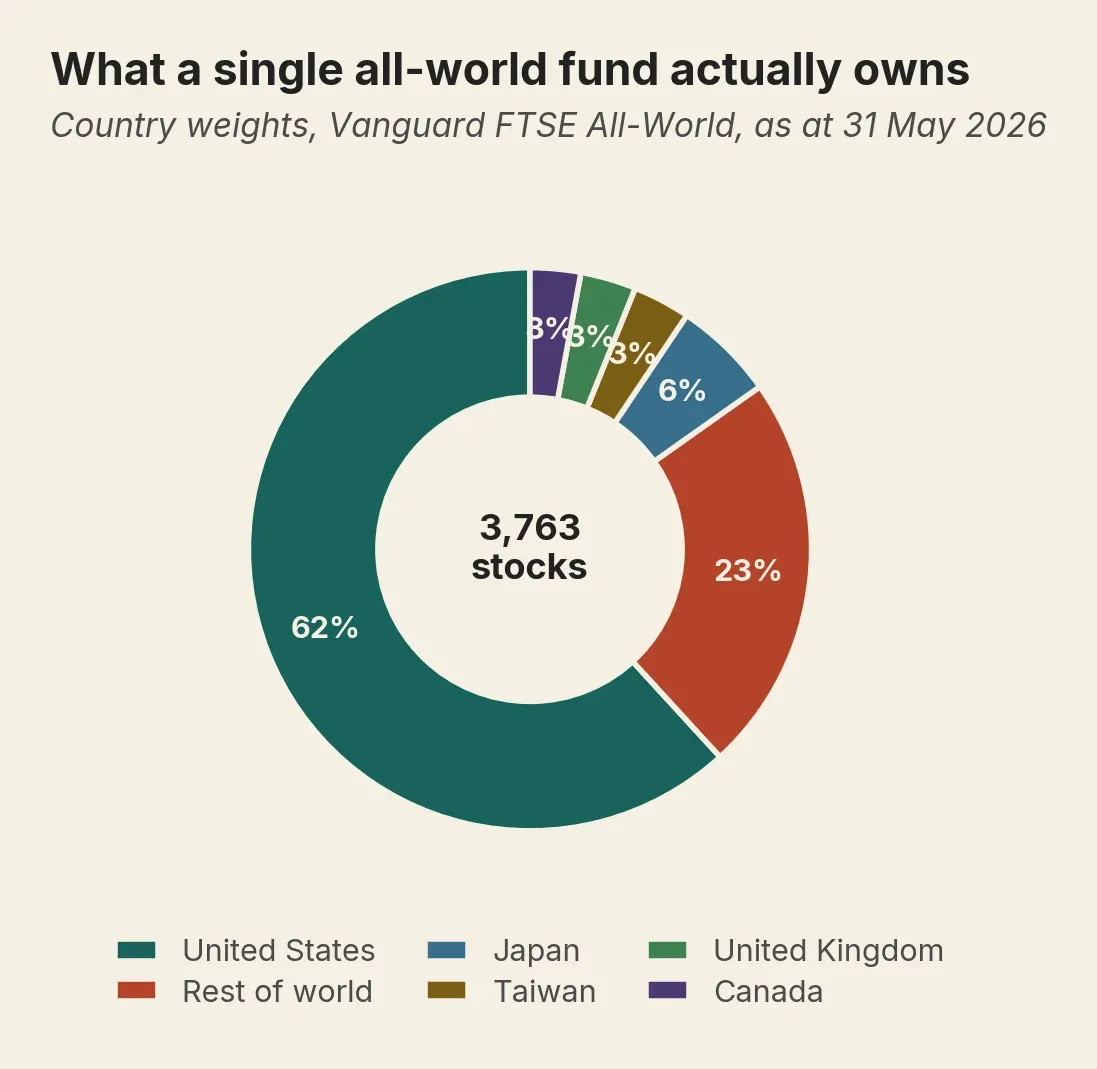
The American “three funds” is just one way to slice an equity pot that, for a European, already comes pre-sliced.
How many funds do you actually need?
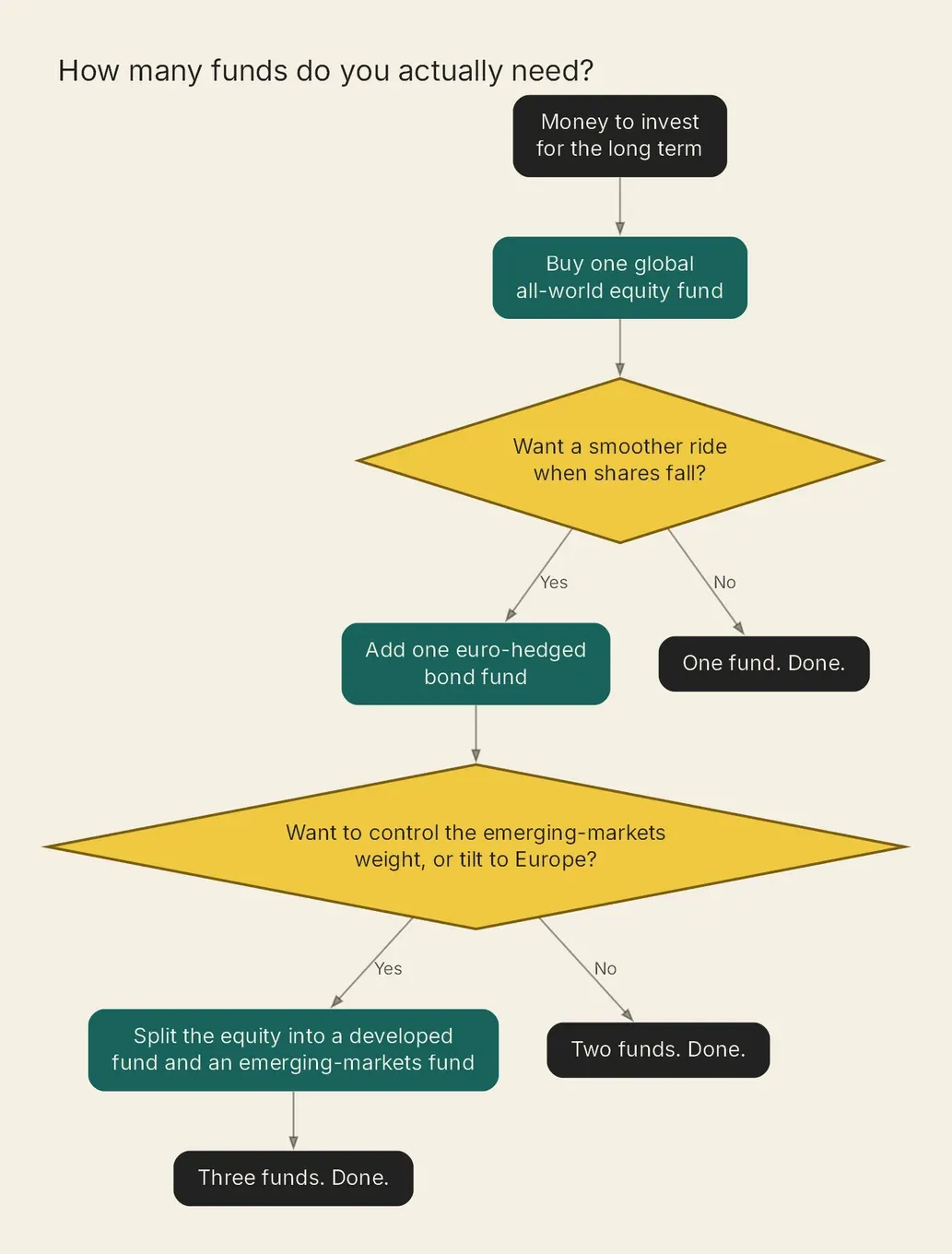
For most people starting out, the answer is two. One global equity fund, one euro bond fund. That’s a complete portfolio. Some call this two-fund build a lazy portfolio, which undersells it. If you’ve been feeling behind for owning fewer funds than the guides demand, you can stop. You were closer than they were. Honestly.
Europe’s securities regulator lands on the same point: which product you pick matters. Verena Ross, who chairs ESMA (opens in new tab), said as much when the 2026 costs report landed:
The report highlights however that benefits are uneven and product choice matters.
Is one all-world fund enough on its own?
A single all-world fund is the whole equity side of your portfolio. It spreads your money across thousands of companies in dozens of countries, developed and emerging, at their market weight. Nothing is missing without a separate emerging-markets fund, because the emerging markets are already inside it. Skipping the rest of the world to chase the recent winner is the real concentrated gamble here. For a first-timer chasing growth, with a long horizon and a strong stomach, one all-world fund is a fine whole portfolio.
What is the second fund for?
The second fund is a bond fund. It won’t make you rich. Its job is to keep the ride smooth enough that you stay put when shares fall 30% in a month, which they do now and then. In a really bad bear market they can roughly halve, down about 50%.
Bonds are steadier than shares, but they aren’t safe either: they can fall too. In 2022 a global bond fund dropped more than 10% when interest rates jumped. The sleeve buys you a smoother ride, not a guaranteed one.
For a euro-based investor the bond sleeve should be euro-denominated or euro-hedged. A wobble in the dollar can wipe out the small yield a bond fund exists to give. One all-world equity fund plus one euro-hedged bond fund is the sensible default for most European first-timers.
When does a third fund earn its place?
The third fund only shows up when you’ve a reason for it you could name. Most often that reason is emerging markets. They already sit inside the all-world at a small weight. A separate emerging-markets fund just holds more of them than the market does, on purpose. Nothing was missing; it’s a lean.
That’s a deliberate call. The same goes for a separate developed-Europe tilt to cut your US exposure. Each is a choice to lean, and leaning is fine, so long as you know that’s what you’re doing. A three-fund portfolio only beats a single all-world fund if you specifically want that tilt.
Whichever count you land on, you steer it with fresh money and the occasional rebalance. That’s the whole job.
Which UCITS funds make up a three-fund portfolio?
Here’s the model, assembled. Everything below is a dated example as of July 2026, not a recommendation and not advice. Check the current figures and read each fund’s KID, the short EU fact sheet, before you buy anything. Costs and fund details drift, so treat the numbers as a starting point. All of these are Irish-domiciled and accumulating, meaning they reinvest dividends inside the fund, unless noted. The ISIN in each table is the code you paste into your broker’s search box to pull up the exact fund.
The two-fund build:
| Sleeve | Fund | Ticker | ISIN | Ongoing cost |
|---|---|---|---|---|
| Global equity core | Vanguard FTSE All-World UCITS ETF | VWCE | IE00BK5BQT80 | 0.14% |
| Euro bond stabiliser | iShares Core Global Aggregate Bond UCITS ETF EUR Hedged | AGGH | IE00BDBRDM35 | 0.10% |
| Euro bond stabiliser (alternative) | Vanguard Global Aggregate Bond UCITS ETF EUR Hedged | VAGF | IE00BG47KH54 | 0.08% |
Vanguard is cutting VWCE’s ongoing charge (opens in new tab) to 0.14% from 0.19%, effective 28 July 2026; older write-ups still quote the old figure.
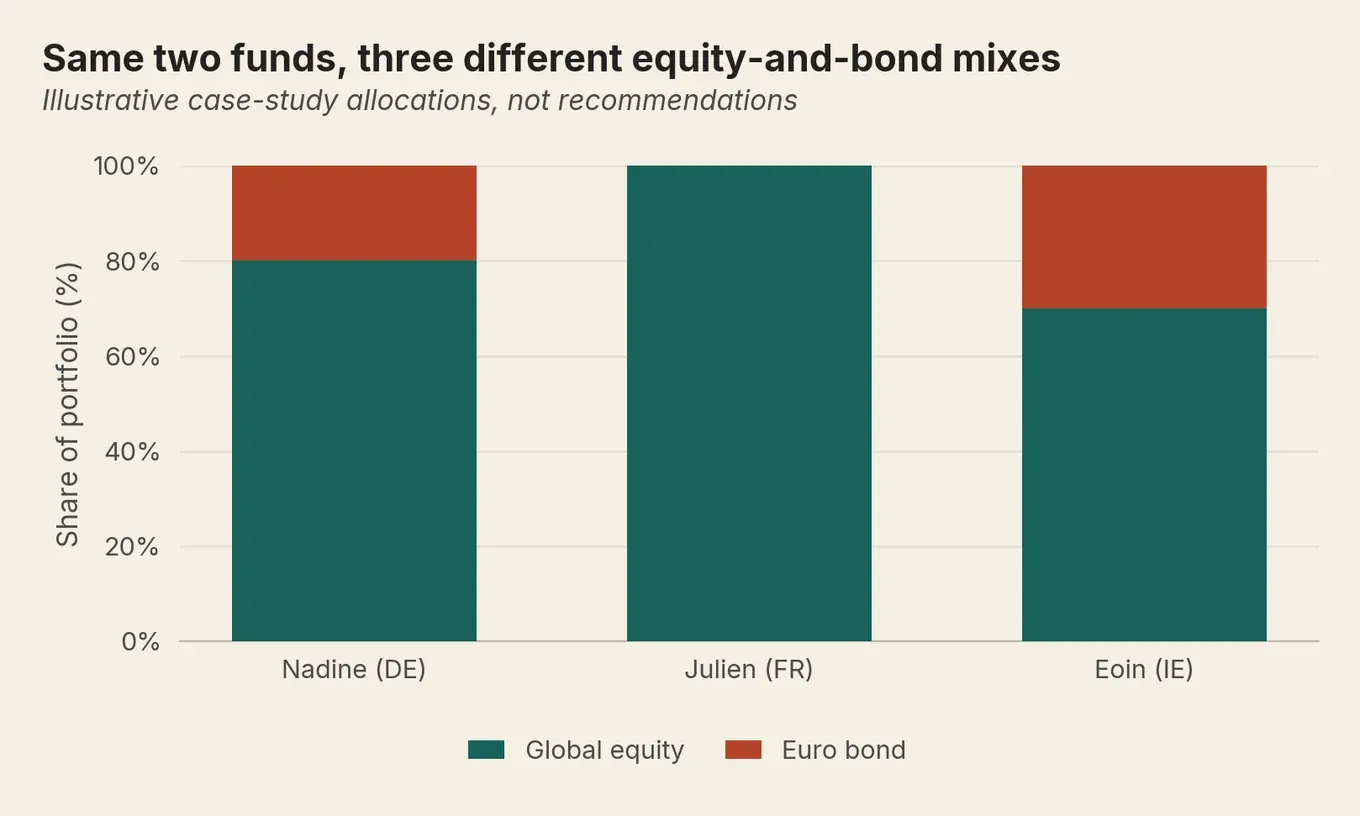
That two-fund build is exactly what Nadine, 38, a logistics planner in Hamburg, landed on. About €28,000 had been sitting in her Tagesgeldkonto, doing its quiet job as a safety net. The safety net was sorted; the surplus was just idle, and every guide she read insisted she needed three funds. She wanted something she could set up in an afternoon and then leave alone, so she built two. In a broker Depot she put roughly 80% into the Vanguard FTSE All-World (VWCE, 0.14%) for the equity core, and 20% into the iShares Core Global Aggregate Bond EUR Hedged (AGGH, 0.10%) to steady it. Blended, the whole thing costs about 0.13% a year. One German wrinkle she noted and moved past. An accumulating fund can trigger a small annual advance tax (the 2026 base rate is 3.20%), softened by the 30% partial exemption German equity funds get and her €1,000 tax-free allowance. The fund names here are illustrations, not recommendations.
If you want the three-fund version, you split the equity core into a developed-world fund and a separate emerging-markets fund, then add the same euro bond sleeve from the table above:
| Sleeve | Fund | Ticker | ISIN | Ongoing cost |
|---|---|---|---|---|
| Developed-world equity | iShares Core MSCI World UCITS ETF | SWDA | IE00B4L5Y983 | 0.20% |
| Developed-world equity (alternative) | Vanguard FTSE Developed World UCITS ETF | VHVG | IE00BK5BQV03 | 0.12% |
| Emerging-markets equity | iShares Core MSCI EM IMI UCITS ETF | EIMI | IE00BKM4GZ66 | 0.18% |
| Emerging-markets equity (alternative) | Vanguard FTSE Emerging Markets UCITS ETF | VFEG | IE00BK5BR733 | 0.17% |
One trap in the three-fund version: keep both equity funds in the same index family. Pair two FTSE funds (VHVG and VFEG), or two MSCI ones (SWDA and EIMI), but don’t take one from each. FTSE and MSCI draw the developed-versus-emerging line in different places. South Korea is the usual example: FTSE calls it developed, MSCI calls it emerging. Take an MSCI developed fund and a FTSE emerging one, and you can end up owning Korea twice, or missing it altogether.
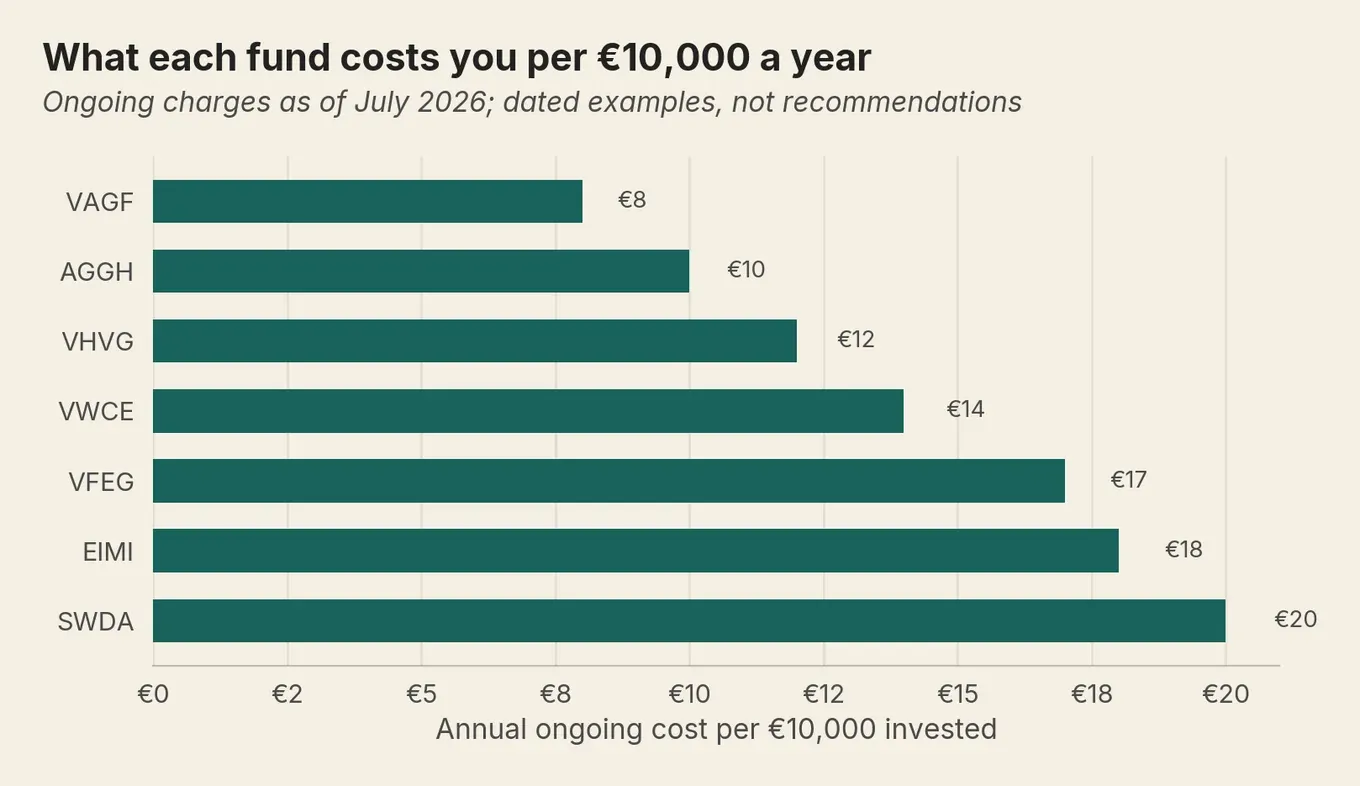
The EU’s markets regulator keeps landing on the same finding: over time, active funds tend to lose to cheap passive ones in net terms (opens in new tab), mostly because of their higher ongoing costs. That’s the case for shopping from the cheap end of the shelf.
The headline ongoing cost is only part of the story. What matters just as much is tracking difference: how far a fund drifts from its index after costs. Picking between two near-identical funds turns out to be its own small skill. Two things about the list above won’t be obvious, though, and both are European-specific.
Why can’t Europeans buy the famous US funds?
I spent a while trying to work out why a European can’t just buy VTSAX. The answer isn’t a law, exactly. It’s a document. EU rules require every investment product sold to an ordinary retail investor to come with a short standard fact sheet called a Key Information Document, or KID (opens in new tab). American fund providers don’t make one, so brokers here can’t legally sell you their funds. That’s the whole barrier. The fix is the UCITS equivalent (opens in new tab), the same market exposure in a fund that does the paperwork. UCITS is just the EU’s fund rulebook, and a fund built under it can be sold across the whole bloc.
Why prefer Irish-domiciled funds?
Every fund above is domiciled in Ireland, meaning it’s legally registered there. That’s not an accident. When a fund gets dividends from American companies, the US takes a cut before the money arrives. The standard cut is 30%. Ireland’s tax treaty with the US (opens in new tab) trims that to 15% for Irish-domiciled funds. Many Luxembourg fund structures miss the same relief and can bear the full rate.
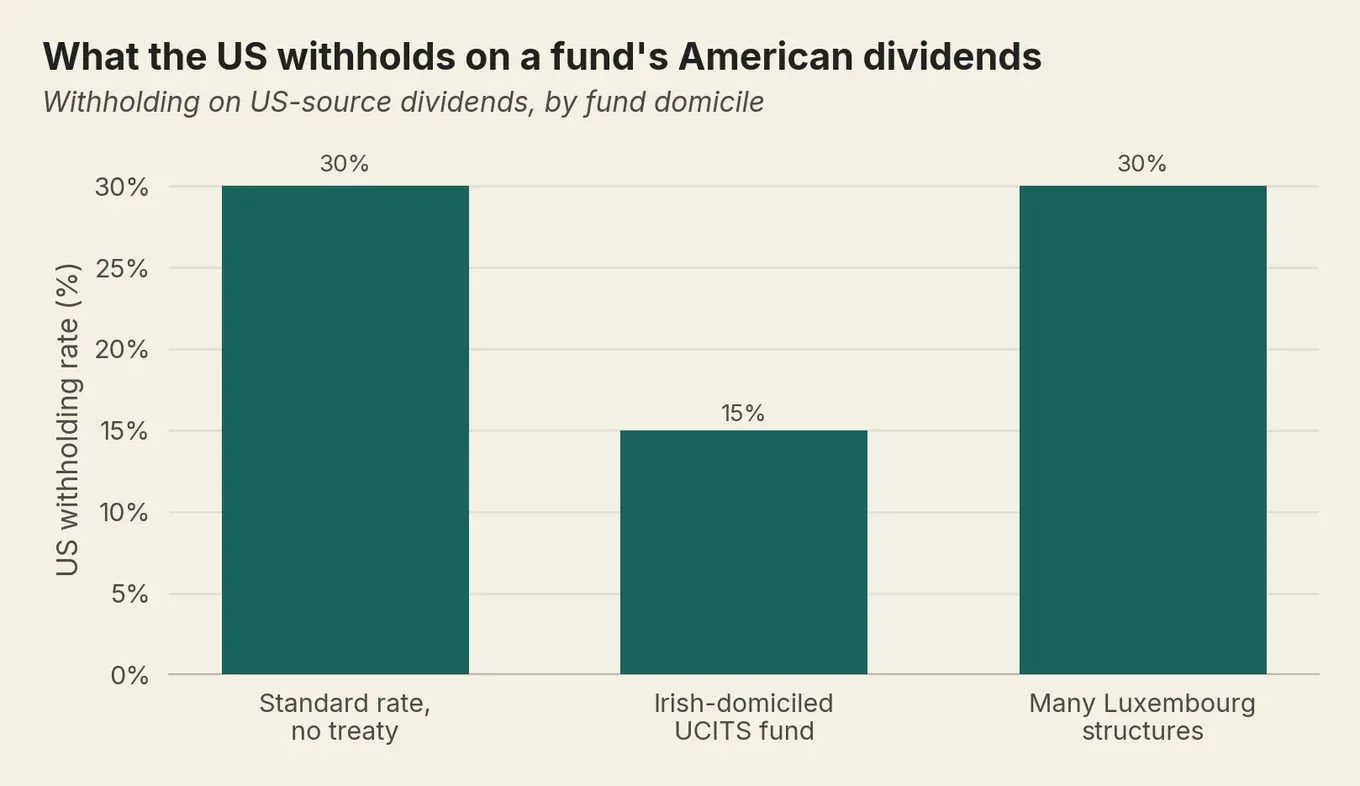
You never see any of this on your broker statement. It happens inside the fund, and shows up only as a faint drag on returns. For anything holding a lot of American shares, Irish domicile is the quiet default. An all-world fund is roughly three-fifths American.
How should you weight the three sleeves?
Forget the split between the two equity sleeves for a moment. The weighting that matters is between equities and bonds, and it comes down to your time horizon and how big a crash you can sit through without selling. A thirty-year-old saving for a house two decades out can hold mostly equities; someone who needs the money in five years should not. As a rough starting point, some investors hold a bond slice near their age minus twenty, then adjust for the size of crash they can stomach. The full age-and-risk framework lives in its own allocation-ratio guide; this piece is the assembly, and the ratio debate lives there.
Why let equities lead the mix at all? Over the long run they’ve paid for the volatility. Global equities have paid an illustrative 5% a year after inflation over the long run, 1900 to 2025, according to the UBS Global Investment Returns Yearbook (opens in new tab). The US did better, nearer 6.6%; the rest of the world less. An all-world fund gives you the global average. That is past performance, not a forecast. Investment values can fall as well as rise, and your actual return depends on the funds you hold and the charges you pay. That’s why the equity sleeve does the heavy lifting over decades. The bond sleeve is there to keep you from bailing out at the bottom.
The people behind that 126-year record make the same point about staying put. As Paul Marsh of London Business School, one of the yearbook’s authors, put it:
In periods of economic and geopolitical uncertainty, it can be easy to lose perspective of the long-term investment horizon.
If you do run the three-fund version, the only extra weighting decision is how far to overweight emerging markets above their small natural share. There’s no correct number. Pick a tilt you can hold through a decade where it lags, because it’ll have those.
Where do you hold it, and what will the tax be?
The fund you buy is one decision. Where you hold it is another, and where you live settles that one.
First, one choice that trips up beginners: accumulating versus distributing. The same fund often comes in two versions. An accumulating version reinvests dividends inside the fund; a distributing version pays them out as cash. Neither is the better fund. Which one is more tax-efficient depends on your country and your account. It’s a tax decision wearing a fund costume.
| Feature | Accumulating (Acc) | Distributing (Dist) |
|---|---|---|
| What it does with dividends | Reinvests them inside the fund | Pays them out to you as cash |
| Where you see it | A higher fund price (NAV) | Cash landing in your account |
| Reinvesting | Automatic, no action needed | Your job, if and when you choose |
Neither version wins outright. Which is more tax-efficient is a country-and-account decision: Germany’s Vorabpauschale mainly touches accumulating funds, while the Netherlands taxes both the same. Source: UCITS share-class mechanics and per-market tax rules, Money Owl research, July 2026.
Here’s the light version of where it lands across the Money Owl markets. This is a pointer, not a tax manual; the full per-market detail sits in the tax-wrapper guide.
| Market | The rule worth knowing |
|---|---|
| Germany | Held in a Depot; an accumulating fund can trigger a small annual advance tax, the Vorabpauschale (opens in new tab) (the 2026 charge is set off a 3.20% base rate), and equity funds get a 30% partial exemption, the Teilfreistellung. |
| France | The tax-favoured PEA (opens in new tab) only accepts funds that keep more than 75% in EU or EEA shares, so a world tracker often can’t sit inside it; the ceiling is €150,000. |
| Netherlands | Box 3 (opens in new tab) taxes a deemed return on your total wealth at 36% (2026), whether your fund accumulates or distributes, so the acc-versus-dist question barely matters here for now. The Netherlands is moving to a tax on actual returns, expected around 2028, after which that choice may start to matter. |
| Ireland | No ISA equivalent; Irish-domiciled funds face a deemed disposal (opens in new tab), a tax on your gain on every eighth anniversary even if you don’t sell, at an exit-tax rate cut to 38% for 2026. |
| Spain | Index mutual funds (fondos indexados) get the traspaso (opens in new tab), which lets you switch funds without triggering tax; ETFs are mostly left out. A Spanish reader who wants that freedom can hold a fondo indexado that tracks the same world index, or keep an ETF and accept the tax when switching. |
| United Kingdom | The one non-euro market: the tax shelters here, an ISA (£20,000 a year) or a SIPP pension (£60,000 a year), protect both fund versions from the second layer of tax. |
Slovenia and Portugal follow the same fund logic; the wrapper detail for your market sits in that same tax guide. The point holds across all of them. Fund domicile is fixed and can’t be changed. Your account is your choice. They’re two separate decisions, one stacked on the other.
Two of those wrinkles are easier to see in a person. Julien, 29, a graphic designer in Lyon with about €9,000 saved, had settled on the simplest start: one world tracker, held in the tax-friendly account every French saver is told to open first, the PEA. Then he hit a wall. The PEA only accepts funds keeping more than 75% of their money in EU or EEA shares, so a plain all-world like VWCE usually cannot sit inside it. (The plan also caps at €150,000, its income-tax break arrives only after five years, and 17.2% social contributions still apply.) He refused to let the wrapper puzzle stall the investing itself. He held the world tracker (VWCE, 0.14%, an example rather than a recommendation) in a compte-titres ordinaire, a plain taxable brokerage account, and left the PEA-eligible European fund as a question for later. Fund first, wrapper second.
Eoin kept waiting to feel ready. At 44, a self-employed electrician near Cork, he had built up about €40,000 in deposit accounts, which was the careful thing to do, and he had half-assumed Ireland offered some ISA-style shelter to move it into. It does not. Once that sank in, the build itself was quick: roughly 70% in the Vanguard FTSE All-World (VWCE, 0.14%) and 30% in the euro-hedged bond fund (AGGH, 0.10%), a blend costing about 0.13% a year, held in an ordinary Irish brokerage account. The Irish catch he diarised carefully. An Irish-domiciled fund faces deemed disposal, a tax on your gains on every eighth anniversary even if you never sell, at an exit-tax rate cut to 38% for 2026 (down from 41%). Knowing the date beats being surprised by it. The funds are dated examples, not advice.
A three-fund portfolio is not clever, and that’s the point. The two gates from the top still hold: reachable emergency cash and cleared debt come before any fund.
With that sorted, if the rest is still sitting in a savings account, the first step is opening a brokerage account, which most banks and app-based brokers let you do online in an afternoon. Then pick the equity fund. Add the bond fund if you want a smoother ride. Set a standing order and leave the thing alone for a year. The third fund can wait until you’ve a reason for it you could say out loud. This was never meant to beat the market. It’s one fewer thing to check at eleven at night.
Frequently asked questions
How many funds do I actually need?
Why can't Europeans buy US funds like VTSAX or VOO?
Which UCITS ETFs make up a three-fund portfolio?
Is a three-fund portfolio better than a single all-world ETF like VWCE?
Why prefer Irish-domiciled funds?
Where should I hold a three-fund portfolio, and what's the tax?
Sources (14)
- ESMA: Costs and Performance of EU Retail Investment Products 2026
- ESMA: New investment funds drive a reduction in costs for investors
- European Commission: Key Information Documents (PRIIPs)
- Central Bank of Ireland: UCITS
- Vanguard: FTSE All-World UCITS ETF factsheet
- Funds Europe: Vanguard reduces fees on FTSE All-World UCITS ETF
- UBS Global Investment Returns Yearbook 2026
- IRS: Tax Treaty Tables
- Bundesfinanzministerium: Basiszins for the 2026 Vorabpauschale
- Service-Public.fr: Plan d'epargne en actions (PEA)
- Belastingdienst: Box 3
- Revenue: Taxation of investment funds (deemed disposal)
- CNMV: Traspasos entre fondos
- GOV.UK: Individual Savings Accounts (ISAs)
— That's the lot. It is now night.
Want more of this in your Google results?
Add Money Owl as a preferred source, and Google will show our finance pieces higher when you search for them.
By Jure Jaklič
Founder and editor of Money Owl. Data analyst by trade; personal finance learned first-hand across six European countries.
Recommended

Staying the course: how to handle market panic and volatility
A falling market is a paper loss until you sell. How to sit through the panic, tell when selling is actually rational, and how long crashes really last.

Loss aversion: why you're too scared to sell losing stocks
That losing share isn't an investment any more. It's a small shrine you tend, waiting for it to apologise. Here's the disposition effect, and the way out.

Dividend investing in Europe: is it really passive income?
Pooled across 2018, 2019, 2021 and 2022, 70.6% of European once-a-year dividend payments arrived in April, May and June. What that does to a monthly budget, and what living off it really costs.