
The point.
- The real cost of hedging is the carry, the gap between euro and dollar interest rates, about 1.4% a year for a euro investor now (ECB 2.25% versus the Fed's 3.50% to 3.75%), not the roughly 0.02-point like-for-like fee.
- Hedging strips out currency risk, not market risk: a hedged global-equity fund falls just as hard as the unhedged one in a crash.
- Default rule: hedge bonds, where the currency swing is a big share of the risk, and leave a long-horizon equity core unhedged.
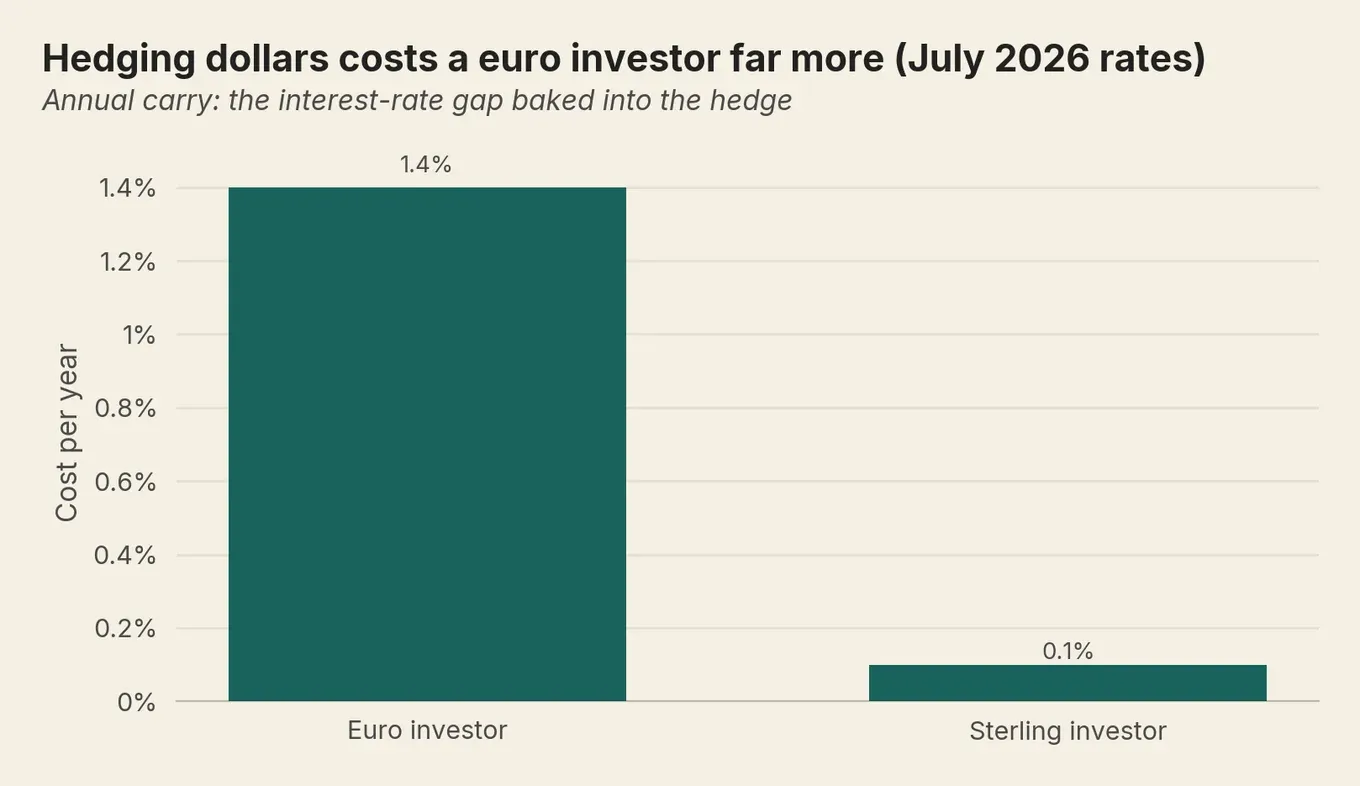
- The euro answer is not the sterling answer. A euro investor pays about 1.4% a year to hedge dollars; a sterling investor pays roughly nothing, because the ECB sits well below the Fed and the Bank of England.
The point.
- The real cost of hedging is the carry, the gap between euro and dollar interest rates, about 1.4% a year for a euro investor now (ECB 2.25% versus the Fed's 3.50% to 3.75%), not the roughly 0.02-point like-for-like fee.
- Hedging strips out currency risk, not market risk: a hedged global-equity fund falls just as hard as the unhedged one in a crash.
- Default rule: hedge bonds, where the currency swing is a big share of the risk, and leave a long-horizon equity core unhedged.
- The euro answer is not the sterling answer. A euro investor pays about 1.4% a year to hedge dollars; a sterling investor pays roughly nothing, because the ECB sits well below the Fed and the Bank of England.
There’s a charge on your global tracker that doesn’t appear in the list of charges. For a euro investor holding the hedged version of a dollar-heavy fund, it runs to about 1.4% a year at today’s rates. No line item. No email. It just leaves.
Strip the jargon off currency hedged vs unhedged ETFs and two things are left: a mechanism, and a cost you were never shown. The choice turns on what you own, not on which button looks safer.
What is the difference between a hedged and an unhedged ETF?
A currency-hedged ETF holds exactly the same assets as its unhedged twin. The difference is a monthly overlay that sells each foreign currency forward to cancel the currency move; the unhedged one leaves it in place. Same fund, two share classes, two cost profiles.
That overlay is a rolling monthly forward contract, a promise to swap currencies at a set rate. It’s the same construction MSCI uses to build its hedged indexes (opens in new tab).
| Unhedged share class | Currency-hedged share class | |
|---|---|---|
| What it does with foreign currency | Leaves it in place; your return includes the currency move | Sells it forward each month to strip the currency move out |
| Headline cost (the published fee) | Marginally lower (e.g. 0.12%) | A touch higher (e.g. 0.14%), roughly +0.02 points like-for-like |
| The hidden cost (carry) | None | The interest-rate gap between the two currencies; about 1.4% a year for a euro investor hedging dollars now |
| Shields you from a market crash? | No | No |
| Best suited to | Long-horizon equity investors | Bonds, and money you will spend in euros soon |
Aoife in Dublin owns an unhedged global tracker, then spotted a EUR-hedged version of the same fund beside it and wondered if she had bought the wrong one. She had not. She had bought a different share class of a decision she had not made yet.
What does hedging protect against, and what does it not?
Hedging removes one thing: the effect of the currency moving between now and when each forward settles. It does nothing about the market itself. A hedged global-equity fund falls just as hard as the unhedged one when shares fall, because the hedge only ever strips out the currency leg, never the market leg. Anyone selling a hedged equity fund as the safe option is selling you calm you won’t get in a crash.
It can be worse than that. In the crashes people fear most, the dollar has often risen as a safe haven, so unhedged dollars were worth more euros while shares fell. Hedging removes that cushion. UBS, which runs these funds, is blunt about it (opens in new tab): hedging is a portfolio-management decision with trade-offs, not a free source of risk reduction.
There’s a deeper confusion underneath. The fund is priced in euros. So, the thinking goes, a euro investor has no currency risk. That feels airtight. It is also wrong.
The price on the screen is a wrapper. What you own is the basket inside, and a global-equity fund holds mostly dollars. Vanguard’s own figures (opens in new tab) put a eurozone investor’s foreign-currency exposure in a global-equity portfolio at about 91%, with roughly 70% of a world tracker sitting in US-listed companies.
Lena in Leipzig holds a global equity tracker and assumed the euro price meant euro exposure. It does not. Her fund is a dollar fund wearing a euro coat.
How much does currency hedging cost?
The cost splits in two, and the small half is the one everyone quotes.
How much is the fee you can see?
Line up a hedged share class against its genuine unhedged twin and the fee gap is tiny. It comes to about 0.02 percentage points (opens in new tab), say 0.14% against 0.12% for the same fund. The scary-looking 0.35-point gap you sometimes see, an older, pricier hedged fund at around 0.55% against a cheap modern unhedged one at 0.20%, isn’t the cost of hedging at all. Different products, not different hedges.
Some real funds a euro investor might line up (example TERs, July 2026):
| Fund | Ticker | Hedged to EUR? | TER (annual) |
|---|---|---|---|
| Xtrackers MSCI World | XDWD | No | 0.12% |
| Xtrackers MSCI World EUR Hedged | XWEU | Yes | 0.14% |
| iShares Core MSCI World | IWDA | No | 0.20% |
| iShares MSCI World EUR Hedged | IWDE | Yes | 0.55% |
| iShares Core Global Aggregate Bond EUR Hedged | AGGH | Yes | 0.10% |
| Amundi Core S&P 500 EUR Hedged (S&P 500 equity, hedged, not a bond) | SPHC | Yes | 0.07% |
These are examples as of July 2026, not endorsements and not advice; fees change and share classes get renamed, so check each fund’s current key information document before acting. A cheap hedged equity share class existing (like SPHC) does not override the “leave a long-horizon equity core unhedged” default below.
(The first two rows show the genuine like-for-like hedging cost, about +0.02 points; XDWD vs XWEU. The IWDA/IWDE pair shows the “old pricey fund next to a cheap new one” trap, not the cost of hedging. AGGH is the hedged bond example the rule below points at.)
What is the cost you cannot see?
The real cost is the carry: the gap between euro interest rates and dollar interest rates, baked into every monthly forward contract. When you hedge dollars back to euros you’re swapping a higher dollar interest rate for a lower euro one, and you pay the difference.
The ECB’s deposit rate is 2.25% (opens in new tab). The US Federal Reserve’s is a range of 3.50% to 3.75% (opens in new tab). That gap of roughly 1.4 percentage points is what hedging costs a euro investor right now, and it never appears in the fund’s fee or its key information document. The 1.4% is the dollar leg; a global fund also hedges yen and others, some of which currently pay you to hedge, so the blended drag can run a little lower.
It surfaces later, in the fund’s tracking difference: the gap between what the hedged class returned and what its benchmark did. You can look it up on the fund’s justETF profile or its factsheet. That 1.4% is today’s number, not a fixed feature: if the ECB rises to meet or beat the Fed, that carry shrinks toward nothing, so check the gap before deciding.
Maja in Ljubljana was comparing the two share classes on cost and couldn’t see why the hedged one dragged. On an illustrative €20,000 in a EUR-hedged global-equity fund, that 1.4% carry is about €280 a year at today’s rate gap. Investment values can fall as well as rise, and the actual figure depends on the fund’s performance, its charges, and wherever the ECB and the Fed take rates next. The published fee told Maja almost nothing. The carry told her everything.
Europe’s markets regulator (opens in new tab) makes the same point from outside the fund industry rather than inside it.
“Transparency and competition remain key to translating market improvements into real gains for investors.”
Verena Ross, Chair of the European Securities and Markets Authority (ESMA), 3 March 2026
Should you hedge bonds but leave equities unhedged?
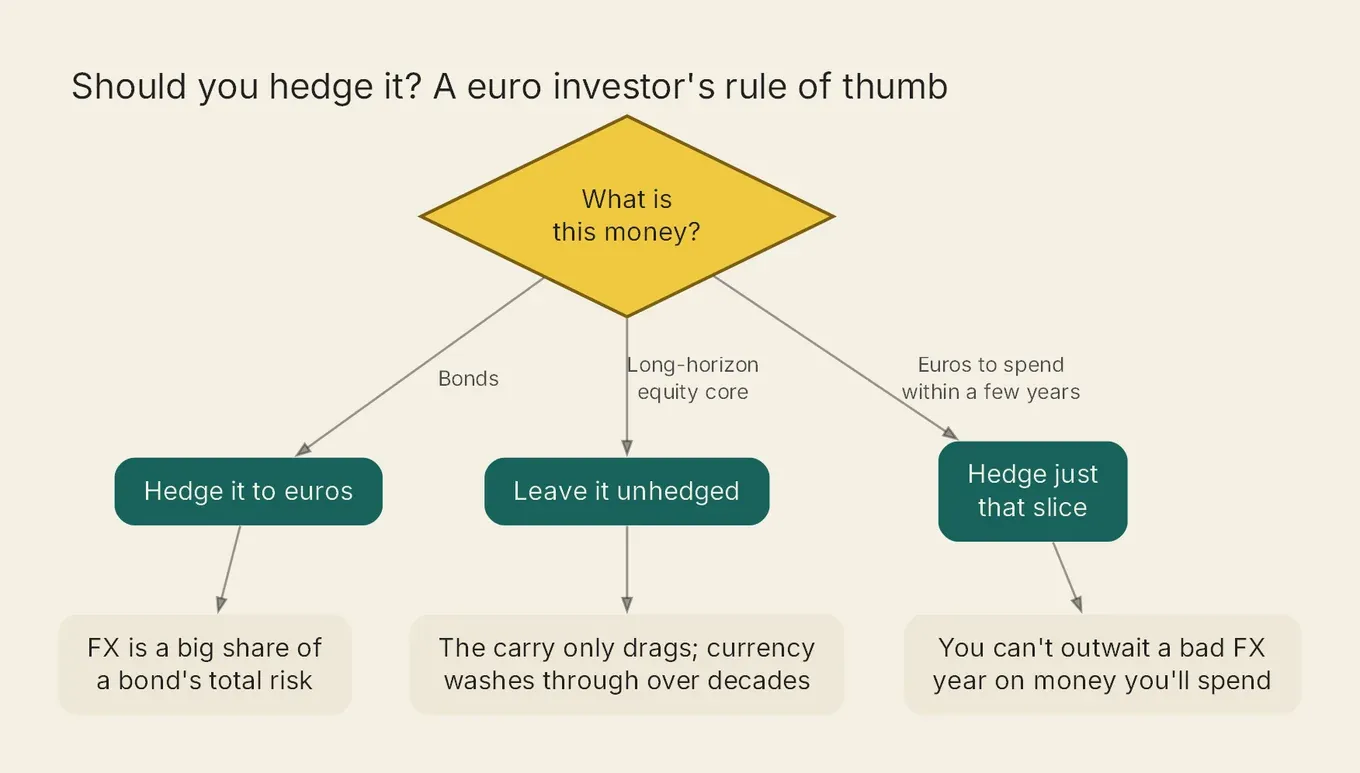
Hedge your foreign-currency bonds. Leave a long-horizon equity core unhedged.
Why does currency matter more to a bond?
A currency moves around by roughly 8% a year, in Vanguard’s long-run reckoning. Global equities swing about 20%. Bonds move far less than either. So for a bond, that currency wobble is a large slice of the total risk, and stripping it out visibly steadies the holding. For an equity fund already swinging 20%, that currency layer is a small share of the ride. Unhedged, foreign currency can even soften the odd bad year. That is why Vanguard hedges its own bond funds while leaving its equity funds alone. And a euro-denominated eurozone bond fund holds no foreign currency to hedge; only foreign-currency bonds raise the question.
Why is hedging everything the wrong instinct?
The temptation is to hedge the lot. Resist it on the equity side. Vanguard’s study found that hedging developed-market equities changed volatility (how much the fund’s value swings year to year) by anything from a 7.1-point reduction in one market to a 3.5-point increase in another. Hedging equities has sometimes raised the risk, not cut it.
On the same illustrative basis, its own worked example says a 1.9-point cut in volatility would justify paying up to 0.76% a year for the hedge. A euro investor’s currently paying about 1.4%. The maths doesn’t clear, and the benefit itself is not guaranteed. Some analysts reject a blanket rule entirely, which is fair; treat “hedge bonds, not equities” as a strong default, not a law.
Do you need a hedged UCITS ETF as a euro investor?
For a long-horizon global equity core, the honest answer is no. A hedged UCITS ETF (the standard EU fund wrapper) still owns mostly dollars underneath, and hedging it costs you about 1.4% a year for a benefit that may not show up. Leave it unhedged. If you already hold the hedged version, switching means selling, and selling can trigger tax that differs by country, so weigh that one-off bill against the carry.
Two things change that answer. The first is a near-term euro bill. If you’ll spend the money in euros within a few years, you can’t wait out a bad currency move before you sell, and hedging the relevant slice becomes defensible even for equities. The second is bonds, where the rule above already points you at a hedged share class: a EUR-hedged global aggregate bond fund runs around 0.10% a year in published fees.
About €30,000 of Bram’s savings already has a job: a house deposit due in roughly two years. The rest of his global tracker is decades away, and he nearly applied the same “leave equities unhedged” rule to both. The horizon splits them.
His long core stays unhedged, because over decades the currency washes through and the roughly 1.4% carry would only drag. But shares are the wrong home for money he’ll spend within a couple of years: a crash can lop a fifth or more off it, dwarfing any currency swing, and the hedge does nothing about that.
Currency is the smaller risk only if the money stays in shares. About 70% of that €30,000 rides on the dollar, near €21,000. An ordinary euro-dollar swing of around 8% could move what he gets back by about €1,700 either way, against a hedging cost of roughly €590 over the two years. Illustrative figures; values can fall as well as rise, and the outcome depends on rates and fund performance.
Most guides to currency hedging were written for someone else. A sterling investor asking whether to hedge dollars gets the opposite answer to you, because the Bank of England’s rate, 3.75% (opens in new tab), sits right alongside the Fed’s. Priya in Leeds pays essentially nothing to hedge her dollars. You pay about 1.4%. Same fund, completely different sum, purely because the ECB sits well below the Fed and the Bank of England doesn’t. When a guide tells you hedging is free, check which currency it was written in.
For most euro investors with a long horizon and a single global equity tracker, the answer is dull: leave it unhedged and stop staring at the button. Hedge your bonds, where the currency swing is a real share of the risk. The one time to think again is money you’ll spend in euros within a few years. Everything else here is a rate gap you can’t control, dressed up as a decision you can. Go and worry about something that pays you back.
Frequently asked questions
What's the difference between a currency-hedged and an unhedged ETF?
What does currency hedging protect against, and what does it not protect?
How much does currency hedging cost inside an ETF?
Should you currency-hedge bond ETFs but leave equity ETFs unhedged?
Do you need a hedged UCITS ETF as a euro investor?
Sources (8)
- European Central Bank: monetary policy decisions (deposit rate 2.25%)
- US Federal Reserve: FOMC statement (target range 3.50% to 3.75%)
- Bank of England: monetary policy summary (Bank Rate 3.75%)
- MSCI: hedged indexes methodology
- UBS Asset Management: understanding currency hedging
- Vanguard: FX hedging whitepaper (eurozone investor foreign-currency exposure)
- justETF: Xtrackers MSCI World fund profile (TER comparison)
- ESMA: new investment funds drive reduction of costs for investors
— That's the lot. It is now night.
Want more of this in your Google results?
Add Money Owl as a preferred source, and Google will show our finance pieces higher when you search for them.
By Jure Jaklič
Founder and editor of Money Owl. Data analyst by trade; personal finance learned first-hand across six European countries.
Recommended

Dividend investing in Europe: is it really passive income?
Pooled across 2018, 2019, 2021 and 2022, 70.6% of European once-a-year dividend payments arrived in April, May and June. What that does to a monthly budget, and what living off it really costs.

The three-fund portfolio for European investors
Europe's three-fund portfolio has its own shape. A single all-world UCITS fund owns the whole world, so most first-timers need two funds, not three.
Warren Buffett's principles, translated for Europe
For 60 years Buffett beat the market, then told everyone else to index. His principles, translated for Europe: UCITS ETFs, the 90/10 rule and tax wrappers.