

The point.
- Systems beat goals because they remove the daily decision: a standing order that fires on payday moves the money before you can spend it, no willpower required.
- One of the highest-leverage moves is an if-then plan, one sentence naming the cue and the action (Peter Gollwitzer and Paschal Sheeran's pooled 94 tests found an effect of d = .65).
- Picturing the win alone can backfire. Pair it with the specific obstacle that will turn up (mental contrasting, packaged as WOOP) instead of daydreaming the outcome only.
- An identity, "I'm someone who pays myself first", survives a missed month; a goal built on willpower alone does not, because a bad week is exactly when willpower runs lowest.
- Automatic habits take longer to form than the 21-day myth claims (a median of about 66 days), and what breaks them is inconsistency, not the odd missed transfer.
The point.
- Systems beat goals because they remove the daily decision: a standing order that fires on payday moves the money before you can spend it, no willpower required.
- One of the highest-leverage moves is an if-then plan, one sentence naming the cue and the action (Peter Gollwitzer and Paschal Sheeran's pooled 94 tests found an effect of d = .65).
- Picturing the win alone can backfire. Pair it with the specific obstacle that will turn up (mental contrasting, packaged as WOOP) instead of daydreaming the outcome only.
- An identity, "I'm someone who pays myself first", survives a missed month; a goal built on willpower alone does not, because a bad week is exactly when willpower runs lowest.
- Automatic habits take longer to form than the 21-day myth claims (a median of about 66 days), and what breaks them is inconsistency, not the odd missed transfer.
Every January, the same small ceremony happens across Europe. Someone buys a notebook, a nice one, hard cover, because this year is going to be different. They write a number on the first page: the amount they’ll save. By February the notebook has slid under a pile of post, and the number is doing precisely nothing, because a number on a page has never moved a single euro on its own.
The psychology of financial goal setting is the study of why that gap opens between the number you wrote and the money that never turned up, and what closes it. Collectively, euro-area households put aside about 14.3% of their income in early 2026, going by Eurostat’s figures (opens in new tab), though that’s a whole-sector average, not a target anyone hands you. Averages don’t help much at 11pm, when the goal is yours and it’s slipping. The short version, and the bit the self-help shelf skips: the fault sat in the setup, not in you. Nobody had built the thing that moves the money while you’re looking the other way.
Why do most financial goals fail?
Most financial goals fail by design, not for lack of grit. They fix on an outcome (“save €10,000”) but name no cued action, so willpower carries the whole load. Present bias then erodes that willpower the moment a nearer, cheaper reward shows up.
That pull has a formal cause. Behavioural economists Ted O’Donoghue and Matthew Rabin set out the formal case in 1999 (opens in new tab) that people over-weight the reward in front of them and discount the one further off. A house deposit four years away loses, every time, to a thing you can have tonight. Call it weakness if you like; the economists call it arithmetic your brain runs without asking permission.
And you have plenty of company. The OECD’s 2023 survey of adult financial literacy (opens in new tab) covered 39 countries and economies. It found that fewer than half of adults disagreed with “I tend to live for today and let tomorrow take care of itself” (44% disagreed, to be exact, and only 43% disagreed that spending beats saving for the long term). If your goals keep slipping, you sit closer to the European norm than to some private failing. The advice was the problem, not you.
What’s the difference between identity-based and outcome-based financial goals?
An outcome goal names a finish line: “save €10,000.” An identity goal names a person: “I’m someone who pays myself first.” Same saver, two different engines.
| Aspect | Outcome-based goal | Identity-based goal |
|---|---|---|
| What you say | ”Save €10,000." | "I’m someone who pays myself first.” |
| What you fix on | A finish line: the number | A person: who you’re becoming |
| The engine underneath | Goal-setting theory aims your effort at a target, but names no cued action, so willpower carries the whole load | When saving feels like you, the hard days read as important rather than impossible, and each transfer is a bit more proof you’re a saver |
| On a bad week | Nothing catches the slip; willpower is the only engine, and a bad week is exactly when it runs lowest | The identity survives the miss; one slip doesn’t undo it. |
| Worked example | ”Save €10,000 by December,” then hope willpower turns up | ”I pay myself first,” proven by a €200 standing order that fires every payday |
The popular version comes from James Clear’s Atomic Habits, and you have almost certainly read it. That’s because the same paragraph about becoming a certain kind of person has been copy-pasted, word for word, across what looks like every financial-adviser blog going. Search “identity based financial goals” and you’ll mostly hit the same syndicated article wearing different logos. That is the goal-setting content industry in a nutshell: one borrowed idea, sold back to you a dozen times.
The real mechanism underneath is better than the slogan. Daphna Oyserman’s identity-based motivation research (opens in new tab) shows that the same hard day reads differently depending on whether the action feels like you. Daryl Bem’s older self-perception work (opens in new tab) supplies the other half: you work out who you are by watching what you do. Move €50 to savings often enough and, the theory goes, you start to read yourself as a saver, which can make the next €50 lighter. The identity isn’t a mantra you chant at the mirror. You earn it, one transfer at a time. And one missed month doesn’t revoke it; a saver who slips is still a saver, just one who slipped.
Oyserman puts the flip in her own words (opens in new tab):
“When action feels identity-congruent, experienced difficulty highlights that the behavior is important and meaningful. When action feels identity-incongruent, the same difficulty suggests that the behavior is pointless and ‘not for people like me.’”
It is that last phrase, “not for people like me,” that does the damage, because it turns one skipped transfer into a verdict on the whole project.
Why aren’t SMART goals always smart?
SMART goals get taught as if they were the science of the thing. They aren’t. The acronym comes from a 1981 management article about writing company objectives, and it makes a fine checklist for drafting a goal clearly. Specific, measurable, time-bound: fine, fine, fine. None of it tells you what you’ll do when the cue arrives, or whether the behaviour will ever run on its own. A SMART goal is a well-worded intention. The graveyard is full of well-worded intentions.
Why do systems beat goals?
A system beats a goal because it removes the daily decision. In money terms it stays dull and concrete: a standing order (an automatic recurring bank transfer you set up once) that fires on payday, before you can spend the money, moving a set amount to a named pot. Better still, point it somewhere with a bit of friction: a separate account with no card attached, or a notice account that makes you wait a few days to get the money back. Then automation locks the money in, not just shuffles it across. Think of the goal as the destination and the system as the car. You need both; a destination with no car is just a place you keep meaning to drive to.
Should you focus on systems instead of setting goals?
Use both. They do different jobs: a goal aims you at a target, a system carries you there without a daily decision. That’s why the fashionable “forget goals and focus on systems” line overshoots the evidence. Edwin Locke and Gary Latham proved over decades (opens in new tab) that specific, hard goals beat a vague “do your best.”
How long does it take a money habit to stick?
Longer than the folklore claims: Phillippa Lally’s team at UCL found (opens in new tab) a median of about 66 days for a repeated behaviour to turn automatic. The finding came with a wide range from a few weeks to the better part of a year. There is no fixed 21-day rule.
Lally is also blunt about what actually breaks a forming habit, and it is not the odd miss.
“In our study we showed that missing one opportunity did not significantly impact the habit formation process, but people who were very inconsistent in performing the behaviour did not succeed in making habits.”
So skipping one payday transfer costs you nothing; skipping most of them costs you the habit. That is exactly why an automatic standing order beats a hand-done one: it takes the inconsistency out before it can start.
Repeat the cued action long enough and it stops needing a decision. It runs, on the day, like the direct debit for your phone. A behaviour that runs on its own is the one behaviour present bias can’t reach, because you’ve left it no in-the-moment choice to hijack.
When does picturing success help, and when does it backfire?
Now the part most articles get backwards. The standard advice says picture yourself succeeding: the paid-off card, the keys to the flat. It sounds sensible, and a solid line of research, chiefly from Gabriele Oettingen’s lab, says it’s half-wrong.
Why can picturing success backfire?
Because a happy daydream spends the reward before you earn it: Gabriele Oettingen found (opens in new tab) that dwelling only on the outcome quietly drains the effort you need to get there, so your brain eases off.
The fix is a technique called mental contrasting: picture the win, then picture the specific obstacle that will turn up (the Friday you’ll want to order in, the sale email at 9pm), and hold both. Packaged up it’s called WOOP, for Wish, Outcome, Obstacle, Plan. The pooled research (opens in new tab) puts its effect at g = 0.336 across 21 studies and nearly 16,000 people, which is real but modest. Nobody’s promising magic. It beats the daydream, that’s all.
What’s the one move that does the most?
Turn the goal into an if-then plan: a single sentence naming the cue and the action, like moving €150 to the house pot the moment payday lands. Peter Gollwitzer and Paschal Sheeran pooled 94 separate tests (opens in new tab) of this in 2006 and measured an effect of d = .65. That sits in medium-to-large territory. But that pooled figure leans on a lot of tidy lab tasks, and for the hard, tempting stuff like money it tends to come in smaller. Useful, then. Not a rescue.
The full sentence looks like this: “If it’s payday, then I move €150 to the house pot before anything else.” It works because you decided in advance; when the cue lands, there’s no deliberation left to lose. Two cheap add-ons help the sentence stick. Start it on a date that already feels like a line in the sand, the 1st of the month or a birthday; the “fresh start” pull is a real, if small, nudge. And bundle the dull admin with a treat you only allow yourself then. Katherine Milkman ran a field experiment (opens in new tab) in 2014 where pairing a guilty-pleasure audiobook with gym visits initially lifted attendance by 51%. Later attempts to repeat it landed a good deal smaller, so treat the trick as a nice-to-have, not the engine. Do the monthly money check with the good coffee if you like. The standing order is the part that matters.
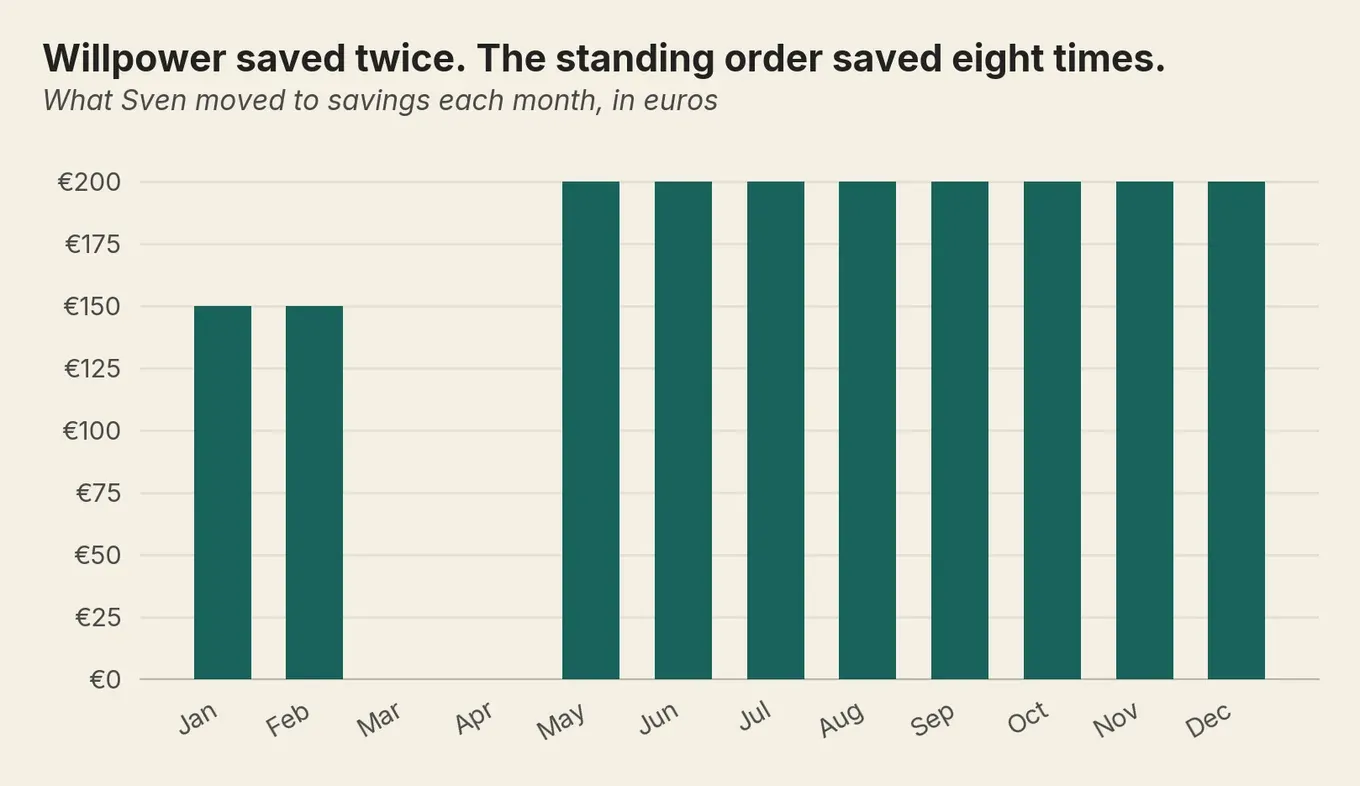
Sven, 34, works IT support in Hamburg. Last New Year he wrote down a target: save €6,000 by December. No plan for how it would happen, just the number and good intentions. He moved money “whenever there was some left over”: twice, in January and February, €150 each time. By March there was nothing left over most months, and he’d stopped checking the account.
The breaking point landed on a Friday payday in April. A 9pm email arrived: 20% off soundbars, ends tonight. He bought one. It was the exact evening he’d meant to move that month’s savings, and the sale email won.
He didn’t try to want it more. He rebuilt the goal instead. First the identity line: “I’m someone who pays myself first, not whoever’s left after the sale emails.” Then the if-then plan, written as one sentence: “If it’s the 25th, I move €200 to the house pot before anything else.” That same week he made the sentence keep itself: a standing order with his bank, dated to fire on the 25th, so the money moved before his card could get anywhere near it. Then the obstacle, named in advance rather than hoped away: that exact payday sale email. The transfer already moved the money in, so his plan was about not pulling it back out. Close the tab, no raiding the house pot to fund a soundbar.
One detail worked in Sven’s favour: he had no expensive card or overdraft balance in the background. If you’re carrying that kind of balance, clear it before you automate a euro into savings, because the interest outruns anything a savings account will pay.
Eight months later, in December, the transfer had gone out every single payday without a fresh decision: eight lots of €200, on top of the earlier €300, for €1,900 saved. Short of the original €6,000 target, and he knows it. But it’s more than six times what four months of “whenever there’s some left over” had managed, and it worked every single payday, not just two out of four. He’s raising it to €250 once a small pay rise lands in the spring. “I stopped waiting to feel like saving,” he says. “The transfer doesn’t ask how I feel about it.”
The boring bit is the bit
Notice what’s missing from all of that: motivation. Nobody in the research is telling you to want it more. The whole machine runs on the opposite bet: you’ll have good days and bad days and the odd genuinely terrible week. So the way to shield a goal from your worst Tuesday is to lift your worst Tuesday out of the decision entirely. Write the sentence once. Set the transfer once. Then let a dull, faintly tedious system run on its own while your willpower wanders off to fret about something else. The boring bit isn’t the price of the result. It’s the result.
Where does this trip people up?
Three ways this quietly falls apart. The first is the fresh-start trap in reverse: the same “I’ll start on the 1st” that gets you going can curdle into “I’ll start next month,” forever. A landmark is permission to begin, not a licence to wait. The second is reading a slip as a verdict. Miss one transfer and the tempting story becomes “see, I’m not a saver after all,” when really you just had an off month. And then there’s the number 66. That figure is a median, and the spread around it is enormous. If your money habit isn’t automatic by day 66, you aren’t broken, you’re on the long tail of a wide curve.
What should you do this week?
One thing. Not ten. Write a single if-then sentence and set the transfer to match it, this week, while it’s still in your head. The sentence: “When my salary lands, I move €[your number] to [the named pot] before I spend anything.” Notice the verb: move. That framing pulls its weight: a large Swedish study of New Year resolutions (opens in new tab) found people who set out to start something stuck with it more often than people trying to quit something. So name a real number you won’t miss (Ana in Porto starting at €40 a week beats Ana meaning to save €400 a month and doing nothing), and let the standing order do the remembering.
Before you settle on that number, a few quick safety checks. No cushion at all? Build a small buffer first, roughly a month of essential spending. Carrying an expensive card balance, the kind that costs you more in a year than any savings account will pay? Point the money there before you automate a cent into savings, because clearing expensive debt beats saving alongside it.
Then size the transfer below what you know clears your essentials, so it is unlikely to tip you into an overdraft. If your income swings month to month, keep it small or move it by hand. If the honest maths says there’s nothing to move right now, that’s your income talking, not your character, and no plan can invent a surplus that isn’t there.
The notebook was never the problem, and neither were you. Buy the nice one if you like, write the number on the first page. Then close it, set the transfer, and let a boring little system get on with the job you kept trying to do by hand. Come back in a year. The number will have moved without you.
Frequently asked questions
Why do identity-based financial goals work better than outcome-based ones?
How do you set a financial goal you'll actually stick to?
How can visualising success help you reach a financial goal?
What's a simple way to map out a financial goal so it doesn't stay just a wish?
Does it matter when you start, like the 1st of the month or a new year?
Sources (11)
- Eurostat: Household saving rate, euro area Q1 2026
- American Economic Review: Doing It Now or Later (O'Donoghue & Rabin, 1999)
- OECD/INFE: 2023 International Survey of Adult Financial Literacy
- USC Dornsife: Identity-Based Motivation (Daphna Oyserman)
- Bem 1972, Advances in Experimental Social Psychology 6: Self-Perception Theory
- ERIC: Goal Setting and Task Motivation (Locke & Latham, 2002)
- UCL: How long does it take to form a habit? (Lally et al., 2009)
- Frontiers in Psychology: Mental Contrasting Meta-Analysis (Wang, Wang & Gai, 2021)
- KOPS Konstanz: Implementation Intentions Meta-Analysis (Gollwitzer & Sheeran, 2006)
- PubMed: Temptation Bundling Field Experiment (Milkman et al., 2014)
- PMC: New Year's Resolutions Study (Oscarsson et al., 2020)
— That's the lot. It is now night.
Want more of this in your Google results?
Add Money Owl as a preferred source, and Google will show our finance pieces higher when you search for them.
By Jure Jaklič
Founder and editor of Money Owl. Data analyst by trade; personal finance learned first-hand across six European countries.
Recommended

How to teach your brain to delay gratification
Delayed gratification is a skill, not a flaw you were born with. Four small levers turn it into a saving habit instead of a daily willpower fight.

How to get back on track after overspending, without starting over
The bad month cost you one month. The nine you didn't go back cost nine times more. Restart at a figure that survives December, and keep the balance.

Why you can't save money (it was never willpower)
You keep failing the willpower test because it was never a willpower test. Change the set-up, automate one transfer, and saving happens without you.