

The point.
- The hedonic treadmill is why your last pay rise barely registers six months on. It is standard human wiring, not a character flaw.
- A raise fades because the bigger number becomes your baseline and your sense of "enough" climbs to match it. A German study that tracked 7,812 people found the happiness bump from more money fades substantially within about four years.
- Left alone, most of a raise dissolves into a higher baseline you soon stop noticing.
- You get used to possessions and status symbols fast, but to daily miseries like a long commute much more slowly. Aim a rising income at time, varied experiences, and buying out the things you dread.
- Appreciation and variety work together to slow adaptation. Gratitude on its own only handles half of it.
The point.
- The hedonic treadmill is why your last pay rise barely registers six months on. It is standard human wiring, not a character flaw.
- A raise fades because the bigger number becomes your baseline and your sense of "enough" climbs to match it. A German study that tracked 7,812 people found the happiness bump from more money fades substantially within about four years.
- Left alone, most of a raise dissolves into a higher baseline you soon stop noticing.
- You get used to possessions and status symbols fast, but to daily miseries like a long commute much more slowly. Aim a rising income at time, varied experiences, and buying out the things you dread.
- Appreciation and variety work together to slow adaptation. Gratitude on its own only handles half of it.
You got the pay rise. For a few weeks it felt like something: a bit more room, a bit less flinching at the card machine. Then it quietly stopped feeling like anything, and if you’re honest, some small part of you is now wondering whether you’re ungrateful, or greedy, or a little bit broken.
You’re none of those things. What happened to you is so ordinary it has a name.
The hedonic treadmill is the habit your mind has of treating a good thing as normal once it sticks around. A pay rise lifts you, then the lift fades, because the bigger number becomes your baseline and your sense of “enough” climbs up to meet it. It’s standard-issue human wiring, and it happens to nearly everyone.
The useful part is that once you can see the thing working, you can do a few specific things about it, mostly with the money the raise would otherwise eat.
What is the hedonic treadmill?
The hedonic treadmill is the tendency for your mood to drift back towards a personal baseline after something good or bad happens, because you get used to whatever stays the same for long enough. Psychologists call the getting-used-to-it part hedonic adaptation. You can call it getting used to things, which is what it is.
The idea comes from one famous study. Back in 1978 (opens in new tab), three researchers compared 22 people who had won big on the lottery, 22 people who had not, and 29 people who had recently been paralysed in accidents. You’d expect a chasm between the winners and the non-winners. There wasn’t much of one. On the whole, the lottery winners weren’t any happier than the non-winners, and they got noticeably less pleasure out of ordinary things: a coffee, a chat, the telly. The windfall had moved in, become the new normal, and stopped paying out.
How much of that baseline is fixed? Partly, but only partly. A review of ten twin studies (opens in new tab) covering nearly 56,000 people put the genetic share of well-being at about 36%, roughly a third. Across those studies the estimates ranged all the way from 0% to 64%, which tells you how loose the wiring is. So your happiness set-point, the level your mood keeps returning to, is a tendency, not a sentence. It differs from person to person, and it can move.
That last part isn’t wishful thinking. The researchers who formally revised the theory, in a paper actually titled “Beyond the hedonic treadmill”, found that “well-being set points can change under some conditions” (Diener, Lucas and Scollon, American Psychologist, 2006 (opens in new tab)).
Why doesn’t a pay rise make you happier?
Because the raise does the one thing guaranteed to switch off its own magic: it stays. A treat only lifts you while it’s unusual, and a bigger salary stops being unusual the moment it becomes every month’s salary. After that it’s simply what your account shows, and the shine is gone.
Why does the raise stop feeling like a raise?
Because a raise arrives as an event, and within a year or two it’s just your salary. The nicer flat becomes the flat. The upgraded car becomes the car. A German study that tracked 7,812 people (opens in new tab) over sixteen years found that the happiness bump from more money fades substantially within about four years. Not down to nothing, but a long way back towards where you started.
Here’s the shape of it, with round, illustrative numbers. Say a mid-career professional somewhere in the euro area gets a net raise of about €400 a month, roughly €4,800 a year. Euro-area households, on average, saved about 14.4% of their income in late 2025 (opens in new tab) and spent the rest. Treat the raise the same way, and about €690 a year goes into savings while roughly €4,110 melts into daily life: better restaurants, a newer phone, the occasional upgrade. That €4,110 is exactly the part the treadmill eats. Within a few years it’s invisible, folded into “normal”, and the good feeling it bought has drained back out.
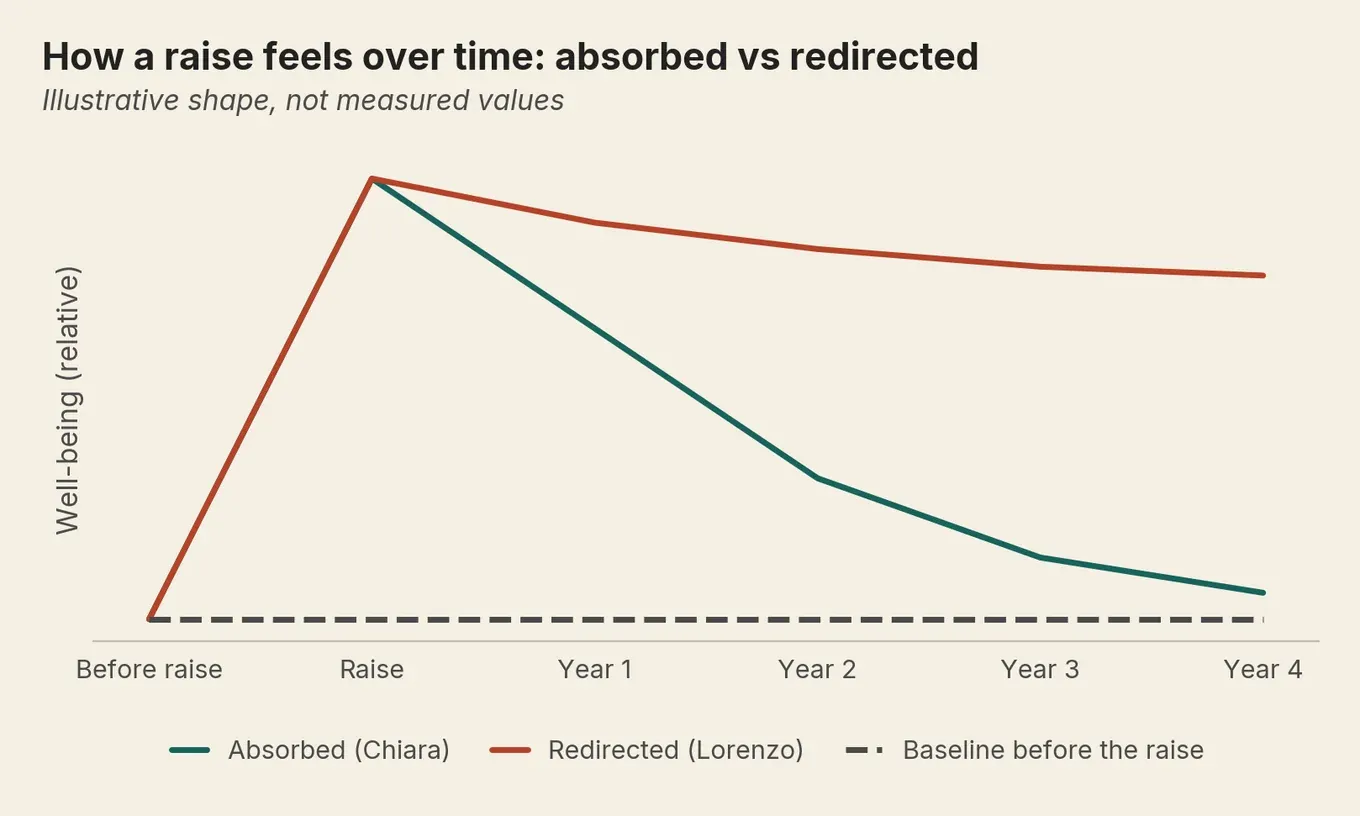
Picture the happiness line if you drew it: a tick up at the raise, then a slow slide back down towards where it began. The money stays higher. The feeling does not.
What moves your yardstick?
A raise shifts the standard you judge yourself against: your own past income, and the people around you.
Part of that is your own history. Once you’ve earned the bigger number for a while, it becomes the figure you measure “getting by” against, so it stops registering as a win. Part of it is the people around you. A raise often nudges you into a slightly richer crowd, with a slightly nicer everything, and you start measuring yourself against them instead of against your old self. The gap you feel is the same size it always was. You’ve moved it upmarket, that’s all. It’s a strange machine to be stuck in. You can be plainly richer than you were three years ago and still feel exactly as squeezed, because the people you now stand next to are richer still.
So does money buy happiness or not?
Up to a point, yes: income still lifts well-being, only less than the headlines promise once you get used to the money. This is where the famous figures get misquoted, so it’s worth slowing down.
In US research, Daniel Kahneman and Angus Deaton found in 2010 (opens in new tab) that day-to-day mood stopped improving past about 75,000 line got everywhere, boiled down to “money stops mattering past a point”. Then in 2021, Matthew Killingsworth (opens in new tab) found no such ceiling, and a joint 2023 study (opens in new tab) settled it: for most people well-being keeps rising with income, with flattening only in those already unhappy. These are dollar figures about American lives, so don’t turn them into euros. The tidy “magic number” story is out of date.
Closer to home, Eurostat’s figures (opens in new tab) tell a plainer version. In 2024, the average person in the EU rated their life 7.2 out of 10. That score rises with income right across the range: from about 6.6 in the lowest income group to about 7.8 in the highest. Slovenia, as it happens, sits near the top at 7.7. So being richer does track higher life satisfaction. The catch is the gap between being richer and getting richer: a higher income is a lasting step up, but the lift from the raise that got you there fades as it becomes your normal. The treadmill is simply why your own raise stops feeling like much once it’s become your normal.
Why do we get used to nice things?
What makes us get used to things so fast?
Getting used to something needs that something to stay the same. A thing that sits there unchanged, a sofa, a car, a salary, stops grabbing your attention, and attention is where the good feeling lives.
It’s a slightly strange thing when you stop to look at it. The sofa that thrilled you in March is, by August, just the sofa you leave your washing on. Nothing about the sofa changed. You did. Your mind filed it under “normal” and moved its attention to the next thing, because filing things under normal is most of what a mind is for. None of that is greed or ingratitude. It’s the same reflex that stops you noticing your own front door.
Does the treadmill work both ways?
Not evenly, no: you get used to good things fast, but to a few specific miseries much more slowly. That’s the part the tidy version leaves out.
You adapt fast to steady, expected upgrades, the material stuff that sits there being nice. You adapt much more slowly to a handful of specific miseries: a long grim commute, a noisy home, ongoing pain, a relationship that’s quietly wrong. People with long commutes (opens in new tab), for instance, report lower well-being they barely adjust to; the drive stays awful every single morning, for years. So the treadmill isn’t a neat loop where everything returns to zero. It runs hardest under the nice things you buy and far more weakly under the daily irritations you put up with.
There’s a quiet upside buried in that. Because some things barely fade, and because a set-point can shift over the years, the baseline you keep returning to isn’t fixed for life. You can’t gratitude your way to a permanently higher one, but you can keep more of each good thing for longer, which is most of the battle. That lopsidedness, the bad and the good of it, is the whole secret to spending well, which is the next question.
How do you get off the hedonic treadmill?
You don’t get off it entirely, and that’s fine. The goal is to slow it down, not to win.
Why isn’t a gratitude journal enough?
Because a gain fades along two tracks at once, and gratitude only slows one of them. The good feeling the thing first gave you dies down, and separately, your wants creep upward. Research on staying happier (opens in new tab) points to two habits that slow both tracks, and you need them working together.
The first is appreciation: noticing the good thing on purpose, instead of letting it turn into furniture. In practice that means catching yourself using it, and keeping in mind that it wasn’t always there and won’t always be. This is the part every wellness article has already sold you, gratitude journal and all, then stops. On its own it handles only one track, the creeping wants, which is presumably why the journal-sellers never reach the second habit.
The second is variety: keeping things a bit fresh and surprising, and spacing your treats out rather than having everything all the time. Novelty is what keeps the good feeling coming in the first place. A weekly takeaway you always have is dull by the third month; the same money on something different each time keeps working. Gratitude without variety is half a plan.
Where should a rising income go?
Towards the things that barely fade: shared time, varied experiences, more control over your week, and buying out the daily miseries. This is where the fast-and-slow split earns its keep. If some things fade fast and others barely fade, the move is obvious: steer more of a rising income towards the things that keep paying.
| Fades fast (the treadmill eats it) | Keeps paying (the treadmill barely touches it) |
|---|---|
| A bigger flat or a newer car | Time with the people you like |
| A status upgrade nobody asked for | Varied experiences, spaced out over the year |
| A raise folded into the standing bills | Buying back time: a shorter commute, fewer chores |
| Anything that sits still and solitary | Getting rid of a daily misery: the noise, the grim drive |
Nobody’s asking you to earn less or feel guilty for wanting more. The move is to flip the default. Left alone, most of a raise dissolves into a higher baseline you soon stop noticing. Aimed on purpose, the same money buys shared time, varied experiences, a bit more control over your week, and the removal of the things that wear you down every day. Some of those moves cost money or take arranging: a shorter commute can mean pricier rent, or a move you can’t make yet.
So start with the version you can actually reach, a smaller misery to remove, a cheaper experience to space out. Time and control resist the treadmill better than objects do. There’s always a fresh way to spend a free hour. A bigger telly is only ever the same bigger telly.
You don’t need to wait for the next raise, either. Once your buffer’s in place and any expensive debt is cleared, the same swap works on money you already spend: a standing cost you’ve stopped noticing, traded this month for something that keeps paying.
Picture two colleagues at the same Bologna firm, Chiara and Lorenzo, who land the same raise in the same month: about €400 more a month, roughly €4,800 a year. The figures are illustrative, but the split that follows is the ordinary one.
Chiara lets it land where raises usually land. A slightly nicer flat, the car upgraded, a few more good dinners out. Three years on she is plainly better off on paper and feels exactly as squeezed as she did before, because the nicer flat is just the flat now and the good dinners are just Tuesday. Most of the raise has folded into her baseline and gone invisible, which is the treadmill doing precisely what it does.
Lorenzo aims the same money on purpose. He buys down the part of his week he dreads, swapping the long drive for a shorter commute, spaces the rest across a few different things through the year rather than one standing upgrade, and lifts what he sets aside. Three years on, the shorter mornings still land every single day, the year still holds a handful of things he looks forward to, and the savings have been compounding in the background. Same raise, same month. Only one of them can still feel it.
The dull foundations come first, of course. A buffer you can reach, and any expensive debt cleared, before a raise is truly yours to aim anywhere. After that, a decent chunk of it belongs in your savings rate, compounding while you get on with your life. Spending the rest on happiness, and keeping lifestyle creep from swallowing it, are their own questions with answers elsewhere. So is what to do with a raise in the first place.
None of this means the raise was wasted, or that you’re ungrateful. Getting used to good things is what minds do. Lottery winners did it. You do it. It’s one of the most ordinary things about you. The trick isn’t to want less; it’s to spend the next raise on the handful of things your mind can’t file under normal, and to look up, now and then, at the ones you already have.
Frequently asked questions
What is the hedonic treadmill?
Why doesn't a pay rise make you happier?
Can you get off the hedonic treadmill?
Is the hedonic treadmill the same as lifestyle inflation?
Sources (11)
- Brickman, Coates & Janoff-Bulman (1978), Lottery Winners and Accident Victims, Journal of Personality and Social Psychology (via PubMed)
- Bartels (2015), Genetics of Wellbeing and Its Components, Behavior Genetics (via PubMed Central)
- Diener, Lucas & Scollon (2006), Beyond the Hedonic Treadmill, American Psychologist (via PubMed)
- Di Tella, Haisken-De New & MacCulloch (2010), Happiness Adaptation to Income and to Status, Journal of Economic Behavior & Organization (NBER Working Paper 13159)
- Eurostat, Household saving rate in the euro area (Euro indicators)
- Kahneman & Deaton (2010), High Income Improves Evaluation of Life but Not Emotional Well-being, PNAS (via PubMed)
- Killingsworth (2021), Experienced Well-being Rises with Income, PNAS (via PubMed)
- Killingsworth, Kahneman & Mellers (2023), Income and Emotional Well-being: A Conflict Resolved, PNAS (via PubMed)
- Eurostat, Quality of Life Indicators: Overall Experience of Life (EU-SILC)
- Stutzer & Frey (2008), Stress that Doesn't Pay: The Commuting Paradox, Scandinavian Journal of Economics (via Wiley)
- Sheldon & Lyubomirsky (2012), The Challenge of Staying Happier: Testing the Hedonic Adaptation Prevention Model, Personality and Social Psychology Bulletin (via SAGE)
— That's the lot. It is now night.
Want more of this in your Google results?
Add Money Owl as a preferred source, and Google will show our finance pieces higher when you search for them.
By Jure Jaklič
Founder and editor of Money Owl. Data analyst by trade; personal finance learned first-hand across six European countries.
Recommended

How to teach your brain to delay gratification
Delayed gratification is a skill, not a flaw you were born with. Four small levers turn it into a saving habit instead of a daily willpower fight.
How your upbringing and 'money scripts' shape your financial habits
Money scripts are the childhood beliefs that drive how you save and spend. Meet the four types, find yours with a short self-check, and rewrite them.
Mental accounting: why a euro from a refund spends differently
A euro is a euro, but your brain files it into pots and spends each by a different rulebook. Spot the pots quietly costing you, keep the ones that save you.