

The point.
- The 60/40 portfolio is not dead. In 2022 both halves fell together for the first time since 1977, then it recovered across 2023 and 2024. These refer to the past, and past performance is not a reliable indicator of future results.
- The 2022 damage came mostly from bond duration, not from owning bonds at all. Long-maturity euro government bonds fell far harder than short-duration ones in the same year; values can fall as well as rise.
- The 60/40 is a decision, not a product. Decide the split first (how long the money is invested and how far you can watch it fall), then choose the funds.
- Set the split by horizon and nerve: a longer horizon and steadier income argue for more shares; being near or in retirement argues for fewer.
- Build it with two euro UCITS ETFs, one global shares fund and one euro or euro-hedged bond fund, rebalanced once or twice a year. These are investment funds, not deposits, and sit outside any deposit-guarantee scheme.
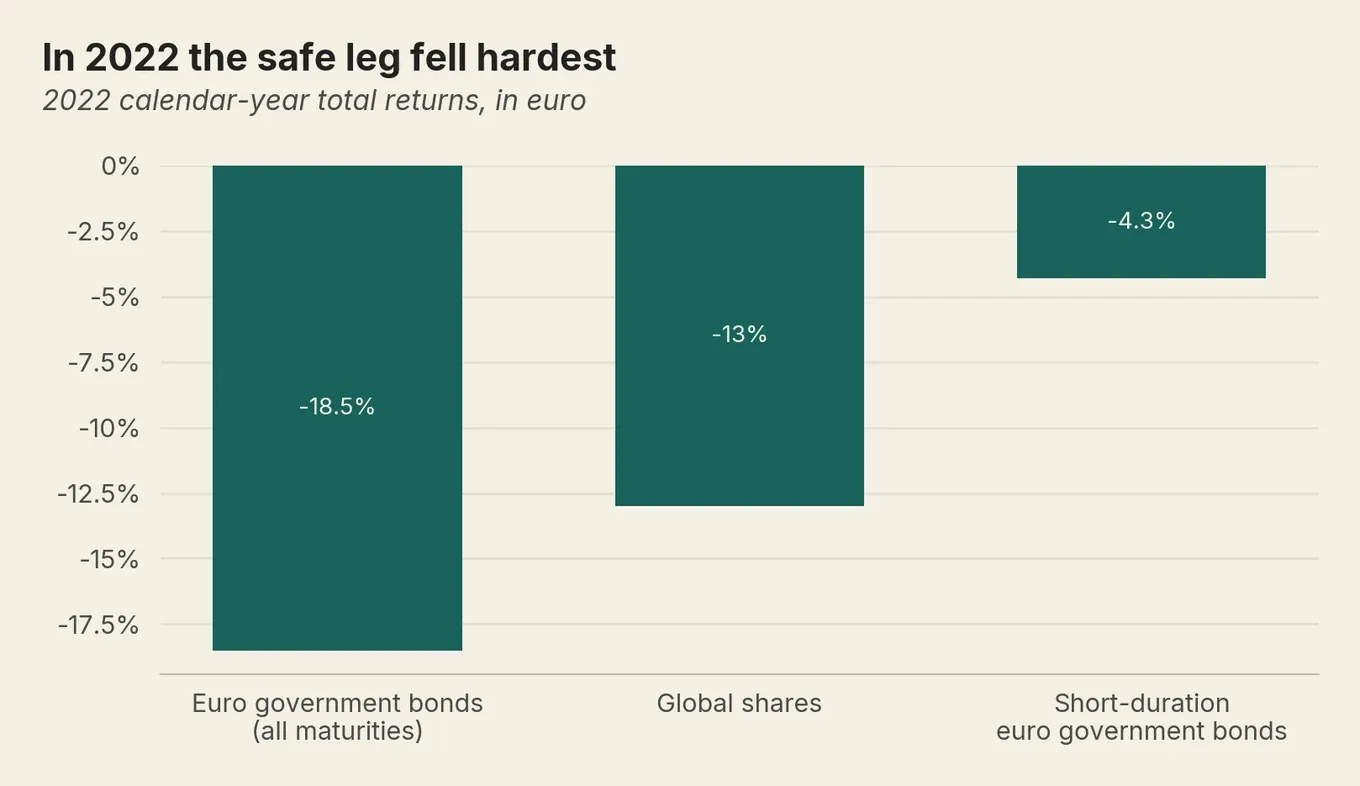
In 2022, the safe half of a balanced European portfolio fell harder than the risky half. Euro government bonds, in theory the calm half, dropped about 18.5% in euro terms. Global shares, the part everyone frets about, dropped about 13%. If that feels backwards, it is. It’s also why a lot of sensible people started asking whether the 60/40 portfolio was finished.
Fair question. It came with an unfair answer, shouted in headlines, and the answer was wrong. The calmer version, then.
What is a 60/40 portfolio, and does it still work in 2026?
A 60/40 portfolio holds 60% in shares and 40% in bonds, rebalanced back to those weights. Does it still work in 2026? Yes, with an asterisk. It broke in 2022 when both halves fell together, recovered across 2023 and 2024, and now needs a deliberate split decision, not autopilot.
Rebalancing is the engine. Every so often you sell a little of what’s grown and top up what’s lagged, back to 60 and 40. The shares do the growing. The bonds are meant to be the ballast. That’s the entire idea. It’s been Europe’s default balanced portfolio for decades.
Over the long run the 60/40 has paid a European investor around 3% a year after inflation since 1900, against about 4% for a globally diversified version, according to CFA Institute research (opens in new tab). Those are past returns, and past performance is not a reliable indicator of what comes next. The asterisk is this: the 60/40 is a decision, not a product. Deciding the split is one choice; the funds you build it with are a separate, later one. Muddling the two is where most of the confusion starts.
Why did the 60/40 portfolio struggle in 2022?
Normally, shares and bonds don’t fall together. When shares drop in a recession, central banks tend to cut interest rates, which pushes bond prices up, so the bonds cushion the fall. That’s why you hold them; in the 2007 to 2008 crash global shares fell around 54% while global bonds rose more than 6%, according to Vanguard (opens in new tab).
2022 was different. The usual recession never came; the shock was inflation. So central banks raised rates hard, and rising rates push bond prices down while they squeeze shares. Both legs fell together, the first calendar year that had happened since 1977. The Bank for International Settlements (opens in new tab) names the mechanism: when inflation is what markets fear, shares and bonds move together instead of opposite, and the bond hedge stops hedging.
For a euro investor there was a sharper, local twist. The European Central Bank’s key rate had sat at minus 0.5% until July 2022, when it lifted rates for the first time in over a decade. From there it climbed to 4% by September 2023 (the full path is on the ECB’s own rates page (opens in new tab)). Euro bonds had been priced off those near-zero yields, and they carried a lot of duration.
Duration is a bond’s sensitivity to rate moves: the longer the duration, the bigger the price fall when rates rise. It’s the hidden dial inside the 40%. Here’s what it did in 2022, across two euro government bond funds. The all-maturity one fell 18.5%. The short-duration one fell 4.3%. Same kind of bonds, same year, and one lost four times as much as the other, purely because of duration. Those are past returns, in euro; past performance is not a reliable indicator of future results.
Is the 60/40 portfolio dead, or has it bounced back?
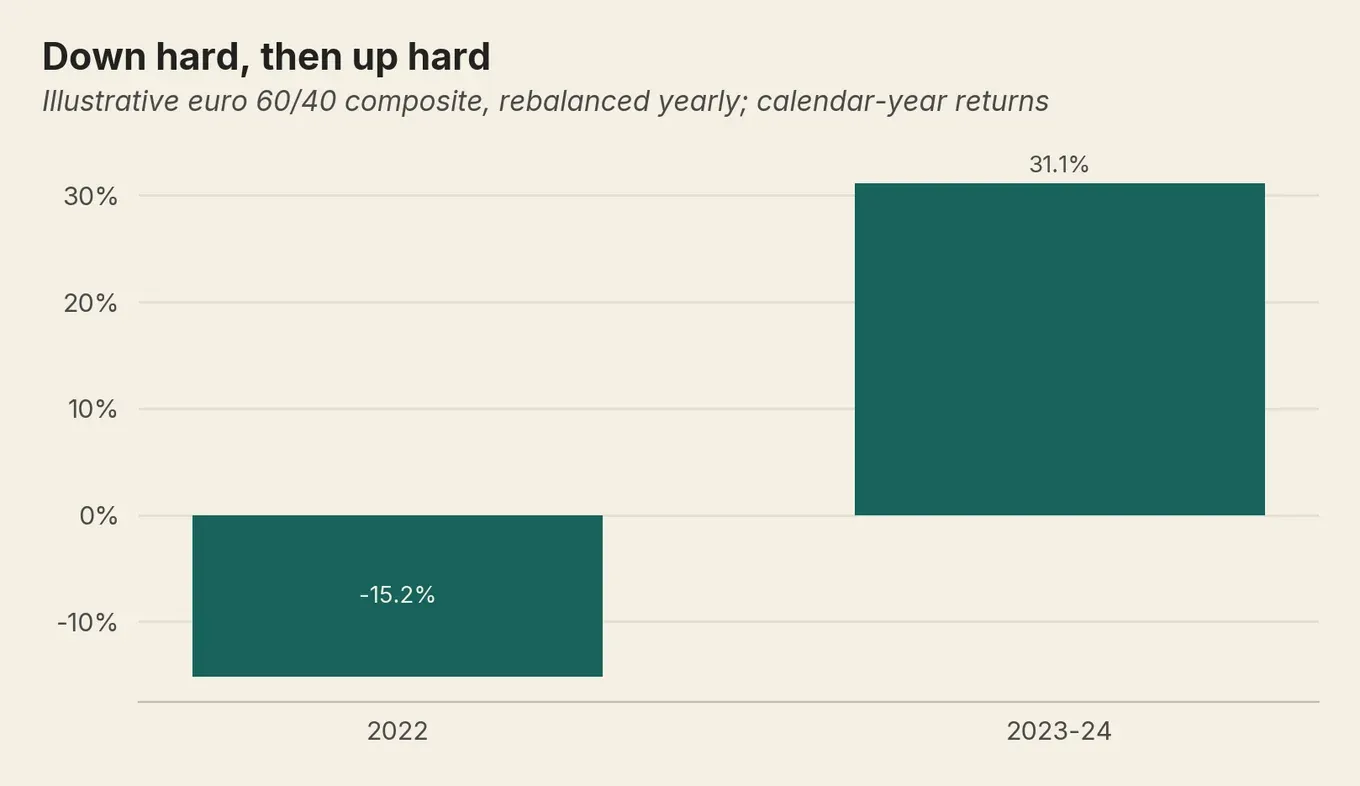
No. It bounced back. The opposite pull between shares and bonds resumed in 2023, and a standard euro 60/40 rose roughly 31% across 2023 and 2024 combined, recovering the 2022 loss. That figure is a rough composite, rebalanced once a year; different funds or a different schedule give a slightly different number, but the shape is the same. Down hard, then up hard.
Timing is the cruel part. Headlines have called the 60/40 portfolio dead for years, and the loudest wave arrived at the end of 2022, near the exact bottom. Anyone who sold then locked in the fall also missed the bounce. The obituary was not just wrong; it was expensive.
Lena, 44, a DIY investor in Leipzig, almost sold her 60/40 at exactly the wrong time. In 2022 its ‘safe’ bond half fell further than her shares, and every headline told her to get out. She held on, kept rebalancing, and it recovered over the next two years. Her fear was not silly; watching the safe half fall hardest has its own sting. Selling then would have turned a dip on paper into a permanent one.
If you did sell in 2022, that’s done. The only question a portfolio ever asks is what to do next: pick a split you can hold through the next fall, and start again.
The serious disagreement is quieter and more useful. Vanguard’s own reading is that diversification is intact and a 60/40 investor would need only a marginal shift, not a wholesale overhaul. The BIS reading is more cautious: in an inflation-led world the bond hedge is less reliable than it was, so you shouldn’t lean on it as heavily. Notice that neither of those is “sell your bonds.” Both argue about how far to trust the 40%.
And the 40% is in better shape than it was. Through the 2010s, euro bonds paid next to nothing and were held mostly out of habit. Now they start from positive yields again, roughly 2.2% to 2.5% in mid-2026. The ECB’s rate eased from its 2023 peak of 4% down to 2.00% by mid-2025, then nudged up a quarter-point to 2.25% in June 2026. Euro inflation (Eurostat (opens in new tab)) was near 2.8% at that point, still above the 2% target. Rates move, so check the current level; a bond leg that pays a positive yield, whatever the exact number, has more room to rise when shares fall, the job it’s there to do.
Should European investors change their 60/40 split?
Maybe. But change it on a plan, not on a fright, and keep 60/40 as the default until you have a reason to move. And separate the two questions that get mixed up: how much bond risk you want (the split) and which bonds you hold to get it (the duration). After 2022, that second question is often the more useful one.
How long until you need the money?
Keep your emergency cash and money you’ll need within a few years out of a 60/40 entirely; it can fall about 15% in a year, as 2022 showed. The further off the rest is, the more shares you can hold. Fifteen years or more argues for 70/30, even 80/20. Get close to the point where you start drawing an income and the case flips the other way, toward 40/60. A big fall near retirement is the one you can’t wait out, which makes 40/60 the honest answer for that stage. The market has no idea you’re about to need the money.
What do income and nerve have to do with it?
Two people with the same horizon can still want different splits. If your income is lumpy, freelance, or rests on a single salary, you’re likelier to be forced to sell during a downturn, so more bonds and shorter duration make sense. Steady income, and the nerve to watch the balance fall a long way, buys you room to carry more shares. Be honest about the nerve; most people overestimate it until they’re tested.
Should you change the bonds before the split?
Yes, more often than the split, because the 2022 damage came from duration. Owning bonds was never the mistake; owning long-duration ones was. Shortening the bond leg, or mixing in a shorter-duration fund, cuts that kind of loss more precisely than dropping to 40/60 ever would. This is the lever the headlines miss. But shorter duration costs you something. Those bonds rise less when rates fall, and they give up some of the recession cushion the 40% is there for. Make it a lasting choice about the bond risk you want, set for the years ahead rather than the fall behind you.
The table below lays it out. Every split trades return against how deep the falls go.
| Split (shares/bonds) | General profile | Relative long-run return | Typical ride |
|---|---|---|---|
| 80/20 | A long horizon, steady income, strong nerves | Highest of the four | Deepest, most frequent falls |
| 70/30 | A long horizon with some appetite for growth | Higher than 60/40 | Deeper than 60/40 |
| 60/40 | The all-round default; a medium horizon | The reference point | Moderate |
| 40/60 | Near or in retirement; low tolerance for falls | Lowest of the four | Shallowest |
These are illustrative general tendencies over long periods, not promises or forecasts. Every split can lose money, and the harder-falling ones can stay down for years. Actual returns depend on the funds you choose, their performance and charges.
How can European investors build a 60/40 portfolio with euro UCITS ETFs?
The usual way is two funds. One global shares fund for the 60, one euro bond fund for the 40, both as UCITS ETFs, the EU-regulated funds you can buy across the bloc from a normal broker (the framework is overseen by national regulators such as the Central Bank of Ireland (opens in new tab)). Then you rebalance once or twice a year. The whole machine.
For the shares, a single global tracker does the job. For the bonds you have a real choice, and it decides how the 40% behaves. The funds below are examples as of July 2026, not endorsements and not advice, listed to be concrete, not to steer you to any one of them.
| Fund (ticker) | What it is | Ongoing charge |
|---|---|---|
| Vanguard FTSE All-World (VWCE) | Global shares, for the 60 | 0.19% |
| iShares Core MSCI World (SWDA) | Developed-world shares, for the 60 | 0.20% |
| iShares Core EUR Govt Bond (IEGA) | Euro government bonds, all maturities | 0.07% |
| SPDR Bloomberg Euro Aggregate Bond (SYBA) | Euro government plus investment-grade company bonds | 0.17% |
| iShares EUR Govt Bond 1-3yr (IBGS) | Short-duration euro government bonds | 0.15% |
| iShares Core Global Aggregate Bond EUR Hedged (AGGH) | Global bonds, hedged to euro | 0.10% |
Two things are worth knowing before you pick. Keep the bond leg in euro or euro-hedged (or, if the euro is not your home currency, in your own EU currency or hedged to it), even though the shares can be global and unhedged. The bond leg is there to be calm, and currency swings can easily swamp its modest returns. And these are investment funds, not deposits: their value can fall as well as rise, and they sit outside any national deposit-guarantee scheme. What you keep depends on the fund’s returns and its charges, and charges are the part you can see in advance: 0.07% a year is a far lighter drag than 1%.
One caveat is local: how these funds and any rebalancing trades are taxed varies a lot by country, so check your own market’s rules before you buy.
The 60/40 portfolio didn’t die in 2022. Both halves fell together for the first time since 1977, then it recovered, which is what a balanced portfolio is built to do. What changed is smaller and more useful. The safe 40%, the part you were never supposed to think about, now asks you a question first: how long is this money invested for, and how far can you watch it fall? Answer that, set the split to match, and pick the funds afterwards. The order matters more than the ticker.
Frequently asked questions
Is the 60/40 portfolio dead?
Why did the 60/40 portfolio fall so hard in 2022?
Should European investors change their 60/40 split?
Which euro ETFs can build a 60/40 portfolio?
— That's the lot. It is now night.
Want more of this in your Google results?
Add Money Owl as a preferred source, and Google will show our finance pieces higher when you search for them.
By Jure Jaklič
Founder and editor of Money Owl. Data analyst by trade; personal finance learned first-hand across six European countries.
Recommended

Dividend investing in Europe: is it really passive income?
Pooled across 2018, 2019, 2021 and 2022, 70.6% of European once-a-year dividend payments arrived in April, May and June. What that does to a monthly budget, and what living off it really costs.

The three-fund portfolio for European investors
Europe's three-fund portfolio has its own shape. A single all-world UCITS fund owns the whole world, so most first-timers need two funds, not three.

Warren Buffett's principles, translated for Europe
For 60 years Buffett beat the market, then told everyone else to index. His principles, translated for Europe: UCITS ETFs, the 90/10 rule and tax wrappers.